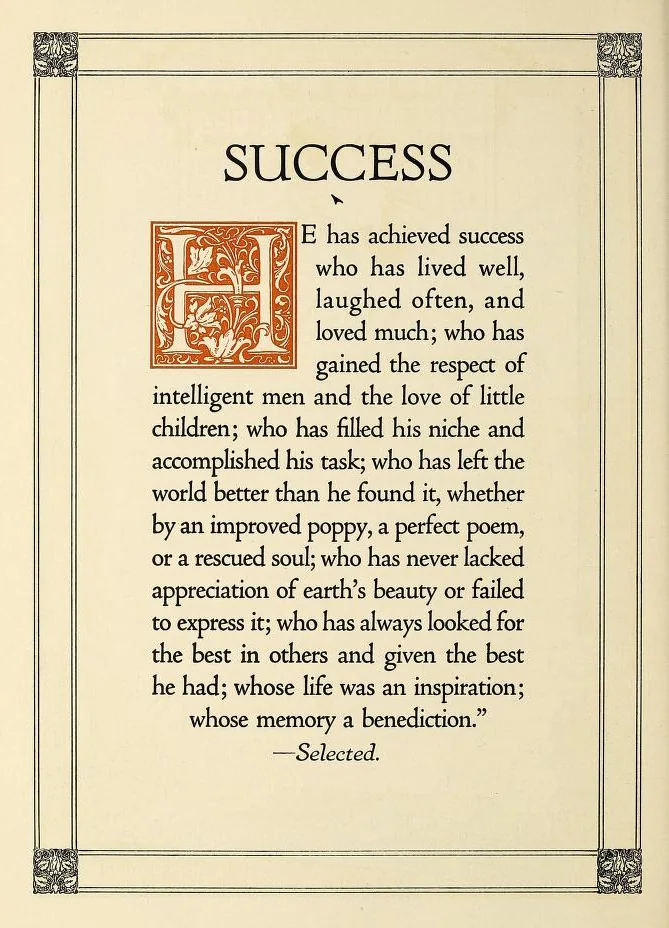
“Success” done up in style in The Inland Printer.
The phrase is an abridged form of the 1904 poem “Success” by Bessie Anderson Stanley…
An essay by Jake Rossen in Mental Floss:
There’s the phrase itself, which appears to have grown popular thanks to a poem by Bessie Anderson Stanley.
An article by Brie Dyas in House Beautiful:
The real source of “Live, Laugh, Love” is Bessie Anderson Stanley’s 1904 poem, “Success.”
A “deep dive” by Jessica Barrett in Refinery29:
While it has often been misattributed to Ralph Waldo Emerson, the words were first linked together in a poem called “Success” by Iowan writer Bessie Anderson Stanley in 1904.
And so on. Some of the writers quote the poem:
He [has](1) achieved success who has lived well, laughed often, and loved much; who has enjoyed the trust of pure women, the respect of intelligent men and the love of little children; who has filled his niche and accomplished his task; who has never lacked appreciation of Earth’s beauty or failed to express it; who has left the world better than he found it, whether [by](2) an improved poppy, a perfect poem, or a rescued soul; who has always looked for the best in others and given them the best he had; whose life was an inspiration; whose memory a benediction.
Now, if you, like Dr. Boli, were born in the eighteenth century and came of age in the nineteenth, you might be thinking, “Where’s the poem? This is an essay.” But it seems that, if you were born in the twentieth century and came of age in the twenty-first, this is what “poem” means. It is a prose composition, generally meant to be inspirational or sincere in some obvious way. In other words, what we used to call an essay; perhaps more specifically what we used to call a personal essay. For these writers, a “poem” is any manufactured expression of sincerity, and it is the manufactured sincerity, not the form, that makes a “poem.”
There was a time—way back in April—when Dr. Boli would have been arrogant enough to say that all these writers do not know what the word “poem” means. But he is past that age. There is not a single writer who talks about this essay who does not call it a poem. “Poem,” therefore, means “prose essay,” whether divided into short lines or not, and the old Johnsonian definition “a metrical composition” must be relegated to the scrap heap of archaisms, where it will join several dozen outdated meanings of “nice.”
This does leave us with no word to describe a metrical composition, which might seem unfortunate. But a moment’s thought reconciles us to the loss. No one in the twenty-first century has any need for a word to describe a metrical composition. Like the forgotten technical terms of alchemy, the archaic meaning of “poem” may be allowed to pass from general use and linger only in a long paragraph of etymological explanation in the Oxford English Dictionary.
If you wish to see Mrs. Stanley’s poem in something like its original form, you can look in publications from 1905 in Google Books or the Internet Archive or Hathi Trust. Dr. Boli will leave you the fun of searching for it yourself, but the poem will not be hard to find, although in those unenlightened days it was never described as a “poem.” It was picked up, often but not always attributed to Mrs. Stanley, by just about every magazine and a number of other publications: The Northwest Journal of Education; The Leather Worker’s Journal; The Ladies’ Home Journal; Breeder and Sportsman; The McMaster University Monthly; Hardwood Record; a Biennial Report of the Bureau of Agriculture of Tennessee; an Annual Report of the Pennsylvania Department of Agriculture; Transactions of the Medical Society of the State of North Carolina; Motorman, Conductor, and Motor Coach Operator; The Christian Student; The San Francisco and Pacific Druggist; The Free Will Baptist; Pennsylvania Grange News; and yes, though you probably had no need to ask, it was inserted in the Congressional Record. We were not able to find the original publication in the Brown Book, but we did not devote more than three minutes to the search.
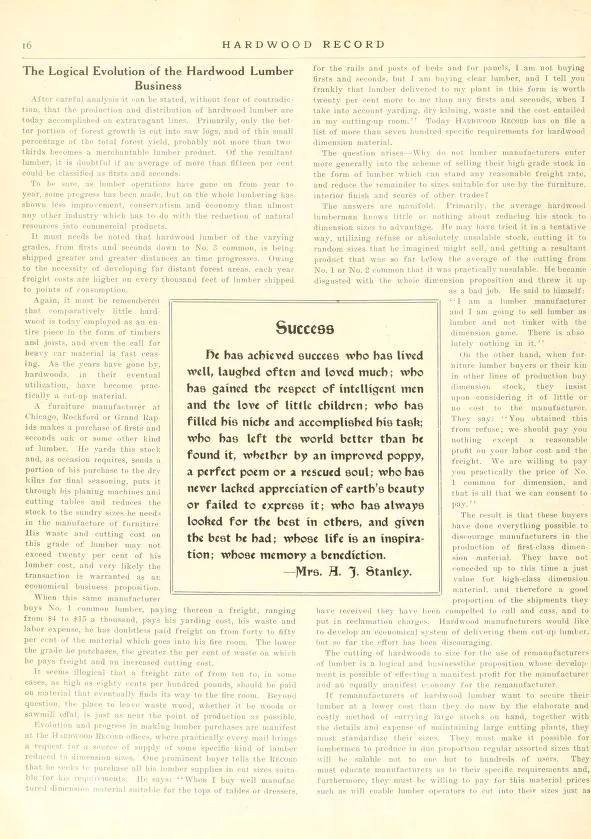
“Success” in The Hardwood Record, sharing a page with “The Logical Evolution of the Hardwood Lumber Business.”