But sometimes he finds himself out in the trackless suburbs, observing their quaint and barbarous customs the way a visitor from another planet might observe Earthling culture, wondering what it all means.
A friend took him recently to a high-toned shopping arcade in the rich inner suburb of Mount Lebanon, which is practically the city (it has trolleys and everything), so Dr. Boli did not expect too many attacks from savages. But when he got to the elevator, he was confronted by this sign, which explains, with helpful pictures to appeal to the illiterate barbarians, the conduct that is expected on elevators in this arcade.
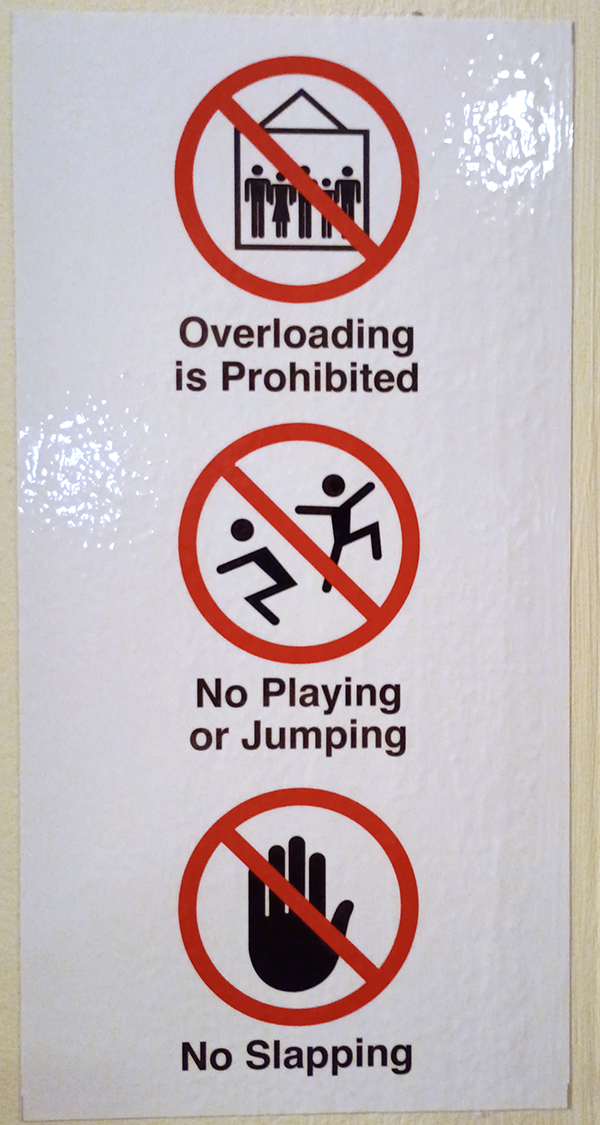
Dr. Boli will not conceal the fact that the sign worried him a little. All his irrational fears of suburbs came back on him at once, but with the hardly consoling consideration that they might not be so irrational after all. As his friend observed, “You don’t put up a sign like that except in response to some definite incidents.”
But what might those incidents be? The imagination races. And since Dr. Boli’s readers have prodigious imaginations, he thought he might leave the question open as a sort of writing prompt for them. What incidents might have provoked the management of this supposedly high-class shopping arcade—the kind of arcade where BMWs with bows and ribbons are on display in the concourses to suggest that you might pick up two or three as stocking-stuffers—to post signs specifically prohibiting slapping in the elevators?
As an example, Dr. Boli will recount the speculation that immediately occurred to him—a speculation based on a vividly remembered experience. Some years ago, he found himself once again in the suburbs, this time in a large suburban supermarket. This one—which has since vanished, replaced by office buildings—had a long passage at the exit that was made one shopping cart wide by railings and double doors, and Dr. Boli found himself stuck in that passage for several minutes. The occasion of the blockage was this: at the head of the line was an old woman with a cart full of groceries, and a cane laid obliquely across the top of the cart. She was moving forward at a rate of about one step every fifteen seconds, and the steps did not advance her more than a few inches at a time. And since people had understandably stacked up at the single exit, which—again—was artificially narrowed, there was no moving forward or backward for the people behind her.
After a few minutes, a pleasant young man behind her asked, with an ingratiating smile, “Do you need any help?”—and laid his hand on the handle of her cart.
Slowly and silently, like a clockwork toy, the old woman reached for the handle of her cane. By infinitesimal steps she lifted it up, and then just as slowly turned it, and then suddenly brought it down with a loud crack on the helpful young man’s forearm.
Suppose this old woman was also a patron of the shopping arcade in Mount Lebanon. Suppose she had managed to reach the elevator, using almost the last ounce of her energy, and then just stood in front of the buttons. Suppose a nice young lady boarded the elevator behind her. “What floor would you like?” the nice young lady asked, reaching around the old woman toward the elevator buttons. The next morning, these signs were posted in all the elevators.