Posts by Dr. Boli
CULTURAL NEOTENY: VERBAL EMOJIS.
Consider the rise of Verbal Emojis in place of adult speech. One or two ritual words are offered instead of a thoughtful comment. Examples: “Bro!”, “Right?!”, “True that.”, “Ship it!”.
It certainly does seem as though whole conversations drift past us on the street that are nothing but compilations of catch phrases, arranged in a predictable order that spares the speakers from thinking but somehow allows them to think they are filling the air with sparkling epigrams.
The question is whether this is a new thing. The phrases are new: our modern Oscar Wildes sneer at the older generations who responded to every stimulus with “All reet!” or “Solid!” and who greeted every unpleasant smell with “B.O.!” in foghorn tones. And of course the hep cats of those days thought the older generations were comically quaint with their “First-rate!” and “Oh, Laura!” But perhaps humanity has always reached for catch phrases to carry on most of its conversations. What are Homeric epithets if not catch phrases? “Swift-footed Achilles” is “swift-footed” because the epithet spares us from having to come up with something new to say about him every time we bring him up in conversation. Most conversation is a social recreation rather than a communication of information. If all the passengers on the streetcar were struck mute for the duration of the ride, the number who would be seriously inconvenienced by failing to receive vital information from their fellow passengers would be small. (The number offering silent thanks for an answered prayer would be at least one.)
What is new is the rise of written emojis, which have become so much a part of our culture that we describe catch phrases in terms of emojis, rather than emojis in terms of catch phrases. There was a time, not so long ago, when the only people who communicated with happy and frowny faces were elementary-school teachers: by the time students reached junior high school, they no longer required smiley faces as commentary on their quiz results, and they would have been insulted if a teacher thought they were so immature.
But, having said that, we recall that printers kept stock cuts on hand that served more or less the same purpose as emojis, and the typefounders’ catalogues are full of the things. Therefore, to remind us that even emojis are not such a new thing after all, we present Victory Rooster.

He comes from an American Type Founders catalogue dated 1897. From now on, Victory Rooster will make an appearance every time we record a minor triumph, because he expresses the idea of triumph with a thoroughness that mere words cannot match.
FROM THE ILLUSTRATED EDITION.

From DR. BOLI’S ENCYCLOPEDIA OF MISINFORMATION.
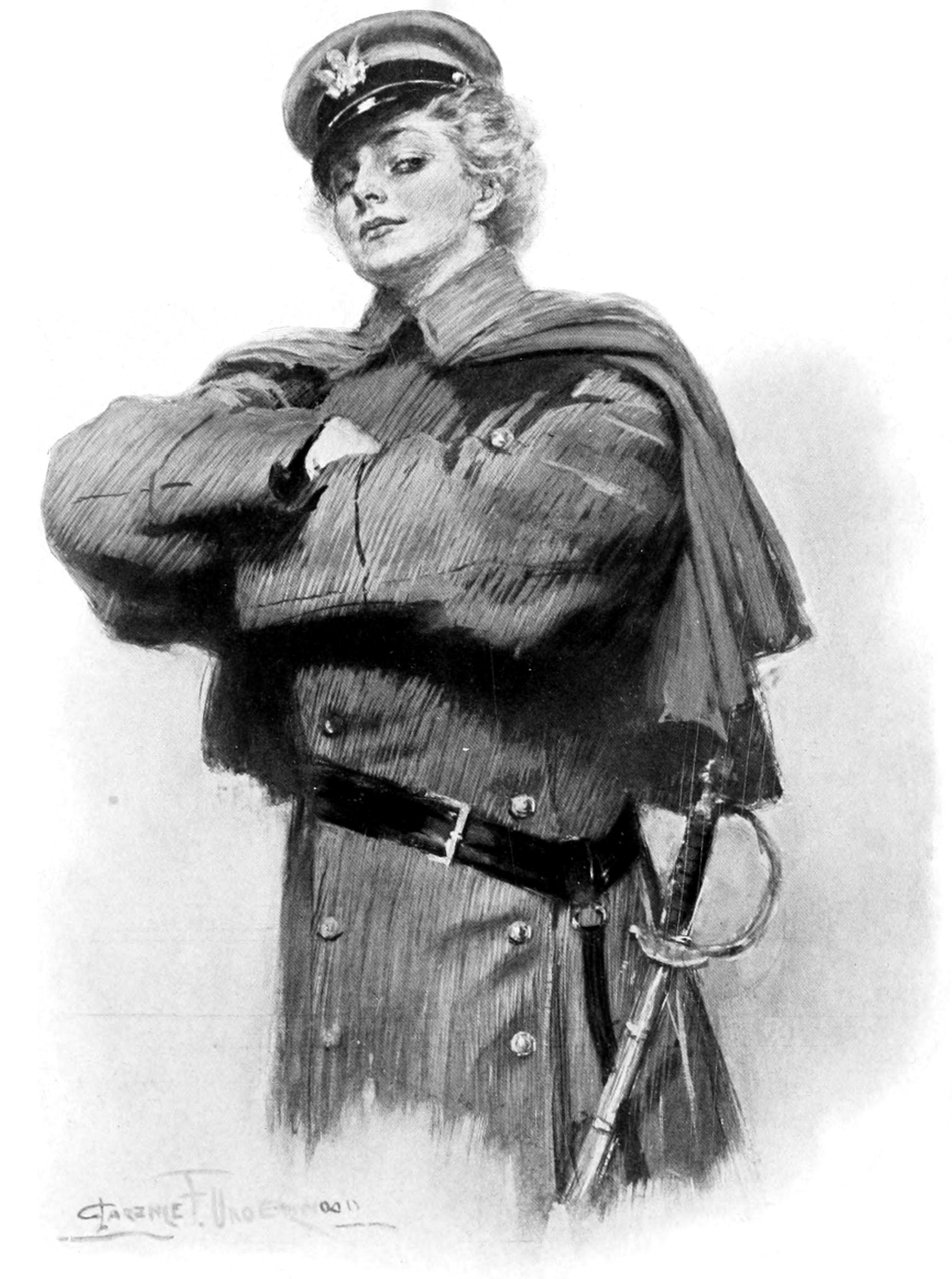
Illustration by Clarence F. Underwood.
Memorial Day. According to a ruling by the United States Bureau of Firsts and Superlatives, issued to settle a number of longstanding and intractable disputes among American towns and cities, Memorial Day was first celebrated on May 30, 1868, by 19,522 municipalities simultaneously.
LETTER TO THE EDITOR.
Sir: It is univerally agreed, and adopted as a principle thoughout our legislation and the court system, that no bad things should ever happen. Therefore, when bad thngs do happen, it is our first and most pressing duty to determine responsibility, so that the guilty parties may be held accountable.
Now, I have been analyzing the news for some time, and I may lay claim to a fair amount of personal experience of my own, so I am in a position to speak with some authority. It has become clear through my researches that one party in particular is responsible for more of the bad things that happen in our city, and almost certainly in the entire world, than any other agent. I will not shirk my duty: when I have discovered unequivocal evidence that this party is guilty, I will allow no timorousness or fear of reprisal to cloud my judgment and stand in the way of my speaking the truth. The agent responsible for more bad things in the world than any other is gravity.
Consider the notorious Fern Hollow Bridge collapse. Making every allowance for poor maintenance, and without ignoring potential design flaws, it is clear that the primary agent in the collapse was gravity. This is true in spite of the fact that the entire bridge was nothing but a machine designed to resist gravity. Think of the millions of dollars that were wasted on that ultimately fruitless endeavor!
Just yesterday I tripped and fell on the sidewalk, and my knee yet preserves the memory of that unhappy event in the form of a somewhat painful scrape. Again, making every allowance for the other circumstances, including the uneven brick surface of the sidewalk and the fact that I was reading a very funny story about my second cousin’s cat on Facebook at the time, it is still true that without the agency of gravity I would not have fallen. I would have remained suspended in the air until I had found the sidewalk with my feet again, and then I would have continued on my way.
Some charitable but mistaken souls may object that there is much to be said in favor of gravity, that its benefits outweigh its risks, and that we are better off with it than without it. But this flies in the face of all legal principle. As a community, we have decided that mistakes and tragedies must not be tolerated. We have a zero-tolerance policy for bad things. Are we to make an exception merely because the culprit has some good qualities as well? Do we pardon serial killers who are kind to their mothers? Is an embezzler let off the hook because he gave a quarter to a street musician? Do we tolerate rain merely because the same clouds gave us pleasant shade? No, we must stick to our principles. No matter what the cost to us in the short term, gravity must be held responsible, or the forces of nature will think they can get away with whatever they like.
This is why I have introduced Bill No. 2023-B-954.88G, entitled, An Ordinance to Prevent Tragedy and Loss Through the Agency of Natural Forces, in the city council. I believe we have enough votes to pass the bill, and Mayor Gainey has promised to sign it, although we did more or less leave him with the impression that it had something to do with transit improvements in Upper Lawrenceville. So don’t get too specific with him when you remind him of his promise. But please do write your own representatives on city council if you are not in my district, and if you could leave your note attached to a six-pack of Duke outside your council representative’s office, that will probably help a lot.
This is only a start. I hope our legislation will serve as a model for action at the state and even federal level. But at least we are making that start. We are showing gravity that we will not stand aside and let it have its way with our best-laid plans. And once we have accomplished that, we shall have a precedent to rely on when we train our sights on momentum.
—Stacey Whatsername
City Council, 11th District
THE FAVORITE-SONG GAME.
But first, a possibly related phenomenon was brought up by our frequent correspondent “James the lesser,” who asks, “how often do you hear someone whistling to themselves? The good Doctor is old enough to remember the art.”
Indeed, Dr. Boli is a practitioner of the art, though he keeps an alto recorder, otherwise known as an English flute, next to the desk for occasions when more advanced forms of whistling are required.
But it is not hard to guess why whistling is nearly extinct. Here is a sociological experiment you can perform yourself, as long as the ethics committee doesn’t hear about it. In fact, it can be made into a kind of competitive game. Simply ask friends, acquaintances, and perfect strangers, “What is your favorite song?” Once you have received the answer, “follow up” (as the journalists say) with the question, “Why is that your favorite song?” If we are playing this as a game, the winner is the first person who finds as much as a single subject who mentions anything at all about the music rather than the lyrics. It may take quite a while to finish this game, but the winning strategy would probably be to conduct one’s interrogations in retirement homes noted for a high centenarian population. For people under the century mark, the purpose of a song is to convey an idea, the music being a sort of unfortunate necessity without which the words are less effective.
Does this phenomenon have something to do with the juvenilization of culture? Possibly, although Dr. Boli would be more inclined to say that it is the ultimate triumph of American puritanism. A century ago, the average educated American sneered at the Methodist fanatics who insisted that the only legitimate music was the stuff listed under “8787D” or “CM” in the metrical index to your standard hymnal. Today the average educated American has become one of those Methodist fanatics. Art must have a practical function, or it is not only useless but evil. Music by itself has no function. Therefore the only acceptable music is that which, by accompanying and emphasizing words, makes it easier to convey useful discourse. The idea of an “instrumental,” as songs without words were called in the first half of the twentieth century, is nonsense to a puritan, and whistling is a kind of instrumental performance without an instrument.
Meanwhile, over at Ink…
A meditation on artistic freedom and how to obtain it, and a subdued tribute to Courier, the type that says, “Don’t look at me.”
FROM THE ILLUSTRATED EDITION.

CULTURAL NEOTENY.
Dr. Boli finds this term so useful that he would like to apply it to the arts of civilization as well. Although a few anthropologists and whatnot have used the phrase “cultural neoteny” to describe various aspects of human behavior, they have used it sparingly and inconsistently. We may therefore regard the term as up for grabs.
Cultural neoteny, then, as Dr. Boli defines it, is the persistence of behaviors formerly considered juvenile into adult culture and discourse. It seems to Dr. Boli, who takes a longer view of cultural history than some people do, that the twentieth century was the century in which the culture of the United States, and to a lesser extent Western Europe, and perhaps to a greater extent Japan, refused to grow up.
This process has been gradual, and some of the steps have been bigger leaps than others. We might say it began right after the First World War, when the Flaming Youth of the 1920s began to dictate what was profitable in entertainment. There was a great leap forward in the late 1960s and early 1970s, when perhaps for the first time in history the repudiation of adulthood was adopted as a stated principle by a large part of a generation. To be fair to that generation, the Nixon administration was not a good advertisement for adulthood. But the process has continued since that time, and a wholesale juvenilization of culture has resulted.
We propose, therefore, to deal with the phenomenon by noting some of its manifestations in a series of occasional articles. Here are some of the topics we have in mind:
- Comic books and superhero movies consumed by adults
- The interrogative tone in declarative discourse
- The rise of the tragic backstory
- Big rims and other trends in automotive design
- The loss of honorifics and the abandonment of surnames
Why begin with this announcement, rather than just shove the first article out there? Well, for three reasons. First, Dr. Boli has not yet written the first article. Second, the term “cultural neoteny” is likely to require some explanation, at least if we wish to be understood. If we wish to publish an article in a sociological journal, it is probably all the better if we write complete gibberish, but Dr. Boli can manage only incomplete gibberish at best. Third, it gives our readers a chance to make suggestions. Have you noticed, among your adult acquaintances, any behaviors or tastes that you consider egregiously juvenile? This is your chance to document your observations and push back the frontiers of science.
INSPIRATION ON A TRUCK.

Always moving forward.

USEFUL WAREHOUSE SIGNS YOU CAN PRINT.


