Posts by Dr. Boli
THE COUNTRYWOMAN AND THE FAIRY.
From Dr. Boli’s Fables for Children
Who Are Too Old to Believe in Fables.
—
Once there was a woman who lived on a farm in the country, and she was just about like all the other farmers’ wives around her, neither more beautiful nor uglier, neither richer nor poorer, neither more nor less fortunate, and neither happier nor more discontented with her lot. This woman had a friend who was a fairy, which is more common in the country than city folk imagine, and when it came time for our farmer’s wife to give birth to her first child, she naturally invited her friend the fairy to her lying-in.
All went as well as could be expected, and the woman gave birth to a healthy baby girl.
Immediately the fairy snatched the child into her arms and said to the mother, “Choose now whether your daughter shall have beauty greater than any other woman’s, with wit and understanding greater than her beauty, and be the empress and autocrat of an immense country, but unhappy; or whether she shall be the ugliest creature in seven counties, with only so much intelligence as she needs to keep her from falling down a well, and with just enough in the way of possessions to keep body and soul together, but contented.”
The farmer’s wife, still recovering from her labor, answered slowly. “It is a hard decision. You say she would be empress with unlimited authority?”
“Unlimited,” the fairy answered.
“And the most beautiful woman on earth?”
“None would surpass her,” said the fairy.
“Or ugly?”
“Hideous.”
“And poor?”
“Just barely able to feed herself.”
“And to be contented she has to be ugly and poor, but to be exalted and beautiful she has to be miserable?”
“Yes, that is the alternative.”
“Well, what if, instead of an empress, she were, say, prime minister of a prosperous medium-sized republic? Would she still have to be unhappy?”
The fairy thought for a moment. “I suppose that, in return for a diminution of her autocratic powers, she might be allowed a few moments of happiness every so often. Not too much, you know, because prime minister is still a pretty big prize.”
“And suppose, say, she were not quite so beautiful: suppose, I mean, she were only the second-most-beautiful woman in the world, or possibly the third.”
“A few rays of happiness might shine into her life,” the fairy reluctantly admitted, “in return for the sacrifice of some of her beauty.”
“Or suppose I chose ugliness and poverty, but instead of absolute contentment, she always wished she had practiced the piano more assiduously. Would she have to be quite so unfortunate then?”
“A small but gnawing regret might gain a little less ugliness and a little more prosperity, I suppose,” said the fairy.
“Or suppose I chose beauty and prosperity, but, instead of prime minister, she were, say, a county commissioner, in a large and prosperous county of course.”
“I dare say the drop from prime minister to county commissioner would purchase several days of happiness.”
And so the conversation went, while the child patiently waited (for the issue of happiness or discontent for her had not yet been decided), until at last the mother and the fairy had reached an arrangement much less extreme than the one the fairy had originally proposed.
So the girl grew up into a woman, and she was not exceptionally beautiful, but not really what you would call ugly, and in spite of a receding chin could actually be quite attractive in certain lights; and she was not by any means rich, but not really poor either, and she was able to support herself and her family when it arrived; and she was not a great wit, but not stupid, and her intellect was adequate to most of the tasks demanded of it; and she had her share of misfortunes and disappointments, but she managed to get through them somehow, and her life was enlivened by moments of sincere delight. In short she was just like the rest of us; for it turns out that most mothers have fairies for friends, and they all end up making more or less the same deal.
HOW TO WASH YOUR HANDS.
Because today is Global Handwashing Day, we are running this useful feature again, which we humbly dedicate to St. Pontius Pilate.
—
1. Remove a paper towel from the United brand paper-towel dispensing system.
2. Using the paper towel you have just removed, remove a clean paper towel from the United brand paper-towel dispensing system. Do not touch the United brand paper-towel dispensing system.
3. Discard the first paper towel, but not the second paper towel.
4. Using the second paper towel, turn on the faucet.
5. Adjust the water temperature so that it is warm but not scalding. This may take some practice, so allow 15 or 20 minutes.
6. Discard the second paper towel.
7. Remove a paper towel from the United brand paper-towel dispensing system.
8. Using the paper towel you have just removed, remove a clean paper towel from the United brand paper-towel dispensing system. Do not touch the United brand paper-towel dispensing system.
9. Discard the third paper towel, but not the fourth paper towel.
10. Using the fourth paper towel, push the button on the soap dispenser repeatedly.
11. We should have told you to hold your other hand under the soap dispenser, so kick the soap off your shoe and try again, this time holding your other hand under the soap dispenser.
12. Discard the fourth paper towel.
13. Rub your hands briskly under the warm water for the length of time it takes to sing “Chinnin’ and Chattin’ with May.” If you do not know the song “Chinnin’ and Chattin’ with May,” send $5 in unmarked bills to the United Paper Towel Manufacturing Corp., Hays, for the complete authorized sheet music.
14. Remove a paper towel from the United brand paper-towel dispensing system.
15. Using the paper towel you have just removed, remove a clean paper towel from the United brand paper-towel dispensing system. Do not touch the United brand paper-towel dispensing system.
16. Discard the fifth paper towel, but not the sixth paper towel.
17. Using the sixth paper towel, turn off the faucet.
18. Remove a paper towel from the United brand paper-towel dispensing system.
19. Using the paper towel you have just removed, remove a clean paper towel from the United brand paper-towel dispensing system. Do not touch the United brand paper-towel dispensing system.
20. Discard the seventh paper towel, but not the eighth paper towel.
21. Using the eighth paper towel, push the button on the United brand forced-air hand-drying machine.
22. Discard the eighth paper towel.
23. Rub your hands briskly and ostentatiously under the United brand forced-air hand-drying machine.
24. Remove a paper towel from the United brand paper-towel dispensing system.
25. Using the paper towel you have just removed, remove a clean paper towel from the United brand paper-towel dispensing system. Do not touch the United brand paper-towel dispensing system.
26. Discard the ninth paper towel, but not the tenth paper towel.
27. Using the tenth paper towel, dry your hands.
–
These instructions provided courtesy of the United Paper Towel Manufacturing Corp., Hays.
ART CORNER.

Dr. Boli thought it might amuse his readers to enlarge this picture and see the angriest-looking psalm-singers in the world. It might also amuse them to note the signature under the engraving.
Advertisement.

NEW BOOKES FOR THE YEERE OF GRACE 1598.
O ye who hunger for Learning and Wisedome, come ye and bee filled at the Booke-shop of Iohn Willet, neere the little North Doore of Paules at the signe of the Bustard, where Tuesday hath ever been and ever shall be Seniors Ten Per Centum Off Day. Heere ensueth a List of new releases which, Deus laudetur, shall be accomplish’d in the Yeere of Grace 1598.
A Panegyrick uppon Virtue, in which Virtue is shewn to be worthie of Praise, and Vice of the opposite. By the Archb——p of Y—k.
A most pleasaunt conceited Comoedie, entituled, Whatever: or, I Cant Bee Bother’d. As it hath beene sundrie times playd at the Greene-friers to great Applause. By W. S.
A Pindarick Ode upon the occasion of the Pulling of her Maiestie’s Molar. To which is added, Aphorisms on the Tooth-ake, illustrated by copious Quotations from Hippocrates, Celsus, Galen, Sacred Scripture, &c.
The Poem call’d Ickle Pickle Packle Pop, by I. M. Maister of Art, & resident at Bethlehem Hospital.
The Index of Obscene and Vicious Bookes, prohibited in this Kingdome, arranged according to the Alphabet, and provided with blank Boxes at the Head of each Entrie, the Whole Designed for a Copious and Convenient Check-List.
The Tragedie of Iack Farthing, Lord-Maior of Cheeseborough, with the Conquest of Granada, & the Building of the Royal Exchange. As it would have been plai’d before Her Maiestie but for an unfortunate Accident.
Discourse on the Voyage lately undertaken by certaine Cittizens of London unto Southwarke, with the Maners, Morals, Governement, &c., of the Peoples they found there. Very profitable and pleasant to all such as are desirous to heare and read of strange thinges.
A Treatise Paraenetical, shewing our Most Gracious and Glorious and All-Wise and Victorious Princess Elizabeth how shee could run her Government better. Dedicated to King Philip of Spaine.
A Fourth Sermon, preach’d to ii. or iii. Stragling Mendicants before the Booke-shop of Iohn Willet, on the Vanitie of Secular Learning, & the Need for Immediate Repentance therefrom: By Wilmot Greesehaire, Selfe-Righteous Prigge.
ASK DR. BOLI.
Dear Dr. Boli: This fancy-pants toothpaste from the organic drug store says it contains activated charcoal. How do they activate charcoal? —Sincerely, A Man Reconsidering the Notion of Putting Black Toothpaste on His Toothbrush.
Dear Sir: Modern charcoal is usually activated by entering an activation code supplied by the manufacturer, which allows the charcoal to be activated by central servers. This precaution is necessary to prevent the chaos that would ensue if everybody could make charcoal without purchasing it from a reputable manufacturer. In the old days, of course, the activation code had to be sent by telegram, on receipt of which the manufacturer would dispatch a courier to the customer’s address with the activation key. It was a dangerous business being a charcoal activation courier, as they were frequently waylaid by miscreants who would stop at nothing to obtain the keys. For this as for at least one other reason (viz., the Magazine you are reading now), we may be grateful that we live in the age of the Internet.
WHEN YOU USE CLIP ART…
When you use clip art, especially from a culture you may not be familiar with, you should perhaps show it to a focus group or something to make sure it sends the message you think it sends. For example, this Taiwanese company that makes publishing software wanted a graphic that said “books,” so…
ANTI-PAMELA, BY ELIZA HAYWOOD.
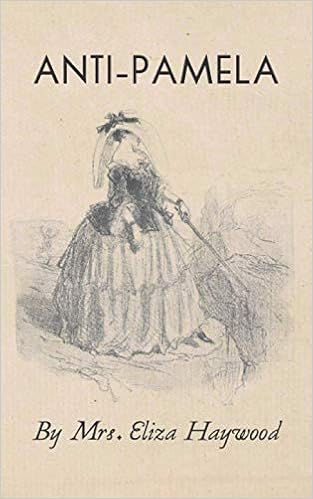
Once again Dr. Boli has contributed an introduction to a work of literature that, if it is not quite a “classic,” is at least older than he is. And once again, by permission of the publisher (who hopes someone will be tempted to buy the book in a very attractive and economical paperback edition), he reprints his introduction here. This time the book is by another professional female scribbler, one who was at least as industrious as the ingenious Mrs. Aphra Behn. In this case the book is a reaction to the biggest seller of the eighteenth century: Pamela, the interminable epistolatory novel by Samuel Richardson. If you were thinking of reading Pamela for some reason, you can do yourself a great favor and read Anti-Pamela by Mrs. Eliza Haywood instead. And with no further introduction to the introduction, here is the introduction.
—
This is not a work of great literature, and we shall not attempt to make you imagine that it is one. It is a very entertaining book, however, and a very instructive one as well.
It was written, as the title alone would tell us, in response to Samuel Richardson’s Pamela: or, Virtue Rewarded, a fantastically popular novel, published in 1740, whose incalculable influence on English literature consists mostly in causing so many better writers to hate it and embark on novel-writing careers of their own in response. No one willingly reads Pamela today, although it is still available in paperback editions for college students who made the mistake of taking classes in eighteenth-century literature, supposing that everything from the 1700s must be as good as Fielding.
Anti-Pamela was published anonymously, the way most reactions to Pamela were published. (Indeed most novels were published anonymously, including Pamela itself; novel-writing was not a respectable vocation.) The author, Eliza Haywood, displays a convincing knowledge of the seediest sides of London life, and indeed she was accused of being a woman of ill repute herself by no less an authority on women of ill repute than Alexander Pope. (To be accused of anything by Alexander Pope was probably a great favor to one’s reputation.) Not much is really known about her life, however, and that is by her own design. She deliberately kept her private life out of the public eye. More than one author might have profited from her example. One thing we do know about her, however, is that she wrote prodigious amounts of copy for anyone who would buy it.
Unsurprisingly this whole book has the appearance of being dashed off in a monstrous hurry. The very punctuation adds to that impression, with phrases and sentences connected by long dashes that make us imagine a writer in too much of a hurry to get to the next word to think up some proper punctuation. Of course this is partly a deliberate technique: the story seems to move faster when the paragraphs are full of dashes. But the printing is hurried, too, with many obvious errors (most of which we have silently corrected in this edition). Anti-Pamela was written, printed, and published in time to be the second response to Richardson’s Pamela; the first, Fielding’s Shamela, beat it by only a couple of days, and whereas Shamela was a short novella, Anti-Pamela is a substantial novel in its own right, twice the length of Shamela. Our impression of hurry is probably justified.
This is therefore not a perfectly constructed story. Plotting is not our author’s strongest skill. When the schemes of mother and daughter are accidentally revealed by a waylaid letter, “they only cursed Fortune, and accused themselves for having trusted the Secret of their Design to Pen and Paper,” as our author says in one of her moralizing passages. Yet their next intrigue is ruined by exactly the same accident, as if they had entirely forgotten the lesson.
Yet, having complained about that, we must admit that the action seems to proceed very naturally. Our author has created a protagonist—one stops short of using the word “heroine” here—whose character is consistent and memorable, and that character drives all the incidents of the plot. Everything that happens to her arises from Syrena’s pursuit of two objects: “interest” and pleasure. She cannot have either, because she demands both, but her pleasure runs counter to her interest, and her interest would deprive her of her pleasure.
It is a little disappointing at first that our author cannot narrate the monstrous actions of Syrena and her mother without pointing out, repeatedly, how monstrous they are. She might have simply let them speak for themselves by sticking entirely to the epistolatory format, as Richardson did. Or she might have adopted a more satirical voice and praised them for their wisdom and perspicacity, as though mercenary considerations were the only virtue. That certainly would have been an effective satire against Richardson.
But our author is not the satirist Fielding was. She has accomplished something Fielding had not yet accomplished, however: she has created a story worth reading for its own sake, whether we know anything about Richardson’s novel or not. When Fielding did attempt stories of his own, he would turn into one of the greatest novelists in English literature, equaled only by Austen, Dickens, and a few others; so it is hardly insulting to the memory of Mrs. Haywood to say that Fielding would later write better novels. Fielding had not yet shown the English-speaking world that there could be such a thing as a better novel. Novels were cheap popular entertainment, not works of art.
And as entertainment, in spite of its flaws, Anti-Pamela succeeds admirably. Mrs. Haywood manages her protagonist with considerable skill. While she is hatching a scheme, we are involved enough with her that we almost hope for her to succeed; when she is on the point of success, she begins to behave so abominably that we are happy to see her humiliated yet again. As long as she sticks to this formula, Mrs. Haywood unfailingly entertains us. Her one attempt at a tragic love story does not come off so well; one wants to shake the poor expiring heroine and tell her to pull up her socks. Wisely she did not attempt that sort of thing again in this tale, and the rest of the book is simply fun.
As for its avowed instructive intent, that is of course the usual excuse for presenting concentrated lewdness to the reader: that the exposure of vice to the light of knowledge will be instructive. To us in the twenty-first century, however, the book is instructive in quite a different way. It is as lively a picture of a certain kind of London life as we can find in all literature: specifically, the world of kept mistresses, casual assignations, and vice papered over with conventional hypocrisy. Most of us will learn more about that world from this one story than we could possibly learn from a dozen academic historical studies.
Instructing us in that way, however, was certainly not the author’s intention. We can be sure that Mrs. Haywood had really only two intentions, beyond selling her book: to entertain her readers, and to lob a great big custard pie at that awful Pamela creature.
We have already remarked that she succeeds in entertaining us. As for parodying Pamela, she succeeds very well at that, too. The thing that provoked such outrage among sensitive readers of Richardson’s great bestseller was that Pamela, presented as the epitome of virtue, seems calculatingly mercenary, and is happy to marry a perfect cad if she can have him on her terms, merely because his status is so far above hers. It has been pointed out by more than one reader—Henry Fielding and Eliza Haywood being two examples—that, merely by observing her actions, there is no way to tell whether Pamela is a simple innocent or a wily schemer who knows what her virginity is worth on the open market and gets her own price for it in the end.
As we have suggested, Mrs. Haywood might have made a cleverer satire, but she hits her mark pretty well with this one. The innocent is not always so innocent, and happy the man who sees women for what they are—which is to say, creatures as much motivated by pleasure and avarice as he is. We might describe Mrs. Haywood as a feminist in at least this sense: that she seems to believe the differences between men and women are artificial, and nature left to herself will make the sexes equal, if only equally bad. In her world it is better, therefore, to harbor no illusions: we should not expect innocence in others, and we should not put too much effort into maintaining it ourselves. (We can hardly help noticing that the only truly innocent character in the whole book dies of sheer innocence and nothing else.) This world is not one that attracts us morally, but to look at it from the outside for a few hours is very entertaining, and what more can we ask from a novel?
H. Albertus Boli.
BUCKET LIST.
Five Famous Buckets You Must See Before You Die.

The Old Oaken Bucket, located at the Woodworth House in Scituate, Massachusetts, inspired the famous song by Samuel Woodworth——
The old oaken bucket, the iron-bound bucket,
The moss-covered bucket which hung in the well.
This remains one of the most famous songs ever written about a bucket.
The Devil’s Bucket, northeast of Dead Armadillo, Texas, is a hole in the ground, approximately twelve feet in diameter, whose shape gives it an uncanny resemblance to a large bucket.
King Ethelbeard’s Bucket, a large golden vessel encrusted with precious stones and elaborate Saxon filigree work, is used by Queen Elizabeth to water her petunias. It may be viewed by the public at Buckingham Palace every year on Bucket Day.
The Amazing Farmer’s Bucket Theme Park in Qianxinan Buyei, China, has as its centerpiece a three-hundred-foot-tall mechanical figure of a farmer carrying a bucket. Riders ascend an elevator to the shoulder and slide down the interior of the arm into the bucket, and the “farmer” dumps them on his “garden.”
The George Jasnorzewski Memorial Bucket Truck in Grant Borough is used every year to place the Christmas decorations on the borough building. It is named for Mr. Jasnorzewski, who tragically died at his desk in the borough building while filling out the requisition forms for a bucket truck.
From DR. BOLI’S ENCYCLOPEDIA OF MISINFORMATION,
Third Series.

Novel.—Although 40,000 words is commonly cited on the Web as the minimum word count for a novel, the exact figure established by recent research is 39,482 words.