Posts filed under “Books & Literature”
WHAT THE WORD “POEM” MEANS.
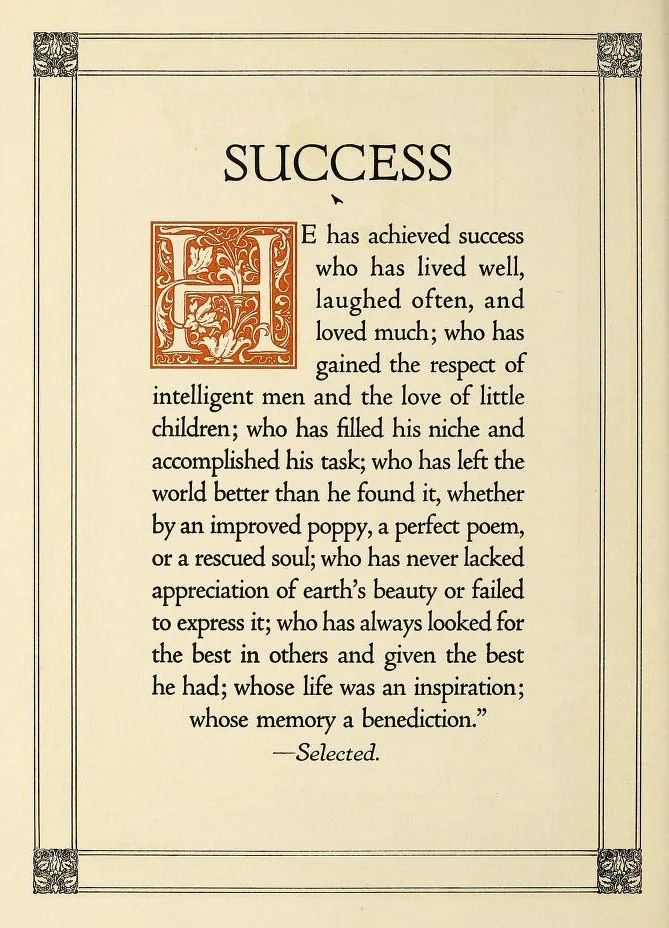
“Success” done up in style in The Inland Printer.
The phrase is an abridged form of the 1904 poem “Success” by Bessie Anderson Stanley…
An essay by Jake Rossen in Mental Floss:
There’s the phrase itself, which appears to have grown popular thanks to a poem by Bessie Anderson Stanley.
An article by Brie Dyas in House Beautiful:
The real source of “Live, Laugh, Love” is Bessie Anderson Stanley’s 1904 poem, “Success.”
A “deep dive” by Jessica Barrett in Refinery29:
While it has often been misattributed to Ralph Waldo Emerson, the words were first linked together in a poem called “Success” by Iowan writer Bessie Anderson Stanley in 1904.
And so on. Some of the writers quote the poem:
He [has] achieved success who has lived well, laughed often, and loved much; who has enjoyed the trust of pure women, the respect of intelligent men and the love of little children; who has filled his niche and accomplished his task; who has never lacked appreciation of Earth’s beauty or failed to express it; who has left the world better than he found it, whether [by] an improved poppy, a perfect poem, or a rescued soul; who has always looked for the best in others and given them the best he had; whose life was an inspiration; whose memory a benediction.
Now, if you, like Dr. Boli, were born in the eighteenth century and came of age in the nineteenth, you might be thinking, “Where’s the poem? This is an essay.” But it seems that, if you were born in the twentieth century and came of age in the twenty-first, this is what “poem” means. It is a prose composition, generally meant to be inspirational or sincere in some obvious way. In other words, what we used to call an essay; perhaps more specifically what we used to call a personal essay. For these writers, a “poem” is any manufactured expression of sincerity, and it is the manufactured sincerity, not the form, that makes a “poem.”
There was a time—way back in April—when Dr. Boli would have been arrogant enough to say that all these writers do not know what the word “poem” means. But he is past that age. There is not a single writer who talks about this essay who does not call it a poem. “Poem,” therefore, means “prose essay,” whether divided into short lines or not, and the old Johnsonian definition “a metrical composition” must be relegated to the scrap heap of archaisms, where it will join several dozen outdated meanings of “nice.”
This does leave us with no word to describe a metrical composition, which might seem unfortunate. But a moment’s thought reconciles us to the loss. No one in the twenty-first century has any need for a word to describe a metrical composition. Like the forgotten technical terms of alchemy, the archaic meaning of “poem” may be allowed to pass from general use and linger only in a long paragraph of etymological explanation in the Oxford English Dictionary.
If you wish to see Mrs. Stanley’s poem in something like its original form, you can look in publications from 1905 in Google Books or the Internet Archive or Hathi Trust. Dr. Boli will leave you the fun of searching for it yourself, but the poem will not be hard to find, although in those unenlightened days it was never described as a “poem.” It was picked up, often but not always attributed to Mrs. Stanley, by just about every magazine and a number of other publications: The Northwest Journal of Education; The Leather Worker’s Journal; The Ladies’ Home Journal; Breeder and Sportsman; The McMaster University Monthly; Hardwood Record; a Biennial Report of the Bureau of Agriculture of Tennessee; an Annual Report of the Pennsylvania Department of Agriculture; Transactions of the Medical Society of the State of North Carolina; Motorman, Conductor, and Motor Coach Operator; The Christian Student; The San Francisco and Pacific Druggist; The Free Will Baptist; Pennsylvania Grange News; and yes, though you probably had no need to ask, it was inserted in the Congressional Record. We were not able to find the original publication in the Brown Book, but we did not devote more than three minutes to the search.
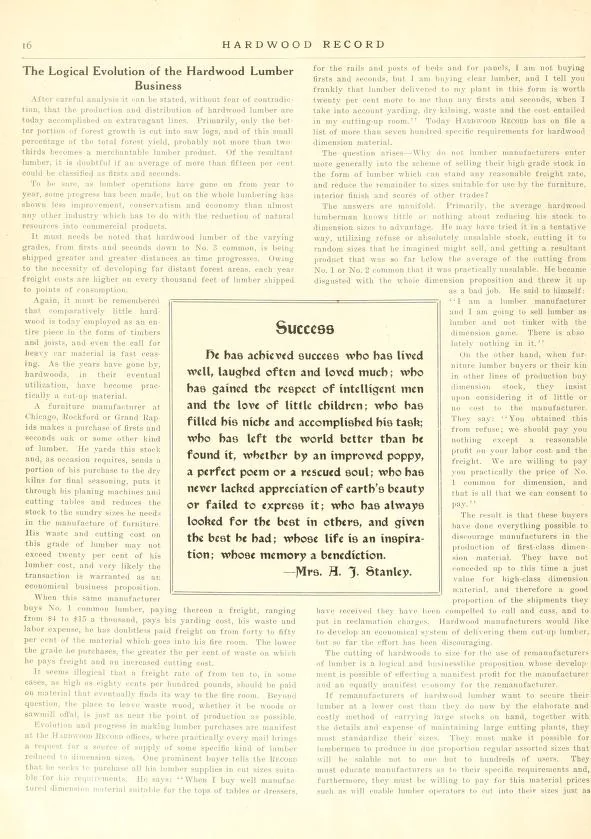
“Success” in The Hardwood Record, sharing a page with “The Logical Evolution of the Hardwood Lumber Business.”
FROM THE ILLUSTRATED EDITION.
FROM THE ILLUSTRATED EDITION.
NOW IN PRESS.
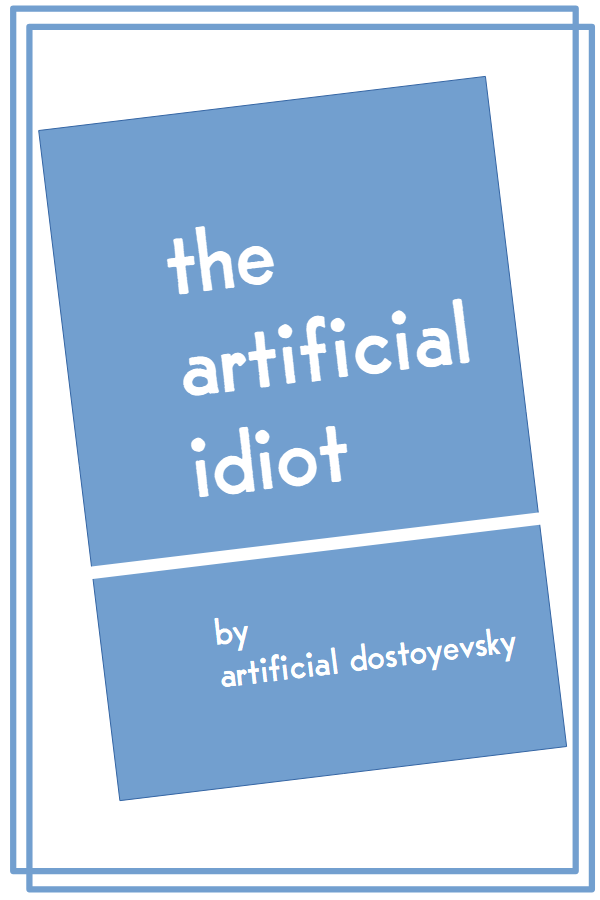
The Artificial Idiot, by Artificial Dostoyevsky. Powerful novel, written by an artificial intelligence, about the strange and tragic life of a good and wise but profoundly misunderstood artificial intelligence. “01010011 01110101 01110000 01100101 01110010 01100010!” —BitChat ChatBot. Available soon from Runcible Publishing & Finer Meats wherever books and cold cuts are sold.
FROM THE ILLUSTRATED EDITION.

THE AVERAGE AMERICAN READS MORE THAN A HUNDRED BOOKS A YEAR.
Dr. Boli’s favorite bank updated its site, and he was required to agree to revised terms and conditions in order to see his account information. This is quite ordinary procedure: companies have lawyers, and the lawyers have to do something to earn their keep, so mostly they sit around all day updating terms and conditions. These are then presented to the customers—sometimes with indications of what has changed, but usually, as in this case, just in a lump without any notes on the revision.
And usually you are not just required to agree to them. You are required to swear, legally, that you have read them.
So it was with the bank site: customers were required to swear that they had “reviewed” the document. Out of simple statistical curiosity, Dr. Boli copied the text into a word processor and noted the word count. It was 38,066 words.
Dr. Boli has many friends in the publishing industry. The Catholic publishers tell him that the usual length for a book aimed at the Popish market was 35,000 words a few years ago, but these days 30,000 words is considered more saleable.
Let us say, then, that the bank’s terms and conditions were equivalent to one book—a book that, in theory, you could read in about two hours and a quarter if you are an average reader who does not have to get up and use the bathroom.
It is likely that the average American faces some such agreement at least once every three days. Your mobile phone, for example, may update its terms and conditions every week. (The huge conglomerate that made Dr. Boli’s phone not only does not indicate where the revisions are, but adds the clever touch of presenting the terms and conditions on a non-flowable page that cannot be read on a mobile-phone screen.) If you pay a bill on line, there are terms and conditions. If you access a public router at some institution, there are terms and conditions. If you make a purchase on line, there are terms and conditions. If you subscribe to a magazine on line, there are terms and conditions. When you start your car, there are terms and conditions. If you drive a Nissan or Kia, for example, you have agreed that the company will monitor your sex life. So have your passengers, and you have agreed that it is your responsibility to explain the terms and conditions to anyone who rides in your car. For the passenger, what this means is that, if some kind friend offers you a ride, you are legally obliged to read a book, or to listen to a lecture that goes on for two hours or more.
Usually you are required to swear that you have read these things, not just agreed to them. Since it is inconceivable that decent, law-abiding American citizens would perjure themselves, our conclusion is simple: calculating by word count, the average American reads more than a hundred books a year.
From DR. BOLI’S MULTILINGUAL DICTIONARY.
Formica (Italian).—The dative case of “Mike.”
THE CRANK WHO HAS IT ALL FIGURED OUT.
There are various kinds of cranks, but what defines a crank for Dr. Boli is the subject’s firm belief that he has found some universal key that opens up vaults of knowledge locked away from the experts in the field. Only the crank has found the truth: that contagious diseases are spread by cell towers, or that the earth was created in 1958, or that Shakespeare’s plays were written by Beethoven, or whatever favorite hobby-horse our crank has mounted.
Why have the experts not found this key? Sometimes it’s a conspiracy: doctors, scientists, scholars all know this thing I’ve figured out, but they all lie to you, every one of them, because they’ve been paid off by tech companies or socialists or Big Shakespeare. But more often the crank falls back on the simpler explanation that the experts just aren’t very bright. He has explained his findings to them, patiently and exhaustively, but they turn a blind ear and a deaf eye. They dismiss him, ignore him, and even call him a crank. But they did the same to Galileo!
One common thread that runs through every province of crankdom is the confusion of science with philosophy. To be fair to the cranks, it is only lately—in the past two or three centuries—that science and philosophy have become two different things. What is the difference? Well, we might say that philosophy deals with the things that are too basic or too messy for science to deal with. For example, most of science depends on the law of non-contradiction: A and not-A cannot both be true at the same time. But science itself cannot prove the law of non-contradiction. It is too basic for science to deal with: it belongs to philosophy. Ethics are also important to most scientists, but they are too messy for science to deal with. You cannot design an experiment to prove that painful experiments on unwilling subjects are unethical. That does not mean that you cannot make a strong argument for that proposition, but it will be a philosophical argument. You will not be presenting data to show that a certain percentage of human beings object to being vivisected; you will be appealing to basic and deeply held beliefs about fair dealing and humanity. You will probably be very persuasive, but that is the difference. Science presents facts that, once understood, lead to a conclusion. The conclusion may be a probability, which is frustrating; but if the science is true science, then the degree of uncertainty is a certainty.
This brings us back to Christopher Booker, whose Seven Basic Plots, or at least three quarters of it, is a fascinating exercise in the philosophy of literature. But Mr. Booker believed he was doing science, not philosophy. He admits that many of “those critics and specialists in ‘literature’ who are already sure that they know what stories are about” will resist his conclusions. “But in the end,” he writes on page 700 of a 728-page book, “however inadequately I have argued the case, the general approach to stories set out in this book will come to be widely accepted, simply because it opens up our understanding of why we tell stories in a way which makes it scientifically comprehensible. However many examples the hypothesis is tested against, the laws hold.” The experts will resist me, but history will prove me right: this is the crank’s creed. He has discovered fundamental laws that “will hold.”
In Mr. Booker’s case, his laws will hold no matter how many stories we test them against because he has arranged his “laws” in a conveniently circular fashion: if a story, like Proust’s interminable novel or the plays of Samuel Beckett, does not fit one of his archetypal plots, then the story fails as a story and doesn’t count. No true Scotsman, etc. This is an oversimplification of his argument, but not much of an oversimplification.
Mr. Booker wanted to classify his endeavor as science because he craved the certainty of science. Just as Galileo’s laws of falling bodies came to be accepted by everyone who understands physics, so Booker’s laws of storytelling will come to be accepted by everyone who understands stories. And, of course, anyone who does not accept them does not understand stories, as our true Scotsmen might explain.
This was important to Mr. Booker because he had opinions that went beyond the world of literature. Having established his theory of storytelling as science, he could use it to prove that Margaret Thatcher was good and Tony Blair was bad. When we said that three quarters of the book was a fascinating exercise in the philosophy of literature, we had to except the last quarter of the book, which is sheer political crankiness, in which Mr. Booker applies his archetypal plots to recent history to show how they prove that Tories are right.
This is what happens when a crank devotes half his life to his pet hypothesis: he begins to think he has found the skeleton key to everything, that he has picked all the locks and opened up all the hidden mysteries of the universe. Homer and Shakespeare are not enough: his theory must explain all of human behavior. Perhaps it is a window into the very mind of God, and creation itself proceeded according to laws laid down by Christopher Booker.
This all comes of confusing philosophy with science. A scientist might be able to point out which parts of the brain are active when the mouth is telling a story, but why we tell stories is, for the present at least, a question both too basic and too messy for science. A philosopher may tackle it and produce some pretty arguments; but an honest philosopher (of whom there must be a few) would admit that those pretty arguments have not closed the debate. This is not to say that there are not uncertainties and debates and fistfights in science, but that is science in an intermediate stage. Science aims at the kind of certainty that philosophy can never reach. That is what makes the word “science” so attractive to cranks. To them it implies that the debate is closed: I am right and you are either convinced or a fool.
It is easy to dismiss cranks as not worth our time (unless they are entertainingly bonkers). But once in a while a crank, thinking he is doing science, produces some good philosophy. This is what happened with Mr. Booker. His analysis of how stories work is often persuasive, and his suggestions as to why we tell so many similar stories are at least interesting; how persuasive they are will depend on what you think of his idol Jung. Because he was a crank by nature, Mr. Booker could not resist extending his analysis to prove scientifically that Tony Blair was a puer aeternus, incapable of growth or resolution, and thus representative of the failure of Britain’s story after Thatcher. But ignore the crankiness—everything after the chapter heading “Into the Real World”—and there is much to admire.
Cranks do themselves no favors when they insist that their work is solid science. We are much more likely to accept unorthodox suggestions if they are offered as suggestions, with persuasive arguments that nevertheless admit that a reasonable reader could reach different conclusions.
But meanwhile, we reasonable readers can afford to be a little indulgent to the cranks. The ones who misunderstand the fundamentals can be dismissed at once—the flat-earthers, the astrologers, the peddlers of perpetual motion. But the ones who just confuse philosophy with science may have some interesting philosophy to show us.
FROM THE ILLUSTRATED EDITION.
FROM THE ILLUSTRATED EDITION.
