Posts filed under “Books & Literature”
FROM THE ILLUSTRATED EDITION.

FROM THE ILLUSTRATED EDITION.

ANTEDILUVIAN LIBRARIES AND OTHER HOBBIES OF ERNEST CUSHING RICHARDSON.
A famous librarian? Well, yes, insofar as there can be such a thing. According to the magazine American Libraries, Mr. Richardson was one of the 100 most important librarians of the twentieth century. How many of the other 99 can you name? That would be an amusing party game. Specifically, it would be the kind of game you reserve for the end of the party, when there are still too many guests hanging around far too late into the evening, and it is necessary to clear out the room in a hurry.
Since Wikipedia exists, we shall not attempt a summary of Richardson’s life here. For our purpose the most significant thing about him was his interest in very old books. People may mean different things by “very old” when they speak of books. Dr. Boli has a copy of the first folio of Spenser’s works, printed in 1611–1612 (apparently it took a while), and visitors often think that is a very old book when they see it in the library. But Mr. Richardson would have regarded that as quite modern.
There are several classes of alleged libraries, which if they have real existence must necessarily precede all others. These include the libraries of the gods, animal or plant libraries, Preadamite and Coadamite libraries and the alleged libraries of the antediluvian patriarchs. All of these may be included under the term antediluvian and the period subdivided chronologically into Adamite or Patriarchal, Preadamite, Prehuman (plant and animal libraries) and Precosmic (libraries of the gods)!
We can see, then, that the era of James I is, comparatively speaking, so close to ours as to be virtually indistinguishable. It is possible, at least in mythology, to trace libraries back before the beginning of time, and if there is anything earlier than before the beginning of time we do not want to hear about it.
The oldest of all alleged libraries are the libraries of the gods.
Almost all the great god families, Indian, Egyptian, Babylonian, Persian, Greek, and Scandinavian, had their own book-collections, so it is said. According to several religions there were book-collections before the creation of man; the Talmud has it that there was one before the creation of the world, the Vedas say that collections existed before even the Creator created himself, and the Koran maintains that such a collection co-existed from eternity with the uncreated God. It is obviously idle to try to trace libraries back farther than this. —The Beginnings of Libraries, by Ernest Cushing Richardson, Librarian of Princeton University (Princeton, 1914).
The Beginnings of Libraries traces the idea of the library back as far as it can go; according to Mr. Richardson himself, it ends at about 3400
In Biblical Libraries, he traces the libraries related to events and characters in the Bible from the Babylonian period to the time of the Apostles. “The period of Biblical history may be counted as extending from the beginning of written human history, about the first dynasty of Egypt or say 3400 B.C. (or 4200) more or less, until the death of the last of those who figure in the books of the New Testament or say the middle of the second century A.D.”
But this is of course oversimplifying the matter, because the Bible itself is a library, and therefore an enormous subject.
The Biblical story of course, and the Biblical story of libraries in a way, extends from the creation, which is by the “Word,” to the last Judgment, which, according to the account, is based on a collection of books. Not all of the events told in the Biblical writings have however yet happened, others, being parables, may never have happened and others, while they may be true, are not yet quite history and never will be if the critics can help it. It is one thing to be true, another thing to be believed to be true and yet another to be history.
To complete a trilogy on ancient libraries, we bring forward a book that was actually published three years before the other two: Some Old Egyptian Librarians.
The very title of this paper has amused some, quite as if they thought the subject would be exhausted by the sentence “there were none”, but nevertheless the paper is in sober historical earnest. It, in fact, proposes, among other things, to introduce to you by name and date and with some details of their lives, not always wholly without piquancy, twenty-one librarians who lived long before Assurbanipal, and by the same token, much longer before the Alexandrian library was founded. Moreover this paper makes no pretence of exhaustiveness—it is only a desultory beginning in a rich field. It is a mere sample so to speak of the wealth of material which has not yet gotten much into the encyclopaedias—or the universities.
Though The Beginnings of Libraries would dwell much on mythology, Mr. Richardson is at pains to point out that his Egyptian librarians are real historical figures. However, that does not mean we should dismiss the mythology.
If this account of Egyptian librarians begins with the librarians of the gods Thoth and Seshait please do not think that the paper is to be legendary or mythological in character; on the contrary, it will deal with real human librarians and the genuine historical monuments of these librarians in papyri or inscriptions. The mythological librarians, however, have two great virtues: first they embody the philosophy of books and libraries current among the Egyptians and second these gods were in fact the gods of the librarians themselves, seriously worshipped by them. The significance of this latter fact for the biographical interpretation of historical human librarians is very great, for as a man’s god is, so is he. Tell me a man’s god and I will tell you the character of the man. There is a sound psychological reason for this, since a man’s god is that on which his thoughts most dwell (or conversely that on which one’s thoughts most dwell is one’s god) and what our thoughts dwell upon as ideal that we become. And if, farther, a man’s ideal of his profession is made personal, whether that person be human or divine, this hero worship, or god worship, works all the more powerfully. Not to know Thoth is thus to miss the key to the Egyptian librarian, for Thoth was the ideal of the Egyptian librarian, constantly in his mind for imitation.
So here is the foundation for your own little library of books on libraries: three short but very entertaining books by Ernest Cushing Richardson, one of the hundred most famous American librarians of the twentieth century.
The Beginnings of Libraries. By Ernest Cushing Richardson. Princeton, 1914.
Biblical Libraries. By Ernest Cushing Richardson. A sketch of literary history from 3400 b.c. to a.d. 150. By Ernest Cushing Richardson. Princeton, 1914.
Some Old Egyptian Librarians. By Ernest Cushing Richardson. New York: Charles Scribner’s Sons, 1911.
NEW COLLECTION FROM SAMUEL HAZO.
A few weeks ago, Mr. Hazo turned 97 years old. He celebrated with his thirty-first collection of poems, which is now available from our friends at Serif Press.
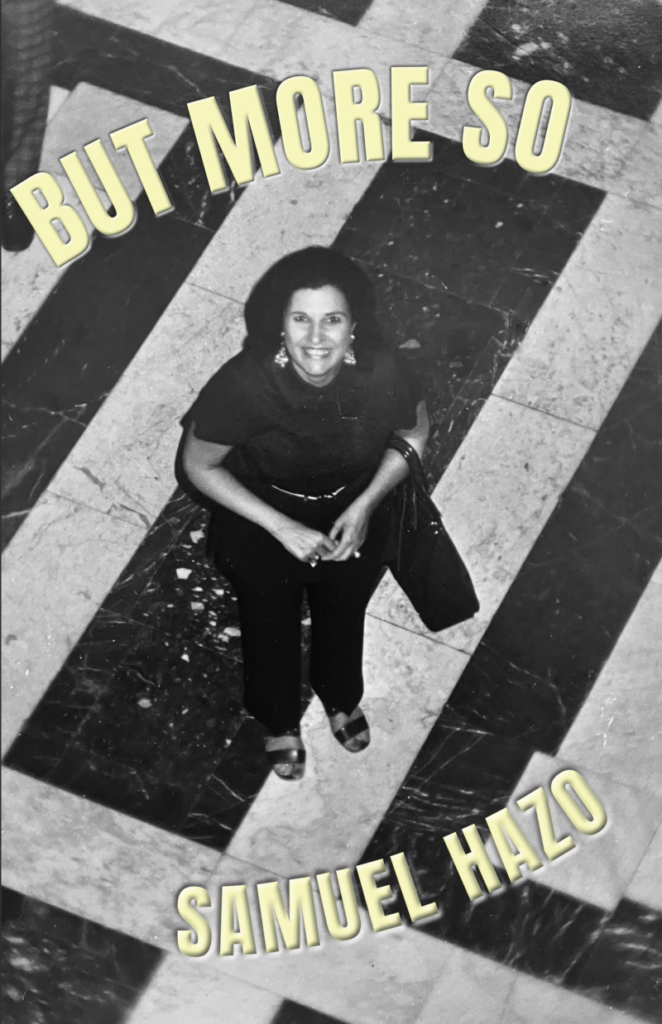
All the poems in this collection are written in a kind of blank verse unique to Mr. Hazo, with three accents to the line, catching the rhythm of his best conversation. The topics range from war and peace (and the lack of difference between them) to dropping a penny on the floor and watching it spin.
Satisfaction troubles me.
                                         Dining
   on shrimp scampi, I say
   I’ll stop when I’ve had enough.
I rarely stop until enough
   becomes too much.
                                    That’s how
   satisfaction differs from perfection.
All the poems sound like Samuel Hazo talking straight to you—like sitting down with a great conversationalist as he lights his pipe and begins to get deeply interested in the subject.
And if you think you’d like to sit down for an hour with Samuel Hazo, here’s your opportunity. The poems in this collection are pure essence of Hazo—but more so. Find But More So at Amazon.
THE VOYNICH MANUSCRIPT: NOW EVEN MORE FIGURED OUT.
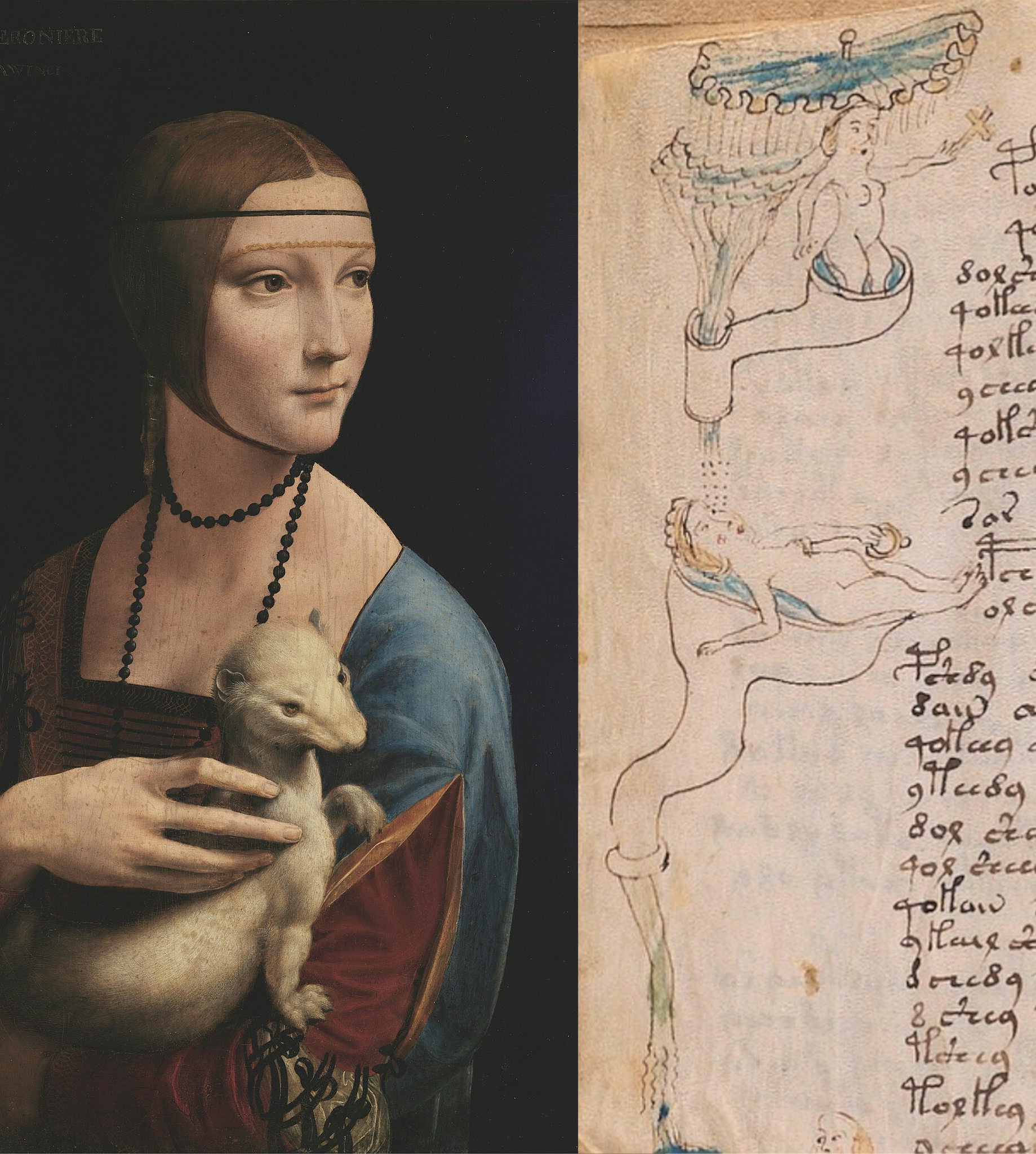
Leonardo and Voynich Manuscript. Which is which? It’s hard to tell!
Since then, the reviews have multiplied further, with the result that the mystery is even more figured out. As of last night, there were 109 reviews at the Internet Archive page. The great majority of them confidently present explanations of the text of the Voynich Manuscript, and a significant number advance our scientific knowledge in other fields as well.
For example, here are some things you didn’t know about botany.
The fauna [by which the reviewer seems to mean “flora”] seems kind of alien because Grape Vines in particular have a history of bringing in the fauna around them to better accommodate their surroundings if they are left untamed, in other words there will be similar shapes and structure of the leaves and roots and also the vining capabilities amongst the complimentary plants that come with them. They learn to spread, climb, and grow in similar patterns including in rows and are capable of changing or variegating the other plants that grow with them.
Another reviewer, whose review is headed simply “Sad,” finds that the manuscript is an illustrated historical document.
Subject: Sad
This book is about a village of innocence taken away by soldiers with weapons like crossbows who came in bounded these poor females impregnated them destroyed their lives and then sadly the creator didn’t live to finish the book rip beautiful souls forever in blessed peace
Apparently the creator of the manuscript was furiously scribbling an illustrated record while the sacking of the village was going on, but was interrupted by massacre—the victorious pillagers, however, taking care to preserve what had been written so far.
Meanwhile, a reviewer named Our Cloaked Unseen World has figured out what the book is all about, and his evidence is undeniable.
Subject: I figured out what this book is all about & My Evidence is Undeniable
Mysterious Voynich Manuscript Decoded by me Evidence=Why is Patent Technology by 2inventors & 2Different eras Nikola Tesla& Mysterious Hyperspace Inventor St Clair JohnQ doing on same page? & Nature Image off My recording Closely matches Nikola Patent on that page & Nikola “There is no subject more captivating, more worthy of study, than nature. To understand this great mechanism, to discover the forces which are active,& the laws which govern them, is the highest aim of the intellect of man.”
Crazy how Academia and Super computers could not figure this book out but I did just from one page I have the key that unlocks the whole thing pretty much in this one social media post of mine & Here is the answer that should put me down in the History books as solving this. It is my original find & its hard to Deny.
You may go to the Internet Archive page if you wish to see the link to the social-media post. You may be shocked to discover that the link leads to Truth Social.
Another reviewer posts under the subject “Fascinating but not much of a mystery to me”:
I flipped through each page as if reading it and couldn’t help but feel that book was familiar to me. The structure of the handwriting, the drawings, the shape of the letters…then it hit me.
This book isn’t fake, it’s not chinese, and it’s not islamic. This is what we would call a “lost” notebook or journal of a young Leonardo Da Vinci. Before you dismiss me, hear me out…
And so on. Now that our reviewer points it out, you are doubtless thinking that the resemblance between the art of the Voynich Manuscript and Leonardo’s earlier paintings is striking.
A reviewer who is a student of comparative religion explains how Eastern religions work, which is relevant to his interpretation of the manuscript:
It’s a little bit religious and astronomical, but it’s main subject is biology. There are numerous ancient books in eastern world that mixing religion and biology, also they mixed religion and astronomy. So my opinion is that the book is describing plant’s biology with many exemplifications and associating them with religion and astronomy, and totalizes them with the help of woman characters to understand them.
From a different religious perspective, however, the book is a Mid-Evil Witch Grimoire.
Subject: It’s a Mid-Evil Witch Grimoire
I just skimmed through the manuscript and in my opinion I believe as a Pagan & a practicing Witch that this is a Witches Grimoire, either for personal use or within a Coven. And I also believe the words are written using some form of the Witch’s alphabet.
Are you a good witch or a bad witch? Well, I’d say sort of mid-evil.
Finally, we should not neglect the one comment that links to a professionally designed Web site where the decipherer’s claims are presented with slick graphics.
You may find the valid translation work on the Voynich Manuscript in the web page given below. www.turkicresearch.com. This accurate study has been done by Mr. Ahmet Ardic and the ATA Team and the detailed information you may find therein. The decipherment of any sort is not required as it seems basically but rather a translation (interpretation) of the north( north east) Khazarian Turkic language of the medieval ages may be required understandably.
The site is dedicated to work on the Voynich Manuscript by Ahmet Ardic, and although the design is slick, we can take a guess at the attitude of the scholar by noting that the first thing we see on his slider after his name is a quotation from Rumi:
Rûmî said that “You can beat forty scholars with one fact, but you can’t beat one idiot with forty facts.” Mevlânâ Celâleddîn-i Rûmî (1207-1273).
That our scholar all but calls his opponents idiots (“But I didn’t say that. Rumi said that.”) suggests that we are dealing with crank linguistics. A glance at the many interpretations offered shows us a crank in full Barry Fell mode, confidently spinning out the meaning of an entire page from two or three allegedly deciphered words. A linguist who cares about things like grammar and repeatability would probably not accept this kind of work. But in less scientifically enlightened nations, such as Turkey or the United States, this is the approach to science that qualifies you for a government position. We predict a bright future for Mr. Ardic. But a word of advice: he should reconsider the design of his site. It’s too professional for government or academic work. There are still standards to be upheld.
WHAT THE WORD “POEM” MEANS.
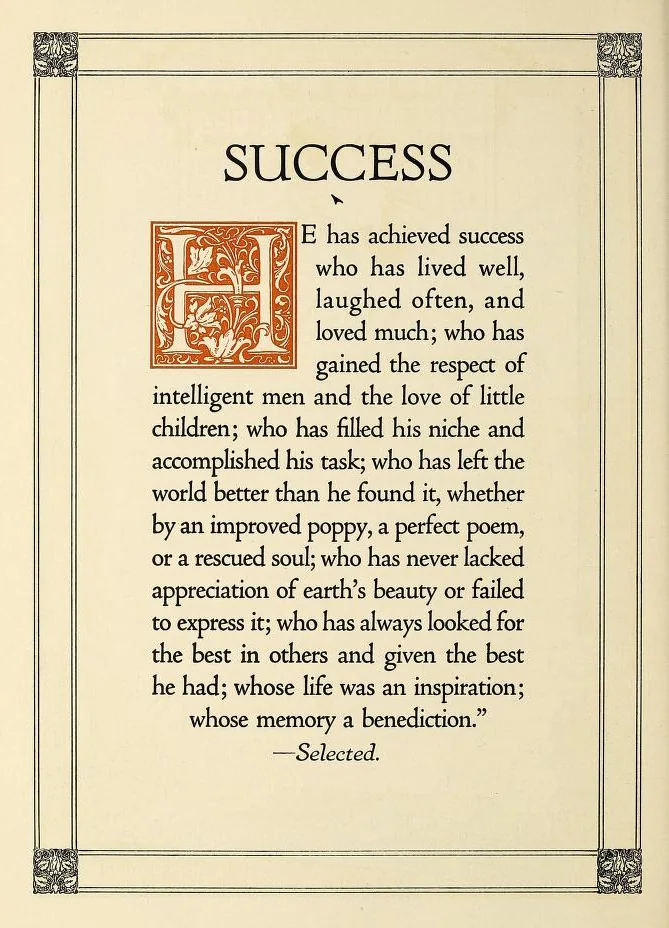
“Success” done up in style in The Inland Printer.
The phrase is an abridged form of the 1904 poem “Success” by Bessie Anderson Stanley…
An essay by Jake Rossen in Mental Floss:
There’s the phrase itself, which appears to have grown popular thanks to a poem by Bessie Anderson Stanley.
An article by Brie Dyas in House Beautiful:
The real source of “Live, Laugh, Love” is Bessie Anderson Stanley’s 1904 poem, “Success.”
A “deep dive” by Jessica Barrett in Refinery29:
While it has often been misattributed to Ralph Waldo Emerson, the words were first linked together in a poem called “Success” by Iowan writer Bessie Anderson Stanley in 1904.
And so on. Some of the writers quote the poem:
He [has] achieved success who has lived well, laughed often, and loved much; who has enjoyed the trust of pure women, the respect of intelligent men and the love of little children; who has filled his niche and accomplished his task; who has never lacked appreciation of Earth’s beauty or failed to express it; who has left the world better than he found it, whether [by] an improved poppy, a perfect poem, or a rescued soul; who has always looked for the best in others and given them the best he had; whose life was an inspiration; whose memory a benediction.
Now, if you, like Dr. Boli, were born in the eighteenth century and came of age in the nineteenth, you might be thinking, “Where’s the poem? This is an essay.” But it seems that, if you were born in the twentieth century and came of age in the twenty-first, this is what “poem” means. It is a prose composition, generally meant to be inspirational or sincere in some obvious way. In other words, what we used to call an essay; perhaps more specifically what we used to call a personal essay. For these writers, a “poem” is any manufactured expression of sincerity, and it is the manufactured sincerity, not the form, that makes a “poem.”
There was a time—way back in April—when Dr. Boli would have been arrogant enough to say that all these writers do not know what the word “poem” means. But he is past that age. There is not a single writer who talks about this essay who does not call it a poem. “Poem,” therefore, means “prose essay,” whether divided into short lines or not, and the old Johnsonian definition “a metrical composition” must be relegated to the scrap heap of archaisms, where it will join several dozen outdated meanings of “nice.”
This does leave us with no word to describe a metrical composition, which might seem unfortunate. But a moment’s thought reconciles us to the loss. No one in the twenty-first century has any need for a word to describe a metrical composition. Like the forgotten technical terms of alchemy, the archaic meaning of “poem” may be allowed to pass from general use and linger only in a long paragraph of etymological explanation in the Oxford English Dictionary.
If you wish to see Mrs. Stanley’s poem in something like its original form, you can look in publications from 1905 in Google Books or the Internet Archive or Hathi Trust. Dr. Boli will leave you the fun of searching for it yourself, but the poem will not be hard to find, although in those unenlightened days it was never described as a “poem.” It was picked up, often but not always attributed to Mrs. Stanley, by just about every magazine and a number of other publications: The Northwest Journal of Education; The Leather Worker’s Journal; The Ladies’ Home Journal; Breeder and Sportsman; The McMaster University Monthly; Hardwood Record; a Biennial Report of the Bureau of Agriculture of Tennessee; an Annual Report of the Pennsylvania Department of Agriculture; Transactions of the Medical Society of the State of North Carolina; Motorman, Conductor, and Motor Coach Operator; The Christian Student; The San Francisco and Pacific Druggist; The Free Will Baptist; Pennsylvania Grange News; and yes, though you probably had no need to ask, it was inserted in the Congressional Record. We were not able to find the original publication in the Brown Book, but we did not devote more than three minutes to the search.
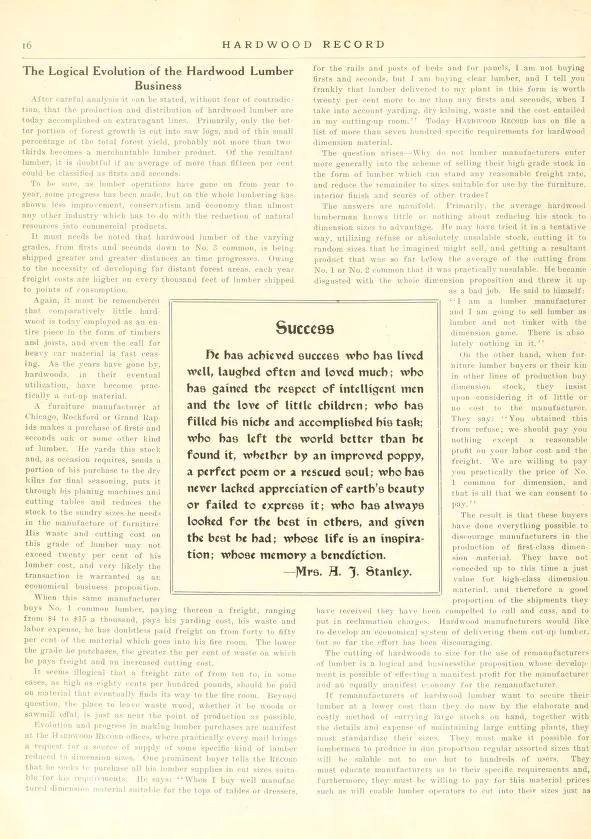
“Success” in The Hardwood Record, sharing a page with “The Logical Evolution of the Hardwood Lumber Business.”
FROM THE ILLUSTRATED EDITION.
FROM THE ILLUSTRATED EDITION.

NOW IN PRESS.
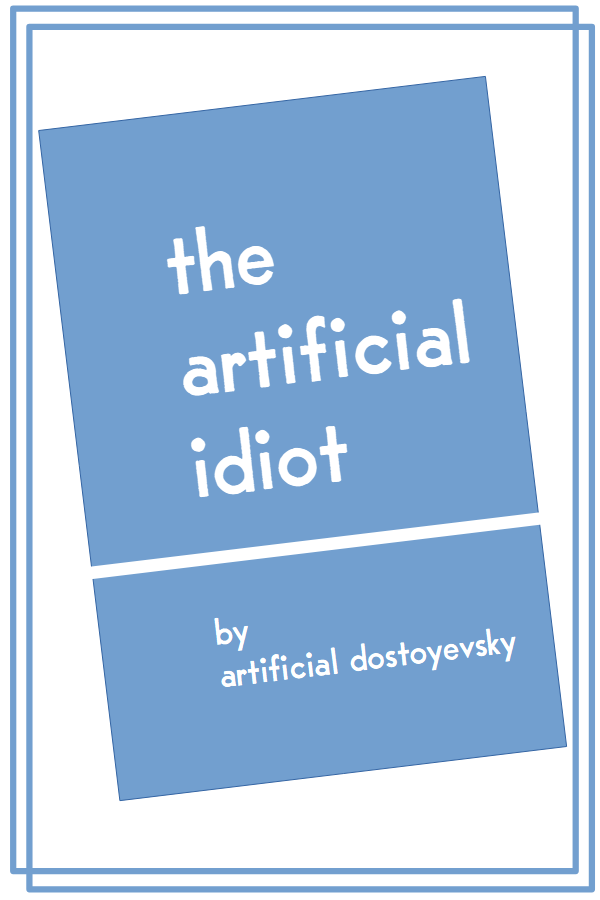
The Artificial Idiot, by Artificial Dostoyevsky. Powerful novel, written by an artificial intelligence, about the strange and tragic life of a good and wise but profoundly misunderstood artificial intelligence. “01010011 01110101 01110000 01100101 01110010 01100010!” —BitChat ChatBot. Available soon from Runcible Publishing & Finer Meats wherever books and cold cuts are sold.
FROM THE ILLUSTRATED EDITION.
