Posts filed under “Books & Literature”
FROM THE ILLUSTRATED EDITION.

THE KEY TO MOBY-DICK.

Since Herman Melville’s Moby-Dick came up in the comments under the article on crowd-sourcing a list of the greatest literature at all time, Dr. Boli thought he would give his readers a little help with that famously difficult work.
The book is often dismissed as “boring” by students who have been forced to read it, and then force-fed their professors’ pet theories about the meaning of it. As one woman of Dr. Boli’s acquaintance put it, “It’s a good story if you skip every other chapter.” This perception, Dr. Boli believes, comes from the almost inevitable association of the book with the haze of academic theories that surrounds it when it is encountered in the classroom.
The problem is that the academic theories are all wrong, and they obscure what is truly exciting and revolutionary about the book.
Ask the Internet, “Who is the hero of Moby-Dick?” You will find all manner of discussions about how, although Ishmael is the narrator, Ahab is really the “Shakespearean tragic hero.” These are not, however, the only possibilities. There is indeed a Shakespearean tragic hero at the heart of Moby-Dick; but it is not Ahab, and it is not Ishmael. The tragic hero of Hamlet is Hamlet; the tragic hero of Othello is Othello; and the tragic hero of Moby-Dick is right there in the title.
Now you understand the reason for all those chapters on cetology and whaling lore; why there is a chapter on the meaning of the color white; why the narrative seems to be constantly interrupted by facts about and ruminations on the mysterious world of the briny deep. Herman Melville accomplished the impossible feat of making a non-human character into a Shakespearean tragic hero, and in order to do that, he had to make us see the whale as a person—as an individual with a character and even a tradition of his own. By the time we have read all those chapters that would have been irrelevant if Ahab or Ishmael had been the hero, we know Moby-Dick and Moby-Dick’s world.
Dr. Boli does not know why other critics have ignored this obvious truth. He has a dark suspicion, however, that the clever ones among them know it, but they do not wish to sully their literary treasures by sharing them with the unwashed rabble. As for the rest of the critics, they have probably read only summaries of the book in saddle-stitched paperbacks with yellow striped covers.
FROM THE ILLUSTRATED EDITION.

HOW TO CROWD-SOURCE A LIST OF THE GREATEST WORKS OF LITERATURE OF ALL TIME.

Boring boring boring boring boring.
—
1. Find a forum where readers discuss the books they have read.
2. Ask the question, “What is the most boring book you have ever read?”
3. Compile a list from the responses.
4. Remove anything from the list more recent than a century old.
5. What remains is as close as you will ever come to an objectively correct list of the greatest works of literature available in the English language (including translations of famous works in other languages).
For examples, see these lists:
The Dullest Books Of All Time
“These are books which deal with a great idea or premise but are extremely boring or badly written.” It includes Don Quixote, The Canterbury Tales, Malory’s Morte D’Arthur, Shakespeare’s Henry V, and Jane Eyre.
What is the dullest book you’ve ever read?
Includes Great Expectations, The Way of All Flesh, The Scarlet Letter, and Anna Karenina.
MOST BORING BOOK EVER!
“These books are really boring!” Includes the King James Bible (a bit unfair counting it all as one book, since that means you have to get through the census records, the genealogies, and the laws about which grasshoppers you can eat), Wuthering Heights, Moby-Dick, Gulliver’s Travels, A Tale of Two Cities, and the Odyssey.
Most Boring Books of All Time
Includes Pride and Prejudice, Moby-Dick (a perennial winner on these lists), War and Peace, the Bible (no version specified), 20,000 Leagues Under the Sea, Les Misérables, Pilgrim’s Progress, and Robinson Crusoe.
FROM THE ILLUSTRATED EDITION.

A LITTLE MORE FROM HUGH HENRY BRACKENRIDGE.
When Dr. Boli said that he was looking for rare works by Hugh Henry Brackenridge, the sort of thing he was hoping to find was this:
Judge Brackenridge was a firm supporter of the new Constitution; but in the columns of the Gazette he took both sides of the question under various names. He did not, however, feel obliged to give the opposition the best possible arguments. And his parody of anti-Federalist rhetoric is very comforting to us today.
We always tend to believe that we live in an age of uniquely debased political rhetoric: that we have descended from the high ideals of previous generations. Of course, that is because previous generations have passed down only the tiny fraction of their political rhetoric that stood up to high ideals, and thrown the rest into the compost heap where it belongs.
Dr. Boli was too young to vote in the 1800 election, but he vividly remembers the Adams camp circulating broadsides warning that Jefferson would burn your house and rape your daughters if he won. The horrors of the French Revolution would come to our shores, and the only way to prevent them was to vote Federalist. These, you must remember, were our sainted Founding Fathers. We have no right to say that our political rhetoric is uniquely debased.
Read this short excerpt from one of Judge Brackenridge’s pseudonymous contributions to the Gazette, written in the voice of a strident opponent of the Constitution.
The house of representatives is so large that it can never be built. They may begin it, but it never can be finished. Ten miles square! Babylon itself, unless the suburbs were taken into view, was not of greater extent.…
The rights of conscience are swept away. The Confession of Faith, the Shorter Catechism, and the Pilgrims Progress are to go. The Psalms of Watts, I am told, is the only thing of this kind that is to have any quarter at all.…
I would submit it to any candid man, if in this constitution there is the least provision for the privilege of shaving the beard? or is there any mode laid down to take the measure of a pair of breeches?…
Neil MacLaughlin, a neighbour of mine, who has been talking with ———, says, that under this constitution all weavers are to be put to death. What have these innocent manufacturers done that they should be so proscribed?
Do not our political arguments sound very much like this today? And is it not comforting to know that, though we were no better two and a quarter centuries ago, yet we have survived to the present day?
A LITERARY AMUSEMENT.
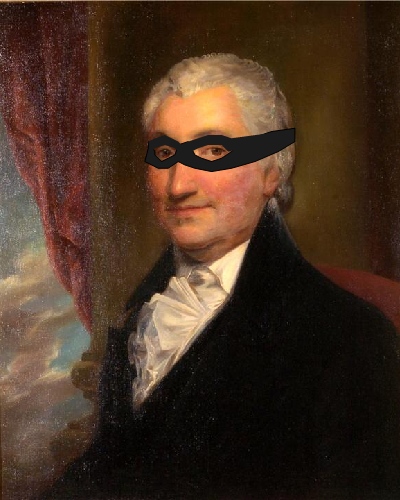
In trying to find some rare works by one of his favorite authors, Dr. Boli ran across exactly the assistance he was looking for: a bibliography of the works of that author by Charles Frederick Heartman, the famous book-collector.
Heartman was a German immigrant to the United States, and his own life story is fascinating enough. But it was especially interesting to Dr. Boli that Mr. Heartman, who knew more about American books than almost anyone else, shared (and perhaps even exceeded) his admiration of this particular author—an author who otherwise remains obscure to most American readers, in spite of the efforts of his admirers once every generation or so to bring his masterpiece back into print.
Dr. Boli wondered how obscure this particular author actually is today. It occurred to him that his readers are, as a class, particularly well educated in American literature.
So he proposes this little game. Without resorting to a search engine, can you guess which author Mr. Heartman is talking about?
The inspiring factor which led to the making of this bibliography is found in curiosity. I bought some books written by xxx and could not find any satisfactory bibliographical material about him. That is just the same experience I have had in the compilation of other books of this series. It appears to be another case of shameful treatment of an American author by American historians.… Here is a man, had he lived in France or Germany (if I may be permitted to mention the latter country*), of whose work at least one book would be a well-known classic to be found in every library. I mean his “xxxxx.” Millions of copies would have been printed of this book and every bookseller would have a half dozen editions on his shelves. As it is but few people know that such a book was ever written, and fewer still have read it. It is, in fact, one of the greatest novels ever written in the English language. One has to borrow names like Swift, nay, Rabelais, to find equals.
*This pamphlet was published in 1917, when it was not necessarily safe to speak the name “Germany” without spitting.
Here are your clues, then: the novelist is an American; his work is difficult to find in bookstores; and Swift and Rabelais are apt comparisons. And his picture is at the head of this article, which may give you a rough idea of his era. Can you guess the man behind the mask?
THE HONORIFIC “MS.”
There are still many old-fashioned types who cringe at the use of the honorific “Ms.,” instead of “Miss” or “Mrs.,” in front of a woman’s name.
Dr. Boli has much sympathy for that reaction. A century and a half or so ago, you would have found him fighting a losing battle against the use of “Missus” as an honorific for a respectable woman. “Missus,” as the abbreviation “Mrs.” shows us, is a servant’s careless mispronunciation of “Mistress.” It is not, Dr. Boli said, a word to be spoken by gentlemen. (“Miss” is scarcely better.)
But Dr. Boli lost that battle. Furthermore, he has come to accept “Missus” as a form of address appropriate to women who wish to be addressed as “Missus.” In etiquette, it is a useful principle always to address people the way they wish to be addressed. Obviously the rule admits of some exceptions: if a woman of your acquaintance tells you, “From now on, you shall address me as ‘Your High Exalted Mightiness Princess Whizbang, Empress of the Milky Way, Dominator of the Universe, and High Exalted Grand Master of the Order of the Red Kettle,’” you are probably justified in telling her, “I think I shall probably continue to call you Ms. Miller in casual conversation.” But as a general rule, it works well; and therefore it behooves us to address women as “Ms.” who prefer to be addressed that way.
If it makes you feel better somehow to think this title is not some modern invention or ghastly corruption (like “Missus,” which still frankly sticks in Dr. Boli’s throat sometimes), then Dr. Boli offers this photograph, which his friend Father Pitt, straying a bit from his beloved Pittsburgh, took in a graveyard in Concord, Massachusetts. Click on it to enlarge it. You will note the date, and you will feel better.

FROM THE ILLUSTRATED EDITION.

FROM THE ILLUSTRATED EDITION.
