Posts filed under “General Knowledge”
HOW MANY WORDS DID YOU AGREE TO?
The Terms of Use contain this provision in all capitals, indicating, of course, that it is not important at all and you should ignore it. They could not be copied by normal means, but optical character recognition made them accessible:
READ THESE CUSTOMER TERMS CAREFULLY BEFORE USING THE SERVICES AS USE OF THE SERVICES INDICATES THAT YOU HAVE BOTH READ AND ACCEPTED THESE CUSTOMER TERMS. THESE CUSTOMER TERMS CONTAIN A DISPUTE RESOLUTION AND ARBITRATION PROVISION, INCLUDING A CLASS ACTION WAIVER THAT AFFECTS YOUR RIGHTS UNDER THESE CUSTOMER TERMS AND WITH RESPECT TO DISPUTES YOU MAY HAVE WITH CALENDLY. YOU ACKNOWLEDGE THAT YOU ARE ENTERING INTO THESE CUSTOMER TERMS VOLUNTARILY AND NOT IN RELIANCE ON ANY PROMISES OR REPRESENTATIONS WHATSOEVER EXCEPT THOSE CONTAINED IN THE CUSTOMER TERMS THEMSELVES.
So, as you see, you are agreeing, by scheduling an appointment with anyone who uses this service for appointments, not only that you will not object to the terms, but that you have actually read them. You “indicate” or “confirm” that you have spent more than an hour reading legal slop that would have made your eyes roll back in their sockets to protect themselves if you had actually spent more than five minutes in it. A commonly accepted figure for the average reader’s silent-reading rate is 238 words per minute, and 15,000 words would thus take you a bit more than 63 minutes if you could read them at the normal reading rate—although, as Dr. Boli has pointed out more than once, you could not read the words at your normal reading rate, because they are words like these:
If you are an Entity purchasing licenses for your Authorized Users, you may provision or deprovision access to the Services, manage permissions, retention and export settings and transfer/assign accounts as described in the Documentation. As such, you will (a) inform Authorized Users of all Entity policies and practices relevant to their use of the Services and of any settings that may impact the processing of Customer Data; and (b) ensure the collection, transfer, and processing of Customer Data under the Customer Terms is lawful. If any terms in the Industry-Specific Supplement (“Industry-Specific Terms”) apply to you (e.g. Customer is a U.S government entity), those terms are also incorporated by reference herein and you agree to fully comply with the applicable Industry-Specific Terms. To the extent any such Industry-Specific Terms conflict with the terms below, the Industry-Specific Terms shall take precedence.
(We remind our readers and any guest attorneys present that these quotations are used for the purpose of criticism, and constitute a tiny portion of the more than 15,000 words under discussion, both of which considerations put us safely within the limits of fair use.)
Clearly you did not spend 63 minutes reading terms and conditions to make an appointment. And neither did anyone else who uses Calendly. But you all made a legal assertion that you did. With trivial exceptions, everyone who uses Calendly has committed the crime of perjury. This is not libel. It is cold fact. To live in the modern world, you must be a criminal perjuror. An American criminal lawyer could tell us whether this crime could be prosecuted under the laws of the land, but that it is a moral crime no one with any moral sense would deny.
We could solve this problem. Do we have the will to do it?
ASK DR. BOLI.
Dear Dr. Boli: I was told not to bring a knife to a gunfight, but, like, why not? —Sincerely, Gus down at Gus’s Cutlery ’n’ Things.
Dear Sir: For the same reason one does not wear a black tie to a white-tie occasion: one would feel uncomfortably out of place, even if the other participants were too polite to say anything.
A NEW LOOK? WELL, NOT QUITE YET.
But some people have asked whether Dr. Boli intends to modernize the site, and Dr. Boli himself has been thinking about its future. That led to this long essay about how this long essay looks when you read it in this Magazine.
There are many reasons for changing the look of a publication, and certainly every magazine, whether in print or on screen, goes through changes in design if it lasts more than a few years. Even the designs that seem most stable—“iconic,” to use a word borrowed from our Eastern brethren, who have not yet noticed that it is missing—can hold out only so long before some marketer or designer fusses with them. Time, National Geographic, the Wall Street Journal—we think of these as bastions of conservative stability. But go back a century and see how different they looked.
The main reason designs change is to keep up with trends. That seems like a very stupid reason: trends are by definition temporary, and no one thinks, “I want to create something that will make people turn up their noses six years from now.”
But trends are never presented as trends. They are always peddled to us as new discoveries in what is true and beautiful. Previous generations wallowed like pigs in the slop of ignorance, but we have stood up, washed ourselves off, and seen the light.
For example, these paragraphs are right-justified. That is a “rookie mistake” in Web design—so much so that WordPress, which runs half the Internet, removed the right-justify formatting option several years ago. How do we know it’s a rookie mistake? Well, this article is one of the sources most often pointed to when the question comes up. Some of its information is outdated: every major browser—Firefox, Safari, Chrome and all its cousins—supports automatic hyphenation now. (Here’s a curious fact that may surprise even the most loyal readers of this Magazine: before browsers supported automatic hyphenation, Dr. Boli used to hyphenate articles by hand. It was not as hard as it sounds. Pasting “­” between syllables of long words took care of it, and few articles were so long that hyphenating took more than thirty seconds.) But you will notice, if you read to the bottom of that article, that our designer’s opinion is not based on or limited to Web technology. He believes that justification is “just bad typography.” Justifying text in print is also a bad idea most of the time, he says. Naturally, his own self-published book is set ragged-right.
Everyone from Gutenberg to the advent of me got it wrong, but at last we know the truth about type. This is how design trends always come to us: as discoveries of how stupid our predecessors were.
Incidentally, here is a little challenge for you. Visit that article if you haven’t done so already, and judge it by its typography. You may think it is a breathtakingly gorgeous piece of design. You may say so in the comments if you like. Dr. Boli thinks it’s ugly and hard to read, but his opinions were formed by reading books. In which context, it is interesting to note that, if you read publishing professionals’ advice on formatting books for publication, you will find that they point out failing to justify text as a “rookie mistake.”
So trends, we reiterate, are a stupid reason for making changes. But adapting to the current state of technology is not a stupid reason. The introduction of printing changed the way books looked, and some of the changes were for the worse. But it was necessary to adapt to the new technology, because the benefits were obvious.
The software that runs this Magazine is WordPress, and the part of the software that controls how everything looks is the “theme.” There are thousands of themes out there for WordPress. Dr. Boli’s site runs on a theme called “Dr. Boli,” which is not one of the more popular ones. As far as he knows, the number of sites running it hovers around the one mark, dipping down to zero on those rare occasions when this one is off line.
This theme was cobbled together from spare parts twelve years ago, and it has been creaking along since WordPress 3.5.1. We are now at version 6.9.4. In most software, something put together for a twelve-year-old version of the software would have ceased to work about eleven years ago. We have WordPress culture to thank for the longevity of this design. “In core WordPress,” writes Matt Mullenweg, one of the founders, “we are obsessed with backwards compatibility. You can run plugins and themes written 20 years ago on today’s WordPress.”
Not all of them, though. Dr. Boli has seen themes break with software updates, and his may be next.
So would it be a good idea to give the site a fresh look, based on current technology instead of the Bronze-Age theme it currently runs?
Dr. Boli has been trying some experiments. On a small model of the site, he created a new theme based on other up-to-date themes. It works.
But then he looks at all those “iconic” publications whose designs have been fussed with and thinks that he liked them better the way the used to be.
So he has made a compromise. For now, he will let the “Dr. Boli” theme continue to shape the site. If it breaks in a future update, though, there is a substitute waiting. It may not be perfect yet, but it will work. This will still be a publication where words are primary, and design exists mainly to make the words easy to read.
And it will still have right-justified text. If it was good enough for Aldus Manutius, it’s good enough for you.
ARE YOU READY?
INTERNATIONAL STEEL PEN APPRECIATION MONTH.


A DOUBLE CELEBRATION.

The typewriter is a Royal Quiet De Luxe (with Pica type) from 1949.
Transcribed below for the better training of our robot friends.HOW MANY WORDS DID YOU AGREE TO?
COMMON INTERNET ABBREVIATIONS.
AFAIK: And furthermore, all is kaput.
BTW: Big tall weeds.
FWIW: Found watermelon, ingested watermelon.
IMHO: I may have overeaten.
OTOH: Over the old hamburger.
ROFL: Random outburst from lungs.
TOS: Terms of slavery.
TL;DR: Tried levitating; damaged rump.
IS IT BAD IF…?
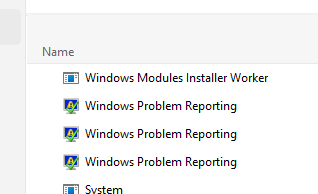
Is it bad if the top tasks in the Task Manager, sorted by “total disk utilization across all physical drives,” look like this? We can see that there are three instances of Windows Problem Reporting running at once and wearing down the drive quite a bit, while the most disk-hungry process is Windows Modules Installer Worker, which we suppose is installing another instance of Windows Problem Reporting.
Dr. Boli’s assumption was that this was just how Windows works. Perhaps it is reporting the useful diagnostic information that the computer is running Windows, which it correctly identifies as a problem. But someone who knows Windows better might be able to give us a more nuanced answer.
ASK HERBERT THE PSYCHIC FLOUNDER.
Dear Mr. Flounder: I find myself in a very delicate situation. Two very nice young men are vying for my attention, and I like them both, and they both seem to have good prospects, but my mother says I can only marry one of them even though I’m a Mormon. So how do I choose? —Sincerely, Salt Lake Sal, the Belle of West Bountiful (Utah).
Dear Miss: In my vision, which came to me in muted pastel tones, I saw a graceful gazelle leaping across the African veldt, unless it was a savanna, because my visions sometimes mix those two up, but at any rate it was a gazelle, or at least some member of the antelope subfamily, and it was leaping, gracefully, as graceful leapers do; and gradually (still, you must remember, in muted pastel tones), the gazelle became a xylophone, which continued to leap, although not nearly as gracefully, and every time it landed it made loud clanking noises; and then a turnip rose up out of the ground and devoured the xylophone; which, however, continued to leap and clank inside the turnip, so that it was the loudest turnip you ever heard; and then instead of the clanking turnip, it was the sound of locker doors slamming, and I was back in junior high school, and I suddenly realized that I didn’t know where my locker was or what the combination was, and I had forgotten to go to all my classes for most of the year already, and now I was going to fail everything, and it was going to go on my permanent record; and then there was that gazelle again, leaping through the hallways of Elinor Glyn Intermediate School like it owned the place, and it went into the teachers’ lounge and closed the door behind it.
To interpret these visions requires delicacy and a sensitive appreciation of Jungian archetypes, so I was wondering if you have tried flipping a coin. I often make decisions by flipping a coin, or rather by having my staff flip one for me, since I am deficient in coin-flipping apparatus. I frankly don’t even know how I ever made it through junior high school.