Posts filed under “Travel”
ADMIRAL HORNSWOGGLE’S NAUTICAL ADVENTURES.
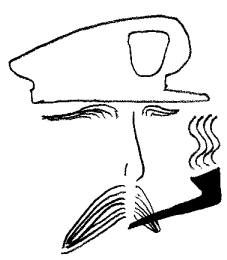
No. 2.—Onward to the Pole.
IT SEEMS AS if it were but yesterday (though in fact it was last Thursday) that I returned from my successful expedition to the Pole and faced those sincere expressions of admiration, which, heartfelt though they were, caused me no little discomfort, my native modesty being of such a quality that even faint praise is a considerable embarrassment to me. Nevertheless, my innate candor and my strict regard for the truth, no matter how inconvenient it may be to myself, compel me to confess that the praises heaped upon me were not entirely undeserved.
For the purpose of our expedition, we had been assigned the Margaret Cavendish, a small but adequate surveying ship. She had begun life as a brigantine in the Royal Navy under the name Prosperity; later she was re-rigged as a brig and rechristened the Elephant Shrew; and then, after considerable refurbishment, she reappeared as a barque under the name Abstraction. Some years later, owing to a clerical error, she was re-rigged as an omnibus and rechristened the 53H Homestead-Duquesne Via Homeville. Eventually she was rebuilt as a frigate and assigned to our expedition.
The Margaret Cavendish was, as I have indicated before, rather small for a frigate, and the space for our equipment and supplies was limited. Under the circumstances, some of my junior officers objected when I insisted on including a company of caterers, with all the tools of their profession; but I assured them that, in the bleak and icy wastelands of the north, we should all be much cheered by a well-catered meal now and then.
We set northward in late June, and for the occasion of our departure our caterers had made up a memorable feast, at the center of which they placed a decorative ice sculpture of the Margaret Cavendish herself. In order to prepare us for our northward voyage, the food was made entirely of blubber of the various sorts we might be expected to encounter.
The first few weeks of the voyage were uneventful, other than my having to quell a slight mutiny when the crew discovered that our caterers had brought nothing but blubber for the entire voyage. Eventually, however, we reached the frozen limit of liquid sea. We were forced to leave the Margaret Cavendish behind with a skeleton crew of caterers and cover the remainder of the distance by dogsled. Since we had brought no dogs, I dressed four ensigns in shaggy raccoon coats and hitched them to the sled that carried our supplies; the rest of the crew and I followed on foot.
I shall not weary you with the details of our long trek to the Pole. Suffice it to say that, when we finally reached it, we were somewhat dismayed to find a small band of Esquimaux already using it to string up their laundry. However, we were able to bribe them with a few trinkets, and they allowed us to place His Majesty’s flag at the top, above three pairs of knickers and a small tablecloth.
We went back by the same route; but you may imagine our dismay when we returned to discover that the Margaret Cavendish was no more! Caught between the edge of the ice pack and a floating iceberg, she had been crushed to splinters. The few men we had left behind had only just managed to salvage their kitchen equipment, which they had employed in fabricating a large tent from the sails, and furnishing it with folding chairs and a banquet table made from the splintered wood of the ship.
At this point my crew were of the opinion that all was lost, and we should doubtless perish in this frozen wasteland. I, however, retained my customary optimism; and to it I added a quality which I have sometimes been flattered to hear called good sense. Looking out to sea, I spied another iceberg, and it put me in mind of the feast we had enjoyed on our first night out of port. Turning to the caterers, I explained my idea, and they set to work at once.
It took a good two days of concerted effort, but the skills of the caterers were up to the task; for after all it was, but for the scale, no different from what I had already seen them accomplish. At the end of that time, they had carved an exact replica of the Margaret Cavendish from the ice all around us. We loaded our equipment on the new ship and set sail once again. I need not tell you, what everyone already knows; viz., that our sturdy ice-frigate made it as far as the extreme northern coasts of our own country, and that from there we were swiftly conveyed to face popular acclaim in the capital.
From this voyage I learned an important lesson, which is that, no matter how long the journey or how inhospitable the country, one should never deny oneself the comforts of home. I shall be certain to insist on a company of caterers in all my future voyages.
ADMIRAL HORNSWOGGLE’S NAUTICAL ADVENTURES.
No. 1.—The Battle of Batter Bay.
TRUTHFULLY I WAS a callow young man when I was given my first command, which was many years ago near the end of the last Spanish War. Doubtless it was the influence of my illustrious family, rather than any demonstration of extraordinary ability on my part, that had elevated me to that position. I had been given the sloop Tomtit, which was armed with but a single cannon, though a rather large one, and I frankly admit that neither I nor the other officers expected any great things from me.
Admiral Blanderson had orders to take the island of San Itario, which was of great strategic value owing to the abundant deposits of soapstone in the interior. The fleet that controlled this island would command the cleanest sailors on the seven seas, and such an honor must at all costs belong to our great and glorious King, whom God save.
The only natural harbor in the island, which was otherwise ringed by inaccessible cliffs, was a commodious inlet known as Batter Bay. This was defended by a Spanish fleet of half a dozen well-armed galleons currently anchored in the bay itself. I had instructions to follow our fleet into the bay, and once there to stay out of the way as much as possible; for it was obvious that Admiral Blanderson placed no great confidence in my abilities. The Admiral himself led the fleet in his flagship, the Ineluctable.
The battle commenced as soon as we rounded the head and entered the bay; the Spanish ships hurriedly drew themselves into battle array, and the deafening blasts of the cannon echoed from the surrounding hills. I, however, followed Admiral Blanderson’s orders to the letter, keeping the Tomtit behind our fleet and well clear of the battle, though I commanded my crew of eight to keep our single cannon loaded and ready to fire in case we should unexpectedly come within range of a Spanish ship.
I had, therefore, a certain degree of leisure not shared by the other commanders in our fleet, and I employed that leisure in scanning the land around the bay for enemy installations. You may imagine my horror, then, when I discerned with my keen eye (which is the left one) a perfidious Spaniard (see Fig. 1), well hidden among the trees at the edge of the bay, training a cannon on the prow of the Ineluctable, and preparing to fire on our flagship!

Figure 1.
We attempted to signal the Ineluctable, but all her attention was on the battle opposite, and no one was looking in our direction. The Spanish gun was out of range of our cannon, though perfectly capable of hitting the Ineluctable. There seemed to be nothing I could do: in a few seconds the cannon on shore would blast a hole in the prow of the Ineluctable, doubtless sinking her and Admiral Blanderson with her.
Losing no time, I quickly sent my first mate for paper and pencil. Plotting a trajectory, I quickly calculated how long it would take the shot from the shore to reach our flagship; then I ordered the first mate to train our cannon directly on the prow of the Ineluctable. He almost refused to obey; but I told him in no uncertain terms that, if he rebelled against my authority, I should be very cross with him for the remainder of his service aboard the Tomtit.
We had only moments to aim precisely, and we had only one shot. If we failed, the Admiral would go to his watery grave, and I should be responsible.
Just as we finished maneuvering the cannon into position, a flash from the shore told us that the perfidious Spaniard had fired. Before we even heard the report, I gave the order to fire, and our cannon fired with a deafening blast.
Moments later we saw a puff of dust and debris from the prow of the Ineluctable; but, marvelous to tell, there was no apparent damage. A glance through the spyglass confirmed that my calculations had been perfectly correct. The cannonball from the shore had struck the prow of the ship at exactly the same time as the cannonball from the Tomtit; and the two balls, striking each other with considerable momentum, had fused on the prow of the Ineluctable, forming a strong iron plate where the wood of the hull had been. This was the effect I had calculated. We had saved the Ineluctable.
It did not take the Spaniards very long to figure out what had happened. When they discovered what we had done, they quite naturally surrendered; and this was the end of the last Spanish war. Since then there has been peace with Spain, and for that I do take some credit. I am a modest man, but I merely state what must be regarded as simple fact.
A HISTORY OF THE REMARKABLE VOYAGE LATELY UNDERTAKEN ON BOARD THE CELEBRATED LEVIATHAN.
Written by Sir John M——, from his own journals.
Continuing the narrative which began here.
The Ninth Day: How We First Set Foot on the Cannibal Coast and Received an Unexpected Welcome.
THE YELLOWISH HAZE of the dawn foretold an exceptionally hot day as our two boats left home—for so I had already learned to think of our leviathan—and headed for the unknown shores of the Cannibal Coast. The Duke himself came to see us off and to dispense a few sage words of advice; but he was laboring under the impression that we were off the coast of Alsace, and his remarks, therefore, dwelt mostly on the subject of how best to deal with the Alsatians, whom he described as an honest but easily offended race.
There is nothing so thrilling as approaching an unknown shore for the first time, though I recognize that there is probably nothing duller than the narration of such an approach. As the boat comes closer to land, a thousand thoughts crowd into the minds of the passengers. What strange creatures live in this new land? Will the native inhabitants be friendly or hostile? Will our names be enrolled in the lists of great explorers in history?
With all these questions running through our minds, we made a gentle landing on the sandy shore. A wide beach of reddish sand separated the sea from a low forest, over which occasional palms towered like sentinels and from which (when the wind blew that way) came the most delightful scents of flowers and spices. It appeared to have all the makings of a terrestrial paradise; yet we had heard that the most savage and ferociously uncivilized tribes of men, if indeed they could be called men, inhabited those unexplored forests. It is also said that the land has such an abundance of gold that the natives place no value on that metal, and indeed (I must suppose) those rumors were at least in part our reason for stopping in such a place: for if the rumors could be verified, the profit to be made by future colonists would be more than compensation for any dangers to which they might be exposed.
Having reassembled our party on the beach, we paused to examine our surroundings. That there were native inhabitants was at once obvious from a number of foot tracks farther up the beach; as the tracks all appeared to funnel into a gap in the margin of the forest, we decided that a trail must lead thence into the forest and whatever settlements might be there.
It had been my understanding that our first business would be to make contact with the native inhabitants on friendly terms, and indeed that was my primary reason for wishing to be part of the expedition. Now, however, there was some debate as to whether such a course was advisable. At least, certain members of the party advised us, let us seek some high ground from which we can survey the land as a whole before making a final decision. I pointed out, with considerable justice (I thought), that we could see no high ground from where we stood, and the mountains we had glimpsed from the sea must be many miles distant, so that we should have to traverse the forest anyway to get to them. This reasoning did not satisfy certain of the more timorous members of the party, among them Lord Darkwood, whom indeed I now suspected of grasping at any excuse to abandon our explorations and return to the safety and comfort of the leviathan.
Although the Count of the Lower Ridings was nominally in charge of our expedition, he is a changeable soul unused to authority, and the arguments of so eminent a man as Lord Darkwood, meritless as they were, appeared to sway him. As the senior diplomat of the party, therefore, I took it upon myself to assure the rest that the Duke would be in no wise pleased if we turned back before we began. This immediately brought the lower orders to my side, for they regard the Duke with a kind of superstitious reverence. With a clear majority in favor of proceeding, the Count was willing to take our chances with the path into the forest.
We formed ourselves into a more or less orderly array, with two soldiers in front, and myself and the Count behind them, and so two by two into the woods. After we had passed through the shrubby and overgrown margin of the forest along the beach, we found the path broad and inviting. It was, however, oppressively hot away from the ocean breezes, and even in the shade of the forest we were soon perspiring liberally.
We had walked about half an hour when we heard voices ahead of us. The soldiers immediately drew their swords; but I admonished them to put them away at once, reminding them that we were to meet any natives on friendly terms if possible. Nevertheless, my heart beat faster, for what we had heard of the natives did not dispose us to regard them with trust.
The natives were not long in appearing; but, far from the half-naked savages I had anticipated, they appeared to be a party of remarkably well-dressed men and women (for there were women among them), and their bearing displayed a cultured refinement. The garments they wore reminded me of nothing so much as the elaborate drapery seen on classical statues, though infinitely more colorful.
By elaborate and obviously respectful gestures they conveyed their greetings to us. We returned their greetings with the best show of respect we could devise, after which I presented a few gifts we had brought with us to the one who appeared to be the chief of the party. He accepted the trinkets with a grateful bow, and handed them to a woman who stood behind him, who handed them to a man who stood behind her. These formalities having been concluded successfully, the chief indicated that we should follow his party; and I could not help feeling, with a certain degree of surprise and perhaps apprehension, that we had somehow been expected.
For hours we walked, and Lord Darkwood began to complain that we were being led to our doom God knew where. I told the Count that the path was well-marked, and we should have no difficulty finding our way back to our boats when the occasion arose. The natives continued to smile and lead us onward through the forest, at one point crossing a river on a terrifying but well-made rope bridge. At last, when the sun was well along in its descent toward the horizon, we came to a clearing at the foot of the mountains, and our astonishment almost deprived us of speech. Here was nothing less than a great city, although like no other city I had ever seen. The dwellings were made of palm fronds and other large leaves woven together and stretched over a skeleton of poles; they were laid out in good order, with straight and capacious streets between the rows. There was something about the place, however, that made it seem hastily constructed; and I reflected that it would hardly be possible for such structures to stand very long without constant reconstruction.
Along the streets were moving men and women of all descriptions, wearing the most splendid variety of costumes. A moment’s survey of the scene was sufficient to determine that the people were mostly moving in groups distinguished by their similar costumes, and a moment’s reflection convinced me that this transitory city was some sort of gathering of travelers or pilgrims from many nations. Perhaps it was the equivalent of one of our great markets or fairs.
Our guides brought us to a group of thatched huts at the fringes of the city, where, after a number of attempts, they at last succeeded in making us understand by gestures that we were to consider ourselves at home. The huts were dry and spacious inside, furnished abundantly with artistically woven mats, and moreover provisioned generously with baskets of strange tropical fruits and unleavened bread. That they had prepared accommodations for us was very strange; but, as it was near the end of the day, we were glad of such unexpected comfort.
Once the guides left us to ourselves, we had quite a lively discussion. Lord Darkwood and his faction (for he seemed to have assumed the leadership of a small but vocal group of noblemen) were of the opinion that we should leave at once and march back to the leviathan, hinting darkly that we were being fattened up for a cannibal feast. I, on the other hand, was certain that these people were not savage cannibals, and I invoked the Duke’s name again to rally the majority to my side. This satisfied the Count, who agreed that we should stay at least one night and attempt to make contact with the leaders of these people.
This evening, before dark, I strolled through the city. Toward the center are a number of large permanent buildings made of wood and stone, and in the very center is a high mound with what appears to be a temple or other public building at the top of it. No one I passed took any notice of my pale skin and strange clothes, which confirmed my impression that this was a gathering where visitors from many nations were expected.
Along my way back I heard a great commotion, and following the noise found my way to a broad thoroughfare leading in to the center of the city. Here I saw a procession, with many spectators lining the way to catch a glimpse of the participants. There were soldiers in exceptionally colorful costume; then rows of dignitaries in costumes even more colorful; and then, in the center of it all, a girl or young woman in chains, dressed simply in yellow drapery. This girl, who appeared to find the whole proceeding most unpleasant, was evidently the reason for the whole procession, and the crowds cheered as she went by. She did not acknowledge their cheers, but stared straight ahead as she walked, or rather was pulled, through the assembled multitude.
I simply did not know what to think of this spectacle. Having returned to our hut, I arranged some of the mats into a passable bed, and was one of the last to retire. On the morrow I might find out more about this convocation of nations, and perhaps about the young woman who so incongruously seemed to be at the center of it.
FROM THE CRITICAL EDITION.
A History of the Remarkable Voyage Lately Undertaken On Board the Celebrated Leviathan.
Written by Sir John ——,[1] from his own journals.
The First Day: Our Departure, and My First Encounter with the Duke.
We set sail from the greenish[2] coasts of home on the last day of spring in the year ——, and I do truthfully believe the whole country had turned out to see our departure;—though whether in delight at the new thing we were attempting or in eagerness to be rid of us I cannot say.[3] There was certainly feasting and drunkenness enough on both sides of the affair, among those of us who went and those who stayed. I myself refused most of the wine[4] that flowed so prodigiously, so that I might retain enough of my senses to enjoy the sight of our mighty Leviathan[5] drifting away from the shore for the first time.
That nothing like our expedition has ever been attempted, and that nothing like it will ever be attempted again: of these two things I am equally sure.[6] For the common sense[7] of the scribblers and the talkers at court is that we failed. Yet of that I am not entirely certain. I suppose the memory of our ignominious return is fresher in most minds than the memory of our departure. But our departure was glorious. In all our thousands of years of history, no human eye[8] had ever beheld such a spectacle. We were doing a thing that our wisest heads had told us could never be done; and if we did not make it to the end of our journey, remember that it was the beginning that was said to be impossible.
When at last the gigantic signal flags unfurled and gave the command, and two thousand giant oars, worked in perfect unison by the most ingenious contrivance, began to beat the water with a mighty roar, the cheer that erupted from six thousand throats on our floating city was nearly deafening.[9] Yet it was not so loud that we could not hear the even greater cheer from the land. And when, after perhaps a quarter-hour of rowing, the great sails began to billow, we could still hear the cheering from the coast. Bank after bank of sails unfurled, all brilliantly colored according to their functions, so that the hardy[10] seamen charged with maintaining them could find their way in the forest of canvas.[11] There were red[12] sails, yellow sails, blue sails, and white sails, thousands of them, and as they caught the wind our Leviathan surged forward with a majestic deliberateness that well became her. The cheering on the coast continued, but from us there was only awed silence.[13]
I must have stood silently admiring the spectacle for a good half hour. I might have stood longer, but[14] a carriage arrived with a summons for me to speak with the Duke. One does not refuse the Duke’s invitation, of course, so I immediately boarded the carriage.[15]
[1] The identity of the author, though hidden behind a modest dash, is of course too well known to need any explanation.
[2] E. G. Athelstan chides the author for lack of patriotism, insisting that the coasts of home are simply green and ought straightforwardly to be called green.
[3] It is to be regretted that scientific opinion polls, which might have shed some light on this question, had not yet become as common as they are today.
[4] The fermented juice of Vitis vinifera, the common cultivated grape. Sometimes said to have an intoxicating effect when consumed in quantity.
[5] The choice of a Biblical name for the vessel appears to have aroused some controversy. See, e.g., E. G. Athelstan, Who the H— Do They Think They Are?
[6] I. E. Godwin argues persuasively that this statement is in error, citing numerous accounts of other voyages made in ships of various sorts.
[7] Meant in the Vichian meaning, rather than in any other meaning that might have occurred to you.
[8] Athelstan asks several rather sneering questions about canine, avian, and reptilian eyes, the substance of which need not be repeated here.
[9] Godwin points out that there are no medical records from the voyage indicating an unusual number of auditory complaints, and accuses Sir John of exaggeration.
[10] Meaning that they survive the winter and continue to grow for multiple seasons, as opposed to annual seamen.
[11] Godwin objects that a “forest of canvas” is a botanical impossibility. Williburton emends it to “flourish of canvas.”
[12] Another account of the voyage gives the color of these sails as carmine; research so far has not been able to reconcile the discrepancy.
[13] Williburton emends this to odd silence. Parchefleur reads pawed silence, and believes the allusion is to the silent footsteps of a cat or other feline creature.
[14] Godwin cautions against taking this conjunction too literally.
[15] This very carriage is still preserved in the Museum of Preserved Carriages in Dumpcester.
A HISTORY OF THE REMARKABLE VOYAGE LATELY UNDERTAKEN ON BOARD THE CELEBRATED LEVIATHAN.
Written by Sir John M——, from his own journals.
The Sixth Day.
UNRELIEVEDLY HOT AND sunny; and though the high sails caught wind enough to keep us moving, not even the slightest breeze was perceptible on the promenades. The sailors took advantage of the calm to catch up on their gambling, but most of the rest of us kept to the shade and remained as inert as possible. I had my supper alone in the evening and retired with Bonsecours, whose Voyages I read till well past midnight, after which the heat abated just enough to allow a fitful slumber.
The Seventh Day: Tea with the Duke.
More heat today, and the wise or fortunate among us restricted our activity to the minimum; but the rest of us had an invitation from the Duke for tea, and one cannot decline the Duke’s invitation for any reason short of death. Not that the Duke would ever have remembered whether I had been present or not, but there were others who would have noted my absence, and it is the business of a diplomat always to make a good impression.
“Ah! Sir John,” the Duke greeted me when I was presented to him. “I believe we may have met once before.”
“I believe so,” I replied.
“Thought so. I never forget a face. Fine weather today, isn’t it?”
“Very fine,” I agreed.
“No clouds and no pirates,” he continued. “That’s the sort of weather we like. Nasty business with those pirates the other day, what? Good thing we had one of our diplomat chappies on the spot to sort it all out.”
“Good thing,” I agreed again.
That was as much of me as the Duke had time for before he had to repeat the same performance with some other humble functionary; but I observed him from time to time, noting that he appeared to be the only one of us completely unaffected by the heat. He simply refused to perspire. The rest of us more than made up what he lacked in moisture. I mentioned the Duke’s cool nature, with some expression of admiration, to his butler.
“His Grace does perspire on some occasions,” the butler replied, “but more frequently he forgets to perspire.”
“Forgets?”
“Yes, sir. Perspiration requires a certain mental concentration on his part.”
This evening a light breeze brought almost the whole citizenry over to the starboard promenade, where I met Lord and Lady Darkwood. Lady Darkwood made cheerful conversation as always; but her husband was more than usually gloomy, and more than once glowered at me with an unsettling frown.
I retired with Bonsecours again. Tomorrow we should be in sight of the Cannibal Coast, and then our explorations begin in earnest.
The Eighth Day.
Storms last night, and fog all day. We had expected our first view of the Cannibal Coast this morning, but in fact I could hardly make out the railing along the promenade, and the sea itself was entirely invisible. I sat outside my door on the promenade and read Bonsecours, though the pages began to curl in the dampness. Just about an hour before sunset, the fog cleared rather quickly, and the golden light of the declining sun illuminated a shore lined with palms, with rolling hills behind and a hint of towering mountains in the distance. Tomorrow we shall send a landing party, and I have asked the Duke that I may be included.
From Dr. Boli’s Encyclopedia of Misinformation.
Misinformation. The line between information and misinformation is much more permeable than generally supposed.
Neutron. Science has at last succeeded in splitting the neutron into subparticles that are even more neutral.
Squid. Giant squid are really quite small except for the tentacles and head.
A HISTORY OF THE REMARKABLE VOYAGE LATELY UNDERTAKEN ON BOARD THE CELEBRATED LEVIATHAN.
Written by Sir John M——, from his own journals.
The Third Day.
NOTHING WORTH RECORDING happened today. The weather was clear and hot, and most of us had the sense to remain in the shade. Toward evening, however, a cool breeze from the west brought many of us over to the starboard promenade. I happened to meet Lady Darkwood, who was out walking with another lady. She asked forgiveness for her husband’s behavior the previous evening. I told her that I always enjoyed her husband’s conversation (which was not strictly true) and that I wished only that I might have heard more of her own (which would have made the evening more bearable).
More Henricus tonight, and then early to bed.
The Fourth Day.
Storms last night, and more storms throughout the day; and yet in spite of high seas, no motion at all was perceptible on our Leviathan. After one of the storms I took a brief walk on the promenade. Scarcely anyone was out, but I did meet Lady Darkwood again. We spoke a few words of pleasant conversation until the next storm chased us indoors to our several habitations.
The Fifth Day: How the Awful Pirates of Tobermantle Boarded and Looted Our Leviathan.
The grayish light of a cloudy dawn revealed a ship of some sort to the east of us; and as the morning grew lighter, the ship grew nearer. We knew that we were entering waters infested with pirates, but we had flattered ourselves that the size of our vessel would deter even the most desperate pirates. We were mistaken. The ship closed in on us; hooks suddenly appeared on the rail of our port promenade; and with fantastic speed a dozen pirates suddenly leaped on the deck, their swords drawn.
Certainly there was no hope of their defeating the entire armed force of our Leviathan—a circumstance of which they must have been well aware, since they immediately seized hostages. As the attack was made very near my house, I happened to be on hand, and I decided that it would be best if I were to exercise my diplomatic functions at once without waiting for instructions from the Duke.
“What is the purpose of this intrusion?” I demanded. It was best, I thought, to let them see that we had no fear of them.
One of the pirates stepped forward. He was a large man with an unkempt black beard, and he was dressed rather more showily than the others. “Have you not heard of us, then?” he asked me.
“We have heard that there are lawless pirates in these waters,” I said with what I hoped was an icy glare.
“Well, my good man, you have heard correctly!” And he laughed a laugh that was like a bellow. “We are the awful Pirates of Tobermantle, and these are our waters you’re passing through.”
I have never found it useful to prolong a confrontation. “State your demands, then,” I said, supposing that their demands would be such as we could in no wise meet.
“Just to start with,” the pirate king responded with a hungry grin, “this little trinket has caught my eye.” He greedily fondled a bejeweled clasp belonging to one of the hostages.
“I see,” I said coldly. “And I suppose you want—”
“I’ll give you a hundred crowns for it,” the pirate king declared.
“I beg your pardon—?”
“A hundred fifty, then.”
The conversation had taken such an unexpected turn that I was momentarily struck dumb. But here the owner of the clasp spoke up. “Absurd! The ruby alone is worth that.”
“Two hundred fifty, then,” the pirate continued. Meanwhile, a number of the other pirates had also opened negotiations for the purchase of various items from the hostages and some of the bystanders.
It was not long before the word began to spread that the awful Pirates of Tobermantle were offering ready money for articles of small value. For it must be said that they were very poor traders. Soon quite a number of ambitious persons had gathered around the pirates, and those who succeeded in pushing their way through the crowd often managed to unload worthless trinkets for remarkably generous prices.
For two or three hours the pirates negotiated; then at last the pirate king sent for me (for I had long since given up watching the curious spectacle).
“Well, friend,” he said when I arrived, “we’ve done our looting for the day, so it’s time for us to let the hostages go and be on our way. And, mind you, there will be no reprisals—do you understand me? Any action taken against us will be punished by an attack even more ruthless than the one you have witnessed today.”
I assured the pirate king that we understood him perfectly, and on that condition he directed the others to set the hostages free. Then the pirates loaded their purchases into their little ship, took a friendly leave of us, and sailed away.
Later I was informed that the Duke, having been told about the morning’s events, was very pleased with my conduct, which I suppose was gratifying.
As the afternoon wore on, there was some grumbling from those, especially among the merchants, who had not been able to trade with the pirates. It was their opinion that we should pursue the pirates and so provoke the threatened second attack. Our Leviathan, however, is not well adapted to such a pursuit, and I do not believe that the Duke will consent to an alteration in our course.
I have finished Henricus tonight, and I found many of his conclusions disagreeable. Tomorrow night I think I shall begin Bonsecours’ Voyages of the Ancients, which seems more appropriate to my current situation.
A HISTORY OF THE REMARKABLE VOYAGE LATELY UNDERTAKEN ON BOARD THE CELEBRATED LEVIATHAN.
Written by Sir John M——, from his own journals.
The Second Day: A Great Naval Engagement, in Which the Leviathan Wins a Glorious Victory Over the Entire Fleet of the Mad Earl of Deira.
ON THE MORROW I woke early, as the reddish rays of dawn were streaming into my chamber. Aelfric had procured some excellent pastries from a baker’s shop nearby; I had just finished a simple but satisfying breakfast when a messenger arrived summoning me to the Duke’s presence again. A carriage was waiting for me, and I was told it was a matter of some urgency.
This morning the trip took less time, since there were no milling crowds to part. All the way I wondered whether the Duke would remember why he summoned me, or whether once again I should be dismissed after a few short pleasantries.
“Ah! Sir John,” the Duke greeted me in his drawing-room. “The man of the hour, as one might say. I believe we may have met once before.”
“Yes indeed, your grace,” I replied. “Yesterday, in this very room.”
“Ah, yes, that must have been it. I never forget a face. Well, Sir John, someone told me that you were pretty good at languages.”
“Yes, your grace.”
“Splendid. We’ll need that. More to the point, we need it right now. Are you at all familiar with the peculiar dialect they speak in Deira?”
I chose my words carefully: I did not wish the Duke to suppose that I was accusing him of ignorance. “As far as I know, your grace, the language is little different from our own, though spoken with a more pronounced accent.”
“Yes, that was precisely what I had always thought. But the thing is, you see, early this morning a little boat hailed us, and we can’t make heads or tails of what the fellows are trying to say. We sat them down in my library—that’s where they are now—and gave them something to nibble on. Pleasantest fellows you can imagine, but they seem to talk absolute gibberish. I could make out that they were from Deira well enough, but after that nothing.”
“I should be happy to place my own small skill at your disposal,” I said, “although I cannot warrant you that I shall have any more success than your grace had.”
“Well, we can give it a try, can’t we?” the Duke responded cheerfully. He led me to his library, which was singularly free of books but was furnished with a pair of scruffy sailors. The Duke spoke to them slowly and loudly, as though they were deaf children.
“This…is…Sir…John…. He…will…speak…with…you…now.”
“We are honored to make your acquaintance, Sir John,” said one of the sailors. He might have had a trace of an accent, but otherwise his command of our language was perfect. I hardly knew what to say next.
“His grace the Duke has asked me to inquire what you would like from us,” I told the two men.
“Oh, yes,” said the one who had spoken before. “In the name of his highness the Earl of Deira, we demand the unconditional surrender of your vessel.”
The Duke leaned toward me. “You see what I mean,” he said in a confidential undertone. “It sounds as though they’re saying something about unconditional surrender, but I know that can’t be right.”
“Let us assume for the moment that it is what they said,” I told the Duke. Then I turned back to the sailors. “And what,” I asked, “will be the consequences if we refuse to surrender?”
“Then you will face the wrath of the entire Deiran navy.”
“I see. And just what sort of navy is this we shall have to face?”
“Well, sir,” said the sailor, “you can see our ship from this window.”
The window he indicated had a view of the sea, and through it I could see a rickety little vessel with two masts. It might have carried a dozen sailors; certainly no more.
“I think I see it,” I said, peering out the window. Then I turned to face our guests. “And is that a fair example of the ships that make up the Deiran navy?”
“No, sir,” the sailor who did all the speaking answered. “That is the Deiran navy.”
“You mean that is the only ship in your navy?”
“The only one,” the sailor admitted.
“I see. Were you aware that there are more than two thousand men on board our Leviathan, not to mention the women and children?”
“We were not aware of the exact figures, but we did have an approximate idea.”
“Well, then, what would you say if I told you that we are not prepared to surrender?”
“We should hardly be surprised,” the sailor answered.
Now the other Deiran sailor spoke for the first time. “The fact is, Admiral Ecgfrith” (he indicated his companion) “and I had orders from the Earl to capture your Leviathan. Well, they don’t call him the Mad Earl of Deira for no reason. So Admiral Ecgfrith and I knew better than to question his orders. We’ve obeyed, and here we are, and it is under such circumstances that we demand the surrender of your vessel.”
“I see,” I said. I turned to the Duke, who had evidently been paying no attention to our conversation. “They demand the unconditional surrender of our Leviathan,” I informed him.
“Never!” cried the Duke. “We’ll die to the last man first!”
“You have your answer,” I told the sailors.
“Ah, well,” Admiral Ecgfrith responded. “We expected no better. But I wonder if we might ask a favor of you.”
Now that I knew something of his plight, I felt a twinge of pity for the bedraggled admiral. “Anything within reason,” I answered.
“Do you suppose you could threaten us a little? The Earl might be more lenient with us if we tell him we faced overwhelming opposition.”
It seemed a reasonable request under the circumstances. I conveyed it to the Duke, who persisted in believing that he could not comprehend the Deirans’ language and needed me to translate. It took some explaining to make the Duke understand the reason for the request, but once he understood he was not unwilling to comply.
“Well, then,” he said after some thought, “tell them they must depart from our Leviathan at once or—or I shall thrash them.”
The Deirans politely objected that the Duke’s threat did not seem overwhelming enough. After all, they pointed out, the Duke was but one man, whereas there were ten of the Deirans all told, including the eight who remained on their ship.
I saw no reason to annoy the Duke with these small details: it seemed to me that I was perfectly capable of handling the matter myself. “Then report to your Earl,” I told the Deirans, “that we had more than two thousand men at arms, and that, if you had refused to leave, we should have divided our forces and assigned two hundred men to thrash each individual Deiran on your vessel, with a few dozen men held back in reserve in case any of the first group should weary themselves with thrashing. Will that be suitable?”
The Deirans assured me that it would be, and they thanked me heartily for my kindness. I sent them off with the Duke’s compliments, and they rowed back to their little ship.
The rest of the day was uneventful. In the evening I dined with Lord Darkwood and his wife. Lady Darkwood is a cheerful soul, and her conversation is always worth recording. However, her husband dominated the conversation this evening, and his conversation is always gloomy, without wither wit or perception. I came to bed late and considered the evening wasted.
A HISTORY OF THE REMARKABLE VOYAGE LATELY UNDERTAKEN ON BOARD THE CELEBRATED LEVIATHAN.
Written by Sir John M——, from his own journals.
The First Day: Our Departure, and My First Encounter with the Duke.
WE SET SAIL from the greenish coasts of home on the last day of spring in the year ——, and I do truthfully believe the whole country had turned out to see our departure;—though whether in delight at the new thing we were attempting or in eagerness to be rid of us I cannot say. There was certainly feasting and drunkenness enough on both sides of the affair, among those of us who went and those who stayed. I myself refused most of the wine that flowed so prodigiously, so that I might retain enough of my senses to enjoy the sight of our mighty Leviathan drifting away from the shore for the first time.
That nothing like our expedition has ever been attempted, and that nothing like it will ever be attempted again: of these two things I am equally sure. For the common sense of the scribblers and the talkers at court is that we failed. Yet of that I am not entirely certain. I suppose the memory of our ignominious return is fresher in most minds than the memory of our departure. But our departure was glorious. In all our thousands of years of history, no human eye had ever beheld such a spectacle. We were doing a thing that our wisest heads had told us could never be done; and if we did not make it to the end of our journey, remember that it was the beginning that was said to be impossible.
When at last the gigantic signal flags unfurled and gave the command, and two thousand giant oars, worked in perfect unison by the most ingenious contrivance, began to beat the water with a mighty roar, the cheer that erupted from six thousand throats on our floating city was nearly deafening. Yet it was not so loud that we could not hear the even greater cheer from the land. And when, after perhaps a quarter-hour of rowing, the great sails began to billow, we could still hear the cheering from the coast. Bank after bank of sails unfurled, all brilliantly colored according to their functions, so that the hardy seamen charged with maintaining them could find their way in the forest of canvas. There were red sails, yellow sails, blue sails, and white sails, thousands of them, and as they caught the wind our Leviathan surged forward with a majestic deliberateness that well became her. The cheering on the coast continued, but from us there was only awed silence.
I must have stood silently admiring the spectacle for a good half hour. I might have stood longer, but a carriage arrived with a summons for me to speak with the Duke. One does not refuse the Duke’s invitation, of course, so I immediately boarded the carriage.
The driver took us slowly up the port promenade, stopping often to wait for the milling crowds to part. We passed the houses of the minor nobility and the prosperous merchants, then the cafes and theaters, finally coming to the palaces of the greater nobles, and at the very end of the promenade the residence of the Duke himself. A footman greeted the carriage and opened the door for me, then led me to the door of the Duke’s palace. From there a butler led me through the entry hall (which was as grand as the limited space assigned to even the Duke would allow) to the drawing room, where the Duke himself immediately greeted me.
“Sir John! We are honored by your visit.”
“The honor is certainly mine,” I replied.
“Yes, I suppose it is. Still, good of you to come. I’ve been wanting to meet you personally for some time now. You’re our senior diplomat, as I understand.”
“That is true, your grace.”
“And I’m told you’re something of a wizard with languages.”
“I usually am able to pick up at least the rudiments of a new language fairly quickly.”
“Splendid,” he said. “We’ll need that. Say something in French for me.”
He caught me off guard, so I strung together the first few words of French that came into my head: “J’aime bien les haricots.”
“Marvelous! Certainly sounded like French to me. I don’t actually know the language myself, but then that’s rather the idea of having someone like you with us, isn’t it? Well, I see no reason why I shouldn’t have every confidence in you. It really was very good of you to drop in. Thank you so much.”
And that, it appeared, was the end of our interview. I learned from the butler on my way out that the Duke had done the same thing to three other men before me that day.
“I certainly can understand if the Duke’s mind is distracted by the weight of his responsibilities,” I said.
“No, sir,” the butler said. “The Duke’s mind is merely distracted. Shall I send for the carriage to take you back?”
“Thank you, but I think I’ll walk. It’s a beautiful day.”
“It is that, sir. My apologies for the Duke’s distraction, but one soon becomes accustomed to it.”
I decided to stroll down the central boulevard on my way back, since there were no other demands on my time. Except for the wood planks under my feet, I might well have been on the high street of one of our more prosperous provincial cities. The houses and shops made the sea invisible, and nothing short of a cyclone could cause our great ship to rock noticeably. First I passed the houses of the lesser nobility (for the greater nobles all had their houses along the outer promenades), small perhaps by land standards, but tastefully built and ornamented by our leading architects. After them came a sudden change in the aspect of the street; it was lined with small shops and bustling with servants and workmen’s wives. Then came another abrupt change; the street broadened, and the shops were grander. When I reached the exact center of the city, the boulevard broadened again into the Great Square, as it was called, a broad piazza or forum as capacious as it could be made considering the limited space, and surrounded by the public buildings necessary in any city (even a floating one): the courts, the guild halls, and—on the starboard side of the square—the public market, bustling with servants and tradesmen’s wives. After that, there were more grand shops; and from there the aft end of the boulevard was something of a mirror image of the fore end. For the wisdom of our architects had decreed that the various orders of persons should be distributed and balanced through the Leviathan, so that factions might be discouraged. At last, turning to the right through a narrow side street, I made my way to the port promenade, and finally to my own comfortable little house, where my man Aelfric was awaiting my instructions for supper. There was something altogether comforting about the little ceremony of giving him the same instructions I gave him every evening: “So long as it’s good plain food, Aelfric, I’ll leave the matter to your judgment.” I sensed for the first time how much trepidation I had felt in setting out on our voyage; but there was great reassurance in seeing that my simple household routine continued unaltered.
After supper I walked to the starboard promenade to admire the sunset; then I retired and read Henricus on the Book of Job until my eyelids grew heavy.