
Advertisement.
Edited by H. Albertus Boli, LL.D.


The premise of almost every game show on American television is that it is infallibly entertaining to watch other people win large amounts of money. To Dr. Boli, nothing could be duller than watching some waitress from Connecticut jump and squeal because a board behind her has a big number with a dollar sign in front of it. Even if the television handed him ten-dollar bills at irregular intervals on condition that he watch the program, Dr. Boli’s attention would wander. Money does not entertain him.
But monetary prizes do not have to be he only attraction of a game show. In fact, why do there have to be prizes at all? Dr. Boli’s first rule for devising an entertaining game show will be that no prizes will be offered. That will force us to think up something genuinely amusing. We cannot hope to create excitement just by adding another zero to the jackpot.
Our next rule will be that our contestants must be clever. They must be people with amusing things to say, not people who exhausted their mental resources picking out the right T-shirt slogan to wear on TV.
We probably need a host or master of ceremonies—someone who can keep the show on track, mostly by making sure that each of our contestants has an equal chance to be clever.
Finally, we need something amusing for our contestants to do. This criterion rules out guessing the price tags of home appliances, to take one example at random.
What amusing tasks could we assign to our guests? Perhaps they could be required to come up with amusingly clever solutions to everyday problems. Back in the heady days of glasnost, there was a game show on Soviet television that asked teams of players to compete in solving problems from everyday life. For example: you are the manager of a hat factory. How can you increase your personal income without getting fired for corruption? One team earned much applause by suggesting that the manager should take the hat off his head, turn it over, and beg. That was an entertaining game show.
One task we might assign to our American contestants: You are in a public place, and there is a television droning with nobody watching it. How can you silence it without attracting a stern lecture from the keen-eyed receptionist?
Word games are also entertaining when the people playing them are amusing. “I Can Give You a Sentence” kept the Algonquin Round Table going and added some immortal wit to our treasury. The key to making word games entertaining for an audience is to make sure they are creative rather than mechanical. We don’t need to watch a crossword ace solve the Tuesday puzzle in the New York Times; we want funny stories and outrageous puns. The game itself should be only the conversation-starter.
Once we have picked clever contestants and given them some excuse for being clever, we have probably done all we need to do. We can let our contestants take it from there, and we have no need of a catchy gimmick. In fact, gimmicks are likely to get in the way. The more time our guests spend guessing the prices of major appliances or spinning giant vertical roulette wheels, the less time they have to be witty.
The final stage in our plan, then, is to get the show on the air. This probably requires a deep-pocketed sponsor. Dr. Boli might suggest that the manufacturers of televisions themselves could sponsor the program. You can imagine the favorable impression it would leave: “This actually entertaining game show is brought to you by DuMont, makers of the televisions too nice to heave a brick through. Wouldn’t you like to have a DuMont at home?”
So there we have our plan for mitigating the evils of televisions in public places. We shall call it Plan B. Plan A is still a brick.
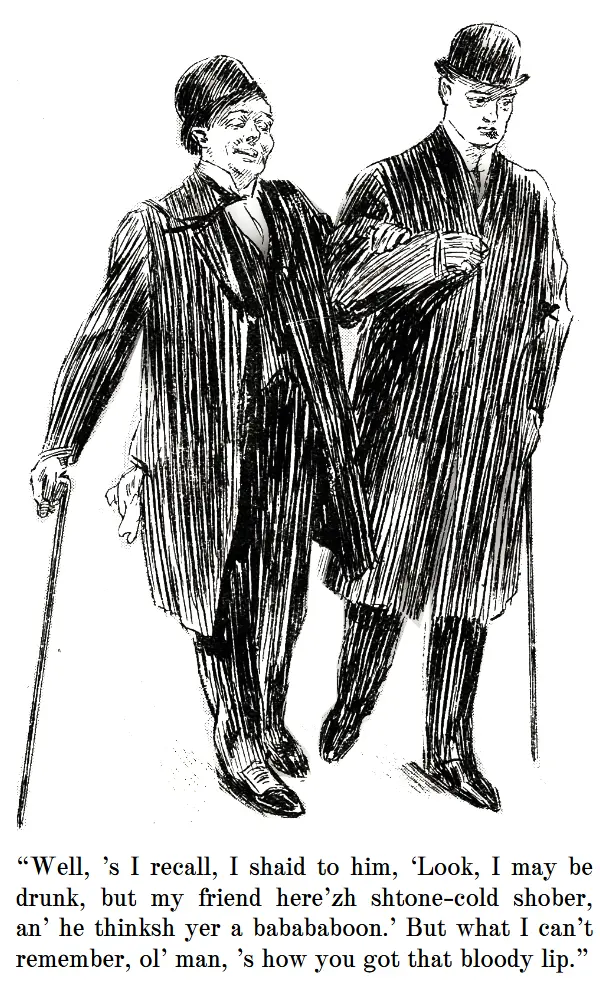
Sing
     Sang
          Song
               Sung.

Ding
     Dang
          Dong
               Dung.

Ring
     Rang
          Wrong
               Wrung.
According to Joycean scholars, this poem is based on the Irish myth of Siobhán Mac Tuilliseach, which no one had ever heard of before the discovery of the poem.
Cocoon (noun).—A raccoon’s assistant, generally charged with lifting the trash-can lids.
But like any enormous enterprise undertaken by volunteers on the Internet, it has its high points and low points. Dr. Boli often looks to see what old books have newly appeared in the collections (“old” defined as “before the 95-year copyright limit in the United States”), and he has lately noticed a trend that he had predicted, but did not expect to see in full flower quite so soon.
A veil has fallen over much of the past because its literature is written in letters we can no longer read. Or at least that was Dr. Boli’s first guess, but now he is not sure what is happening—except that whatever is happening seems to show a profound ignorance of the past.
For example, a volume of Thackeray’s works was recently added to the Internet Archive.

The uploader filed it as “the complete works of william makepeace charkeray by various.”

What Dr. Boli had thought was a particularly legible form of blackletter type is no longer legible to current readers. (The word “blackletter” itself is unknown to the Firefox spelling checker.) But even if the type is difficult, doesn’t everyone know that there is only one third name that follows the two names “William” and “Makepeace”? Apparently not. Furthermore, the title of the individual volume (The Adventures of Philip on His Way Through the World) is not catalogued at all, so you will never find it from the metadata. The uploader apparently does not understand how sets of books work.
An archive of documents from the Shakers includes several neatly handwritten iterations of the Holy Laws of…Lion.

Again, even if the cursive is illegible, which it seems to be to many people younger than forty or fifty, what place would have holy laws in the minds of a Christian sect? Anybody?
In spite of research that might suggest the contrary, it has become dogma on the Internet that sans-serif type is easier to read than serif type. Does this mean that we are actually losing the ability to interpret serif type? It looks that way:


“The Great Debate Between Robert Young Hayne of South Carolina and Daniel Website of Massachusetts.”
But what happens when we add the confounding factor of a foreign language—namely German written in Fraktur? We get a curious result:

This is filed as “Dr. Martin Futher’s Complete Works.” Note that whoever it was—librarian, volunteer, AI bot—who uploaded this book was able to read and translate the German for “complete works,” including the lower-case K in “Werke,” which does not look like a K at all to English-speakers. Yet somehow the name Martin Luther meant nothing to the person, or at least not enough to trigger a doubt about the interpretation of the author’s name. (Actually, the author here is listed as “Various.”)
And finally, what happens when the language is a dead language—meaning one that Google Translate refuses to deal with in any but the most rudimentary and dismissive manner?

This is filed as Unknown by Various. At least we didn’t identify the author as Tommy Tertius.
These are all good books, and thanks to the tireless volunteers at the Internet Archive they are available to anyone who needs them. Good luck finding them.
Hey Bob: My car has a fast-charging port, but my phone won’t charge from it, even though it charges normally from the charger at home. I’ve tried multiple cables, but no dice. However, my wife’s phone charges just fine from the same cable in the same port in the car that won’t charge my phone. What can I do? —Sincerely, Flummoxed in Finleyville.
Dear Flummoxed: You will never figure out what the problem is. You will ask AI bots, and they will tell you to check the cable. You will ask the phone’s manufacturer, and you will get an AI bot telling you to check the cable. When you tell the AI bot that you’ve used multiple cables, and anyway the cables all work with a different phone, you will be told that most cars don’t have the right voltage for charging phones, even though you already specifically said that your car has a fast-charging port labeled “