WHAT IS SLOP?

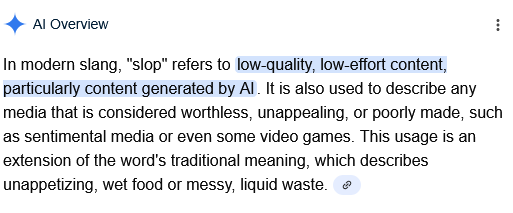
What is “slop” in modern American slang? AI can tell you.

In modern slang, "slop" refers to low-quality, low-effort content, particularly content generated by AI. It is also used to describe any media that is considered worthless, unappealing, or poorly made, such as sentimental media or even some video games. This usage is an extension of the word's traditional meaning, which describes unappetizing, wet food or messy, liquid waste.

Γνῶθι σεαυτόν, as the graffiti said on the Temple of Apollo at Delphi. This is, as the young people say, very meta.


The screenshot extract from Google results is quoted for the purpose of mockery, which is one of the purposes that qualify as “fair use” in American legal theory.

Comments

  1. Ima Hogg says:

    Hogs everywhere are eager to consume this “slop”.  After you’ve had your fill, pass the bucket along.  No bogarting the slops bucket.

  2. von Hindenburg says:

    I had a couple religious experiences today with AI.

    In one, Father Mike Schmitz (a prominent Catholic communicator) spoke about some of the AI scams that use his face and voice. Many of these are superficially convincing. They were a great teaching tool to show my child what to watch out for. (Though this information will be outdated in 6 months.)

    I also fell down a rabbit hole of figuring out how many Lutherans there are in the US. The AI answer on Google and Duck Duck Go is 5.3 million. This comes from Wikipedia’s article on “Lutheranism by Region” which, in a footnote, states (with grammatical errors) that that number only includes Lutherans within the Lutheran World Federation. And that the actual number (per Pew) is 6.8 million. This jives with the 6.7 million that you get by adding up the subtotals on the “List of Lutheran Denominations” article.

    Except that the only American Lutheran church in the LWF is the ELCA, which is the largest, but which represents only 1/3 to 1/2 of American Lutherans and hasn’t had 5.3 million members in years. Meaning that the footnote is entirely wrong. And all of these figures are meaningless because the self-reported figures for the ELCA and the LCMS (the second largest Lutheran church in America) are lower than those on Wikipedia by hundreds of thousands.

    Whew….

    Point being: AI, even well-trained AI is still often confidently wrong and will remain so, so long as the information that it has quickly at hand is incomplete or incorrect. It misses nuance and depth of research in the same way that I do when I want to look smart and so provide a quick answer in a chat by giving the first figure I come across. If the people paying for work or information care about or are required to care about its accuracy, they can’t get rid of experienced humans quite yet. If you make cheap advertising, yeah… That’s going to be rough. There’s also danger for entry level folks in various professions who did scut work research for their seniors who knew what questions to ask and what assumptions to challenge of either an AI or a recent college grad. But if you are really an SME, well, I guess you’ve got a few years.

    .

    .

    .

    (So long as the customer or management prefers an informed conclusion that costs more and takes longer over an immediate answer that looks OK at first glance.)

Leave a Reply to von Hindenburg Cancel reply

Your email address will not be published. Required fields are marked *