And What We Can Do About It.
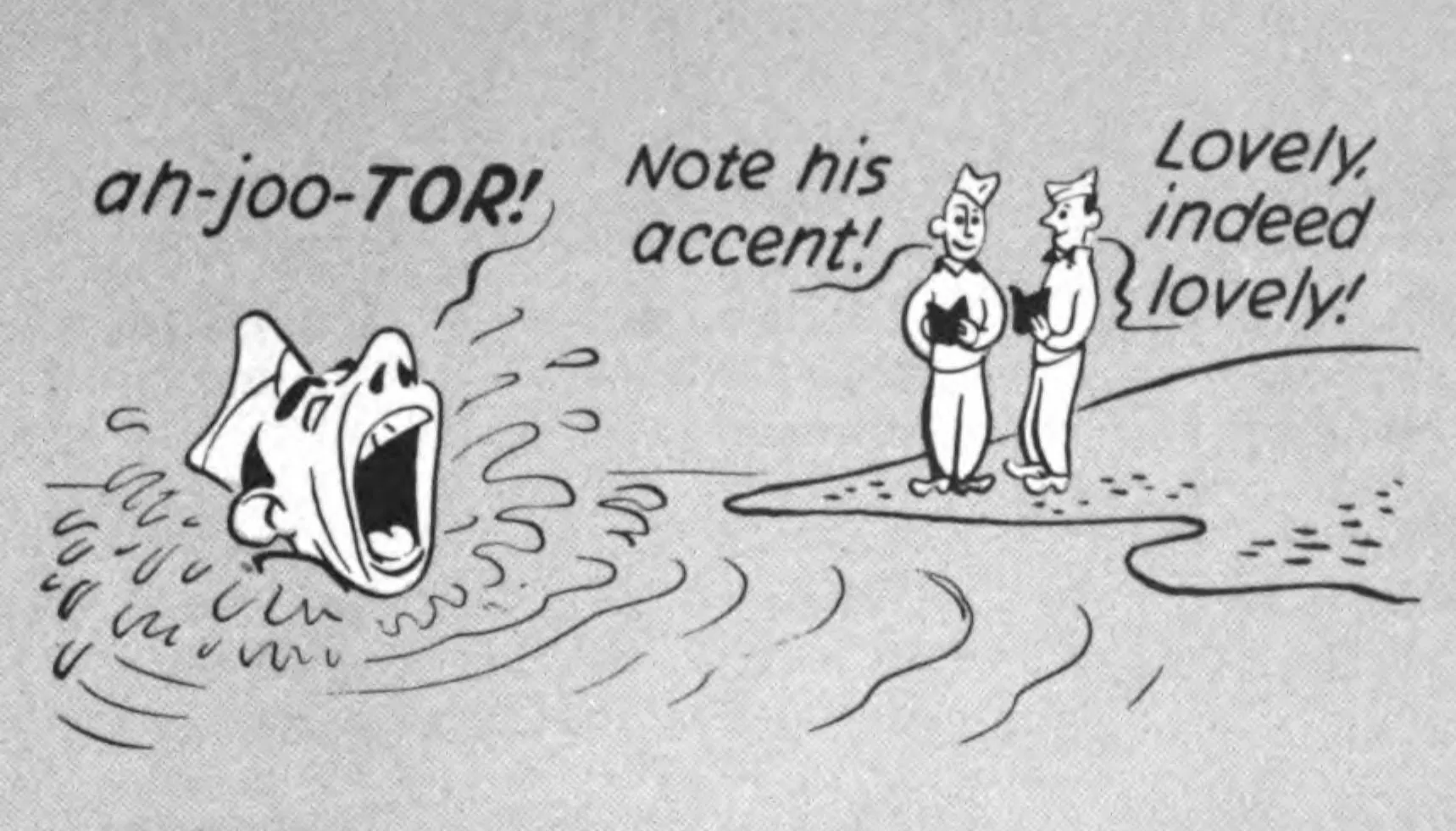
An American soldier making himself understood in Romanian.
Cynics will tell you that it is because Americans are lazy ignorant xenophobes. And the cynics are mostly right, if only because most human beings are lazy ignorant xenophobes, and Americans are no better than anybody else.
But many lazy ignorant xenophobes in other countries are bilingual or trilingual. Some of the most profoundly stupid people Dr. Boli has ever known have been fluently stupid in two or three languages.
So why not Americans?
There are practical reasons. We live in the midst of an ocean of English, and few Americans need to understand any other language to get on with their everyday lives. It is true that they may have thousands of neighbors who speak Spanish or Korean or Uzbek; but average English-speaking Americans deal with those neighbors by ignoring them most of the time, and by shouting at them when they cannot be ignored, on the well-known principle that shouting makes even foreigners understand plain English.
But Dr. Boli proposes another reason as well, which is that our methods of teaching languages make learning them impossible for all but the most motivated students. The pedants have taken over language instruction, as they have everything else, and they place prickly severe-tire-damage roadblocks right at the beginning of the course to discourage us from learning anything.
The very first thing you have to learn in a language is the set of basic sounds that language uses. Native speakers of a different language will probably use sounds you cannot imitate. The pedants will insist at the beginning of the course that you must spend a week trying (and failing) to get those sounds right. After that week you are thoroughly discouraged; you say “This is hard” and abandon the class and sign up for Macrame 101 instead.
Consider the French nasal vowels. You want to ask where the restaurant is in French: “Où est le restaurant?” It’s as simple a question as you could ask, but that word “restaurant” ends in a sound that American mouths cannot form—partly because it involves not just the mouth but the nose as well. You are stuck at the beginning of your Intro to French course, and you feel like a fool.
But now think back to your acquaintances who are fluent in multiple languages. Dr. Boli has had good friends from Spain, Hungary, China, Germany, Ethiopia, and many other places who all spoke English fluently: they could express any idea easily, with grammatical precision and expressive elegance that would shame most American native speakers of English.
But they spoke with an accent. You could tell the German was German; his vowels and consonants came out as approximations of English sounds adapted to the way a native German could easily form them. And that was fine. No one had any trouble understanding him. We noticed his accent at first, but we forgot it a few minutes into a conversation with him. The same is true of all the others: they made themselves understood perfectly in English, perhaps even better than many native Americans.
Successfully bilingual people are usually people who have got over their fear of having a funny accent.
So we go back to our American introduced to French for the first time. He wants to ask where the restaurant is. We can give him diagrams of mouth positions; we can show a cutaway view of the human head with arrows indicating the direction of air flow. He will be confronted with a pneumatico-anatomical treatise that will make him despair.
Or we can just tell him to say this:
“oo AY luh RESS-to-RAHNG?”
Yes, he will have an American accent in French. But any French speaker will understand that question and be able to point to Chez Micheline on the corner.
In the Second World War, American soldiers descended on Europe and Asia by the shipload, and they had to learn in a hurry how to make themselves understood. This was an urgent necessity, and fortunately the War Department had the best technical writers ever gathered together in one enterprise. They put together quick guides for the soldiers that would let them make themselves understood, funny American accent and all. KAWM-pruh-nay VOO?
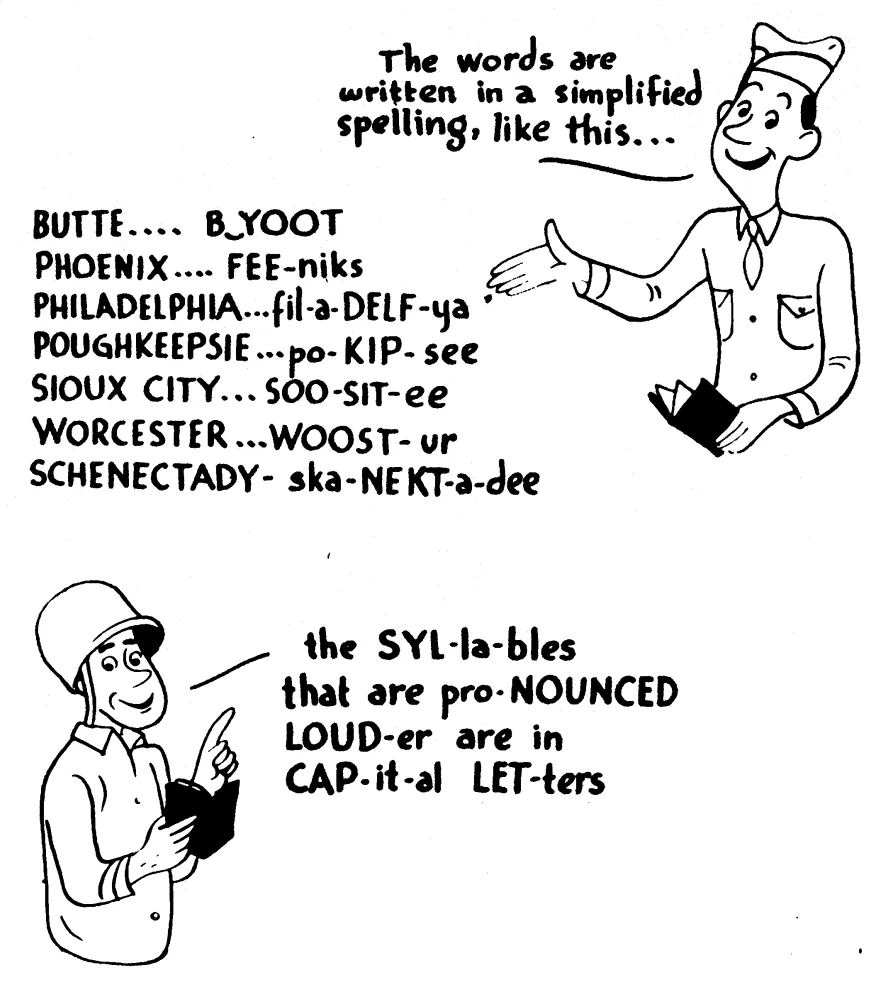
These are probably the best introductions to foreign languages ever written for American English-speakers, because they assume that the goal is not native pronunciation but communication. The pronunciations shown in the guides are not perfect: they are simply good enough.
You will find all the words and phrases written both in French spelling and in a simplified spelling which you read like English. Don’t use the French spelling, the one given in parentheses, unless you have studied French before. Read the simplified spelling as though it were English. When you see the French word for “where” spelled oo, give the oo the sound it has in the English words too, boot, etc. and not the sound it has in German or any other language you may happen to know.
These manuals were meant to accompany a set of records, and if you were the lucky kind of soldier who could sit down with a phonograph and listen to the recordings, you might hear the actual native pronunciation of the language. But the compilers of the manuals knew that many soldiers would not be so lucky, so the printed pronunciations would have to do the job well enough.
Longtime readers may already have guessed this: Dr. Boli has rounded up most of these War Department language manuals and created a new page in the Eclectic Library:
War Department Language Guides.