Racism and racial identity seem to be today’s most fruitful source of anxiety among people who wish to be known as enlightened. The subject is a minefield of contradictions: scientists will tell you that race is impossible to defend as a scientific concept, and so the enlightened writer or speaker must endorse and amplify that conclusion; yet the enlightenment also requires us to affirm that racial distinctions are vitally important to our identity, which is a term so indefinable in modern discourse that Dr. Boli has taken the trouble to prohibit it.
Dr. Boli does not find it necessary to repeat the shibboleths, because he has discovered, over the course of a long life and much experience, that there are no Gileadites waiting to kill him if he says the wrong thing.
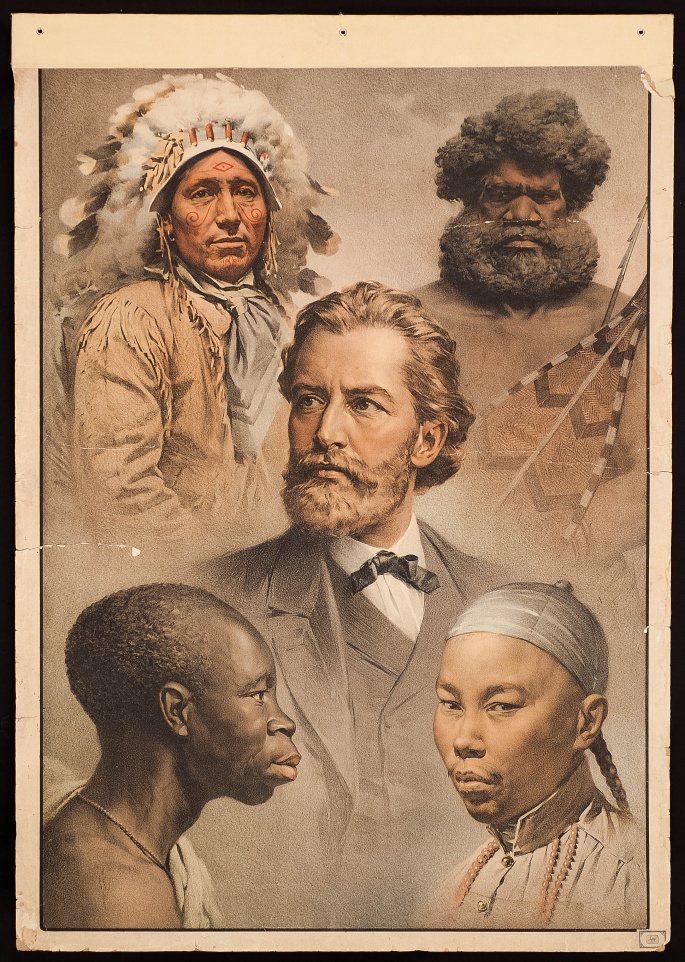
All of which brings us to the picture at the head of the article. It is an illustration of Die fünf Menschenrassen (The Five Races of Man) by G. Ellka from a book of the early twentieth century. Dr. Boli has no idea what the book says; he assumes it is full of the sort of nonsense that inevitably came out when people of the era discussed race, which was different from the sort of nonsense that inevitably comes out when people of our era discuss race. The idea that there were five races—Caucasoid, American Indian, Negroid, Mongoloid, and Australoid—was one of the standard scientific dogmas of the time. It is nonsense in our age of gene sequencing, but at least it was an attempt at science, and the idea itself—as opposed to much of the rubbish built around the idea—was not inherently cruel or destructive.
Nevertheless, the mere existence of evidence of an outdated race theory triggers the shibboleth instinct in some people, and on the discussion page for this picture at Wikimedia Commons, someone felt compelled to speak out. Under the heading “This picture is very racist,” the commenter wrote,

This picture is White Supremacy at its best. Every race has good-looking people, but in this picture, the Asian guy, the African guy, and the Aboriginal Australian guy all look very ugly, the American Indian guy looks ordinary, not handsome but not too ugly, only the European guy in the centre looks handsome, gental, and very elegant.
And now Dr. Boli will apply some critical race theory to that comment, because the comment represents White Supremacy at its best. The commenter’s identity is only a number, but nevertheless Dr. Boli is confident that the person is of White European ancestry.
Of course the European illustrator’s unconscious assumptions must have been embodied in the illustration. But it seems clear that an honest attempt was made, not to draw caricatures of imaginary stereotypes, but to depict real models, probably from photographs. Yet the 21st-century commenter finds that “only the European guy in the centre looks handsome, gental, and very elegant.”
Does anyone besides Dr. Boli think the comment tells us far more about the commenter than about the artist who drew the illustration?
To Dr. Boli’s eyes, these are all fine faces. If he had to pick one as the most elegant, handsome, and gentle, it would be the American Indian. But the Australian looks deeply thoughtful; the African looks like someone we would instantly trust; the Chinese man has a faraway pensive look that suggests an active imagination. Only the European, to Dr. Boli’s eye, is dull; one suspects that his was the only portrait drawn from the imagination rather than a photograph.
Yet the stereotypical European ideals of good looks are so deeply embedded in the commenter’s mind that he takes them for universal aesthetic principles. It does not even occur to him that the Australian might be looking at the European in the center of the picture and thinking, “What a pasty-faced rube.”
We do not mean to shame a commenter whose heart is undoubtedly in the right place. Stupid race theories have done more damage to humanity than any other mistake of science. But we would encourage the commenter to think deeply about what racism is. The real damage is seldom done by overt racists these days. It is done by our hidden prejudices and assumptions, so deeply hidden that we mistake them for virtues. The commenter would doubtless have been pleased if the illustration had shown all the different races of man as more or less Northern European, but with different skin colors. But God’s taste is superior to his, and so humankind has been created in such a range of different forms and colors that we can never tire of the variety.
Now, you may be wondering what caused Dr. Boli to be thinking about the “five races of man” in the first place. The answer is in a school built in the 1930s, still standing and in use on Lemington Avenue in Pittsburgh, where a colorful terra-cotta frieze of the “five races of man” decorates the cornice—a daring assertion, considering the era, that this school was for everybody. Our friend Father Pitt pointed it out and provided these pictures. You will note that all but one of the five races is shown as dignified and respectable. The African:

The American Indian:

The Asian:

The Australian:

These four all keep their innate dignity, in an illustrated-Sunday-supplement sort of way. But when we come to Caucasoid Man…

…he looks as though someone just stuck a pin in him.