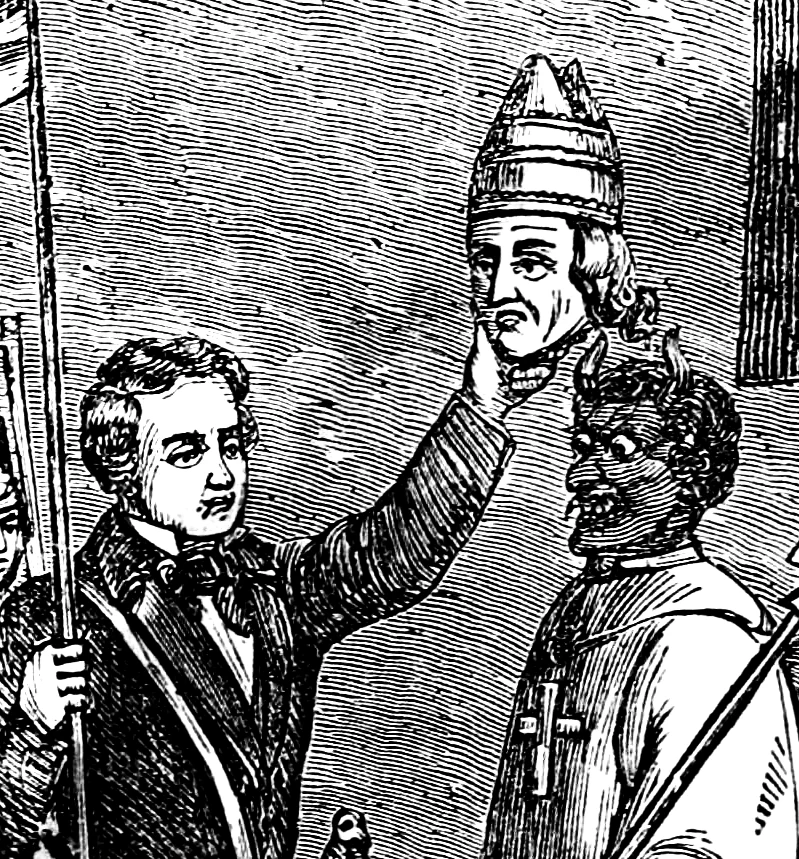
The general premise of the Protestant anti-Catholic writers has always been that the falsehood of popery is obvious, and we need only hold it up to the light of day to convince people that it is obvious. That the Catholic Church might have reasons for its beliefs other than greed and outright satanism does not usually enter into our writers’ calculations. “Many are the errors and evils of Popery,” says the author of A Thunderbolt for Rome, “but the cause of them all is one only, namely, the withholding the sacred Scriptures from the people. The evils and sad effects of Popery are many, but the remedy and cure for them all is one only, namely, the free circulation and perusal of the Bible. The people need not to be admonished against the evils and idolatries of Popery; as soon as they read God’s holy Word for themselves, they will abandon it of their own accord.”
It is quite true that, in the past, the Catholic Church has occasionally been parsimonious with the Scriptures, keeping them out of the hands of ordinary people as long as it was possible to do so. The reason for the parsimoniousness was a belief that ordinary people are stupid, and left to read Scripture on their own will come to all sorts of daft conclusions. On the one hand, this belief is insulting and illiberal. On the other hand, it is objectively correct. We may console the Romanists for the current accessibility of the Bible in such a bewildering array of translations by observing that probably as many Catholic converts have gone over to the Popish side because of what they read in the Bible as Protestant converts in the other direction. Once you open the floodgates of Scripture, you must accept the consequences, and it is probably just as likely that a Protestant will become Catholic through excessive exposure to the sacred writers as that a Catholic will become Protestant.
None of our anti-Catholic propagandists would admit that, of course, and we can assume that they were sincere in their beliefs. They do not strike us as a bright lot. But our readers may judge the sincerity of these authors for themselves, because—as the regulars have already deduced—we have added a page of Anti-Catholic Propaganda to the Eclectic Library.
In choosing works for this collection, we were guided by the principle that they must be unintentionally amusing. There are plenty of dull works of theological argument that we could have added, but skipped because they did not amuse us. There are also plenty of works in which the anti-Catholic propaganda consists entirely of long quotations from Catholic liturgy, on the grounds, it seems, that simply exposing the Catholic liturgical books to the light and air would cause them to turn to dust. We have skipped those as well. We preferred to include only works that are breathtaking in their self-confidence, because pride goeth before a fall into a cake, as Mack Sennett could have told us. Thus the author who promises us that “This work contains, it is hoped, a complete refutation of Popery in a short space” is assured of a place in our collection.
At some future time it may amuse us just as much to collect a page of works of Catholic anti-Protestant propaganda. But it will be hard for the Catholics to stand up to the amusement value of the nineteenth-century Protestant writers we list here: