It has become the norm in museums to post explanatory plaques beside works of art, the plaques not only explaining who the artist was and where the work fits among the various artistic trends and fads, but also telling us what we are supposed to think of the art.
While wandering through the splendid “French Moderns” show at the Frick Art Museum in Pittsburgh the other day, Dr. Boli noticed a particular tendency among the plaques for the various works. The exhibition gathered a number of the Impressionists, the “Fauves,” and a few later modernists, but it also included half a dozen Academic artists as well to show us what the modernists were rebelling against. How, after all, can you understand Renoir without knowing about Bouguereau?
What Dr. Boli noticed was that the plaques for the Academics were likely to explain why the art was evil, whereas the rest—all the works that are usually lumped as “Moderns,” from the Impressionists on—would just explain who the artist was and what the artist was trying to do. The explanations might not be very good, but they were at least about the art.
Once he noticed this tendency, Dr. Boli realized that he had seen it on every recent trip to an art museum. Art from before the Impressionists is likely to come with an explanation of why it is morally wrong, but an artist with “Modernist” credentials seems to be exempt from moral examination.
Thus we can make a trip to the museum into a sort of guessing game, or perhaps an exercise in creative imagination. For every realistic or pre-modern work of art, we try to imagine what a museum curator would think was morally unacceptable about it.
Here are a few examples to get us started.

The Carpet Merchant of Cairo, by Jean-Léon Gérôme. What’s wrong with this picture?
“Although his detailed rendering of two carpets lends this painting a documentary appearance, Gérôme’s stereotypical portrayal of an Egyptian vendor and brightly costumed passerby reveals his desire to appeal to European fantasies of the Arab-Islamic world. In France, such imagined scenes were interpreted as faithful records of an unchanging ‘Orient,’ helping to justify and obscure the harrowing transformations enacted by European imperialism within North Africa and the Middle East.” Now, it is also possible that Gérôme painted a Cairo street scene this way because Cairo streets looked like this. He had been to Cairo and toured Egypt and loved every minute of it. But we know he was a bad man, because he painted in a pre-modern style, so he must have been conniving with perpetrators of atrocities to hide the evidence of their crimes, which as everyone knows is most effectively done by pictures of men selling carpets.
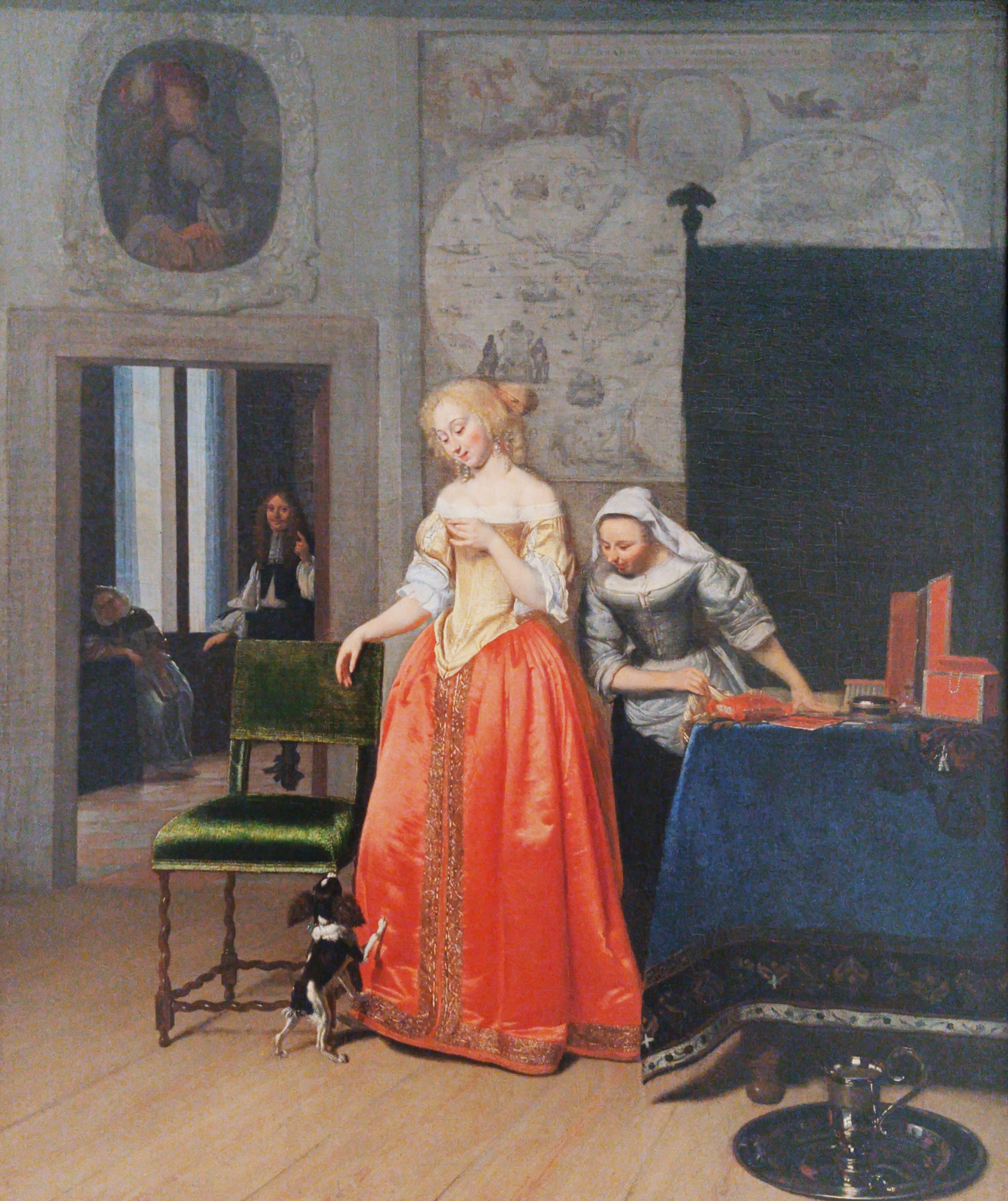
Lady with Servant and Dog, by Jacob Ochtervelt (c. 1671–1673). Here is a charming little domestic scene showing everyday life in a Dutch household. But we know it must have sinister implications, because it was painted before anyone had even heard of Impressionism. What’s wrong with this picture?
The “boastful world map” in the background reminds us that horrible colonialists were perpetrating colonial horrors. It’s true that the canvas is small, so there are no clear details on the world map, but to possess a world map is crime enough in a seventeenth-century Dutch family.

Here is part of the long series of murals in the Grand Staircase of the Carnegie Institute, showing crowds marching toward enlightenment, which they will never reach because John White Alexander, the artist, died before he could paint the symbolic figures of the Noble Quartet (Art, Science, Music, Literature). What’s wrong with this picture?
According to a plaque on the wall, the crowd does not accurately represent the racial or economic makeup of Pittsburgh.

Pourquoi naître esclave ? (“Why Born a Slave?”) by Jean-Baptiste Carpeaux (1868–1870).
Here is a bronze bust made as a deliberate rebuke of the enslavement of Africans. Surely, even in our age, when art is judged only by the quality of its political expression, this work must be above reproach. But no: it was sculpted in a pre-Impressionist style, and therefore it is morally compromised. What’s wrong with this picture?
“Created twenty years after the abolition of slavery in the French colonies (1848), the bust was meant to appeal to the antislavery views of a progressive white audience. Despite its seemingly sensitive portrayal of an individual, the bust nonetheless reinforces the objectification of the Black female body as an exoticized other…”
See? You can do it.
Now it’s your turn:

Innocence, by William-Adolphe Bouguereau.
You can answer in the comments: What’s wrong with this picture?