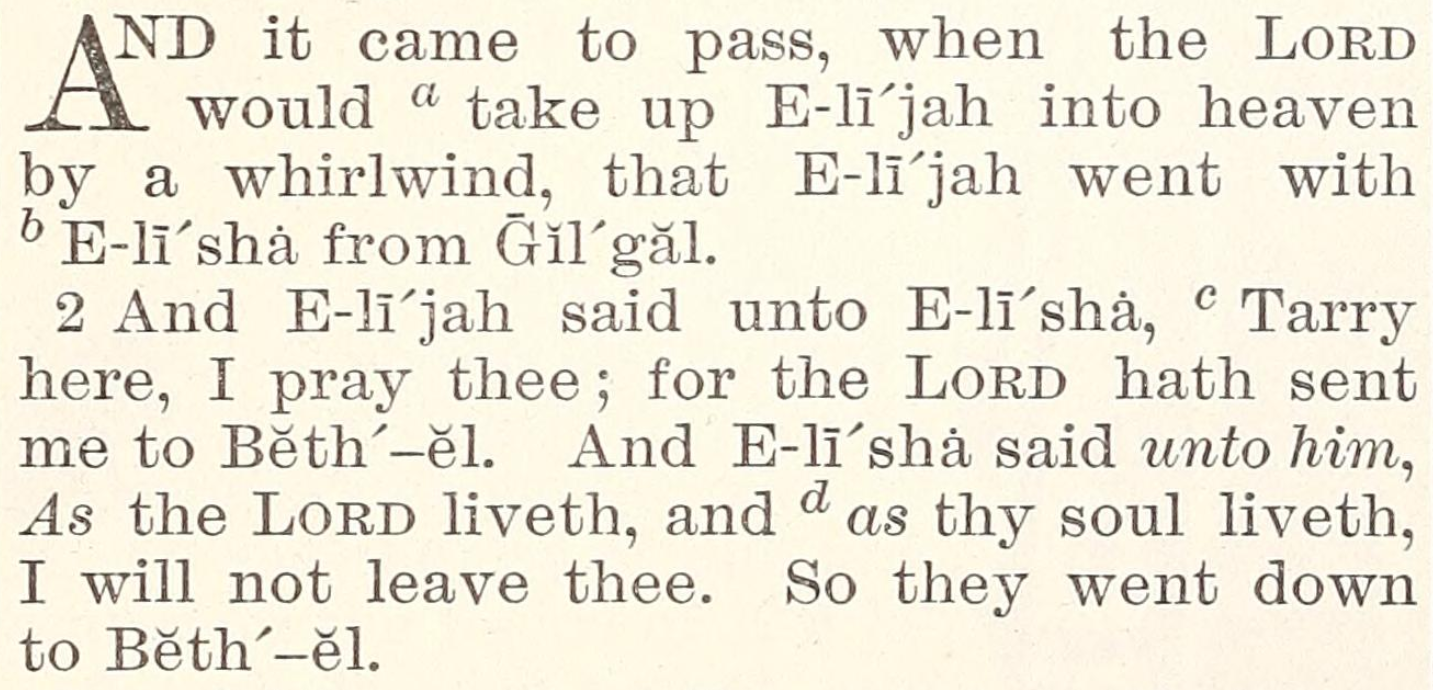
Dr. Boli hesitated for several days to answer this comment, because he was not sure whether he had interpreted his correspondent correctly, and he did not want seem critical of a correspondent whose participation over many years has added immeasurably to the pleasure Dr. Boli takes in producing this Magazine. We decided to write this long answer as an article partly because it seems to illustrate an interesting phenomenon, partly because it gives us an opportunity to explain how you, too, can have an impressive parlor trick for very little effort, and partly because we had nothing else prepared for today.
We hope Herr von Hindenberg will forgive us if we have misinterpreted his figured pronunciation, but it looks to Dr. Boli as though what he has identified as a “morph” is the correct English pronunciation: long I, accent on the second syllable.
We should say the correct English Protestant pronunciation. Until the late twentieth century, Catholics had a different set of Scriptural names, using the Latin spellings of the Vulgate, so that Elisha’s name was Eliseus (el-i-SEE-us). In the King James Version of the Bible, Protestants had to deal with these spellings when the names came up in the New Testament and the Apocrypha, so that it was necessary to explain to schoolchildren that Jesus meant Elisha when he said, “And many lepers were in Israel in the time of Eliseus the prophet; and none of them was cleansed, saving Naaman the Syrian” (Luke 4:27). Later Protestant versions regularized the names, using the Old Testament spellings in the New Testament as well.
With the New American Bible, American Catholics adopted the Protestant forms of the names, but it seems to Dr. Boli that they have been a little tentative about their pronunciations ever since. In particular, he has heard many Catholics say “e-LISH-uh” for Elisha, and sometimes even “e-LEESH-uh.” But so far he has not seen any printed reference that gives anything other than the standard English pronunciation.
The rules for the English pronunciation of Scripture names, in the spellings that Protestants and Catholics now agree on, are simple, and they are only three in number:
1. Forget any smattering of learning you might have come across about Hebrew or Greek. We are speaking English, and the names have English pronunciations.
2. Every syllable is pronounced; there is no silent E.
3. Look in a pronouncing Bible (or a Bible dictionary) to find the accent for any name you come across.
That last one feels like cheating, but it is the easiest way to deal with the problem.
Some editions of the Bible go all out on pronunciation helps, marking all the syllable divisions and the length of every vowel, so that “Elisha” might come out “E•lī′shȧ” (the dot over the A meaning that it is pronounced with the indistinct “uh” sound linguists call the schwa). That is distracting for ordinary reading, so most Bibles that give any indication of pronunciation simply mark the accents: “Eli′sha.” But even these use a very simple code to tell you the length of the vowel in the accented syllable. If the accent mark comes directly after the vowel, the vowel is long. If the accent mark comes after an intervening consonant, the vowel in that syllable is short. Thus Eli′sha (ee-LIGH-shuh, with the I long), but Elish′ama (e-LISH-uh-muh, with the I short). You will notice that the unaccented syllables are not determined by this method, but that scarcely makes any difference. No one will notice whether you say “ee-LIGH-shah” or “uh-LIGH-shuh”; it is the accented syllable that matters.
Once again, we hope our correspondent will forgive us if we have misinterpreted him; and if we have not misinterpreted him, we hope he will not think we have meant any unkindness. He gave us a free subject for an article, and subjects for articles are valuable commodities.