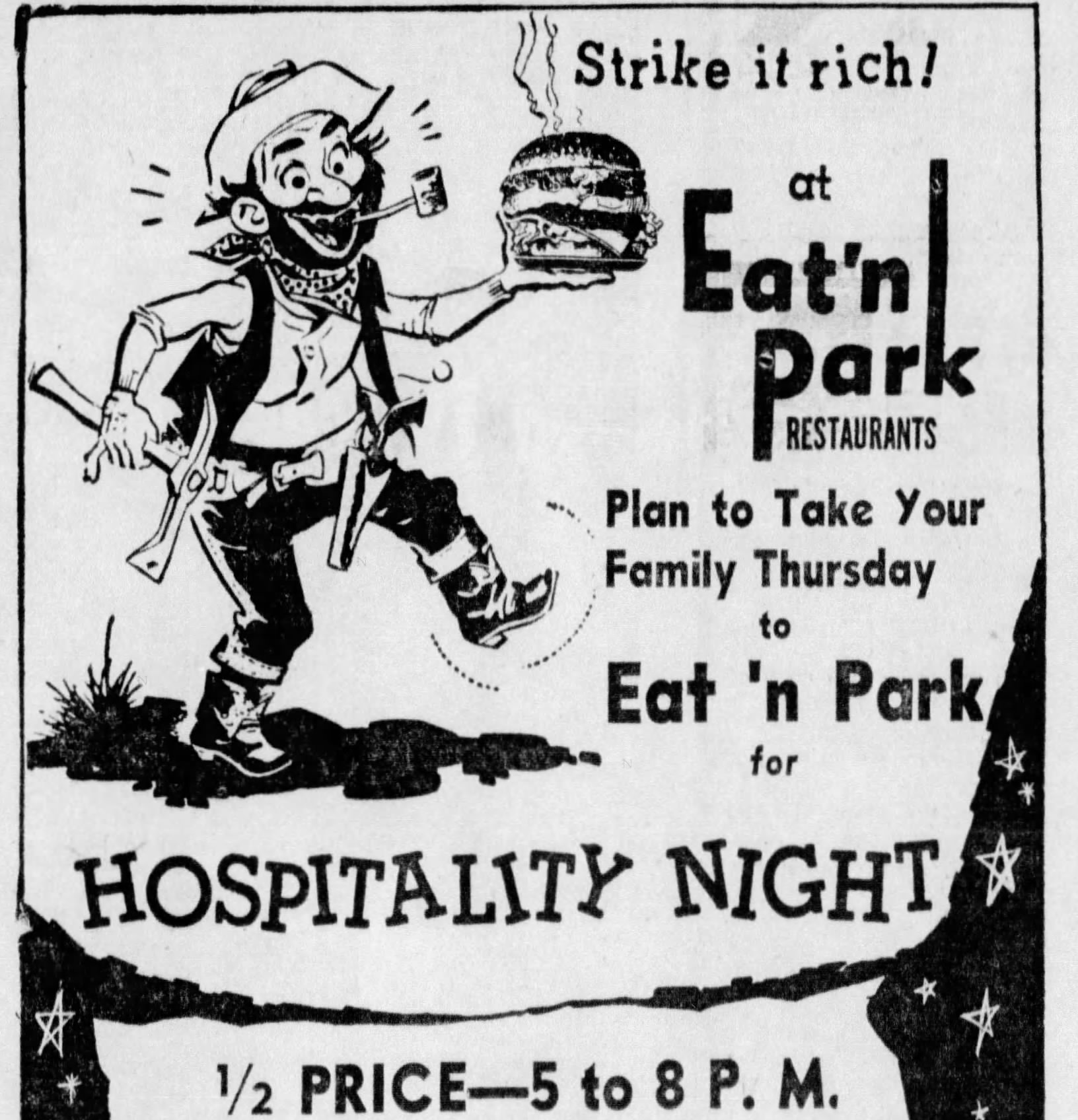
From a 1961 ad: behold the immensity of the Big Boy, which by today’s standards is a little bitty hamburger.
But why are Americans more obese now than they were half a century ago?
It’s a difficult question, the experts say—so difficult that you will need platoons of experts to answer it. They propose many hypotheses. Perhaps it is because of artificial preservatives or chemical additives. Or perhaps it is because we eat prepared meals instead of cooking at home. Or perhaps it is something in the kind of oil our food is cooked in—perhaps we ought to cook everything in olive oil, or in lard.
Where there are many hypotheses, it indicates that no one of them is satisfactory. They have all failed the test: they have not produced a theory, which is to say an explanation that makes testable predictions that come true.
Dr. Boli will now offer a hypothesis of his own, and any graduate students in public health may test its predictions. Dr. Boli’s hypothesis is that Americans are getting fatter because they are eating more food.
His evidence for that assertion is a series of observations made over a more than usually long life. But fortunately some of the evidence is available to anyone who cares to do a bit of archaeology. You need only pick up your pick and go digging in the menus of chain restaurants.
If you are in the Pittsburgh orbit, for example, you are familiar with Eat’n Park, a chain of “family restaurants” that began as a drive-in burger joint. Down at the bottom of the list of hamburgers is the littlest of them all, the Superburger.
If it’s so little, why is it called “Super”?
Well, because, when it was introduced, it was immense. It was a feast for a glutton. It had twice the meat of a normal cheeseburger. (In fact, it was originally a Big Boy, but it had to be renamed when Eat’n Park lost the Big Boy franchise.)
So why did the Superburger shrink?
It didn’t. It’s still the same size. But bigger, more glutton-friendly hamburgers grew up around it, until it looked like a miniature model of a hamburger by comparison.
You can see the same phenomenon wherever these little bits of history are preserved in chain-restaurant menus. The biggest thing on the menu fifty years ago is the smallest thing on the menu today. This pattern reflects, and perhaps caused, a change in Americans’ expectations. We demand more food in a meal today. We eat snacks with the same number of calories that made up dinner in the middle of the twentieth century.
This is Dr. Boli’s hypothesis: that more Americans are obese because we have developed a cultural expectation of eating more food.
To make the hypothesis into a scientific theory, its predictions must be tested.
Some nutrition advocates have tried to match the rise in obesity to the rise of fast-food chains like McDonald’s. But they usually fail. The curves don’t track: there is a significant period after fast food became a huge business when Americans still weren’t getting fatter.
Dr. Boli predicts, however, that the rise in obesity will closely follow the rise of bigger and bigger cheeseburgers that dwarf the former giants like the Superburger, the Big Mac, and the Big Boy. In other words, he predicts that statistical-historical analysis will show a close relationship between getting fatter and eating more food.
Graduate students, you have your assignment.