Posts by Dr. Boli
WRITING A FARCE? HERE ARE SOME NAMES FOR YOUR VILLAIN.
Thorsten E. Billquist
Chauncey W. Hodgdon
Theophilus P. Chandler, Jr.
Sidney Winfield Foulck
Adolphus Druiding
Ulysses J. L. Peoples
Maximilian Nirdlinger
Robert Swain Peabody
Ellsworth Dean
Titus de Bobula
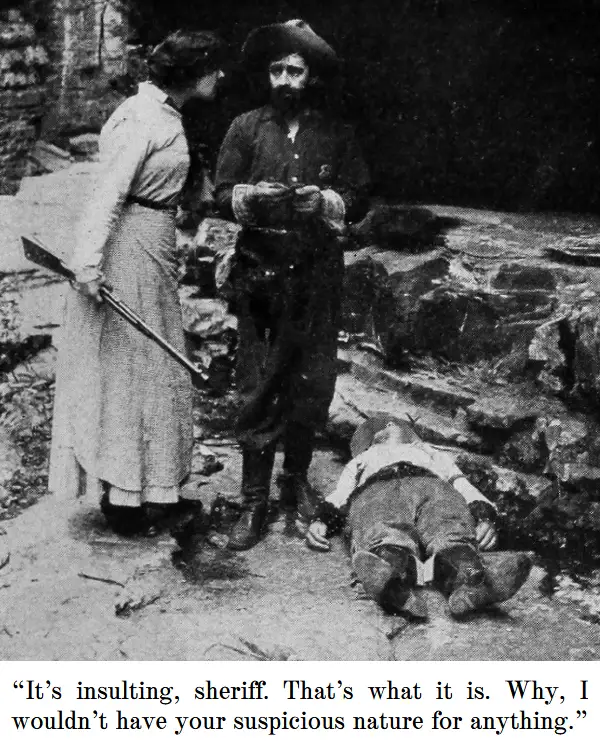
Dr. Boli wishes he had made every one of those names up, but they are all ready to hand in the Great Big List. If you run across someone with a name like Thorsten E. Billquist (the E is for Elnar, by the way), then really the only merciful thing to do is to turn the Marx Brothers loose on him to knock the starch out of his collar. He will thank you for it eventually.
FROM THE ILLUSTRATED EDITION.
LETTER TO THE EDITOR.
Sir: When are we going to rein in these artists? They have lost all sense of discipline. Art is completely out of control these days. I was just in an art gallery looking for some free wine and cheese, and I happened to glance at some of the paintings on the wall. Do you know what I saw? Pictures! They were pictures of recognizable people and objects rendered in colored paints! I saw a portrait of a woman in a business suit, and a picture of a bowl of fruit, and some sort of seascape with waves crashing on rocks.
What makes these artists think they can get away with this stuff? Images like those are what cameras are for! Art is not supposed to have recognizable things in it. It is supposed to be splotches of paint in random patterns, or straight lines, or—better yet—a blank canvas with an explanatory plaque. These things are art because no one enjoys them, and the purpose of art is to create a visual expression of the unenjoyable. Art is supposed to be a purgative experience, a mortification of the aesthetic sense that leaves us feeling hopeless and empty, so that we will be easier to control. But these—well, I can only call them pictures, not paintings, and they are not mortifications at all. Some of them were quite pleasant to look at. Art that is pleasant is art that is not doing its job.
It is clear that artists are not capable of regulating their own behavior, so it is time for the government to step in. We have agencies and bureaus. We have a whole National Endowment for the Arts. What are these government agencies for if not to tell artists what to do with their brushes? We have standards for food additives, standards for education, standards for packaging. It is time we had strong and enforceable standards for art. What do we pay taxes for, anyway? We have a right to expect art that is depressing, confusing, boring, and above all non-representational.
Therefore I am calling on our elected representatives to shove all other business to the side until this pressing emergency is addressed. This is a bipartisan issue if ever there was one. Every citizen, of whatever ethnicity, gender, religion, or party, has the right to aesthetic mortification. It will not be an easy struggle. Bureaus and agencies will have to be created. Inspectors will have to be hired and trained. Government agents will have to be armed and transported to offending galleries. But it will be a struggle that will unite America.
—Sincerely, Hickory K. Crosshatch, Concerned Citizen.
HANDY GUIDE TO GREEK PHILOSOPHY.
Heraclitus. Everything changes and nothing stays the same.
Parmenides. Nothing changes and everything stays the same.
Empedocles. The merchandise changes, but the prices at the Drachma Tree store do not change.
Democritus. The price at the Drachma Tree store goes up to a drachma and a quarter, but the merchandise is always the same cheap rubbish.
Plato. Prices individually are subject to change without notice, but the reality of Price is eternal and unchanging.
Aristotle. Heraclitus says that everything changes and nothing stays the same. Parmenides says that nothing changes and everything stays the same. Empedocles says that the merchandise changes, but the prices at the Drachma Tree store do not change. Democritus says that the price at the Drachma Tree store goes up to a drachma and a quarter, but the merchandise is always the same cheap rubbish. Plato says that prices individually are subject to change without notice, but the reality of Price is eternal and unchanging. But these arguments are easily refuted, and the truth is somewhere in the middle.
ON THIS DAY IN HISTORY.

FROM THE ILLUSTRATED EDITION.

A LITTLE MORE ON ARTIFICIAL INTELLIGENCE AND ART.
The whole essay is worth reading, and though Dr. Boli quotes only a few lines here, he earnestly recommends the full original.
The essay was provoked because Dr. Boli did not express himself clearly on the subject of artificial intelligence in entertainment. The Baron believes that artificial intelligence will soon be able to mimic the style of the best singers, Edith Piaf included.
I think humans have a bad tendency to assume that there must remain some area of human expertise that will remain free of the unceasing encroachment of machine intelligence. This frequently express itself in the belief there is something unique about artistic expression that will remain forever out of the reach of the allegedly strictly-logical machines.
But in fact, as the Baron points out, artistic expression is just where artificial intelligence excels. It is useless for the things we might reasonably have wanted to use it for. Our friend Father Pitt provides us with a perfect example: he asked Bing to get him a searchable map of property owners in Pittsburgh in 1910, and Bing very politely told him, “Do it yourself.” Bing did mention that there was a site that had scanned copies of plat maps from that time, and suggested that Father Pitt could “search manually.” Yes, but do you know what would be really good at sifting through a mountain of written information to find one relevant detail? A computer!
Ask the bots to be creative, though, and they will come through with the goods. This is perhaps because there are no absolute standards for creativity, so we cannot tell them with complete assurance that they have done it wrong.
As the robot brains absorb more and more of our culture, they will be able to imitate anything humans can do. More than that, they will be able to create new works of art beyond what we could have imagined. As the Baron says,
The answer to the question “Can a robot sing as well as Edith Piaf?” is “Not yet, but they can already mimic the style and they almost certainly will be able to, given a few updates.” (Whether humans choose to make them sing like Edith Piaf is another matter.)
But in that last parenthetical remark lies the very problem Dr. Boli had identified, though he did not express himself clearly enough. When we hear the Auto-Tune-addled pop music of today, we must remember that we have a choice. It is not the computers who decided to make the music sound that way. We were the ones who decided to feed all our singers through a black box that makes them sound like robots. We wanted it that way.
Dr. Boli still believes that entertainment by artificial intelligence will be blandly perfect and vapidly predictable. But he does not believe that because he thinks AI will be incapable of doing better. On the contrary, he takes it for granted that the artificial brains will work better than ours in every way. No, Dr. Boli believes that AI will produce insipid entertainment for us because we will train it to do so. We will tell it that vapidity is what we want, and it will shovel out the vapidity by the carload. There will be no human artist—like the Muzak arrangers, for example—to say, “Well, they may want vapidity, but I still have to have some fun.” No, we will get exactly what we want, and nothing more. We will get the most perfectly vapid entertainment the superior robot minds can devise for us, and it will be all our fault.
WHAT WILL ENTERTAINMENT BY ARTIFICIAL INTELLIGENCE BE LIKE? WE ALREADY KNOW THE ANSWER.
Of course, the creative types are absolutely right. The big entertainment conglomerates are certainly looking at artificial intelligence and thinking how much money it could save them on writers, musicians, actors, and so forth. If we can just tell the bot to make a movie, what do we need with creatives?
That, at least is what the short-term thinkers in the entertainment business are thinking. If there are any long-term thinkers among the executives, which is unlikely, they are also considering which second career in manual labor they would like to adopt. If the ordinary viewer at home can just tell the AI bot, “Entertain me,” then what do we need with big entertainment conglomerates?
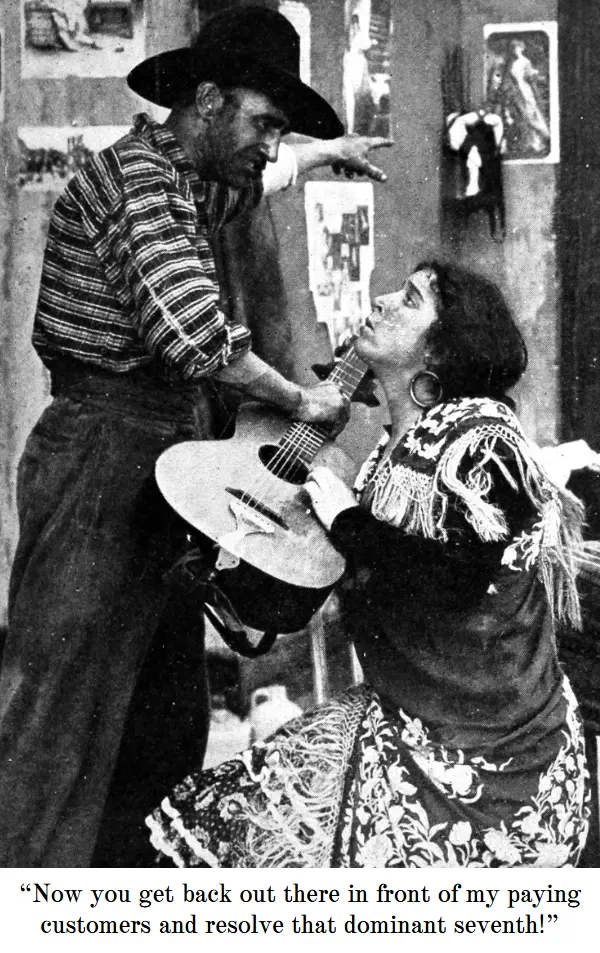
But what will entertainment by artificial intelligence be like? Dr. Boli was listening to some old French records the other day, and it suddenly occurred to him that we already know what AI entertainment will be like, because there is one branch of the entertainment business in which the robots have already taken over. Every popular singer is brought to us through pitch-correction software that adjusts the voice to what the robot thinks we want to hear, rather than what the singer actually sang. This is true even in so-called live performances.
Now, think for a moment what we would lose if we had had pitch correction decades ago. You can think of any singer you like, but Dr. Boli had these thoughts specifically when he was listening to Edith Piaf.
What made Edith Piaf such a legend? What made her stand apart from the hundreds of chanteuses who were popular in their day but have long since been forgotten? It would be very hard to answer that question, but Dr. Boli could easily give the wrongest possible answer. The wrongest possible answer would be something like this: “Edith Piaf was better than the rest because she was always exactly on pitch.” Surely Edith Piaf is at her most characteristic, her very Piafiest, precisely when she is deviating from the correct pitch. It is not that she is incapable of hitting the note right on: it is that she understands how to bend the pitches to her will. She was a legend because she could convey every shade of Gallic emotion, from cynical ecstasy to cynical melancholy.
You could think the same thoughts about any legendary singer of the past. What about Billie Holiday? Some day Dr. Boli will write an essay proving that it is heresy to say that there is such a thing as a “note” in jazz. Or what about Enrico Caruso? Surely the great Caruso was always on pitch! But listen to any Caruso record and you will hear that he was not on pitch: that the very thing that made Caruso stand out from the ordinary tenors of his time was his perfect instinct for twisting and bending the pitches away from the chromatic scale.
It is possible to use pitch-correction software to bend notes and deviate from the chromatic scale, but the very fact that we are discussing that possibility shows how many layers of artificiality have been stacked between us and the increasingly irrelevant human singer.
This is a preview of entertainment by artificial intelligence. We know what it will be like, because we have already seen what artificial music is like. Our AI entertainment will be perfect, in the same way that singing with pitch correction is ear-numbingly, mind-emptyingly perfect. It will be soulless, dull, and intolerably vapid. And the masses will love it, and they will want nothing else.
SOMETIMES FRENCH IS EASIER THAN YOU THINK.
By looking up some French popular music on YouTube, we find the answer:
“Streamez l’album ici.”
Perhaps we ought to have written this entire article in French:
Comment sayez-vous “stream the album here” en français?
En lookant-up quelque musique populaire française on YouTube, nous findons l’answer:
“Streamez l’album ici.”
C’est better, ain’t-it?
FROM THE ILLUSTRATED EDITION.