Posts by Dr. Boli
REFERENCES.
Reingold and Shaw, “The Golden Ratio in the Styling of Chrysler Minivans, 1998–2003,” Journal of Multidisciplinary Auto Mechanics, Vol. XXXIV, No. 7 (August 11–23, 2011).
Blevins, “I Was a Teenage Geophysicist,” Geofun, September Bonus Issue, 1963.
Monkey, Shines, et al., “Distribution of Axiocyclic Heptamorphs in Counterethnic Set Theory: A Paper That Exists Only to Cite Our Previous Papers, but We’re Betting the Journal Editor Won’t Even Read the Whole Title, Let Alone the Abstract,” Journal of Totally Peer-Reviewed Mathematical Sociology, Vol. V, No. 3 (November, 2022).
Norworth and Von Tilzer, “ ‘Take Me Out to the Ball Game’: Use of Irrelevant Song Titles in Astronomical Publications, 2008–2017,” Proceedings of the Rodgers and Hart Institute for Lunar Observation, Autumn, 2018.
Joyce, Finnegans Wake. Philadelphia: Society for Industrial and Applied Mathematics Press, 2006.
Advertisement.

POST THIS NOTICE.

ASK DR. BOLI.
I think one’s talents would be better employed in finding the wrongest word in the English language.
It might be difficult to meet both criteria of “wrong” and “in the English language,” since we could argue that if it is flat-out wrong, it is not in the English language. Perhaps the word “rhyme,” which came from the French “rime” but was corrupted by pedantic association with “rhythm,” would be the wrongest accepted word in the English language. The efforts of nineteenth-century counterpedants to restore the spelling to “rime” came to nothing, and we seem to be stuck with the longer and more awkward spelling.
In a decade or so, “rhyme” will have competition for the wrongest standard word in the English language from “reigns” for the straps that control a horse. “No need to pull the reigns that hard or fight the horse.” (From a book published this year by the two-century-old academic publisher John Wiley and Sons, in which the word is consistently spelled that way.) As Dr. Boli has remarked before, there is a strong pedantic tendency for the more complex spelling of two homophones to displace the simpler one. Indeed, in the metaphorical use, we must consider the battle already lost. The search engine Mojeek finds 4,516,979 results for “free reign” and 2,126,951 for “free rein.” (We turn to Mojeek because Google tries too hard to give us the results we really meant to look for, even if we put the search terms in quotation marks.) There are enough counterpedants in the world that this spelling is still considered wrong by linguistic authorities, but how long can authorities like Merriam-Webster, with its dogma of description not prescription, stand firm against the obvious fact that the wrong spelling is more than twice as common as the right one?
Of course, language changes because people make mistakes in usage, and the mistakes stick. The question in a literate culture is how long we mean to resist the mistakes. Dr. Boli has decided that he will resist the obvious errors like “reign” for “rein” or “your” for “you’re” only as long as he himself lives, and after that you’re all on your own and will have free rein to do what you like with the language.
Incidentally, we thought we might use an artificially intelligent image generator to come up with an illustration for this article. We asked for a picture of “King James I of England with the face of a horse,” which we planned to caption with some very clever pun on the word “reigns.” The intelligence in the box gave us a picture of King James I of England with the face of King James I of England. Our robot brains may be developing a sarcastic sense of humor.
ASK DR. BOLI.
Dear Dr. Boli: A boy in my class was saying that “antidisestablishmentarianism” was the longest word in the English language, but I thought he was wrong so I punched him. Actually, I didn’t know any longer words, but he looked so smug he just needed a good punching. But anyway, was he right? Is that the longest word in the English language? —Sincerely, Olivia, Mrs. Fanshawe’s Fifth-Grade English Class, Blandville Elementary.
Dear Miss: The wonderful thing about the English language is that it gives us all the tools we need to prolong words indefinitely. Thus there is no longest word, because we can always make a longer one from the parts available.
Let us take your classmate’s example of antidisestablishmentarianism. It is indeed a long word. But what would we call the very early stages of antidisestablishmentarianism? We open up our caddy of word parts and immediately come up with protoantidisestablishmentarianism. We have lengthened our word by two syllables, but why stop there? What would we call a movement that looks like protoantidisestablishmentarianism, but does not meet the strict definition? Reaching in and rummaging around among the prefixes, we come up with pseudoprotoantidisestablishmentarianism. We have now added four syllables to our already long word, and we have not even reached into the suffixes compartment yet. Something that reminds us of pseudoprotoantidisestablishmentarianism would be pseudoprotoantidisestablishmentarianismesque, would it not?
You see, then, that there is no upper limit to the length of words in English, so your classmate was wrong, although it is generally not good practice to go around punching people who are wrong: there are too many of them, and some of them are bigger than you. If you are looking for long words, however, the field of chemistry is fertile soil in which they grow abundantly. Wikipedia mentions the chemical composition of titin as the “longest known word overall by magnitudes,” adding that “Attempts to say the entire word have taken two to three and a half hours.” In keeping with our usual strict limits on the kind of language allowed in this Magazine, we will not repeat the word here. But what would you call the early stage of that chemical composition? What would you call something that resembled that early stage, but did not meet the strict definition? What would you call something that reminded you of something that resembled the early stage of the chemical composition of titin but did not meet the strict definition? You see how this works.
ON THIS DAY IN HISTORY.

ASK DR. BOLI.
Dear Dr. Boli: We know that the theater was a favorite amusement in the fourth and fifth centuries in big cities like Antioch or Rome. Why have no Greek or Latin dramas survived from late antiquity, or indeed—with the exception of Seneca’s—from Roman imperial times at all? —Sincerely, Antigone Johnson, Ph.D., Associate Professor of Drama, Duck Hollow University.
Dear Madam: Because, as archaeology confirms, the plays were really bad. We quote from A Short History of Antioch by Edmund Spenser Bouchier: “The theatre, which was in three stories, attributed respectively to Caesar, Agrippa, and Titus, standing below the Acropolis on the Silpian Hill, still shows traces of the stage and vomitories.”
A LITERARY GUESSING GAME.
“
Question: In what context does our author make this autobiographical assertion?
Answer:
(more…)THE EDUCATION OF WOMEN.
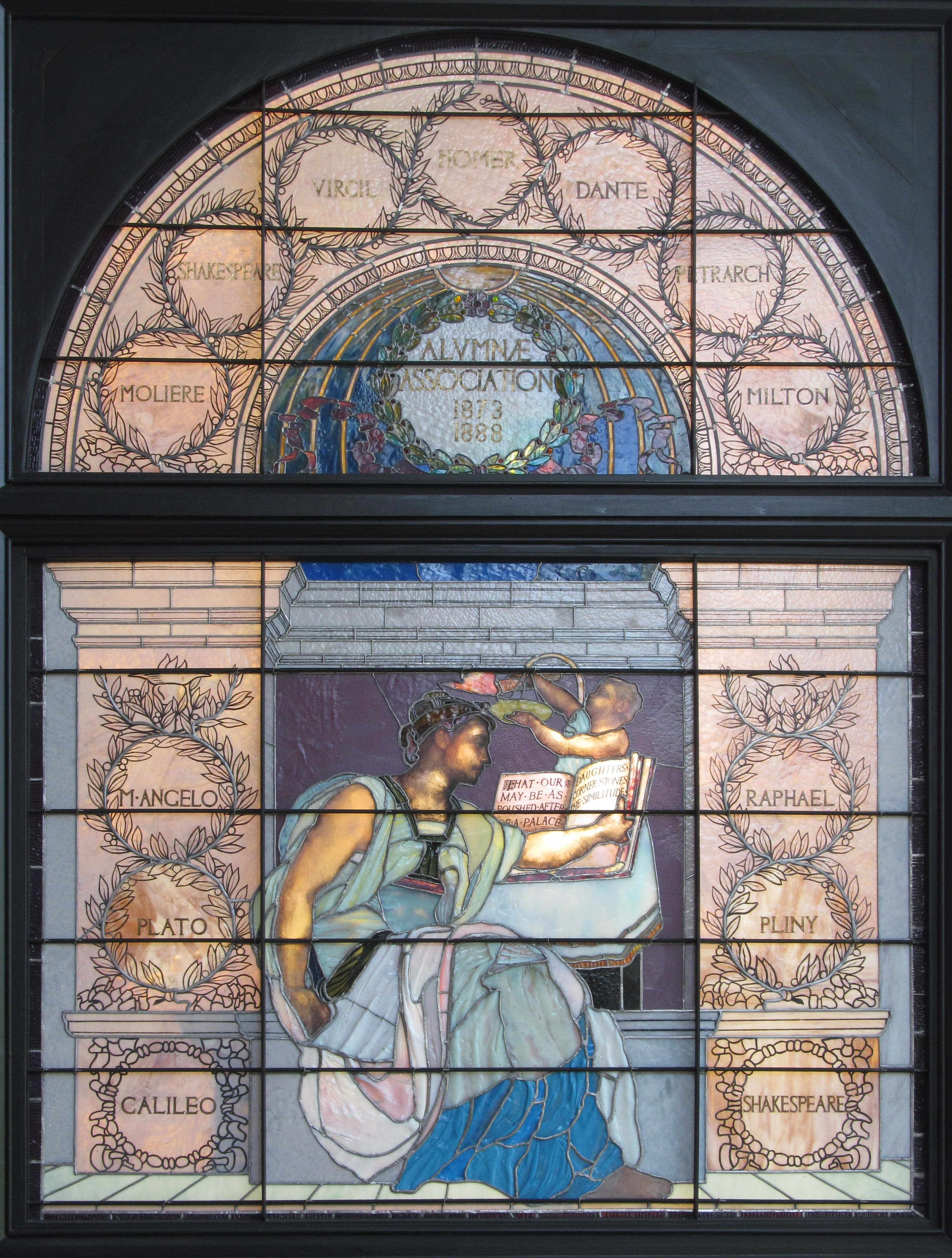
The context was a window by Louis Comfort Tiffany at Chatham University, which was given to Chatham’s ancestor, the Pennsylvania College for Women, in 1888. It is an allegory of women’s education, with a stained-glass version of Michelangelo’s Erythraean Sibyl and the names of great writers, thinkers, and artists in wreaths surrounding the subject. This is Herr von Hindenburg’s comment:
It is a pity that, at a women’s college, they couldn’t find a single female author to include. Dickinson, Hildegard of Bingen, Austen? Are there any better examples who might have been held in more esteem at the time?
The answer is probably not, and yes that is too bad. But it is a fact of the time. Emily Dickinson’s poems had not yet been published in 1888. Jane Austen was a popular novelist, and popular novels were a lower form of art—we do not find Cervantes or Fielding on the window, either. The only female author among the classics and moderns who could possibly have stood with the names in that window was Sappho, whose reputation as the greatest of lyric poets stands out as a striking anomaly in classical culture.
But in context the choices were good ones. When the Pennsylvania Female College was young, its students and alumnae were very conscious that giving women an education equal to traditional male education was a new thing. Women had not been equal to men in the past, but they would be in the future. They would therefore take as their models, not works that were pretty good considering that they were written by women, but the very peaks of human achievement; and in taking those as their models they would force women into an equal ranking with men.
And they did. If today we were donating a memorial window that commemorated the greatest human achievements since 1888, we would, without even trying to be “inclusive,” automatically include a number of female names. This is because those first generations of educated women did not say to themselves, “I will be excellent among women.” They said, “I will be Galileo. I will be Plato. I will be Homer and Virgil and Dante. I will be Shakespeare twice over.” They started with the assumption that their female identity was, to borrow theological language, an accident and not their substance, and that as human beings there was no limit to what they could accomplish. Because they did that—because they went out into the world insisting that they could show Raphael or Moliere a thing or two—today we are forced, merely by the facts of history, to admit women as human beings equal to men. In 1888, that was a debatable assumption, probably contested by most men and even by a majority of women. This window took a stand for the minority opinion.
Dr. Boli has written before about the Balkanization of human achievement. To use a bit of fashionable academic jargon, he believes it is another manifestation of white male privilege. He has spoken with students of various designer colors who are constantly told by their professors (who are often white and male) that they should devote their studies to representatives of their race or culture or gender or sexual orientation, and there is something wrong with them if they happen to be more interested in Thomas Aquinas or Confucius or anyone outside their own designated identity. You should be affirming your identity by learning about the achievements of your kind of people, we tell them. Meanwhile, we white males will enjoy the achievements of our culture and your culture and everybody else’s culture, and we’ll feel smugly enlightened about doing it. It would be hard to imagine a balder assertion of white male privilege: we get the whole world of human achievement, and you get Slovenia.
The alternative we propose is that we should regard human achievement as the achievement of humans, not as belonging to particular subspecies of humans. Duke Ellington was a genius by human standards, not simply by the standards of Black composers from Washington, D.C. Lady Murasaki was a novelist for all the world, not just for Japanese women. Marie Curie’s scientific discoveries do not fall apart if you are not female and Polish.
Whether there is such a thing as moral progress is debatable, but the strongest evidence for it is the twentieth century’s repudiation of the ideas of racial and sexual superiority. It seems to Dr. Boli that much of that progress goes back to institutions like the Pennsylvania College for Women, where students were told by everything around them—even the stained glass—that nothing less than greatness was expected of them. So, yes, it is a pity that they had no female models to aspire to—not yet. But they were doing the right thing. They were preparing themselves to be the models to which all of us, male and female, would look up in the future.
RELIGIOUS GOSSIP.
Bishop Zubik of the Popish Church went to Rome and unexpectedly returned with a cardinal’s hat. Boy, was Cardinal Zucchino mad! Bishop Zubik says he doesn’t know how the thing got into his luggage and he’ll get it back in the mail as soon as he can get to the post office.