Posts by Dr. Boli
ASK DR. BOLI.

A typical implementation of the open-concept plan.
Now do “open-plan concept” vs. “open-concept plan.” ASAP, please: we’re renovating.
The main difference between these two terms is that an open-concept plan is a plan for a space built on the open concept, whereas an open-plan concept is a concept of a space built on the open plan. It is thus merely a matter of priority: one comes before the other, and we may confidently leave it to the reader’s intelligence to determine which is which.
But what is the open plan? one might ask, and one would be right to ask. Wikipedia explains,
In residential design, open plan or open concept (the term used mainly in Canada) describes the elimination of barriers such as walls and doors that traditionally separated distinct functional areas, such as combining the kitchen, living room, and dining room into a single great room.
We can see how architecture of this sort might save a great deal of money, and Dr. Boli would encourage you to proceed along these lines. In fact, you should consider the elimination of walls and doors as only the beginning. Clearly, after all, the elimination of walls almost necessitates the elimination of ceilings as well; and since a ceiling is really only the underside of a floor, either actually or in potentio, it follows that floors must be the next to go. Thus the implementation of an open-concept plan, or indeed an open-plan concept, leads inevitably to a return to the state of nature or terrestrial paradise, which is the ultimate goal of all renovation.
LETTER TO THE EDITOR.
Sir: It is abundantly clear that whoever is in charge of the worldwide conspiracy of all things is falling down on the job. As a rich person, I am supposed to be immune to all inconvenience. Yet only this morning I had to come to a dead stop while some pokey old woman with a walker held up traffic at the intersection of Carson and 18th, as if she had a right to amble across the street at her leisure just because the walk sign was on in her direction. Now, clearly, in a well-ordered conspiracy of everything, there would be no little old ladies holding up drivers in any car above the level of a Lexus. My own car is a Bentley, so I should not even have to think about inconvenient old women.
It is time for drastic measures. I call for the resignation of the leaders of the conspiracy, and their replacement by competent professionals who know how to run a proper cabal. I also call for aging to be made illegal. Clearly a competent conspiracy would be able to eliminate all the inconveniences associated with advancing years.
Since there are no other candidates publicly announcing themselves, I offer myself for the position of generalissimo or archon or supreme pontiff or whatever it is you like to call the head of such an organization. Clearly I am qualified, since I know what is to be done and have a proper Bentley. But if someone else is willing to take on the onerous duties and get the job done, I have no objection. The vital thing is to make sure the rich suffer no more inconveniences. Otherwise they will lose all motivation to remain rich, and then what will become of our economy?
Sincerely,
Standard N. Poor,
Rich Person with a Bentley.
ASK DR. BOLI.
Dear Dr. Boli: I was reading that long-form content is in demand these days, and that it is rewarded by search engines and drives reader engagement and increases return traffic. So what I was wondering was this: What’s the difference between long-form content and long content? —Sincerely, Roberta Griselda Morgana Willoughby-Smythe-Blanket-Henderson, Vice President for Content, Market Optimization Associates.
Dear Madam: “Long-form” is the long form of the term “long.”
Advertisement.

IN TECHNOLOGY NEWS.
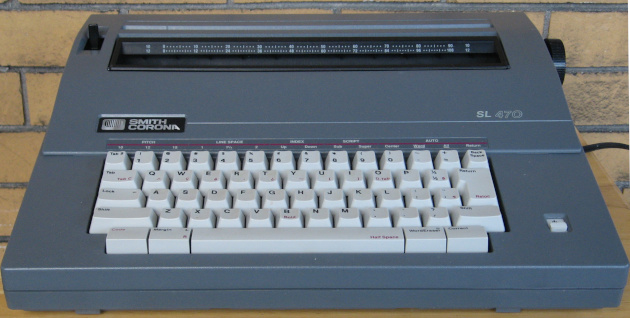
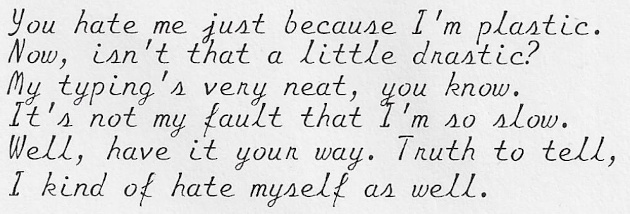
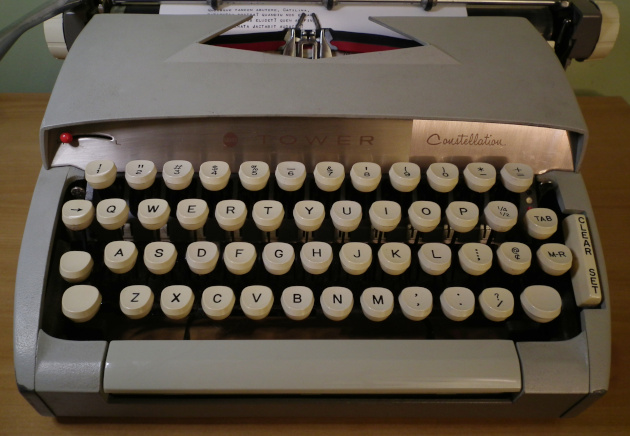
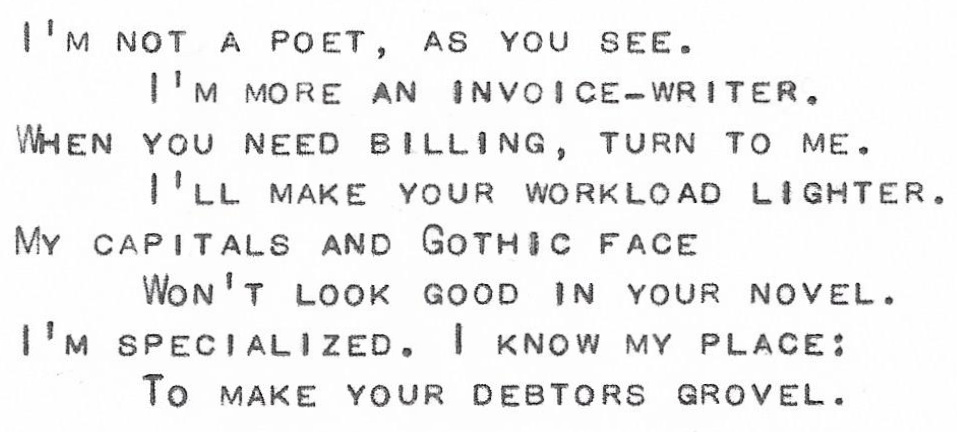
TYPEWRITER EPIGRAMS.
Smith Corona SL 470:
Tower Constellation with Elite Gothic No. 16 type (often used for invoicing and billing):
Advertisement.

ENTRIES FROM THE INTERIOR, BY SAMUEL HAZO.

He had the window seat. After take-off he said, “My line is socks; what’s yours?” I said I was a writer. He smiled his least impressive smile and asked, “What do you write?” I paused and said, “I hope they are poems.” “Where are you headed now?” he added. I told him I’d been invited to recite my poems at a university. “They pay you for that?”
The concise poem of a Volkswagen compared with the blunt prose of a truck…
Loyalty to whom? Loyalty for what? I hear so much about loyalty, but loyalty remains, like courage, a blind virtue. One can be loyal to crime as faithfully as one can be loyal to one’s country or one’s family. One can be loyal to a lie as well as to the truth.
Is sensory knowledge more memorable than empirical knowledge? Probably. The pain of a broken arm is a stronger memory than the square root of four.
Poetry precedes religion historically and philosophically. Whatever is alive in religion is poetry. The rest is ritual.
Sloth is invariably considered by many as the mother of invention. Who, for instance, but a lazy man shortcutted his way to the wheel, the match, the boat? But sloth is also the father of mischief. Who but a lazy man opted for slavery?
Poetry has no past tense. Nor does music. Nor does God.
A LESSON IN BEING SPECIFIC.
What marketing told production:
“We need little leatherette-bound notebooks with inspiring words like ‘Goal’ and ‘Plan’ and stuff on the covers.”
What production delivered:

NOW AT YOUR NEWSSTAND.
