Posts by Dr. Boli
LETTER TO THE EDITOR.
Sir: I was listening to some doubtless inebriated politician ranting about how America is failing to create manufacturing jobs, and it was making me sick. Now, I was also eating two large orders of Freedom Fries from Bob’s Burger Yurt at the time, so I cannot say whether I can attribute my symptoms exclusively to this yammering America-hater, but one way or the other he was wrong, and people should not be allowed to be wrong on the radio. How can he say that America is failing to create manufacturing jobs? America leads the world in designing products to be manufactured in China. Millions of Chinese citizens would be out of work if it were not for our talented American industrial designers. Look it up on TikTok if you doubt me: America is the engine that drives China’s prosperity. The next time you think you want to insult America, Mr. Fancy-Pants Representative from Some Godless New England State, choose a subject where it isn’t so easy to contradict you with a simple TikTok search.
Sincerely,
Roland Ronald Dorlan,
Arnold
Advertisement.

TYPEWRITER EPIGRAMS.
Royal HH, 1951:


Remington Noiseless, 1937 (this one types):


Royal KMM, 1942:


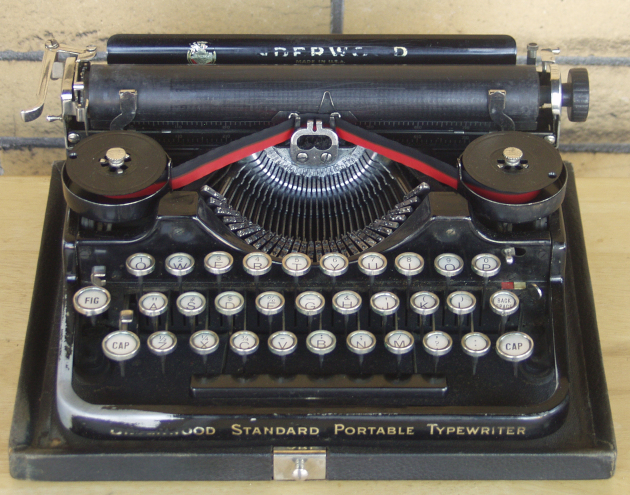
Underwood Standard Portable, 1926:

IN BUSINESS NEWS.
ASK DR. BOLI.
Dear Dr. Boli: What is the worst crime an American citizen can possibly commit? —Sincerely, Some Guy Who’s Just Asking for a Friend.
Dear Sir: You ask a moral question whose answer would depend on our definitions of terms like “worst” and “crime.” However, it seems to Dr. Boli that there is a good and fairly objective way to answer your question. Our common notions of morality are generally expressed in public policy: the more heinous the crime, the higher the legal penalty. Our public policy has decided that the penalty for one crime in particular is death without trial; therefore, we may say that the worst crime an American citizen can possibly commit is drinking untaxed alcohol.
Advertisement

MORE ALPHABETIC SENTENCES.
Each of the following is an original pangram or alphabetic sentence: that is, each sentence uses all twenty-six letters of the English alphabet.
Extremely zealous journalists vowed to pick up the quaint engraving of a crab.
Equality is a fuzzy notion, but such axioms have always presupposed our being hep to the jive, Jack.
I am in a quandary: I should like to fight back, but I am puzzled as to how to deal with his javelin and his axe.
Each step into the quagmire further dampened her zeal for every kind of jewelry box.
After consulting the best references and rejecting all their suggestions, we decided to name him Kpqvxyz.
PUZZLE TIME.
The sentences below cover a wide range of subjects from the mundane to the surreal, but they all share one interesting property. You will probably have little trouble guessing what it is; but the answer will be printed below the metaphorical fold, along with the source of the quotations.
The lazy horses gave a quick jerk which broke the axle and hurled the farmer upon his head.
He was puzzled to know how to coax the brave juggler to some quiet spot away from the platform.
One of the boys quickly threw the large javelin beyond the maximum distance and won the prize.
The zealous student became quite exhausted and dizzy before the journey through the park was half over.
The jury quickly agreed upon a verdict and all expect the musical zealot will be given a heavy fine.
In consequence of his love of luxury the wealthy jeweler did not join in the craze to climb the high mountain peaks.
Four jovial sailors went to the quizzical captain on the deck and asked him to give them leave of absence for sixty days.
Few men could be more jolly than our new acquaintance until he saw his clerk puzzling over the columns of the stock exchange.
Though still dizzy the injured chauffeur who wore a quaint crimson cloak gave an exact description of the vanishing automobile.
A large quantity of heavily glazed jars was taken out of the burning building by two policemen and a tax collector.
The firemen thought it would jeopardize many lives if they did not acquaint the inmates of the extreme danger of the falling bricks.
All the expenses of publishing the jokes in the columns of the daily press were borne by the queer old man whose zeal never flagged.
Many unjust laws allow bold knaves to exist in high places and acquire great influence with which they dazzle the eyes of the people.
The poor cabman many times expressed his thanks to the judge for his kindness and said he would return with the zebra as soon as his quest was over.
He was at the zenith of his power when the officials began making an inquiry in regard to his prejudice against the single tax movement.
Next day they were all equally amazed to see the grizzled veteran enter the ranks and march from the barracks to join in the parade.
Several of the boys had torn their jackets before they realized the wisdom of taking an axe to chop away the branches at the edge of the quarry.
One of the men at the zoo had just recovered from an attack of smallpox when an urgent request for his removal was made by the park commissioner.
In my remarks tonight I shall extemporize briefly upon my views of a subject equally dear to the hearts of-us all.
If you wish to move up and join the ranks of the experts, you should be sure to work with zeal, keeping your fingers quite close to the keys and hitting the keys with a low lift of the hands.
The answer:
(more…)Advertisement.

NOT DEAD YET.
From the Files of Mush Marlow, Private Investigator.
Continuing the story that began here.
CHAPTER 6.
“Well, I hate to keep people waiting,” the Archbishop said with a friendly smile. “The moment I heard you wanted to speak with me, I made sure to extend you an invitation in what I understand is the approved Yankee style. I hope the gentlemen I hired performed their duties in a satisfactory manner.”
“They got me here,” I told him, which was about the best I could say for them.
“Good. In England, of course, one would simply have sent a card, but one likes to make the natives feel as though one has made an effort. In Kenya, for example, to send an invitation it is customary to strip to the waist, climb a tree, beat one’s chest, and yodel. I should never have known that if my native guides had not told me. Delightful people, the Kenyans—always smiling and laughing. But enough of my fascinating reminiscences. I believe you and I share a common interest, Mr. Marlow.”
“I don’t know,” I said. “I think if you tried to read me thirty-nine magazine articles, I’d doze off by the twenty-seventh.”
“I beg your pardon?—Oh, yes, I see! This is an example of that bracing Yankee humor I’ve heard so much about. I tried to read a bit of Josh Billings in preparation for my visit, but I must be candid, Mr. Marlow: I couldn’t make head or tail of the fellow. The fault is all mine, I’m sure. But one thing I do know about you Yankees is that you like to get right down to business. There I think I can oblige you. As you are doubtless aware, I am fortunate enough to be the possessor of the world’s largest collection of picks.”
“Even bigger than the Pope’s?” Billy asked.
“Oh, I say! More of your delightful American humor! As every connoisseur knows, Pope Pius collects beer cans. It is one of those minor differences that keep the Bishop of Rome out of the Anglican Communion for the present, although we pray ceaselessly that he may be brought back into the fold. I do hope I can learn before long to incorporate some of your bracing Yankee wit into my own discourse. But to business. The rumor in the world of pick connoisseurs is that you have come into the possession of a pearl of great price. I speak metaphorically; I quote from Scripture, having spent much of my youth idly turning its pages before my onerous duties deprived me of the leisure for such pleasant but unproductive recreations. The object to which I refer is in fact a marbled pick, blue rather than pearl, bearing the name of Jeremiah Croydon. When your secretary telephoned and told me you wished to see me, I presumed you had terms to offer; and since I am most eager to obtain the Croydon, I think you will find me very willing to entertain any reasonable offer.”
“And what makes you think I’ve got the Croydon?” I asked.
“Well, really, I— Oh, I say! It’s the Yankee way, isn’t it? The complete package, as it were. I say to you, ‘Look here, old chap, there’s a thing I want,’ and you say, ‘Well, mack, what if I ain’t got it?’—and that spurs me to make a more generous offer. Why, it’s just like one of your tuppenny novels! That is, one of your dime novels. Excuse me—I am not as accustomed yet as I hope to be soon to your delightful colonial attempts at currency.”
“Yeah, but I—”
“Now, let me assure you, Mr. Marlow, I mean to be very generous. If you have other offers, I will exceed them. An archbishop’s base salary is perhaps—how would you say it?—‘nothing to write home about,’ but I do make quite a tidy income from the subsidiary rights. Since my worldly needs are met by the kindness of the parishioners, I really have nothing to spend it on but my collection. It would therefore be profitable to you to be forthcoming about the Croydon, and is not profit your highest moral duty in this delightful country of yours?”
“Well, yeah. I mean, that and conga lines.”
“Splendid. Then we can, as you say, do business.”
“We could, except I don’t have it.”
“I beg your pardon?”
“Believe me, I wish I had a Croydon. It would make my life a lot simpler. I’d sell it to you, and then I’d tell the next guy who thought I had it that, no, you have it, and my life would get back to normal. But I haven’t got it.”
“Oh, dear,” said the Archbishop. “Well, to be entirely straightforward with you, Mr. Marlow, I am not at all sure whether I believe you. I’m afraid I may have to call on the skills of Mr. Kosciuszko here, much as I would prefer not to. You see, Mr. Kosciuszko has informed me that he has ways of finding out whether you’re telling the truth. Mr. Kosciuszko?”
Suddenly the guy who had shoved me into the car was coming toward me. I didn’t like the look of this at all.
He stopped right in front of me and held up his hand in front of my face, with the thumb and little finger folded across the palm.
“How many fingers am I holding up?” he asked.
“Uh—three?” I answered.
He pulled back his hand and carefully counted the extended fingers. Then he turned around.
“He’s tellin’ the truth, boss,” he told the Archbishop.
“Ah, well,” said the Archbishop. “This is disappointing, I must say. There is no other word for it. I had thought I was on the verge of a triumph, and— Well, Mr. Marlow, I shall not detain you any longer. But I should like you, in the Yankee vernacular, to keep in touch. It is quite clear to me that, wherever the Croydon may be at the moment, you have as great an interest in finding it as I have. It is a matter of your peace and security, Mr. Marlow. Until the Croydon is found, the rumor that it is in your possession will continue to circulate. And there are, I regret to say, certain connoisseurs who are less scrupulous than I. They may not take the trouble to ascertain your veracity. In your position, Mr. Marlow, I should be very careful.”
“Yeah,” I said. “Me too, I guess.”
“And now, Mr. Marlow, I thank you for your time. Mr. Kosciuszko, would you be so kind as to take Mr. Marlow back to his office?”
“How about that?” said Billy as we walked out of the hotel with Mr. Kosciuszko and his minions. “My first day on the job and already I get to meet a big gang boss like that!”
“It’s just one thrill after another in this business,” I told him.
“You think we’ll see another one today?”
“Don’t expect too much excitement, Billy. Wasn’t meeting the head of the Anglican gang enough for one day?”
“Yeah, but I need action in my life. Thrills, you know? I sat at that desk too long.”
“Okay,” said Kosciuszko, “get in the car.”
“Actually,” I said, “I think we’ll walk back. It’s stopped raining, and the air is fresh, and it’s not too far from—”
“I said get in the car!” Kosciuszko growled, and before I knew what was happening I was face down on the back seat again. Tires squealed, and the car jolted forward.
“Golly!” I heard Billy saying. “You really do live a life of thrills and action! I shoulda been a sidekick a long time ago.”
I managed to right myself in the seat. Once again I could see the city going by outside at a worrying clip.
“Where are you taking us?” I demanded.
“We’re going to see the boss,” said Kosciuszko.
“I thought we just saw the boss,” said Billy.
“I mean the other boss.”
“How many bosses you got?” I asked.
“Look, it’s like this,” said Kosciuszko. “I got a wife an’ three kids, an’ two of ’em wanna go to college. The third wants to sing soprano with the Allegheny Opera. I don’t know what’s wrong with that boy. But anyway, it takes a lot of money to raise three kids. I had to take a second job, an’ I couldn’t be too picky.” Then, almost to himself: “Imagine a good Catholic boy like me workin’ for the Archbishop of Canterbury.”
We careened down a long hill, and then we were going across the Fortieth Street Bridge. At the end we turned right and barreled down a little back street until, with a squeal of brakes and a shriek of tires, we stopped in front of a backstreet bar.
“Made it,” said Kosciuszko. “Last one out’s a rotten egg.”
Billy and I both jumped out quickly, leaving one of the minions to suffer the curse Kosciuszko had pronounced. Then we were led into the dark little bar, and near the back was a dark little booth, and in that booth was a little man who observed our approach with calm but keen interest.
“I brung Marlow and his sidekick, boss,” said Kosciuszko.
“Excellent,” said the man in the booth. He had a high tenor voice, but he managed to sound a bit intimidating anyway. “Allow me to introduce myself, Mr. Marlow. Facto’s the name. But you can just call me Ipso. Everybody does.”