Posts by Dr. Boli
Advertisement.
WANTED: Bad People with Good Credit
If you’re a drug dealer, gang boss, investment banker, or other unsavory character who requires a flashy car to maintain your image, Bob’s Bentley and Firearms Emporium is looking for you. All this month we have special deals on fully equipped Bentley Flying Spur sedans with aftermarket rims for you if you can show us a high credit rating and a 1040 demonstrating that you can’t afford a Bentley, just so we know you’re illegit. Bob’s Bentley and Firearms Emporium is your one-stop go-to for the active villain lifestyle.
INCIDENTS OF THE INSURRECTION.
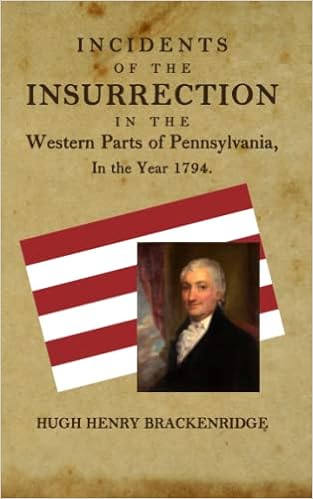
Once again Dr. Boli has contributed an introduction to a worthy, though mostly forgotten, work of literature.
It also has the advantage of being a suspense thriller with a sense of humor—the Alfred Hitchcock sort of suspense thriller. Hugh Henry Brackenridge was a famous wit, and time and again his sense of humor pulls him out of a tough scrape.
It is not really necessary to know the history of the Whiskey Rebellion to enjoy the story: Brackenridge will tell you as much as you need to know. Whiskey was the staple crop in the west country of Pennsylvania; it was a way of making grain portable so that it could be sold at a good profit across the mountains in the East. When the federal government, looking for sources of revenue to pay off the debts from the Revolution, placed an excise tax on distilled spirits, Westerners mostly refused to pay it. It would eat up all their profits and make it impossible to compete with the Eastern farmers, they said.
Two things happened in 1794 to bring things to a head. First, a U. S. marshal came through the west country serving writs on distillers who had evaded the tax. Second, John Neville, a wealthy plantation owner (he was a Virginian, and his plantation included slaves, since slavery was not yet banned in Pennsylvania) accepted a commission as revenue collector. When a mob surrounded his house, shots were fired, people died, and the rebellion was on.
Now it was impossible not to take a side, and there was only one safe side. “Tom the Tinker” sent threats to anyone who paid the tax, and anyone who cooperated with revenue collectors had better leave the country.
Now, what was Brackenridge’s role in all this? Like most men of sense (we hear very little of women in this book), he saw that open rebellion could lead only to disaster. He also saw that the flood was rolling and could not be dammed. The best he could hope to accomplish was to turn it into harmless channels.
His chief weapon was the joke. He tells us so repeatedly. A man who was laughing with him was a man who was, for the moment, not killing him. Not to be killed immediately was not enough for him, however: he hoped for a life in which he could stop worrying about being killed. If the insurrection continued, it would be civil war, and that would mean constant worry. Therefore the insurrection must end.
So began his tightrope walk: he must seem to be in sympathy with the insurgents, while at the same time keeping them from destroying themselves and him with them. Naturally he earned enemies on both sides. But there is good reason to think that he may have prevented a civil war.
A scrupulous historian might ask, How much of this narrative is true? That it is self-serving Brackenridge would be the first to admit. The Nevilles and Craigs continued to form a powerful cabal in Pittsburgh, and in the next generation Neville Craig would write the first substantial history of Pittsburgh, in which Brackenridge is portrayed as an unscrupulous villain. It provoked a response from Henry Marie Brackenridge, Hugh Henry’s equally literary son, who relied much on the evidence in his father’s book.
The long train of depositions and affidavits at the end of the book is meant to answer the question of whether the Brackenridge version deviates from the truth. After such a mound of evidence, it would require an intricate conspiracy theory to insist that Brackenridge had falsified the facts. In the main his account is verified. The only question is about his motive—the quo animo, as Brackenridge the legal scholar calls it. Of course we have no evidence but his word as a gentleman for that.
It is worth noting that Brackenridge flourished in the years after the Insurrection. He was made a justice of the Pennsylvania Supreme Court in 1799. He published two more parts of his novel Modern Chivalry with considerable success, and he constantly tinkered with the book for new editions up to 1815, the year before he died.
Hugh Henry Brackenridge was a curious literary phenomenon. He was admitted to the bar in Pennsylvania in 1780—before the Revolution was won—and moved to the frontier town of Pittsburgh, a small pond where he could be a big fish. He set himself up there in a law practice; but literature was his first love. Finding no literary outlet in Pittsburgh, he put up the money for John Scull to have a press hauled over the mountains in 1785. Thus the Gazette was born—today, as the Post-Gazette, the second-oldest metropolitan newspaper in the United States. Brackenridge filled its columns with sophisticated wit that would shame many of the Eastern papers. In 1787, he arranged for the founding of the Pittsburgh Academy, now the University of Pittsburgh. He began writing the first substantial novel in America, Modern Chivalry, and published two parts that sold well and made a permanent contribution to American literature. Brackenridge gave Pittsburgh a sheen of sophisticated Eastern culture—which the country people hated.
Pittsburgh was already a substantial town in 1794. The population of the town itself was probably less than a thousand, but it served as the center of commerce and government for the whole of Western Pennsylvania. Though to an Easterner like Brackenridge it was no more than a village, to the country people it was the big city, the new Sodom, an outpost of the Eastern civilization they despised. Throughout our story the constant—and entirely justified—fear in the town is that the country people will loot what is portable and burn the place to the ground. It is clear that the whiskey tax is only the latest ingredient in a long-simmering stew of resentments. Give the country people any pretext, and they will burn the town just for being the town. Extraordinary measures must be taken to avoid giving them any pretext.
This bitterness has never quite subsided. A glance at the map of Pennsylvania shows that Philadelphia has absorbed its surroundings out to the county line, but Pittsburgh remains confined to very narrow borders, with the rest of Allegheny County divided into a riot of small independent jurisdictions—129 of them, far more than any other county in the Commonwealth. This book will help explain that jealous jurisdictionalism.
Brackenridge is also a keen student of human nature. Has anyone ever so thoroughly or so shrewdly analyzed the psychology of insurrections? Brackenridge observes that the leaders are seldom leading at all; in fact they are men who fear the results of their own actions, but have more to fear from the wrath of the mob. Yet many among the most wrathful in the mob are also acting out of fear of the rest of the mob, and privately wish that the whole affair could just evaporate. They must be seen to be enthusiastic supporters of what they know to be a disastrous course, or the mob will turn against them. And they must join the mob in turning against any of their neighbors who seem insufficiently fanatical, or risk being suspected of insufficient fanaticism themselves. The doubters may be in the majority, but the mob is still unified in its fanaticism.
As history and as psychology, then, this is a useful book. But it is also a very entertaining book. Brackenridge was a master entertainer. A review of an 1847 edition of Modern Chivalry tells us this story of Brackenridge and President Washington:
Judge Brackenridge was accounted a great wit in the days of Washington, whom he endeavored to entertain with his stories upon one occasion at a public dinner, but without effect, the Presidential decorum not relaxing a muscle; but at night when the Father of his Country was laid aside with the buff and blue, the humorist had the satisfaction of hearing the bottled-up laughter of the day explode with many a gurgle through the thin partition which separated their bed-rooms. Such was the prudence of Washington, and such the humor of Brackenridge.1
In spite of his acknowledged haste in scribbling the book, Brackenridge has the master’s instinct for telling a good story. He knows how to build tension, how to tug at our human sympathy, and how to set up a punch line. If you have no interest in the Whiskey Rebellion, you will still find yourself enjoying the book. Books that still entertain us after more than two centuries are rare. This is one of them.
Buy Incidents of the Insurrection at Amazon.com.
RETURN OF THE FRANKLIN HEAD.
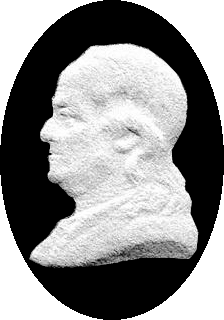
But we are not planning a horror movie. Instead, we are announcing a new publishing venture that takes its name from an old publishing venture.
In 1800, a young man named Zadok Cramer—only 26 years old—came to Pittsburgh and set up a bookstore, library, and publishing house on Market Street. Invoking the patron of all American printers, he put out the sign of the Franklin Head, and immediately set to work supplying the West with books at Eastern prices.
Almost at once the Franklin Head became the literary center of Pittsburgh. Cramer began with yearly almanacs. His famous Navigator, a guide to the Ohio and Mississippi all the way to New Orleans, went through edition after edition. Soon he was publishing everything from popular novels to school textbooks to a massive two-volume Bible dictionary with sumptuous illustrations.
In tribute to Zadok Cramer and his love for his adopted city, Father Pitt and Dr. Boli have taken the name of the Franklin Head for their new joint publishing venture. At the Franklin Head you will find books about Pittsburgh, printed to our usual high standards and sold at economical prices. Our first production is a new edition of Incidents of the Insurrection by Hugh Henry Brackenridge—the only edition in print right now of the most valuable primary source for the history of the Whiskey Rebellion. You will recognize the name of the well-known writer who contributed the introduction.
The address is easy to remember:
WAYS AND MEANINGS.
It has occurred to Dr. Boli more than once that the standards for naming these “ways” are different from the standards for naming streets. Street names usually have to have some marginal attachment to meaning. Sometimes there is a theme: the Mexican War Streets, for example, are so called because they are named for battles in the Mexican War; the streets in Bellevue are named for Civil War generals; the streets in West View are named for universities and colleges; and so on. Sometimes streets are named for trees or flowers. Sometimes they are named for things that used to be there, like an old estate on which a city neighborhood was built.
But “ways” seem to be named as often as not by flipping open a dictionary or encyclopedia at random and pointing at a word blindfolded. Here, in no order at all, is a list of “ways” in Pittsburgh whose names have at various times struck Dr. Boli as odd or amusing:
Woolslayer Way
Cabinet Way
Lycurgus Way
Asteroid Way
Sewer Way
Pitcher Way
Crooked Way
Gypsum Way
Equator Way
Comet Way
Fred Way
Urn Way
Telegraph Way
Vanilla Way
Relic Way
Livery Way
Alhambra Way
Asterisk Way
Parody Way
Archon Way
Alcove Way
Lunar Way
Pandora Way
Appian Way
Plummet Way
Revision Way
Highnote Way
Investor Way
Pontoon Way
Minor Way
Repeal Way
Petite Way
Caress Way
Rope Way
Brim Way
Press Way
Boer Way
Saturn Way
Cameo Way
Betty Jane Ralph Way
Quartz Way
Legion Way
Now, for the sake of absolute honesty, Dr. Boli will note that one of those odd names has a foundation in history. Rope Way was a rope walk two hundred years ago: a rope factory was set up next to it, and a long straightway was necessary for pulling the strands straight and twisting them together. Perhaps some of these other ways have similar histories: perhaps they ran past manufactories of asteroids or betty jane ralphs. But Dr. Boli does not know those histories, so the names remain inexplicable to him.
IN THE NEWS.
NOW IN PRESS.

ASK DR. BOLI.

Dear Dr. Boli: I was in the dollar store looking for Zimbabwean dollars, which they didn’t have, but what they did have was oven mitts with the slogan “Enjoy the Journey” printed in cheerful script. And what I want to know is, Where is my oven going? —Sincerely, A Man Who Was Hoping to Be a Trillionaire.
Dear Sir: Your oven is on a journey of self-discovery. It may have grander ambitions: perhaps it dreams of becoming a kiln or a furnace. Or it may be in the early stages of a midlife crisis. This is a voyage on which your oven must travel alone, but you could show solidarity by buying an oven mitt with a cheerful slogan. After all, your oven has taken the heat for you plenty of times.
EXPERIMENT WITH SHARING BUTTONS.
LETTER TO THE EDITOR.
Sir: I seldom venture outside these days on account of the danger of alien abduction; in fact, the last time I remember being out of the house was in January of 1986, and I made sure to do it in the middle of the night, staying under awnings as much as possible so that the aliens would not be likely to see me. Believe it or not, some of my friends (I only have the Facebook kind, but they’re good enough for my purposes) tell me I’m crazy. They say there’s no proof aliens are coming here and abducting people to make them love slaves for lonely fiendish alien princesses. Then I send them the 150,000-word informational email I keep ready for occasions like that, and pretty soon they stop talking to me and I know they’ve been abducted by aliens. Guess they’ve got their proof now.
But anyway, yesterday I ran out of aerosol cheese, and when I called the Food Festival they said they didn’t have any delivery slots available, but the guy I talked to said there had hardly been any alien abductions at all this week, and I could probably make it six blocks to the store without running into a tractor beam of any sort. So I risked opening the curtains a little, and I saw that it was a cloudy day, and the cloud cover might be some protection against aliens, so I decided to risk it.
Well, I got about halfway there when I noticed that the clouds were breaking up. Somebody ought to do something about defective cloud cover, by the way. What are we paying taxes for? And in one more block, the clouds had moved aside, and suddenly there it was: a huge extraterrestrial object in the sky. I could feel the heat of the radiation it was giving off, and it was glowing so brightly I couldn’t bear to look directly at it. But I took this picture of it with my phone, just to show those doubting Thomases that the alien menace is real.

Then I ran back home, and I ordered a whole case of spray cheese from Amazon, and believe you me it’s going to be a long time before I make the mistake of leaving the house again. But what I want you to do is warn your readers. Tell them not to go out of the house, because there’s some giant extraterrestrial object in the sky that’s giving off who knows how much radiation. Stay inside, pull down the blinds, close the curtains, and eat your cheese. —Sincerely, Walter Walterson Walters, Blandville.
THE SINGULAR ASPECT.

Fifteen years ago today, Dr. Boli’s Celebrated Magazine appeared on the Web with this story, the first thing Dr. Boli ever printed in electrical form. Dr. Boli had considered giving up on these celebrations, but fifteen seems like an important number. If we take 1993 as the birth date of the usable public World Wide Web, then for more than half its life the Web has been host to Dr. Boli’s Celebrated Magazine.
It is well known by now that Magnus Abelard deals only with singular cases, so everyone who walks through the door announces that he has a singular case. Nevertheless, the door is, by Abelard’s explicit command, never locked; and this case really did turn out to be singular. I have taken the trouble, therefore, to record it among Abelard’s most remarkable achievements, in the hope that the record will serve as an imperishable monument to Abelard’s genius.
We began with the usual formalities. I informed our visitor that he would have ten minutes to convince Abelard of the singularity of his case. I also explained the payment schedule in the unlikely event that Abelard did pronounce his case singular. Abelard did not speak during the proceedings; he never does speak until some singular aspect of the case has caught his attention.
“Mine is a singular case,” the visitor began as I took notes. “Indeed, it is so singular that I have not spoken with anyone about it until now. I have lived for ten years in fear for my life—a fear all the worse for being secret. I have not dared reveal it to anyone, and yet it eats at me, day after day, hour after hour, like a kind of parasitic creature that gnaws but cannot consume.”
“You have nine and a half minutes,” I reminded him.
“Ten years ago, my wife, to whom I had been married only a month, announced that she had a few purchases to make, and declared her intention to walk to the drug store on Murray Avenue. She would be gone for about an hour, she said. I bid her farewell; she walked out the door; and that, Mr. Abelard, was the last time I ever saw her.
“I shall not weary you with the details of my inquiries. Over the years, I have found opportunities to interrogate our neighbors and the clerks at the drug store. From their statements, I have discovered that my wife did indeed reach the drug store; that she left and turned right on Murray Avenue; that she was last seen walking on Phillips, the very street on which we lived, in the direction of our house. But she never arrived.”
Here the visitor stopped; and, as Abelard was still silent, I knew the narration had not interested him enough for him to take the case. It was therefore incumbent upon me to disappoint our visitor.
“Disappearances such as the one you describe,” I told him, “while exceedingly regrettable, are not extraordinarily uncommon. Perhaps the city police, or a less specialized private agency, might be able to render you some assistance.”
Our visitor sat back in his chair and sighed. “I have not yet revealed to you,” he said slowly and quietly, “the singular aspect of the case.”
Abelard leaned forward. This statement had at least caught his attention.
The visitor took a deep breath, appeared to think for a moment, and then continued, picking his words with care and deliberation.
“About an hour after my wife left, a woman entered my house by the front door. She entered boldly—as if she owned the place, you might say. Now here is the singular and remarkable thing: in every particular, this woman was the exact image of my missing wife. Even her clothes were the same as the ones my wife had been wearing when she left. She proceeded to make herself quite at home; she treated me as though she were actually my wife.”
Here the visitor leaned forward and lowered his voice about a fifth. “For ten years, Mr. Abelard, that woman has inhabited my house, living in every respect as though she were my wife. For ten long years, I have lived in fear, utterly convinced that this woman in my house is somehow deeply involved in the mystery, and afraid even to sleep at night—afraid I might fall prey to the same sinister forces that took my beloved wife from me. The fear is tearing at my soul, sir, and I have at last resolved that, whatever the cost to myself, I must unravel this mystery.”
A moment of silence followed; then Abelard spoke for the first time.
“And how exactly was it that you knew this woman was not really your wife, returned from her shopping trip?”
The visitor started forward; then he sank slowly back in his chair, staring straight ahead.
“Good lord,” he whispered hoarsely.
Abelard observed him closely.
“Good lord,” the visitor said again, somewhat louder this time. “I never thought of that.”
He sat upright in his chair with a new air of confidence. “Well, sir, you certainly have earned your reputation. I never would have imagined that a mystery of such devilish complexity could be unraveled in such a short time. I shall certainly be recommending your agency. You may expect a check from me in the morning, although you must be aware that no remuneration could ever express my profound gratitude. I bid you good day, and once again I thank you from the bottom of my heart.”
Abelard watched him walk out of the office with a jaunty confidence that had been completely foreign to him only minutes before.
For some time after, Abelard was silent, as though lost in thought. At last he turned to address me.
“Perhaps,” he said, “we ought to reconsider the idea of locking the door.”