Posts by Dr. Boli
PERSONAL INADEQUACY GUESSING GAME.
The second premise of advertisements in the backs of magazines is that your embarrassing deformities can be corrected, easily and painlessly, by the expenditure of a very reasonable sum of money. These days the money is likely to bring you a pill of some sort, perhaps a homeopathic cure for ugliness made from a 13C dilution of toad. But in the 1920s, the treatments might be much more aggressive, taking their inspiration from the Spanish Inquisition, with the cleverly American twist of making the victims specify and pay for their own tortures.
As he was harvesting illustrations from a 1924 magazine, it occurred to Dr. Boli that these advertisements might make an amusing guessing game. Here is the game: Can you guess what hideous deformity each of these appliances is intended to correct? The answers given by the advertisements themselves will be published in this space tomorrow, but Dr. Boli is certain some of his readers can give better answers than the original advertisers themselves came up with.


ON THIS DAY IN HISTORY.

FROM THE ILLUSTRATED EDITION.

PEOPLE ALSO ASK…
Where do New Caledonian crows live?
How can I determine my favorite color?
What was the Enlightenment and how did I miss it?
Where did they put Düsseldorf?
Is a rondeau funnier than a sonnet?
If I adopt a Russian wolfhound, do I have to learn Russian?
Which comic-book hero didn’t have a tragic backstory?
Was James Joyce on drugs or what?
Is violating the Geneva Convention really all that bad?
ON THIS DAY IN HISTORY.

BOZAR THE CLOWN’S SEVEN AESTHETIC WORKS OF MERCY.
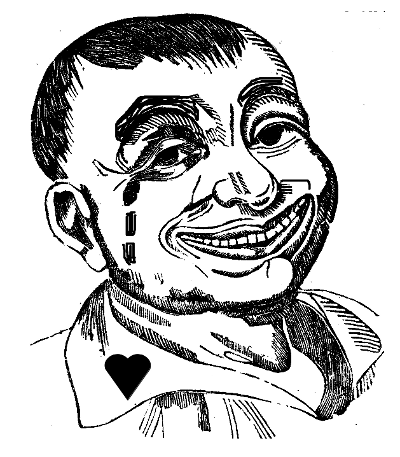
- Turning off the television.
- Unplugging and removing the amplification system from a concert hall.
- Correcting backwards apostrophes at the beginnings of words in signs and advertisements.
- Reeducating practitioners of “contemporary Christian music.”
- Teaching writers of popular lyrics the principles of rhyme.
- Using a fast shutter to capture a waterfall, in defiance of the motion-blurring convention of every inspirational poster in the dentist’s office.
- Teaching an art student to draw.
FROM THE ILLUSTRATED EDITION.

Advertisement.

GREAT MOMENTS IN DANCE.

Willa de Wispe as the National Debt in Heyser’s ballet “Principles of Keynesian Economics for the Twenty-First Century.”
A WORD FOR THE STUDY OF CRANKS.

Sir Isaac Newton, inventor of calculus, discoverer of the laws of gravitation, and world-class alchemy crank.
—
I’ve been enjoying learning about different types of cranks! Is there a word for this study?
It is a very interesting question because there does not seem to be a good answer. If you ask the Internet at large for a word for “the study of cranks,” nothing obvious comes up.
When there is no obvious term, we make one up ourselves. What would we call a “crank” in Greek? Perhaps “false prophet” would be the best equivalent in meaning. A false prophet is a ψευδόμαντις, so we might call the study of cranks pseudomantology—a word that seems to be available, since a Google search finds not a single instance of it on the Internet. It is distinctive and memorable, and it will—thanks to our correspondent—be Dr. Boli’s term for this discipline from now on.