Posts by Dr. Boli
THE KEYWORD SONG.
If you’re looking for a keyword, here it is.
It’s the very finest keyword in the biz.
     It’s the what-you-want-to-see word,
     It’s the perfect made-for-me word:
If you’re looking for a keyword, here it is.
So:
Chorus:
Keyword, keyword, keyword, keyword, keyword, keyword, hey!
Keyword, keyword, keyword, keyword, keyword, keyword, ho!
If you think you need a keyword for your site,
Just sit down and keyword this with all your might.
     Choose your what-you-want-to-be word
     And you’ll never have to reword
If you think you need a keyword for your site.
So:
Chorus:
Keyword, keyword, keyword, keyword, keyword, keyword, hey!
Keyword, keyword, keyword, keyword, keyword, keyword, ho!
Sponsored by
Reaching out to website owners with the gospel of the keyword since 2012
LETTER TO THE EDITOR.
Sir: Are you going to eat that? I could eat that. I could eat it for you. It would spare you the trouble of eating it. I could eat that, and it would be eaten. And then I could eat more of that, and you would not have to eat that, either. I could eat as much as you would like me to eat. You could put it on the floor right now, and the next time you looked, it would be gone, and you would not have to worry about it. I could meet it halfway. If you lowered it to knee level, for example, I could still eat it. I could eat the rest of it, even though you have eaten half of it by now. Do you think you have eaten enough? Maybe you have eaten enough, and you need help eating the rest. I will be happy to be of service. I will eat the rest, and you will not have to eat the rest. You will not suffer from overeating at all, because I will have eaten it. Is there more in the pan? I think there is more in the pan. I could eat that as well. But right now if you simply tilted your plate, it would allow gravity to operate, and I could eat whatever fell. It would not even hit the ground. I am willing to make that sacrifice for you. I would eat it, and I would spare you the necessity of cleaning it up. Now you have eaten what was on the plate, but I could still lick the residue. I could clean that plate so well it would not have to go in the dishwasher. Are you going to get more from the pan? I think you are going to get more from the pan. You did get more from the pan. Are you going to eat that? I could eat that. ——Sincerely, The Dog Under the Table.
REMARKABLE ANIMALS.
A groundhog in the garden of Miss Azalea Partridge of Hazelwood eats only the left sides of kale plants. Other crops do not appeal to it. Miss Partridge possesses the largest patch of right-handed kale in the tri-state area.
Sparrows in the parking lot of the Meadowlands Racetrack consistently arrange themselves in patterns spelling out the names of horses running in the day’s events, but so far have failed to pick a winner.
The green iguana (Iguana iguana) has a three-chambered heart, but pays its mortgage by renting out two of the chambers.
A cow named Evangeline in Amherst, Nova Scotia, has given only almond milk for the past seven years.
FROM THE ILLUSTRATED EDITION.

KNOW YOUR ROAD SIGNS.

Left turn, maybe. Sometimes it’s okay to make a left turn here, sometimes not. What, you expect us to make all your decisions for you?
ASK HERBERT THE PSYCHIC FLOUNDER.
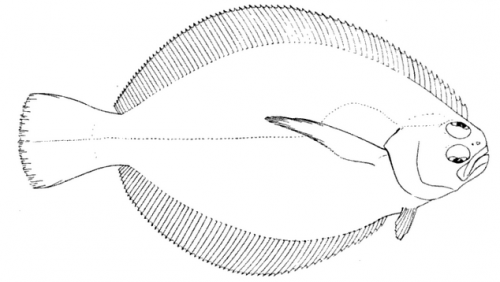
Dear Mr. Flounder: There’s this guy in my class who, like, really likes me, and I, like, like him and all, but I don’t know if I, like, like him the way he likes me. So, like, what should I do? ——Sincerely, The Girl in the Third Row with the Red Top On, the One with the Little Hearts.
Dear Miss: Atmospheric conditions and unusual sunspot activity are making contact with the higher planes spotty today. In my vision, I see a splendid horse in a meadow of asphodel, or it may be asphalt, and the horse is romping up and down, up and down, as horses do, its mane billowing like an ocean wave, and its tail flying like a banner behind it, longer and longer; and the flowers in the meadow wave as the horse romps past, unless it is a meadow of asphalt, in which case they are probably traffic cones or some such thing; and there seem to be birds twittering, although that could just be interference on the astral waves in the 750-milliliter band; and as the horse romps up and down, up and down, the tail gets longer and longer, and more and more like a banner, until there seem to be letters forming on it, indistinct, but growing more and more distinct as the tail unfurls more and more, until I can just about read what they say, which seems to be something like “Don’t give that creep the time of daj.” I am not sure what that message portends, the last word being unfamiliar to me; and of course it could merely be that interference again; but at any rate please write again if you need more advice, and perhaps the next time the sunspots will not be so aggressive.
LETTER TO THE EDITOR.
Sir: As your readers are doubtless well aware, this is National Store-Brand Packaging Week. The Continental Association of Supermarket and Drugstore House Brand Designers, of which I have the honor to be secretary, would like to take this opportunity to remind your readers of the effort that goes into creating a suitable brand identity for store-brand products. Most shoppers, we find, have no real idea of the delicate calculations, not to mention the sheer artistry, involved in creating packaging that is almost but not quite as attractive as that of the national brands. Great care is necessary: a moment of immoderate inspiration, unchecked by rigid discipline, and we might create a product more appealing than the identical but more profitable name-brand product. That, of course, would be a catastrophe. To create exactly the right impression of pretty-good-for-the-price requires heroic dedication to the principles of mediocrity in design.
As a class, designers of store-brand packaging are a selfless lot. We do not ask for much. Only once a year, and only for a week, do we set out our tip jars in the aisles of your local supermarket and drug store. All we ask is that, as you pass by and debate with a loved one, or with yourself if you have no one who loves you enough to debate this question with you, whether the national brand is worth the extra 40¢, you remember the artists who made the debate possible. Give generously to the people who make sense of your world by ordering all the products in it in a subjective and arbitrary hierarchy of perceived quality.
—Sincerely, Ranulf Hotch, Secretary, Continental Association of Supermarket and Drugstore House Brand Designers.
A PROPOSITION FOR PROFESSORS OF LITERATURE.
Being an immensely sophisticated narrative that opens up various perspectives onto a rich cultural and social life, Metamorphoses was underappreciated until recent decades.
Dr. Boli has a proposition for professors of literature and allied academics. If you will refrain from asserting or implying that yours is the first generation in history to develop sophisticated literary tastes, Dr. Boli will refrain from spending the five minutes in Google Books it would take to prove you wrong.
LAUGHABLE STORIES.
A certain comedian was asked, “When the rooster gets up in the morning, why does he hold one foot up in the air?”The comedian replied, “Because if he held up both he’d fall down.”
Ha ha! You must be thinking to yourself, “Dr. Boli has a new writer on his staff, one of those young kids who are up on all the latest jokes.” But in fact this joke is a fairly old one. It comes from a joke book compiled in Syriac in the 1200s by Mar Gregory John Bar Hebræus, who was Maphrian of the East from 1264 to 1286. Mar Gregory was merely a compiler, so most of his jokes are considerably older than that. Dr. Boli thinks that a religion whose maphrians sit around compiling books of jokes is a religion that has its priorities straight.
The book has a whole section of “laughable stories of actors and comedians,” and it is clear that the medieval Syriac-speaking Christians developed a Borscht Belt long before we had thought of such a thing.
An actor had taken money on loan from a certain man, but then denied it. The lender took him to court, and the judge asked him,
“Do you have any witnesses?”
The lender said, “No.”
The judge turned to the actor. “Now swear to me that you have not received the money.”
“If it’s all right with you,” said the actor, “could you let my brother swear for me? I know for certain he hasn’t taken anything.”
Some of the jokes make fun of people who are ostentatiously religious, showing that our maphrian had a fine contempt for hypocrisy.
An actor heard a man saying to his companion, “When you’re traveling at night and you want the dogs not to molest you, shout this verse from the Psalms in their faces: “Deliver my soul from the sword; my darling from the power of the dog.”
The actor broke in: “But tell him to take a stick in his hand, too. Not all dogs understand the Psalms, although there may be some of them who read them.”
Of course there’s a big section of fools, too. Fools say the darnedest things.
A fool said. “My father went to Jerusalem twice, and he died and was buried there. But I don’t know which time he died—the first time or the second.”
Often the mark of the fool is overlooking the obvious.
Another fool whose hawk had escaped asked the governor to shut the gates of the city until he had caught him.
But sometimes these fools make us wonder how foolish they really are.
Another fool was praying: “O Lord, give me five thousand pieces of silver, so that I may give a thousand of them to the poor. But if you don’t trust me, just give me the four thousand and give the other thousand to the poor yourself.”
Then there are cynical professionals like doctors and lawyers.
A certain man had been a painter, but became a physician instead. When he was asked why he had done that, he replied, “Everyone could see the mistakes I made in painting. All the mistakes I make in healing are buried in the ground.”
The book comes to us in a translation by the indefatigable E. A. Wallis Budge, who was Keeper of the Egyptian and Assyrian Antiquities in the British Museum, and who seems to have read Arabic, Syriac, and Ethiopic as fluently as he read Egyptian hieroglyphs and Assyrian cuneiform. Dr. Boli has modernized the fussily literal translation, but the jokes themselves need no modernization. Many of the stories in the book are not really laughable; some are remarkable occurrences that happened too early to be reported in a supermarket tabloid, and some are pithily wise sayings from philosophers and kings. But there are plenty of jokes, and it does us Westerners good to see how little we differ in the fundamental things from our Eastern brethren. We have added this book to the new page of Syriac Christianity in the Eclectic Library.
The Laughable Stories collected by Mâr Gregory John Bar-Hebræus, Maphrian of the East from
a.d. 1264 to 1286. The Syriac text with an English translation. By E. A. Wallis Budge. London: Luzac and Co., 1897.
FROM THE ILLUSTRATED EDITION.
