Posts by Dr. Boli
WE ALL HAVE DAYS LIKE THIS.

Speaking of illustrations from the Renaissance, here is a woodcut from the title page of a 1535 Tractatus perutilis et completus de fractura cranei (“Really Useful and Complete Treatise on the Fracture of the Skull”).
IMAGINE A ZEBRA.
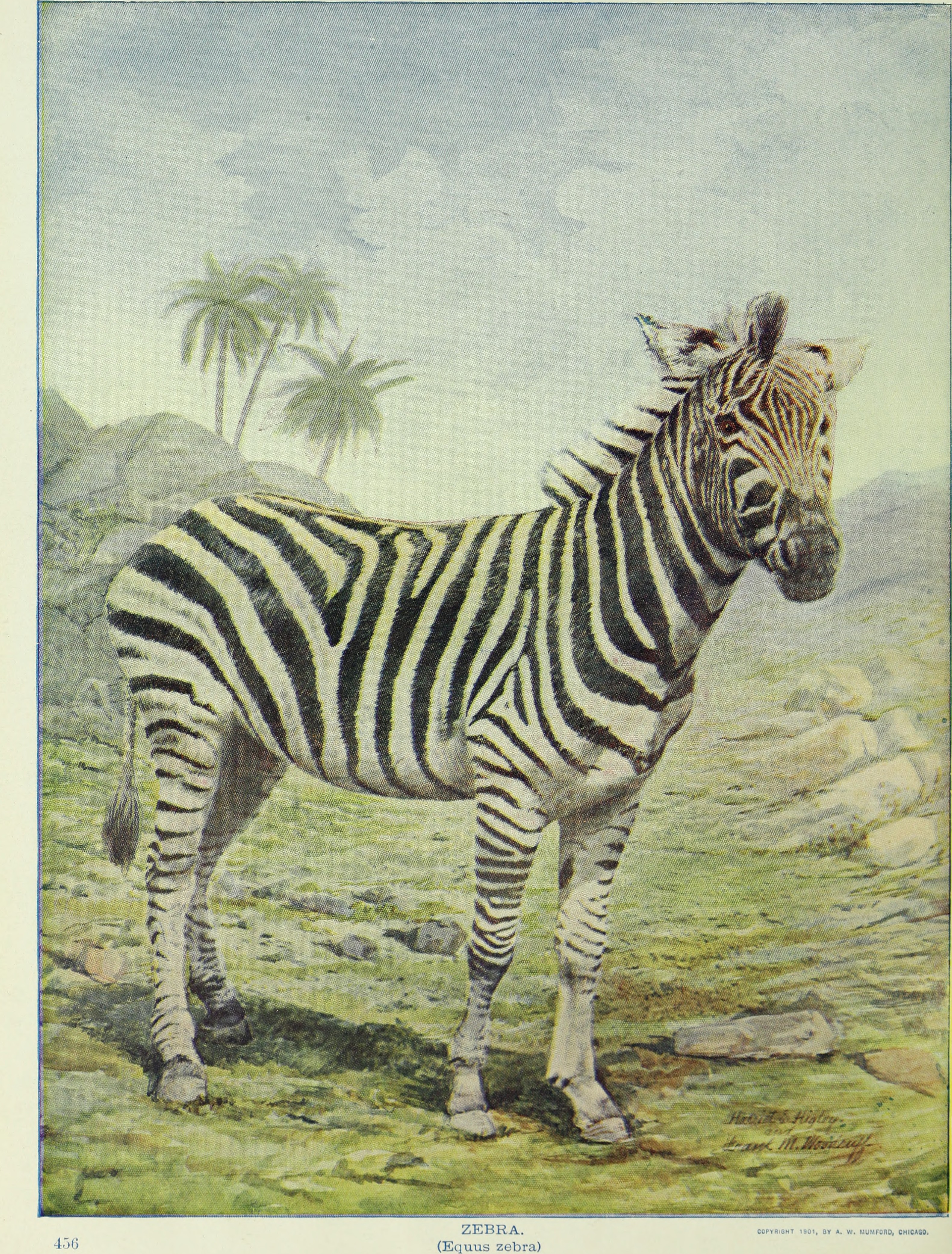
Behold the zebra. No animal is so easily recognized today; every child of four can point out a zebra in a book.
But suppose you had never seen a zebra. Suppose you had only heard a description of it. You have been told that it is a striped horse; that the stripes are black and white and brown; that they are arranged on the side of the animal proceeding from the back down toward the breast in hemicycle fashion; that the head and legs are striped as well. This is not a bad description of the zebra (except, arguably, for the brown stripes; but zebras do come in multiple patterns).
Now you are told to draw a zebra from that description. What will you come up with?
Well, this, of course.

This is how the zebra was imagined by the celebrated de Bry brothers for a book about the Congo in 1598. Given the information they had to work with, it is not at all a bad guess.
Now, many owners of luxury illustrated books in the Renaissance had the engravings hand colored. Suppose you were given the assignment of coloring this engraving. You have only the engraving to work from. The description of the animal is on the same page, but it is in Latin, which is Greek to you. How will you color it?
First, of course, you will shade the landscape with light watercolor washes, like this:

So far the results are typical. But we have avoided the problem. What are we to do with the zebra? We know only what we see in the engraving, and we have to imagine what the colors might be.
Under these conditions, Dr. Boli can imagine only one outcome:

YOU CAN SAVE WHEN YOU PURCHASE THIS PRODUCT AS PART OF A COLLECTION.

From DR. BOLI’S ENCYCLOPEDIA OF MISINFORMATION.
Third Series.

Map of the Holy Roman Empire at the end of the Thirty Years’ War, by Wikimedia Commons user “Astrokey44,” licensed under the GNU Free Documentation License.
Thirty Years’ War.—Although it is usually spoken of as a religious war, the Thirty Years’ War actually began with a bloody rebellion by the cartographers’ guild of Stuttgart. Unfortunately the rebellion accomplished very little.
EMBLEMATA.
A series of selections from
Dr. Boli’s Book of Allegorical Emblems.

No. 3. “Impartiality in all things.”
NURSERY RHYMES FROM THE FORKS OF THE OHIO.

Oranges and lemons
Say the bells of St. Clement’s.
Persimmons and quinces,
Say the bells of St. Vince’s.
Valve-stems and hoses,
Say the bells of St. Rose’s.
Ubers and jitneys,
Say the bells of St. Britney’s.
Lederhosen and sombreros,
Say the bells of St. Oscar Romero’s.
Baconian and Shakespearean,
Say the bells of Third Presbyterian.
Here comes a candle with light for your eyes,
And here comes a parish committee to reorganize.
WHEN LIUTPRAND PLAYS THE KRUMMHORN.
When Liutprand plays the krummhorn,
The people stamp and shout
And tell him it’s a bum horn,
And then they kick him out.
When Liutprand plays the fiddle,
They chase him out the door.
It really is a riddle
Why he comes back for more.
When Liutprand plays the tuba,
He really takes a hit.
He flies down to Aruba
Till things cool down a bit.
But what falls also rises,
And each dog has his day;
And guess who wins the prizes
When Liutprand plays croquet.
FROM THE ILLUSTRATED EDITION.

THE MATHEMATICS OF MARKETING.
On a package of half a dozen rolls of paper towels is a big splashy oval—the sort of thing graphic designers call a “bug”—with very large figures:
6=9
We may measure how well the marketers have formed us to their desires by noting that no one finds anything odd in that statement. In fact, no one in the grocery store thinks about that statement at all.
From DR. BOLI’S ENCYCLOPEDIA OF MISINFORMATION,
Third Series.

Friedrich Schiller. Although today he is considered a master of the German language, in his youth Schiller spent three months in jail for an incorrect use of the subjunctive.