Posts by Dr. Boli
FROM THE ILLUSTRATED EDITION.

SPEAKING OF SPAM COMMENTS…
A commenter leaves us this encouraging message:
this artical is in view of that usefull to us thank you
It may be a little worrisome, however, that the article on which he left it was “Learn English the Spam-Comment Way.”
Advertisement.

THE HALF-LIFE OF SPAM COMMENTS.
How long do they last, those boilerplate texts that spam commenters use in their attempted blog postings? We have already seen that many of them seem to be picked from circulating manuals of spam commentry, very much like the standard letter-writers that used to be popular in the Victorian era. But how long do those circulating manuals keep circulating? We just received one comment that may give us some clue if we interpret it correctly:
Hi there! Someone in my Myspace group shared this website with us so I came to check it out. I’m definitely enjoying the information.
This indicates that some of our spam-commenting manuals date from the Pleistocene era of the Internet.
Perhaps we ought to speak in terms of half-lives. Like radioactive materials, the spam-commenting manual is probably very active when it is new, but then gradually settles down, only firing off an occasional gamma ray to let us know it still has some life left in it.
At any rate, Dr. Boli really hated to mark this comment as spam. It felt like smashing a valuable antique. Eventually he settled on presenting the text here, shorn of any hyperlinks that might mislead the unwary, and deleting the comment itself.
THE MISCELLANEOUS CHESTERTON.
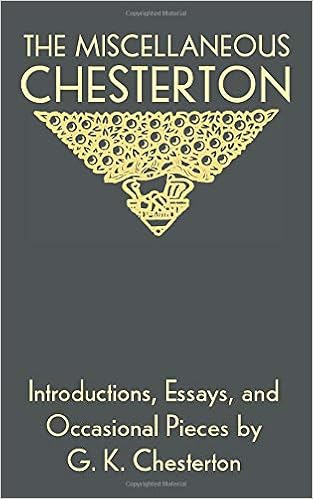
G. K. Chesterton is a favorite among many of Dr. Boli’s readers. No more excuse is needed for this announcement that Serif Press, an enterprise intimately associated with Dr. Boli’s Celebrated Publishing Empire, has put together a fat book of Chesterton writing that most of Chesterton’s fans have probably never read—more than 400 pages with 55 different pieces taken from newspapers, magazines, and introductions to other people’s books (one of Chesterton’s most characteristic forms of writing). But if a further excuse were requested, Dr. Boli might point out that the volume also includes a new introduction by H. Albertus Boli.
If you have been wondering what to get your crotchety old aunt for Christmas, The Miscellaneous Chesterton is the perfect gift to make her even more crotchety. It works equally well for uncles. University libraries will need to order the book in bulk. Members of one political party (it makes no difference which) will want to hand out copies at rallies to prove that Chesterton predicted the errors of the other party (it makes no difference which) a century ago. Survivalists will want to stock up on a book that not only will provide precious entertainment when the apocalypse comes, but also will provide precious fuel when the wood runs out. In short, every class of person and institution needs this book, and needs it in large quantities.
But perhaps the ones who need it most of all are the people who enjoy reading Chesterton and wish they had more Chesterton to read. Here is a small collection of quotations culled from the pieces in the book, just to show that, no matter what the occasion, Chesterton is always Chestertonian.
A teacher who is not dogmatic is simply a teacher who is not teaching.
While order would make the Cabinet Minister appear as automatic as the cow, literature would, on the other hand, make the cow appear as disturbing and incredible as the Cabinet Minister.
I am concerned here only with urging that aristocracy is in its essence anarchic. It is a mere trend towards that vague victory of the fortunate over the unfortunate which would occur more completely if there were no government at all.
Aristocracies in a state mean simply the strength of Nature and the weakness of the state; just as weeds in a garden mean the strength of Nature and the weakness of the gardener.
Political equality grows greater by being remembered, like the words of the American Declaration. But political inequality grows greater by being forgotten, like the power of the American Trusts.
Capitalism is not at present even a practical success, far less a moral or artistic one.
Art exists solely in order to create a miniature universe, a working model of the universe, a toy universe which we can play with as a child plays with a toy theatre.
A great drama of the past does not consist of one sincerity. A great drama consists often of twenty sincerities, all colliding with each other.
When chaos overcomes any moral or religious scheme, it is not merely the vices that are let loose. The vices are let loose and wander and do terrible damage. But the virtues are let loose even more; and the virtues wander more wildly, and the virtues do more terrible damage.
A seven-headed dragon is, perhaps, a very terrifying monster. But a child who has never heard about him is a much more terrifying monster than he is. The maddest griffin or chimera is not so wild a supposition as a school without fairy-tales.
Our historians lie much more than our journalists; our fashionable conceptions of the past change with every fashion; and like most fashions, are fantastic and hideous.
The first use of good literature is that it prevents a man from being merely modern.
Without education we are in a horrible and deadly danger of taking educated people seriously.
In dealing with the arrogant asserter of doubt, it is not the right method to tell him to stop doubting. It is rather the right method to tell him to go on doubting, to doubt a little more, to doubt every day newer and wilder things in the universe, until at last, by some strange enlightenment, he may begin to doubt himself.
Now, when you are in the proper Chestertonian frame of mind, would be the perfect time to dash on over and order the book. You might also like to mention it to your Chesterton-loving friends, if you have any friends left after quoting so much Chesterton at them.
HANDY GUIDE TO FOOD SAFETY.

Vectors of disease and serious choking hazards.
—
Many consumers are unaware of the best practices in food safety, with the result that consumers all over the country are dropping like mayflies. Be aware of these important food safety facts to prevent sudden agonizing demise in your family.
Food wants to kill you. This is the first principle of food safety. To prevent food from having its way, make sure you eat only foods produced under carefully controlled conditions.
Raw meat is the most dangerous of all foods and should be handled only by fully qualified professionals, as it can carry not only diseases but also serious choking hazards in the form of “bones.” It is a useful principle to remember that raw meat is always more dangerous than the animal it came from. Yet most consumers seem to be unaware that cooked meat comes directly from raw meat. The only safe way to eat meat is to obtain meat that has been carefully prepared and neutralized under laboratory-like conditions, as is done, for example, in the packaged processed snack-food industry. Packaged processed snack meats come in many convenient forms, most of them vaguely cylindrical, all of them carefully neutralized with improving chemistry “for thine especial safety,” in the words of the immortal Bard.
Dairy products, such as milk and cheese, are technically meat at one remove. Standards for cheese are appallingly low, and it is a known fact in the industry that some cheese is sold in such an advanced state of decay that it is literally mottled with fungus. To be safe, insist on cheese that has been carefully stripped of its harmful properties, such as, for example, that found in many “cheez”-flavored packaged processed snack foods.
Fish is simply meat that lives under water. The safest way to consume fish is in the form of small crackers baked in sanitary factories and coated with safe and delicious cheez-flavored topping.
Fruit is a kind of meat produced by plants to seduce the unwary into spreading their filthy seeds. Fresh fruit is a known vector of many diseases and may contain inedible components, such as stems, cores, etc., which are technically the bones of the fruit and present similar choking hazards. Fruit is best consumed in the form of flavored processed snack foods, as the “froot” flavor can be safely produced in a laboratory without any contact with the dangerous meat of wild fruit.
Vegetables are nothing more than the meat of plants, with all the dangers of disease and choking that come with raw meat. The most reputable food scientists advise avoiding vegetables altogether.
This handy guide to food safety is brought to you by the North American Association of Delicious Packaged Processed Snack-Food Manufacturers (NAADPPSFM), promoting Food Safety Through Plastic Packaging.
THE THINGS YOU CAN BUY ON LINE.
Battle Of Lepanto on eBay – Seriously, We Have Battle Of Lepanto
Ad www.ebay.com/
Free Shipping Available. Buy Battle of Lepanto on eBay. Money Back Guarantee! We Have Everything. World’s Largest Selection. Fast ‘N Free Shipping. Returns Made Easy. Under $10. Top Brands. >70% Items Are New. Huge Savings. Make Money When You Sell. Fill Your Cart With Color. Types: Fashion, Motors, Electronics, Sporting Goods, Toys, Home & Garden.
 rating
Ad
www.bestdeals.today/Online_Deals
▼
Special Offers For The Battle Of Lepanto. Expires Soon, Redeem It Now! Top Brands. Huge Discounts. Big Savings. Huge Selection. Best Deals. Free Shipping. In Stock. Types: Electronics, Fashion, Auto Parts, Home & Garden.
Ad
www.discount99.us/Battle+Of+Lepanto
▼
Discover hundreds of ways to save on your favorite products. Get the Deals now! Popular Deals. Remnants. Top Ratings. Exclusive Deals. Compare prices.
BUILD-YOUR-OWN-JOKE KIT.
Speaking of Terms and Conditions, here is a single sentence from the summary of updated Terms of Service for YouTube:
Terminations. Our Terms now include more details about when we might need to terminate our Agreement with bad actors.
If that is not all the material you need to build your own joke, you probably ought to give up humor and take up knitting.
SERIAL PERJURY.

Contract expert Simon Legree explains to Uncle Tom the provisions of his Terms and Conditions and E-Sign Disclosure Notice.
—
“I have read and accept the Terms and Conditions and E-Sign Disclosure Notice,” say the words beside the little check box. And you check the box and go on, because without checking the box, you cannot go on—you cannot order your consumer goods, or pay your bill, or live your life on the Internet.
But you have not read the Terms and Conditions and E-Sign Disclosure Notice. You did not even click on the link to the Terms and Conditions and E-Sign Disclosure Notice. You lied. In fact, since this is presented as a legal document, you committed perjury.
Why did you not read the Terms and Conditions and E-Sign Disclosure Notice? Because they were, in this case, 6,573 words long. That is quite an ordinary length for Terms and Conditions.
How does that compare to things you would willingly read?
In the New York Times, a newspaper renowned for its copy-heavy greyness, the average article is 1200 words. Assuming you read them at the same speed, you could read these Terms and Conditions in the amount of time it would take you to read five and a half New York Times articles.
But you could not read them at the same speed, because the Terms and Conditions are so dull that your brain will shut down in self-defense about a thousand words into them. A New York Times feature about allegations of corruption in the Nepalese Ministry of Agriculture is the soul of entertainment by comparison.
Yet you may be expected to swear that you have read documents like this several times a day. You have probably sworn, over the last month, that you have read hundreds of thousands of words of legal jargon that would have made no sense to you even if you had opened the page.
What can be done about this? Years ago, Dr. Boli would have said that no court would take such a supposed agreement seriously. There can be no agreement when knowing the terms of the agreement is quite literally impossible for any normal human being.
Courts, however, have adapted to the realities of life in the twenty-first century. It is now very likely that a court would agree that you should have known what the terms were, because they were right there for you to click on whenever you liked. You had the choice: you could decide to be a Luddite. But if you have decided to avail yourself of the privilege of existing in a world where an Internet connection is required for anything you desire to accomplish, then you will agree to the conditions, whatever they may be, and if you want your firstborn back you will do it without poking too deeply into the text of those conditions.
Thus we seem to have come to a point where a contract is no longer an agreement between parties, but rather a series of conditions imposed at will upon one person by another person or entity. The technical term for such a relation between parties is slavery, and Dr. Boli recalls that years ago there was some movement to amend the Constitution to prohibit it; but evidently the movement came to nothing.
The answer to our question of what can be done, therefore, is clear. When conditions are imposed unilaterally, one must manage to be the imposer rather than the imposed-upon. Dr. Boli, for example, has drawn up a list of terms and conditions that will be imposed upon any entity expecting to receive on-line payments from him. Curiously, in his version of the contract, the payments all flow toward him rather than away from him. But that is the price these businesses will have to pay for the convenience of doing business with him without having to push a cart up his street (which is, by the way, a very steep street). The alternative for them, of course, would be to admit that they committed perjury when they swore that they had read the terms and conditions thoroughly before continuing with the transaction, and the consequences of that admission might be worse than the consequences of Dr. Boli’s terms and conditions.

FROM THE ILLUSTRATED EDITION.
