Posts by Dr. Boli
SOMETIMES LIFE IS A CARTOON.

A street scene in Colonial Williamsburg: a carriage driver in colonial garb uses a colonial iPad to capture a group portrait of the passengers.
THE ANSWER.
If you had visited Pittsburgh in the later 1700s, you might have been surprised to find that the little frontier city seemed to have a thriving literary culture. It had a little paper filled with witty and clever items that would shame many of the Eastern papers—the Gazette, which by random luck has survived since 1785 (through various combinations) to be one of the world’s oldest metropolitan newspapers. Bookshops displayed interesting and useful volumes printed in the city. There was every indication that Pittsburgh was becoming a haven for authors of substance.
You might have been even more surprised to discover that all this culture was the work of one man. Hugh Henry Brackenridge financed the Gazette and persuaded its editor to haul a press across the mountains to Pittsburgh; Hugh Henry Brackenridge wrote the cleverest columns in that little newspaper (under the names of numerous fictitious correspondents who frequently argued with one another); Hugh Henry Brackenridge poured forth an unending torrent of pamphlets, treatises, and poems; and—above all—Hugh Henry Brackenridge wrote the novel that everyone was reading, and talking about, and laughing over.
Modern Chivalry was the book described by Charles Frederick Heartman as “one of the greatest novels ever written in the English language.” It is a rambling picaresque tale of a wandering captain and his Irish servant, often compared to Don Quixote—but with this difference: that the master is usually the voice of sanity, and the servant carried away by delusions. Nevertheless, it is the ignorant servant who succeeds in American society, which of course is the satirical point. There is no place for an accomplished gentleman; the new country belongs to the unprincipled rogues.
Fashion is probably the main reason for the eclipse of Hugh Henry Brackenridge’s memory. He is the only American novelist of the school of Fielding, Smollett, and Sterne. When he wrote, romanticism had already taken over serious literature; and it is a principle of all arts that the fashions of the generation immediately previous are always repudiated as the most barbarous fashions in the history of art. By the time the United States developed a strong literary culture of its own, Brackenridge was ignored by serious readers—who, by the way, also found Fielding, Smollett, and Sterne far too vulgar for their tastes. When the canon of American literature was forming, Brackenridge was left among the sweepings on the floor. He was still read, though: editions of Modern Chivalry continued to appear throughout the first half of the nineteenth century, snapped up by the old folks who remembered it as that book they had laughed at so much when they were young. (John Quincy Adams was a big fan.) One very attractive edition had pictures by F. O. C. Darley, the best American illustrator of the middle nineteenth century.
The novel is still reprinted about once a generation, when some academic rediscovers the book and attempts to bring it back into the public eye through a university press. These editions usually end up in remainder bins.
A review of an 1847 edition of Modern Chivalry tells us this story of Brackenridge and President Washington: “Judge Brackenridge was accounted a great wit in the days of Washington, whom he endeavored to entertain with his stories upon one occasion at a public dinner, but without effect, the Presidential decorum not relaxing a muscle; but at night when the Father of his Country was laid aside with the buff and blue, the humorist had the satisfaction of hearing the bottled-up laughter of the day explode with many a gurgle through the thin partition which separated their bed-rooms. Such was the prudence of Washington, and such the humor of Brackenridge.”
Hugh Henry Brackenridge is well represented in Dr. Boli’s Anthology of American Humor, the book your bathroom has been begging you for.
A LITERARY AMUSEMENT.
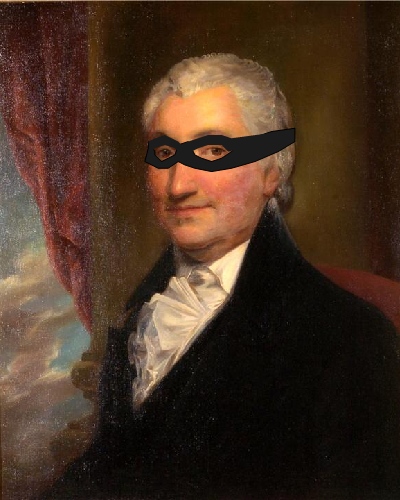
In trying to find some rare works by one of his favorite authors, Dr. Boli ran across exactly the assistance he was looking for: a bibliography of the works of that author by Charles Frederick Heartman, the famous book-collector.
Heartman was a German immigrant to the United States, and his own life story is fascinating enough. But it was especially interesting to Dr. Boli that Mr. Heartman, who knew more about American books than almost anyone else, shared (and perhaps even exceeded) his admiration of this particular author—an author who otherwise remains obscure to most American readers, in spite of the efforts of his admirers once every generation or so to bring his masterpiece back into print.
Dr. Boli wondered how obscure this particular author actually is today. It occurred to him that his readers are, as a class, particularly well educated in American literature.
So he proposes this little game. Without resorting to a search engine, can you guess which author Mr. Heartman is talking about?
The inspiring factor which led to the making of this bibliography is found in curiosity. I bought some books written by xxx and could not find any satisfactory bibliographical material about him. That is just the same experience I have had in the compilation of other books of this series. It appears to be another case of shameful treatment of an American author by American historians.… Here is a man, had he lived in France or Germany (if I may be permitted to mention the latter country*), of whose work at least one book would be a well-known classic to be found in every library. I mean his “xxxxx.” Millions of copies would have been printed of this book and every bookseller would have a half dozen editions on his shelves. As it is but few people know that such a book was ever written, and fewer still have read it. It is, in fact, one of the greatest novels ever written in the English language. One has to borrow names like Swift, nay, Rabelais, to find equals.
*This pamphlet was published in 1917, when it was not necessarily safe to speak the name “Germany” without spitting.
Here are your clues, then: the novelist is an American; his work is difficult to find in bookstores; and Swift and Rabelais are apt comparisons. And his picture is at the head of this article, which may give you a rough idea of his era. Can you guess the man behind the mask?
LETTER TO THE EDITOR.
Sir: Do you remember how, when we were young, the world was full of love and laughter and brightness and irresponsible joy? Now we are old, and the world is full of pain and illness and bills and worry. From this observation, we can draw only one conclusion: the world is much worse now than it was when we were young. Somehow the world has lost its brightness and laughter and filled up with pain and darkness. Clearly the government is to blame.
So why are the seemingly dozens of presidential candidates infesting our country not talking about the one issue that affects everyone in their generation? Why has not a single candidate gone on the record unequivocally as in favor of joy and against pain? Why has not one stood up to say, “In my administration, there will be no arthritis, and tooth decay will be outlawed”? Where is the candidate who has the courage to promise an end to worry?
As a citizen, I expect my government to provide for my needs. Right now what I need is some cheering up. I demand a hearing from the current crop of presidential candidates. Which one of them will put on a clown suit and fall off a unicycle? Which one will give us a champagne-and-croquet party on his front lawn? Which one will make rainbows light up the sky while pink flower petals drift lazily to the ground? That is the candidate who will have my vote.
——Sincerely, Alain-Yves-Pierre Roulon de la Baguette, Windgap.
THE HONORIFIC “MS.”
There are still many old-fashioned types who cringe at the use of the honorific “Ms.,” instead of “Miss” or “Mrs.,” in front of a woman’s name.
Dr. Boli has much sympathy for that reaction. A century and a half or so ago, you would have found him fighting a losing battle against the use of “Missus” as an honorific for a respectable woman. “Missus,” as the abbreviation “Mrs.” shows us, is a servant’s careless mispronunciation of “Mistress.” It is not, Dr. Boli said, a word to be spoken by gentlemen. (“Miss” is scarcely better.)
But Dr. Boli lost that battle. Furthermore, he has come to accept “Missus” as a form of address appropriate to women who wish to be addressed as “Missus.” In etiquette, it is a useful principle always to address people the way they wish to be addressed. Obviously the rule admits of some exceptions: if a woman of your acquaintance tells you, “From now on, you shall address me as ‘Your High Exalted Mightiness Princess Whizbang, Empress of the Milky Way, Dominator of the Universe, and High Exalted Grand Master of the Order of the Red Kettle,’” you are probably justified in telling her, “I think I shall probably continue to call you Ms. Miller in casual conversation.” But as a general rule, it works well; and therefore it behooves us to address women as “Ms.” who prefer to be addressed that way.
If it makes you feel better somehow to think this title is not some modern invention or ghastly corruption (like “Missus,” which still frankly sticks in Dr. Boli’s throat sometimes), then Dr. Boli offers this photograph, which his friend Father Pitt, straying a bit from his beloved Pittsburgh, took in a graveyard in Concord, Massachusetts. Click on it to enlarge it. You will note the date, and you will feel better.

IN THE NEIGHBORHOOD GROCERY.
CHILD IN CART. Wait, Mommy! I need one more thing! Mommy, I need one more thing! I need one more thing, Mommy! Mommy! Mommy, wait, I need one more thing! I need one more thing! Mommy, I need one more thing! I need one mo——
MOTHER. Okay! Okay! What’s this one more thing you need?
CHILD IN CART. Um… I don’t know.
FROM THE ILLUSTRATED EDITION.

ASK DR. BOLI.
Dear Dr. Boli: There are so many different health and wellness modalities out there. How do I know which ones are scientifically sound? —Sincerely, Josephine P. Briggs, M.D., Director, National Center for Complementary and Integrative Health.
Dear Madam: Dr. Boli has a single rule that, while it may seem a bit odd at first, may help you distinguish science from pseudoscience. (By all the laws of the Internet, therefore, this article should be headed “Learn to Recognize Bogus Medicine with This One Weird Rule.” Yet, unaccountably, it is not.) This is the rule: Real knowledge does not have a trademark symbol after its name.
So when you are judging the scientific basis of a “health and wellness modality,” ask yourself this question: How much of the knowledge—not the products created from it, obviously, but the knowledge itself—underpinning this discipline is protected by trademark law? “Massage” is not; “Therapeutic Touch®” is. You can see the principle; go and apply it. You might allot a few million dollars to some worthy organization to study the matter. We might suggest, purely at random, the Boli Foundation for Integrative Research, the first research organization openly dedicated to integrating solid statistical research with wishful thinking.
RETURN OF THE TRACFONE UNLOCKING POLICY.
Hey, kids! Remember this from last October?
Can you unlock a cell phone you bought from TracFone and use it with another provider? Yes, says this page [the page has now been revised]. TracFone will be happy to unlock it for you if your phone meets certain criteria. Here are two of them:
The TracFone device was first introduced for sale on or after January 1, 2014.
The TracFone device has been in service for at least 12 months with paid, verifiable airtime.
So good luck with that unlocking thing.
The amusing thing, of course, was that, last October, there had not been twelve months since January 1, 2014, so it was literally impossible to fulfill these conditions.
One of those “laws” that people love to quote on the Internet is called Hanlon’s Razor: “Never attribute to malice that which is adequately explained by stupidity.” In that spirit, we were inclined to imagine that the policy created impossible conditions simply because someone had not thought it through very carefully.
But an alert observer has just pointed out to Dr. Boli (you know who you are, and thank you very much) that Tracfone just announced a new unlocking policy. And it begins with this preamble:
Handsets offered for sale by TracFone (with the exception of iPhones) are locked to TracFone service, and not technically capable of being unlocked. TracFone has recently entered into an agreement with the Federal Communications Commission (FCC) regarding handset unlocking. Next year TracFone will begin launching handsets which are capable of being unlocked.
If this is correct, then it seems that TracFone was not unlocking phones at all, because it was not possible to do so. We still do not attribute the former policy to malice, because of course that might be libelous; but the stupidity takes on brighter colors. Meanwhile, it is good to see that the FCC is doing some of the work we hired it to do.
WE HAVE ELVIS IMPERSONATORS, AND SCOTLAND…
…has Sir Walter Scott impersonators.
That was the thing that was most delightful to Dr. Boli about this news story: it is a fine thing that the Borders will have passenger rail service again, but the fact that there are Sir Walter Scott impersonators, and that they are so ordinary as not to excite any remark or explanation in the story itself, fills him with a warm glow.