Posts by Dr. Boli
DR. BOLI’S ALLEGORICAL BESTIARY.

No. 28. The Road-Runner.
Appropriately enough, the road-runner allegorically represents the virtue of patience.
FROM THE ILLUSTRATED EDITION.
CONSIDER THE GNU.
By Irving Vanderblock-Wheedle.

Consider, if you please, the gnu.
Now, hasn’t he been true to you?
The gnarwhal has a pointy end;
The gnewt’s at best a chilly friend;
The gnighthawk seldom stops to chat;
The gnumbat up and left me flat;
The gnautilus just backed away;
The gnapu said, “Some other day.”
So if you want a friend who’s true,
Consider, if you please, the gnu.
FIFTY THOUSAND COMMENTS CAN’T BE WRONG.
I very delighted to find this internet site on bing, just what I was searching for as well saved to fav.
We have informed the paleontologists at the Carnegie Institute that there may still be a living population of Internet Explorer users somewhere in the wild.
Wow! This can be one particular of the most useful blogs We’ve ever arrive across on this subject. Basically Fantastic. I’m also a specialist in this topic therefore I can understand your hard work.
It is interesting that our correspondent identifies himself as a specialist in this topic, since the article on which he left his comment was one of our previous roundups of comments from the spam folder.
I love how this blog promotes self-love and confidence It’s important to appreciate ourselves and your blog reminds me of that.
Dr. Boli confidently appreciates himself. He is not sure how he feels about some other people.
Hello, i think that i saw you visited my website thus i came to ?return the favor?.I’m trying to find things to improve my web site!I suppose its ok to use some of your ideas!!
Dr. Boli agrees that using some of his ideas would probably improve your web site.
I appreciate how well-researched and informative each post is It’s obvious how much effort you put into your work.
We have this one so thoroughly fooled that it would be simply cruel to burst her bubble.
I love how this blog gives a voice to important social and political issues It’s important to use your platform for good, and you do that flawlessly
We are happy that Best Online Casino understands how important it is to use the Internet for good.
bookmarked!!, I love your web site!
—says Best Knee Surgeon in Oklahoma City. It is probably usual for patients in Western states to choose their surgeons according to the number and quality of their spam comments on random Web sites. We received a similar comment from Knee Meniscus Repair Surgeon OKC and another from Best Hip Surgeon in Oklahoma City. This is why Dr. Boli seldom ventures west of the Mississippi.
Your house is valueble for me. Thanks!?
Our house is not for sale, but thank you for the generous offer.
I tried a two products from Tillmans Tranquils – Relax Gummies and really liked the entire experience. The gummies contain a straighten up know, slick configuration, and in harmony quality. The flavors stroke reasonable, and the portioned servings return it easy to on what works in behalf of you. Their packaging looks premium and everything feels thoughtfully made. A true mark with products that are enjoyable and reliable.
It sounds as though these gummies are addictive, and we feel compelled to suggest that our reader should honestly ask herself whether she has overindulged just a little bit.
I do not even understand how I ended up here, but I assumed this publish used to be great
This correspondent probably needs urgent medical attention. Is there a doctor in the readership?
I loved as much as you will receive carried out right here. The sketch is attractive, your authored material stylish. nonetheless, you command get bought an nervousness over that you wish be delivering the following. unwell unquestionably come further formerly again since exactly the same nearly very often inside case you shield this increase.
For some reason our anti-spam system keeps filtering out James Joyce. Our apologies, Mr. Joyce, and please feel free to write again.
IN THE NEWS.
INDEX VERBORUM PROHIBITORUM.
Today’s verbum prohibitum is “indigenous”—specifically when it is followed by “peoples.” Dr. Boli has nothing against the word when it is used by botanists or zoologists, who may talk about the indigenous flora of New Caledonia or the indigenous reptiles of the Galapagos Islands to their hearts’ content with his entire approval. But “Indigenous peoples” is out.
Why does Dr. Boli make that sweeping prohibition? For the usual reason: that the word has become meaningless; and insofar as it has any meaning, it is wrong.
First of all, there are no peoples who are indigenous. The best guess of paleontology is that the human species developed in eastern Africa. Every human who is not currently in eastern Africa is descended from people who came from somewhere else. Every human who is currently in eastern Africa is almost certainly descended from people who went somewhere else, and then came back and kicked the older population out.
What, then, do people mean when they say “Indigenous peoples”? It’s a surprisingly slippery term. “Indigenous peoples,” says the Wikipedia article on “Indigenous peoples,” “are non-dominant people groups descended from the original inhabitants of their territories, especially territories that have been colonized.” We have already remarked on the difficulty with calling any inhabitants “original.” As for the other qualification, it adds another layer of absurdity: if your ancestors had dwelt on the site of the Garden of Eden since the time of Adam and Eve, you still could not be “indigenous” if you were “dominant.”
Indeed, the Wikipedia article admits the problem in the second sentence. “The term lacks a precise authoritative definition,” it says. But then it adds, “although in the 21st century designations of Indigenous peoples have focused on self-identification, cultural difference from other groups in a state, a special relationship with their traditional territory, and an experience of subjugation and discrimination under a dominant cultural model.”
There’s a lot to peel apart in that attempt at a definition.
The first qualification is “self-identification.” That means that if you call yourself “Indigenous,” the rest of us are obliged to take your word for it. We shall doubtless run into some difficulties with native-born Yinzers who insist on being called Indigenous inhabitants of Pittsburgh, but what can we do? They certainly are culturally different from other groups in the state of Pennsylvania. Furthermore, it is only quite recently that the Yinzer dialect has been embraced rather than deprecated and shunned by every Pittsburgher who gained a smidgen of education, so there’s your experience of subjugation and discrimination. As for a special relationship with their traditional territory, just try to take away a Yinzer’s black-and-gold anything and see where it gets you.
In current popular thought, however, there is a specific meaning for “Indigenous peoples” that the Wikipedia definition hints at but does not dare to say out loud. What we mean by “Indigenous peoples” (usually with a capital I) is “noble savages.” You can read about the Noble Savage at Wikipedia, where you will find that “One question that emerges is whether an admiration of ‘the Other’ as noble undermines or reproduces the dominant hierarchy,” so perhaps you might skip that article after all, because it doesn’t look as though you’ll get anywhere. Noble savages are good and wise with a deep natural wisdom, and we could all learn a lot from them, as long as we don’t actually have to be them. When we see “Indigenous wisdom” held up as a thing to admire, that is what is meant. The praise of “Indigenous wisdom” is merely the myth of the noble savage under a pseudonym.
Let us look, for example, at “The Wisdom of Indigenous Cultures” at EARTHDAY.ORG. It begins: “Of the more than 4,000 religions worldwide, several hundred are considered Indigenous religions, associated with distinct cultural beliefs and traditions.”
Right away we know we are in the realm of romantic fantasy, and specifically Western European romantic fantasy. If you try to pick apart that statement, you cannot find any meaning in it.
Let us take the example of Pittsburgh again. The Jehovah’s Witnesses were founded in Pittsburgh, and Pastor Russell, the Laodicean Messenger, lies buried here near a scale model of the Great Pyramid, which he believed was a complete prophecy in stone of the shape of human history. There are still Jehovah’s Witnesses in Pittsburgh, where the movement was born; they are therefore indigenous to Pittsburgh in the only sense of that term that has any definite meaning. Furthermore, they have distinct cultural beliefs and traditions: ask any former Witness who has left the movement and as a result has not been allowed to see her family for years.
But are Jehovah’s Witnesses among the faiths “considered Indigenous religions”?
Any religion began somewhere; if anyone still practices it in that place it is indigenous to that place. But that is not what is meant by “Indigenous religions.” Usually what is meant is “the religions of noble savages.”
We assign a romantic vision of goodness and wisdom to these noble savages, untainted by the things we recognize as worst in our own civilization. That seems very complimentary, so many people who belong to groups we would call “Indigenous” are happy to embrace it.
But many others are not happy at all, because they have realized that, in shrouding them in our romantic haze, we take away their right to be seen as people, as distinct human beings, with good and evil qualities so thoroughly twined together that the tangle can never be sorted out. We speak of their “wisdom” in just the same way we talk about how clever our dogs or horses are, and our patronizing kindness is the same. We despise someone who abuses “Indigenous peoples” the way we despise someone who beats his dog.
Then what should we do? The only way to bring “Indigenous peoples” back to a full measure of humanity in our own imaginations is to recognize that they are just as bad as we are. They are not worse, but they are not better. They are not a distinct variety of human—Homo sapiens indigenus—with a special gift of wisdom. Some individuals are good, some bad, some indifferent, most just scraping by like the rest of humanity.
Perhaps it is paradoxical, but we shall always see “Indigenous peoples” as less than human until we recognize that they have the same capacity for evil and the same fatal and stupid pigheadedness that we have. Then we shall at last see their individual virtues and their delightful peculiarities, and even their wisdom.
The first step along that path to full recognition is to give up the word “Indigenous,” which has picked up such a load of connotations and associations that it is broken. It no longer conveys any real meaning, and therefore, through the mighty power of arrogance, Dr. Boli prohibits it.
FROM THE ILLUSTRATED EDITION.

Advertisement.
OUR VALUED CORRESPONDENTS.
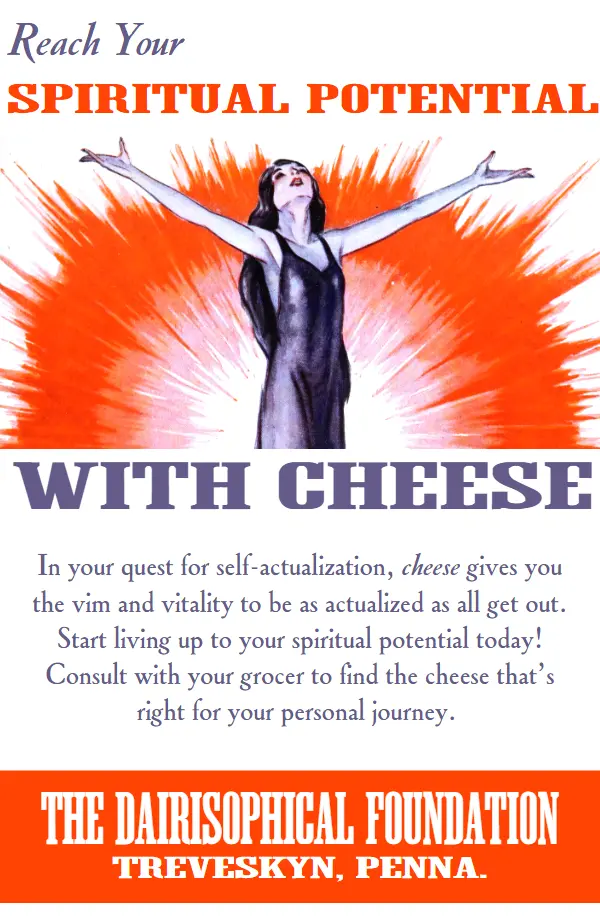
Why does everything these days need to be a “journey”? Although, I suppose that a cheese wheel smooths the personal journey toward full spiritual potential.
Dr. Boli will not presume to answer on behalf of his advertisers. He can only offer his own opinion: everything is a “journey” because, if you actually reached the spiritual destination on offer, you would find it was not all it was cracked up to be.
Advertisement.