Posts by Dr. Boli
FROM THE ILLUSTRATED EDITION.

ON THIS DAY IN HISTORY.
On this day in 1349, Jews were massacred in Mainz.
On this day in 1391, Jews were massacred in Palma de Mallorca.
On this day in 1924, Jews were massacred in Hebron.
A day with only three notorious massacres is actually a pretty good day for the Jewish demographic.
Advertisement.

NEW FALL LINEUP ON DUMONT.
Look for these thrilling new additions to the Dumont schedule beginning this fall:
Sluggo. One of the new wave of comic-book adaptations this season, Sluggo is a dark retelling of the adventures of Ernie Bushmiller’s tortured and angst-ridden boy from the wrong side of the tracks.
Hippo Repo. The continuing real-life adventures of a crack team dispatched to repossess hippopotamussesses from zoological parks that fall behind in their payments.
The Laughing Dead. Hysterical new sitcom about the zombie family down the street trying to fit into suburban society while eating their neighbors.
NCIS: Indianapolis. Thrills and mystery abound as a team of colorful characters solves crimes in America’s largest landlocked naval yard.
The Alan Sundry Variety Hour. Host Alan Sundry attempts to bring back prime-time variety with an all-dancing-poodles-and-spinning-plates format.
Advertisement.

FROM THE ILLUSTRATED EDITION.

FROM THE ILLUSTRATED EDITION.

WHITER THAN SNOW.
Our friend Father Pitt, who has just released a lovely little picture-book of Pittsburgh cemeteries, shares this interesting epitaph adapted from Psalm 51:7 (because the monument stands in a Catholic cemetery, the quotation is adapted from the Douay version, where it is Psalm 50:9):


The epitaph would not be interesting in itself, but as applied to the deceased, it has a certain ringing appropriateness:

Here, by the way, is an excellent argument for the use of a professional proofreader even in very short texts, especially when there is a possibility that one’s mistake in the name of a certain gulch will be immortalized in stone for more than a century.

THINGS WE SIMPLY CANNOT IMPROVE.

Dr. Boli has long believed that many of our conflicts today come from a misunderstanding of the difference between approval and tolerance. They are nearly opposite. It is possible for a Baptist to tolerate a Mormon: that is, to welcome him as a neighbor, to vote for him as a candidate for city council, to patronize his business, and to leave him alone to worship as he chooses. But do not ask the Baptist to approve of Mormonism. The Baptist must condemn Mormonism as fiction and heresy, or he ceases to be a Baptist. Likewise, the Baptist has every right to expect tolerance from the Mormon, but it would be shameful indeed if the Mormon were to approve of the Baptist’s religious doctrines: it would be an admission, in fact, that the Mormon’s supposedly fundamental beliefs are nothing more than a sham.
When advocates of a religious system or an alternative family arrangement demand our tolerance, they have Dr. Boli’s heartfelt support. When they demand our approval, however, they are asking for something to which they have no right. Dr. Boli has lived a long life, and he has seen many changes in the world, but he has still not been able to bring himself to approve of Presbyterians.
We all need a basic lesson in tolerance, and fortunately it is given very succinctly here, in a short passage from a very sensible etiquette guide published in 1855.
—
Every denial of, or interference with, the personal freedom or absolute rights of another, is a violation of good manners. He who presumes to censure me for my religious belief, or want of belief; who makes it a matter of criticism or reproach, that I am a Theist or Atheist, Trinitarian or Unitarian, Catholic or Protestant, Pagan or Christian, Jew, Mohamedan, or Mormon, is guilty of rudeness and insult. If any of these modes of belief make me intolerant or intrusive, he may resent such intolerance, or repel such intrusion; but the basis of all true politeness, and social enjoyment, is the mutual tolerance of personal rights. And every one who wishes to see the world anything but a scene of conflict and a prison house, must be willing to give this toleration themselves, and to demand it of all others, and for all others. Admirable was the answer of a friend of ours to some one who came to him with a complaint of what he thought the improper conduct of a neighbor: “I may not approve this man’s acts,” he said; “they may be contrary to my judgment, and offend my taste, but I would shoulder a musket to-morrow in defense of his right to do as he pleases in a matter that infringes upon the rights of no other person.”
No doubt there is a criticism which is proper and useful in society. There is no objection to very free criticism, when made in the spirit of toleration. The critic who says: “Neighbor, I understand that you ate cabbage for dinner to-day. I consider eating cabbage immoral, and opposed to the best interests of society.” This may pass, and I may thank my friend for the suggestion, and engage to take it into respectful consideration. But if he adds, “You have no right to eat cabbages, and if you persist we intend to pull your house down,” I should be apt to buy a revolver and try the issue.
It may be known, as a matter of fact, and innocently related, that such a man is a fire-worshiper; that such a woman knits on Sunday; that another eats his Welsh rarebit with mustard; that Miss Jones has the misfortune to be devotedly in love with her friend’s husband; or that Mrs. Thompson accepts the free-love theories of the Fourierists. But when such matters, the love or the mustard, become causes of persecution, there is a very gross violation of the first principles of good manners.
——The Illustrated Manners Book, 1855.
As to the author, “We have solemnly pledged to keep his incognito sacred,” says the publisher.
ON THIS DAY IN HISTORY.
On this day in 1819, seventeen demonstrators were killed and hundreds injured in what became known as the Peterloo Massacre.
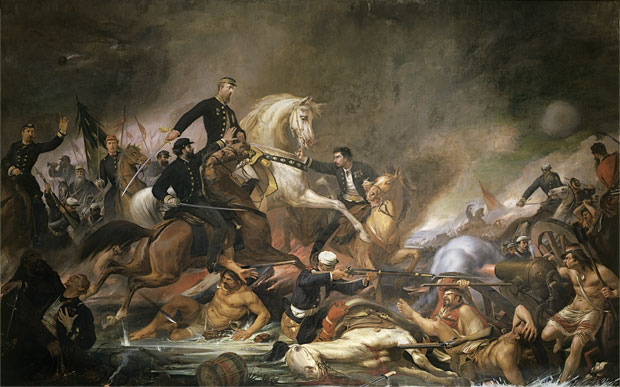
On this day in 1869, a Paraguayan battalion of children was massacred by the Brazilian army.
On this day in 1929, riots began in Palestine, ending in the massacre of roughly equal numbers of Arabs and Jews.
On this day in 1946, massacres began in Calcutta that would leave thousands dead.
On this day in 2012, South African police killed thirty-four striking miners in the Marikana Massacre.
Historians are still divided on the question of why the date August 16 is so unusually light on famous massacres.