Posts filed under “Books & Literature”
FROM THE ILLUSTRATED EDITION.

ON EBOOK READERS.
Dr. Boli would not have imagined that the mere mention of ebook readers could lead to such spirited discussion among his regular correspondents. Clearly the topic is one that provokes strong opinions, even among those who do not use ebook readers.
If everyone else has strong opinions on the subject, it will come as no surprise that Dr. Boli has some opinions of his own. To carry around a whole library in an object smaller than a single book is a wonderful advance in technology, but far too little attention has been paid to elementary considerations like type. Dr. Boli is looking at one of the most popular ebook readers right now. It right-justifies lines, but cannot hyphenate words, making pages look as if they were laid out by a third-grader with a home printing press. It counts all hyphens as nonbreaking hyphens, and two words separated by an em dash as one unbreakable word, which makes the page look even sloppier. One has the impression that the thing was designed by people who had heard of books at second hand, possibly by watching a short television documentary on the subject, but had never handled a book themselves.
For this reason, Dr. Boli prefers to read scanned books on a tablet computer, which is probably as close as one can come to having the experience of a paper book without any paper. Fortunately there are thousands and thousands of such books available from Google Books and the Internet Archive. Google Books even makes scanned pages searchable; Dr. Boli has no idea how such a miracle is accomplished, but he imagines it has something to do with slave labor.
Finally, Dr. Boli is pleased to report that, since he last wrote, he has found a simple and elegant solution to the problem of synchronizing an ebook with the paper copy at home. With most of the popular ebook readers, it is a simple matter to synchronize the book across multiple devices—in Dr. Boli’s case, various Linux computers, ebook readers, and Android devices. Having set up that synchronization on the desktop computer at home, one simply instructs one’s valet to check the last location read in the ebook a few minutes before one is expected at home, and then find that place in the printed book and insert a bookmark there. Similarly, before one leaves the house, the valet checks the position of the bookmark and advances the ebook to that location. Thus the synchronization is accomplished with no effort at all on the reader’s part.
ASK DR. BOLI.
Dear Dr. Boli: What do you think of these “ebook” things? —Sincerely, Mavis Buckle, Reference Librarian, Carnegie Branch Library, Blandville.
Dear Madam: Dr. Boli finds that ebooks are still in a very primitive state. He would like to do one simple and obvious thing with ebook readers, but it cannot be done with current technology. All Dr. Boli wants is an ebook reader that will sync to the paper copy of the book at home. One ought to be able to come home and find the bookmark stuck in the same page where one left off in the ebook while one was waiting for the streetcar. It is a very simple thing, yet no currently available device can do it, and that is frankly appalling.
FROM THE ILLUSTRATED EDITION.

MOCHA DICK.
Visitors to Google have doubtless noticed that today is Moby-Dick day, in which we celebrate the publication of one of the greatest works of American literary art. What few readers of Melville’s great novel remember, if they ever knew it, is that the story itself is not entirely original. It was based on real reports of a white whale, whom sailors named “Mocha Dick,” that actually did roam the Pacific mashing boats to splinters in the early nineteenth century. The account of the whale that Melville read, and that set him to furiously scribbling, appeared in the Knickerbocker magazine for May, 1839.
And because Dr. Boli loves a good sea story as much as the next man, and possibly even better than the man after that, he has found a copy of that original publication for you, his esteemed readers.
Mocha Dick: or the White Whale of the Pacific: A Leaf from a Manuscript Journal. By J. N. Reynolds, Esq., in the Knickerbocker for May, 1839.
Moby-Dick and other works by Melville may be found in Dr. Boli’s expanding on-line library, which, though it is still in early development, may reward the the literary visitor with unexpected treasures.
FROM THE ILLUSTRATED EDITION.

THINGS WE SIMPLY CANNOT IMPROVE.
The Tragedy of Chrononhotonthologos: being the most tragical tragedy that ever was tragediz’d by any Company of Tragedians. Written by Benjamin Bounce Esq. Edinburgh, 1734. —“Benjamin Bounce” is really Henry Carey, who in this play produced the blank-verse tragedy beyond which no blank-verse tragedy can ever go.
What other tragedy has ever introduced a character whose name alone takes up exactly one line of iambic pentameter? Yet here we have that character’s name, Aldiborontiphoscophornio, as the very first line of the play.
Or what tragedy has ever given us a more tragical speech than this?
A blow! Shall Bombardinion take a blow?
Blush! blush thou Sun! Start back the rapid Ocean!
Hills! Vales! Seas! Mountains! all, commixing, crumble,
And into chaos pulverize the world;
For Bombardinion has receiv’d a blow,
And Chrononhotonthologos shall die.
And could anything in Shakespeare equal this?
Ha! what have I done!
Go call a coach; and let a coach be call’d;
And let the man that calls it be the caller;
And, in his calling, let him nothing call
But Coach! Coach! Coach! O! for a coach, ye gods!
No, this must forever be the standard against which all other tragedies are measured. Fortunately, the original is available on Google Books, so when you need to measure a tragedy, you now have a proper measuring-stick.
FROM THE ILLUSTRATED EDITION.

ST. JEROME POLITELY RESPONDS TO HIS CRITICS.
Today is the feast of St. Jerome in the Lutheran, Roman Catholic, Anglican, and various other traditions. In honor of the great theologian and translator, we present the preface to his translation of Jeremiah, in which he demonstrates his application of Christian charity to the authors of unfavorable reviews that had appeared in the Observator Romanus some time before.
—
I pay little heed to the ravings of disparaging critics who revile not only my words, but the very syllables of my words, and suppose they give evidence of some little knowledge if they discredit another man’s work—as was exemplified in that ignorant traducer who lately broke out, and thought it worth his while to censure my commentaries on Paul’s Epistle to the Ephesians. He does not understand the rules of commenting (for he is more asleep than awake and seems utterly dazed), and is not aware that in our books we give the opinions of many different writers, the authors’ names being either expressed or understood, so that it is open to the reader to decide which he may prefer to adopt; although I must add that, in my Preface to the First Book of that work, I gave fair notice that my remarks would be partly my own, partly those of other commentators, and that thus the commentary would be the work conjointly of the ancient writers and of myself.
Grunnius, his precursor, overlooked the same fact, and once upon a time did his best to cavil. I replied to him in two books, and there I cleared away the objections which he adduced in his own name, though the real traducer was some one else; to say nothing of my treatises against Jovinianus where, you may remember, I show that he [Jovinianus] laments that virginity is preferred to marriage, single marriage to digamy, digamy to polygamy. The stupid fool, labouring under his load of Scotch porridge [scotorum pultibus praegravatus], does not recollect that we said, in that very work, “I do not condemn the twice married, nor the thrice married, and, if it so be, the eight times married; I will go a step farther, and say that I welcome even a penitent whoremonger; for things equally lawful must be weighed in an even balance.” Let him read the Apology for the same work which was directed against his master [Jovinianus], and was received by Rome with acclamation many years ago. He will then observe that his revilings are but the echoes of other men’s voices, and that his ignorance is so deep that even his abuse is not his own, but that he employs against us the ravings of foes long since dead and buried.
(Translated by W. H. Fremantle.)
ASK DR. BOLI.
Portrait of William Shakespeare, from the First Folio.
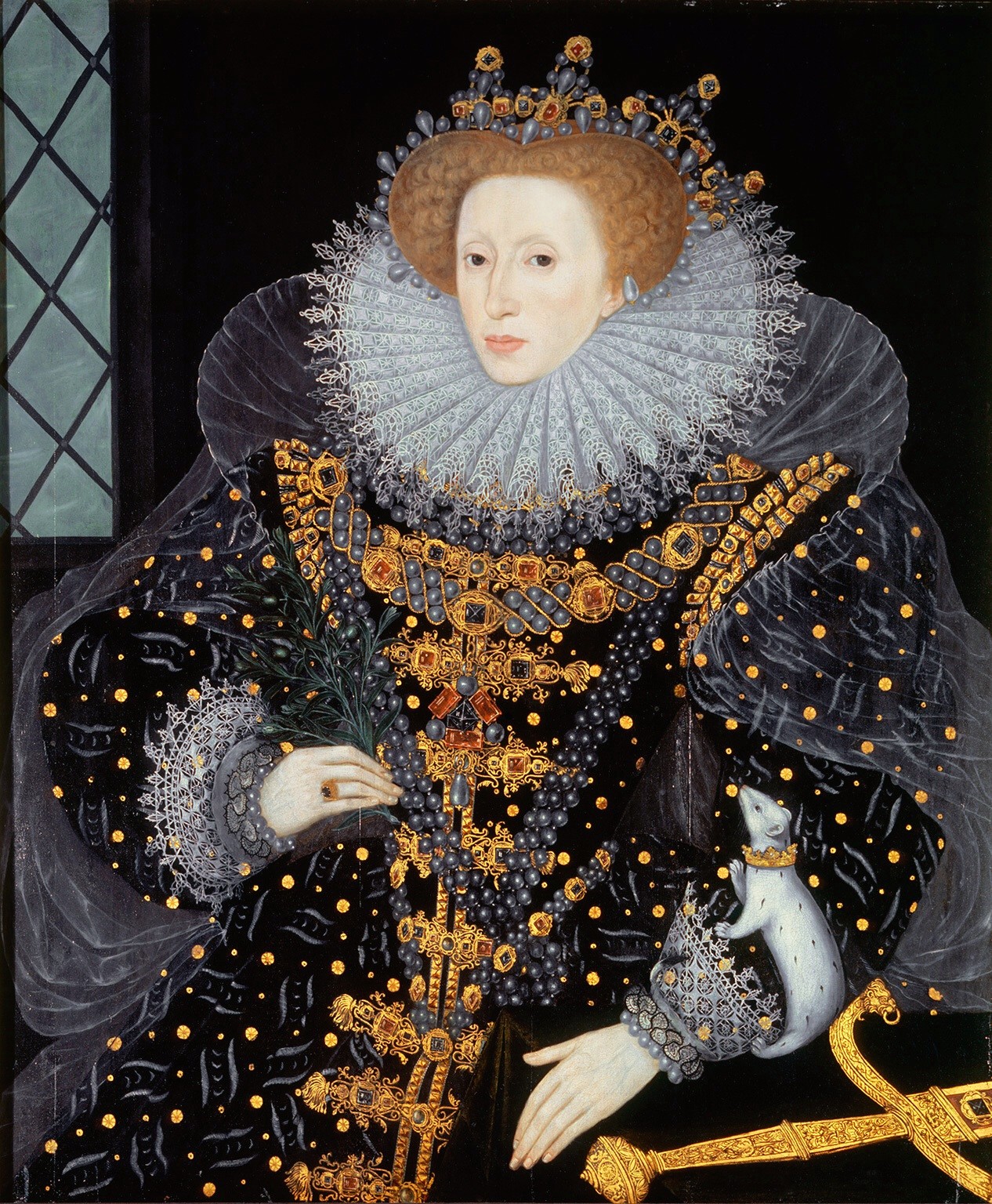
Dear Dr. Boli: A friend of mine says that the Earl of Oxford wrote Shakespeare’s plays. I thought everybody knew that Sir Francis Bacon wrote Shakespeare. But when I looked on line, I found all sorts of other theories—some people say Queen Elizabeth wrote Shakespeare, and others that it was Sir Thomas Bodley, or King James I, or the Earl of Salisbury, or Cardinal Wolsey, or Mary Queen of Scots, or Sir Thomas More, or the Earl of Derby, or the Earl of Essex, or the Earl of Rutland, or the Countess of Rutland, or Sir Philip Sidney, or Baron Brooke, or Sir Francis Drake, or the emperor Constantine the Great. So who wrote Shakespeare’s plays, anyway? —Sincerely, a Professor of Literature at the Pennsylvania University of California.
Dear Sir or Madam: Dr. Boli clings to the old-fashioned opinion that Shakespeare wrote Shakespeare’s plays, even though it causes children in the street to laugh at him as he passes by. (At least he assumes that his opinions on the Shakespeare question are the cause of their laughter, since it is well known that American children are full of unreasonable prejudices on questions of English literature.) He might bring forward any amount of literary evidence to support his unfashionable theory, but instead he argues from quantity rather than quality.
A gentleman of the nobility might amuse himself by writing two or three plays, and perhaps even having them produced on the stage; he would, of course, follow classical models and adhere strictly to the Aristotelian unities. But only a man whose continued existence depended on producing the next play would have written such a prodigious quantity of plays. Setting all questions of style and content aside, the mere number of Shakespeare’s plays tells us that we have here a man who wrote for a living. Dr. Boli is of the opinion that literary critics ought to consider the word count before they attempt to attribute such a mass of literary labor to a nobleman whose days were filled with affairs of state. As is so often the case in English literature, the critic’s most effective tool is a pocket calculator.