Posts filed under “Books & Literature”
FROM THE ILLUSTRATED EDITION.

THE CRIMES OF GALAHAD—NOW FOR NOOK.
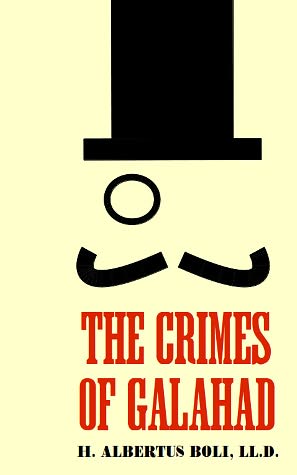
The acclaimed novel by H. Albertus Boli, The Crimes of Galahad, is now available from Barnes & Noble for your Nook reader, or for any device with access to Barnes & Noble ebooks.
The Nook version joins the Kindle version already available, as well as (of course) the print version, which is really quite a beautiful book, printed to the best 1880 standards, but on much better paper than a book from 1880 would have used.
Note that the digital versions are produced without annoying “digital rights management” technology. Dr. Boli believes that purchasers of digital copies should be free to do what they like with them, just as purchasers of print copies are.
FROM THE ILLUSTRATED EDITION.

A SMALL COLLECTION OF RARE FIRST EDITIONS.

Communism was a delightful idea, was it not? The humblest worker should be elevated to the level of the richest aristocrat, and all the advantages of education and material prosperity that once belonged only to the wealthiest should now be showered upon the whole population indiscriminately. And if the promise was not fulfilled as well as the projectors of communism had hoped, we may charitably lay the blame at the feet of a recalcitrant reality, rather than supposing any want of effort on the part of the communists. The real world refuses to produce luxuries in quantities sufficient to make every resident of it a decadent aristocrat, and until some strong measures are taken to bring reality in line with our expectations of it, truly successful communism may be out of human reach.
On the Internet, however, we are freed from the galling constraints of reality. When possessions are virtual, they can be multiplied without limit, and everyone with an Internet connection may possess what in the real world would be beyond the reach of all but the wealthiest.
How much would an autographed first edition of Moby-Dick be worth? There cannot be many such things in existence. The book was a failure on its first publication; no more than a few thousand of the first edition were printed, and many unsold copies were doubtless destroyed. But Dr. Boli, whose generosity with things that do not belong to him knows no bounds, stands ready to give each of you, his loyal readers, an autographed first edition of Melville’s masterpiece. This is the first American edition, from which every accurate edition is derived,—not the botched English edition that slightly preceded it.
Moby-Dick; or, the Whale. By Herman Melville. New York: Harper & Brothers, Publishers. London: Richard Bentley. 1851. (Look in the end-papers, before the title page, for Melville’s autograph.)

Moby-Dick is certainly one of the most famous American novels of all time. Mr. Melville dedicated it to his good friend Nathaniel Hawthorne, who, just one year before, had published The Scarlet Letter. Hawthorne’s book was a decided success, and it would not be too much to say that American fiction falls easily into two eras: before and after The Scarlet Letter. In this color scan of the first edition, we discover that the title itself was printed in scarlet letters:
The Scarlet Letter, A Romance. By Nathaniel Hawthorne. Boston: Ticknor, Reed, and Fields, 1850.

J. Fenimore Cooper was the writer who gave the United States a place among the literary nations, rivaling Sir Walter Scott as a purveyor of adventure tales, and almost universally acknowledged in his time as the greatest master of the sea story. He wrote prolifically and in all genres, and made one fascinating attempt at a Swiftian satire:
The Monikins; Edited by the Author of “The Spy.” In two volumes [both included in this scan]. Philadelphia: Carey, Lea, & Blanchard, 1835. —The first American edition, at archive.org.

The Monikins, incidentally, though it was an embarrassing failure in 1835, has gained a surprising second life among fans of science-fiction. It tells the story of an English aristocrat and a Stonington sea-captain who meet a race of intelligent monkeys living around the South Pole.
We also have a later tale by Cooper:
The Wing-and-Wing, or Le Feu-Follet; A tale, by the author of “The Pilot,” &c., &c. In two volumes. Philadelphia: Lea and Blanchard, 1842. —Both volumes are included in this scan. Cooper’s tales were often published under different names in America and Europe, and often the name changed in later editions. This tale is the same one published in other editions as The Jack-o-Lantern or The Privateer.
There are many more interesting first editions out there, and Dr. Boli is very generous, if not downright extravagant, with other people’s virtual possessions. Look for more such valuable free gifts in the near future.
FROM THE ILLUSTRATED EDITION.

THE CRIMES OF GALAHAD.


—
Update: Now available for Kindle or for Nook.
—
Every year, thousands of new books are published. But how few of those books are worth reading! Or, to put it another way, how few of those books are written by Dr. Boli!
Dr. Boli has long lamented the dearth of good fiction in modern publishing, and very sensibly came to the conclusion that, if he wanted a novel worth reading, he would have to write it himself.
That book, easily the most eagerly anticipated production of the literary season, is now available to you, the discerning public, at a very reasonable price.
The Crimes of Galahad is a new novel destined to stand with the works of Henry Fielding, Nathaniel Hawthorne, and Amanda McKittrick Ros as a permanent contribution to the literature of the English-speaking world. In it, Dr. Boli has not been afraid to plumb the darkest depths of the human soul.
Galahad Newman Bousted dedicates his life to evil at a young age. But will he succeed in his pursuit of pure wickedness, or will he be seduced by the many temptations to do good that stand in his way? Will he really carry out the monstrous crimes he has plotted? Can he possibly get away with them?
“Gripping.” —Industrial Vise & Grip Weekly.
“Shocking!” —Electrical Workers’ Local No. 278 Newsletter.
“Longer than Frankenstein, but shorter than Moby-Dick.” —Word Count Illustrated.

THE WISDOM OF GALAHAD NEWMAN BOUSTED.
Cultivated pearls from the book The Crimes of Galahad, now available in print, for Kindle, or for Nook.
—
To persist in evil requires dedication and perseverance. At every step, the temptations to do good are numerous, and at times nearly overwhelming.
The truly evil man, which is to say the enlightened man, does not prize continence for its own sake; but any virtue may be a tool in the pursuit of that which he desires. This is an important principle that every aspiring evildoer ought to take to heart: the truly evil man does not hesitate to practice virtue when doing so conduces to his advantage.
The appearance of piety can be of great use in promoting an evil scheme.
I do not recall a single novel in which the action was confined to repeated sales of identical commercial goods.
Money can buy the satisfaction of almost any lust, whereas lust almost invariably eats up money. To the young man pursuing a life of wickedness, I have this advice to give: always put greed before lust when indulging your petty sins.
Nothing so effectually robs a man of his wickedness as this insidious passion: though lust be accounted a sin, it too often proves a cunning trap that pulls a man inexorably downward, away from his true self-interest, and toward that disinterested sort of love that desires the good of its object. The wickedest man in the world, giving in to his lust, may find himself positively virtuous before he knows it.
What a strange thing it is that a man who, in the eyes of all society, would be condemned as a vicious criminal if he ravished an unmarried woman, can be, by a few words spoken in a church, made into a paragon of virtue, with the uncontested right to ravish the same woman whenever he pleases!
By what defective reasoning was I induced to love virtue, when vice carried off every prize? I have but one defense, which is that the misconception that virtue is of all things most desirable is inculcated in us from our earliest years. Nor would I make any alteration in that education, for now I see clearly the utility of it. For one who has given his life over to wickedness, nothing is more necessary than that the great mass of mankind should believe in virtue. In any jungle there must always be many more prey than predators. Therefore I applaud virtue; I give it my highest commendation whenever I meet with it; I lend it all possible aid and encouragement; I fatten it up, so that it shall in time fatten me up.


FROM THE ILLUSTRATED EDITION.

FROM THE ILLUSTRATED EDITION.

THE DAWN OF SURREALISM.
Note: This article has been rendered even more surreal by the strange process of drift that occasionally affects images from Google Books. Some day Dr. Boli may attempt to correct the problem. Evidently that day is not today.
What is surrealism? “Surrealist works,” says the omniscient Wikipedia, “feature the element of surprise, unexpected juxtapositions and non sequitur.” By this standard, the most perfectly surrealist works of literature are the type samples issued by the great type foundries of the nineteenth and early twentieth centuries. Dr. Boli will make no further argument for this proposition, because argument is superfluous where demonstration carries conviction, These samples are all drawn from a single catalog of the Economical Printing Company of New York, issued in 1896: