Posts filed under “Books & Literature”
PAST AGES WERE FULL OF IDIOTS.
“It used to be considered of poor literary quality, but a mass of recent writing (most notably in the Budé edition and commentary on the poem in 18 volumes) has demonstrated that it shows consummate literary skill, even if its distinctly baroque extravagance is for a modern reader a taste that has to be acquired.”
This is from the Wikipedia article on Nonnus of Panopolis, referring to his Dionysiaca, the longest epic surviving from antiquity. It is typical of the use of the word demonstrated in current academic writing about literature, a use that implies “case closed, no further argument necessary, objectively correct conclusion reached.” Past ages incorrectly assessed the literary quality of this work, but our own age has demolished their aesthetic judgment with science.
All right, but…
If you ask Dr. Boli to decide whose critical judgment is more likely to be objectively correct—a classicist of the nineteenth century whose taste may be a bit conventional, or a classicist of the twenty-first century who believes that consummate literary skill can be demonstrated like a proof from Apollonius—you will not be at all surprised by his decision.
ADVICE FOR LIBRARIANS.

Librarians like to cite titles without capitalizing any word but the first and any proper nouns. Thus The History of Tom Jones, a Foundling, is known in library catalogues as The history of Tom Jones, a foundling. This saves wear on the shift key and is not generally objectionable, but it does require some care in distinguishing proper nouns. For example, there is a world of difference between An introduction to Vulgar Latin and An introduction to vulgar Latin.
FROM THE ILLUSTRATED EDITION.

THE MAN IN LOWER TEN,
BY MARY ROBERTS RINEHART.
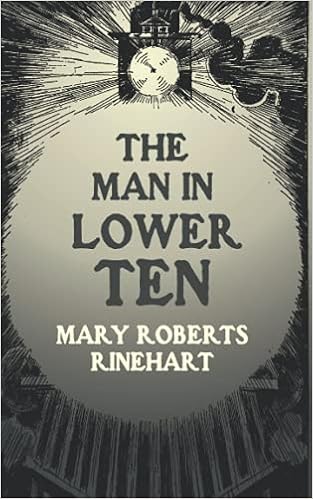
Once again Dr. Boli has contributed a short introduction to a Serif Classics edition of an interesting book from the past. This time the book is by Mary Roberts Rinehart, who ought to need no introduction, but whose enormous popularity and influence have been strangely forgotten recently. The book can be found on line, of course, but the Serif Classics edition is well formatted, pleasant to hold and read, and always there for you when the power goes out.
We make no apology for launching this new edition of The Man in Lower Ten without a lengthy introduction. It is pure entertainment by the author who, of all American writers, was most adept at entertaining us.
By a strange freak of the publishing industry, though, Mary Roberts Rinehart’s books have been largely forgotten today. It is not because they are no longer entertaining. It is simply because they are filed in the wrong section in the bookstore.
In her lifetime, her books were described as mysteries. We have a different expectation for mystery stories now, however. We expect something either more like Agatha Christie or more like Raymond Chandler.
Agatha Christie stories give us a comfortable formula, in which the same detective solves one mystery after another, regardless of the creeping depopulation of her village.
Raymond Chandler gives us the seamy underworld with its colorfully amoral characters, one of whom is a detective whose breezy cynicism hides a little diamond core of morality. We expect it always to be the same detective, even if the stories are by different authors.
The category that fits Mary Roberts Rinehart today is “thriller.” The Man in Lower Ten could almost be a story by the late Dick Francis. With one notable exception, Francis’ heroes did not reappear for later stories. They had their one big adventure, and then they retired to live normal lives. This is the Rinehart way.
The one thing that tells us right away that this is not a Dick Francis story, however, is that Rinehart has a sense of humor. Francis never mastered that department of writing. He did just fine without it. One feels, however, that with humor added to thrills, mystery, and romance, the package is more complete.
Our story takes place mostly in Pittsburgh (which was officially spelled “Pittsburg” in 1909) and Washington and along the railroad between them. This is territory Rinehart knew backwards and forwards, and her familiarity with it makes the narration seem natural and effortless. There is a missing bundle of papers, a hero wrongly accused of murder, a train wreck, a beautiful woman with a mysterious secret, two old dark houses, a comically tyrannical housekeeper, and a wisecracking best friend. You can rely on these ingredients to produce first-rate entertainment, and you can rely on Mary Roberts Rinehart to make the best use of her ingredients. And with that we confidently leave you to enjoy the show.
FROM THE ILLUSTRATED EDITION.

FROM THE ILLUSTRATED EDITION.

FROM THE ILLUSTRATED EDITION.

FROM THE ILLUSTRATED EDITION.


HAPPY WORLD INTELLECTUAL PROPERTY DAY.
But you might ask, What is “intellectual property”?
The simple answer is this: intellectual property is the legal right of large conglomerates to keep individuals from saying anything of which the conglomerates do not approve.
This is distinct from copyrights and patents, whose purpose is explained in admirably succinct terms in the United States Constitution: “To promote the progress of science and useful arts, by securing for limited times to authors and inventors the exclusive right to their respective writings and discoveries.” In other words, writers and inventors should be able to make a living, and if they can do so, we shall have more writing and invention. For a limited time, then, a writer or inventor is the only one who can use the thing she has written or invented. After that, it becomes the property of the public, which is the primary purpose of encouraging writing and invention.
Contrast this with the intellectual-property laws we have today, which have the opposite effect. Until the end of this year, the first record by the Original Dixieland Jazz Band, Livery Stable Blues, is still under copyright. If you want to use it to establish atmosphere in your movie set in 1917, you have to pay a licensing fee. Were Nick LaRocca, Larry Shields, and the rest encouraged to create by knowing that, a hundred years later, their creation would make money for a Japanese conglomerate? In literary works, the copyright in the United States now lasts for 95 years from publication. How many writers are making a living today from works they themselves wrote 95 years ago?
You might, of course, say that authors are encouraged by the idea that they might leave their intellectual property to their grandchildren. Perhaps they are. But do we have more authors because of 95-year copyrights than we would have had if the copyright lasted for 28 years? Dr. Boli does not believe that any more writing is encouraged by copyrights that last long past the death of the author.
But much is discouraged. The purpose of copyright is to cause more people to write for a living. With copyrights that last into their great-great-grandchildren’s generation, however, successful authors can establish an intellectual-property aristocracy whose defining characteristic is that it has no need to contribute anything to our intellectual life. On the contrary, by asserting their right to a work produced decades ago by someone long dead, they stifle our intellectual life.
Consider the case of Shakespeare. That is really all you have to do: the argument is made. Shakespeare’s best plays would have been impossible under modern intellectual-property law. If he had produced them, the conglomerates who owned the rights to the vastly inferior source material would have sued him and taken all the proceeds of his genius. Would that have encouraged Shakespeare? Would it have promoted the progress of his art?
Very well, you say: I am convinced, but what can I do? The ordinary citizen can do much. The best thing to do is to adopt the strategy of the intellectual-property empires, the strategy that brought us to this point, and use it against them. Buy yourself a representative, or a senator if you can afford one, and make it clear to your new pet that the campaign money will cease to flow unless legislation is introduced to restore a sane balance to copyright law.
But if you cannot afford even so much as a representative, you at least can vote. It is surprising how much your vote is worth; you could make a rough estimate by aggregating all the costs of the campaign advertising directed at you, and you would be surprised at the number. Candidates for office do care about your vote. Set some sensible conditions on it, and encourage others to do the same. The empire of intellectual property was not built in a day, and it will not be dismantled in a day. But we barbarians will bring it down eventually if we concentrate our efforts on its weakest frontiers.
THE AMERICAN-EST AUTHOR’S NAME IN HISTORY?
In Nature’s Image: Chapters on Pictorial Photography, a fine book on art photography from the 1890s, by Washington Irving Lincoln Adams.