Posts filed under “Books & Literature”
HOW DECIMAL CURRENCY WAS INTRODUCED IN THE UNITED STATES.
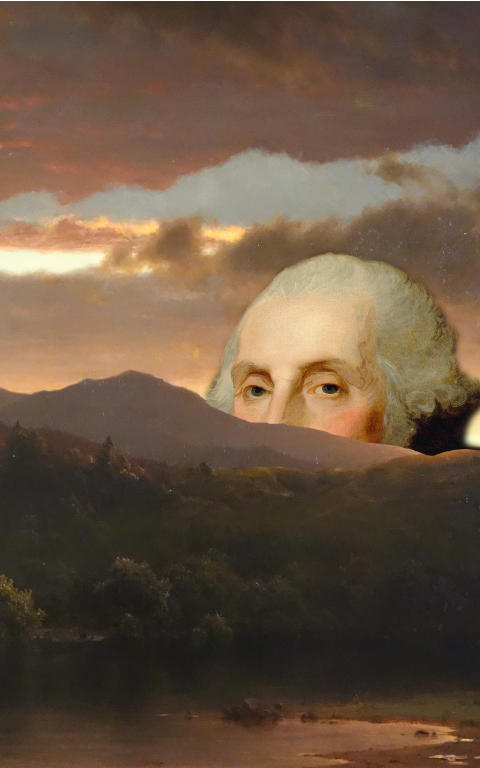
Monday, August 10, is George Washington Day. Be ready for the whole truth about the Father of His Country. Here is a very short specimen of what you may expect.
—
Meanwhile the business of creating a government occupied most of the meetings of Congress; and as Congress created the positions, the President was required to nominate men to fill them. Of course Washington could think of only one man to be the Secretary of the Treasury, and Mr. Hamilton was hardly able to contain his joy at being able to found his own currency.
“We shall base it on tens,” he explained, “which will at a stroke eliminate the difficulties of converting between pounds, shillings, dollars, and all the other coins that jangle in our purses; and we shall have a national currency, so that there will be no complicated formula, as there is now, to convert the coin of New Hampshire to that of North Carolina. As the people are familiar with the name, and as it carries no memories of our oppression by the British, we shall call our coin the dollar, and if—”
“And these dollars,” Washington interrupted—“of what size and weight will they be?”
“The weight, of course, will depend on the value we assign to the United States dollar; as for the size, we shall consult with the men we choose to run our mint, who will be able to tell us how such and so much a weight of silver is best distributed in a coin.”
“These are very important considerations from the point of view of a coin’s projectile properties,” said Washington. “The Spanish milled dollar travels well through the air, and possesses enough heft to carry it to its target without being too much buffeted by the wind. I should hate to see an American dollar without those properties; for men who throw dollars for sport are very particular about the dollars they throw, and might reject our United States dollar if its range and accuracy do not meet their expectations.”
“I am certain you could persuade our mint to take those considerations into account,” said Hamilton. “Now, as I said, multiples of ten will—”
“A milled edge also improves the grip, which for sporting purposes is one of the most important considerations.”
“Yes. The grip. Now, as I was saying, we shall make our dollar divisible into tens, which we might call ‘dimes,’ as being, of course, the tenth part of a dollar. A tenth part of a dime would then be a ‘cent,’ because it is the hundredth part of—”
“I thought you said it was the tenth part.”
“It is the tenth part of a dime, and therefore the hundredth part of a dollar.”
“Why can’t it make up its mind?”
“It is both at the same time!”
“My word! That’s clever.”
“And then the tenth part of a cent would be a mill, bec—”
“Because it is the millionth part of a dollar!”
“No,” Hamilton explained with strained patience, “only the thousandth part.”
“Then why is it called a mill?”
“Because it is—”
“Why not a thou?”
“Because the names come from Latin, or rather—”
“Oh, Latin,” said Washington knowingly. “Well, Latin is another matter altogether.”
Hamilton was about to say something more, but then appeared to realize that he had won as much of a victory as he was likely to win in this discussion, and resumed his earlier topic. “As I was saying, the division into tens will make calculations much easier for ordinary shopkeepers and merchants, who will find their duties lightened considerably.”
“For example,” said Washington, “if I buy a turkey quill at Stimson’s in Alexandria for one bit, which is an eighth of a dollar, then that comes to…now let me see…”
“Twelve and a half cents,” said Susanna.
“Twelve and a half? Well, that doesn’t sound very easy at all. How is that easier than saying ‘one bit,’ Hamilton?”
“It just is!” Hamilton sputtered. “Tens are easier!”
I looked at Susanna, but she had nothing more to say. With Hamilton’s explosion, she had accomplished her goal.
HOW WASHINGTON AND DE GRASSE PLOTTED TO DEFEAT CORNWALLIS.
Monday, August 10, is George Washington Day. Be ready for the whole truth about the Father of His Country. Here is a very short specimen of what you may expect.
—
“It sounds very well,” said Washington, “but how are we to be sure of victory against so great an army? Cornwallis has greater numbers on his side.”
“The French fleet, sir, will be essential,” replied Susanna. “Cornwallis, we hear, has taken a position on the peninsula. If the French can prevent his escape by water, and prevent his being reinforced or resupplied, then we need only block the land routes, and we have him.”
This seemed like good advice to Washington, and so Admiral de Grasse was summoned to a meeting with the General, at which La Fayette was also present, along with Susanna and me. We unrolled a large map of the peninsula between the York and James rivers, and the three great leaders studied it in intense silence for a while. At last Washington spoke.
“If we dispose our soldiers here, on the north and east, with Fayette’s French army on the south, then you, Admiral, should be able to cut off Cornwallis completely by water to the west.”
“Yes,” de Grasse agreed, “the plan, it is excellent. He shall not escape us, by blue.”
Susanna looked down at the map. “I believe, sirs, that you have mistaken the water for the land, and the land for the water. These wavy lines here, you see, indicate the water; the land is this area behind them, here.”
“Ah!” said Washington. “Thank you, Phillips. Well spotted. That is important information, and complicates the strategy considerably. We cannot expect the men to stand very long in water that is possibly up to their necks, or even over their heads. We shall need to make some adaptations; perhaps some sort of bridge or pier assembly, or better yet a series of floating wooden platforms with which we can surround the peninsula on three sides, and on which the men can stand dryshod for an indefinite period of time. It will require a good bit of wood, which will require a good bit of labor; although the labor will be hastened considerably if we can find any large stands of wild cherry. That will do for the army; but, unless I am very much mistaken, the disposition of the fleet will require at least as much thought and labor, if not more.”
“Very assuredly,” the Admiral agreed. “I believe that a construction of the rollers, made perhaps of the trunks of the trees, will be necessary for the placing of the ships in position, if indeed suitable trees find themselves nearby.”
“Well, there fortune favors us,” said Washington. “Tidewater Virginia has many stands of pine that grow straight and tall, with few branches until very near the top; such trees would, it seems to me, make admirable rollers for our purposes.”
Susanna was sitting with her head down, her eyes closed, and her fingers on her temples; but now she spoke again. “If I may be so bold, sirs, it might be better to reverse the positions of the army and the fleet.”
The General and the Admiral both looked at her blankly for a moment; then Washington spoke slowly and cautiously. “Do you mean, the army on the land, and the navy in the water?”
“Yes, sir,” Susanna said with care and patience. “Each force deployed in its native element, so to speak.”
“My word, Phillips! How much simpler that makes everything! You see, Admiral, why I insist on having Captain Phillips present whenever we discuss strategy.”
GEORGE WASHINGTON IS COMING.
Monday, August 10, is George Washington Day. Be ready for the whole truth about the Father of His Country.
The painting, “Washington Rising,” is an unwilling collaboration between Frederic Church and Gilbert Stuart.
FROM THE ILLUSTRATED EDITION.


THAT ZEBRA AGAIN.
Dr. Boli is in the habit of leaving no stone unturned when there is information to be sought. Most of the time he finds potato bugs, but now and then he does stumble across the thing he was looking for. In this case, he has found a German translation of the book Regnum Congo, Hoc est Vera descriptio regni Africani, quod tam ab incolis quam Lusitanis Congus appellatur (The Kingdom of Congo; that is, a True Description of the African Kingdom, Which by the Natives as Well as by the Portuguese is Called Congo), from which he took the de Bry brothers’ illustration of a Zebra two days ago. The German translation uses the same cuts, and the owner did in fact have them hand-colored. Unfortunately the text that described the Zebra was in the vernacular language of the colorist, so he was able to follow the description explicitly. Still, the result, you will certainly agree, is striking.
WE ALL HAVE DAYS LIKE THIS.

Speaking of illustrations from the Renaissance, here is a woodcut from the title page of a 1535 Tractatus perutilis et completus de fractura cranei (“Really Useful and Complete Treatise on the Fracture of the Skull”).
YOU CAN SAVE WHEN YOU PURCHASE THIS PRODUCT AS PART OF A COLLECTION.

FROM THE ILLUSTRATED EDITION.

From DR. BOLI’S ENCYCLOPEDIA OF MISINFORMATION,
Third Series.

Friedrich Schiller. Although today he is considered a master of the German language, in his youth Schiller spent three months in jail for an incorrect use of the subjunctive.
THE WONDERFULL AVENTURE OF SYR GAWAYNE IN THE CASTELL OF MAYDEN CLERKES,
Which Is a Tale Sette Downe for One of the Trewest and Mervayllest Aventures That Ever Bifel Syr Gawayne.
—
There was probably one reader in the world, besides Dr. Boli himself, who was entertained by this story when it was first published years ago, and that reader is now gone. In honor of the late Professor Frank Zbozny, a great medievalist and frequent reader of this Magazine, Dr. Boli will print it again.
—
And after ryding above thre Englysshe legues syr Gawayne cam uppon a fayre castell. And over the castell gate was wryten in letters of gold,
WORDPRESS TAG: POETRY
And in front of the castell on a roche there sate a mayden, weping ful sore for pyté. And syr Gawayne unmounted hym and asked the mayden, “Wherefor makyst thou soche dole?”
And the mayden answered him, “Trewely I am wepyng for the custome of this castell, for whan that I sawe thee, a knight valyaunt and ful of vertu, approche unto thys curssed castell, hyt nyghe brast myn herte for pyté.”
“Tell me,” quod syr Gawayne, “what ys the custome of this castell?”
“Trewely,” quod the mayden, “ill chance hath brought thee here. For thys ys the Castell of Mayden Clerkes, and hyt ys the custome of this castell that no knyght may passe but that the Mayden Clerkes assaulten hym with dogerel. And many knyghtes have com hereby, but none be yet on lyve.”
“That ys an yvell custome,” seyde syr Gawayne.
“Wherefor I dyd make soche dole whan that I sawe thee. For hyt is seyde that none bot the moste valyaunt of King Arthurs knyghtes schal conquer thys castell. And truely the knyght that enchevyth this aventure schall have moche erthely worschipp. And lo, the Mayden Clerkes approche even now, wherefor I byd the mak haste to arme the.”
And syr Gawayne loked and biheld sevvyn maydens armed like unto knyghts. And eche helde a scroll on whych wer wryt straunge letters, and at once they biganne to rede from the scrolls. And syr Gawayne helde hys shelde tofore hym, but the maydens dyd shoot jagged half-rimes that brast hys shelde asonder.
And whan syr Gawayne was sore bysette, and wot not how he myght defend hymselffe, bihold there appered unto hym Merlion, who gav hym a boke and bade hym rede therfrom. “And loke you rede loude and eke streng,” quod Merlion, “for your lyf dipendyth uppon hyt.”
So syr Gawayne opyned the boke, and lo, in it wer wryten the workes of the Englysshe poets of most renome and worschippe. And syr Gawayne bigan to rede dan Chaucer his poemys in a voys ful resonaunt. And straightaway the maydens dyd dropp hir scrolls, and thei did cover hir eares with hir hondes. And at the fift stanza of Troylus and Criseyde, the maydens all fel doun dede, and the castell vanysshed al sodeynly, for the inchauntements of the place were al to-brokyn.
And on the roche wher the mayden had sate Merlion lette wryt in gold letters,
HERE SYR GAWAYNE DYD CONQUER THE CASTELL OF MAYDEN CLERKES BY POUER AND VERTU OF TREWE POETRIE.
And the peple of the lands about the castell mad grete chere of syr Gawayne, and he dyd abyde with hem fyve dayes with grete honneur.