Posts filed under “Young Readers”
DR. BOLI’S PAINT-BY-NUMBERS.
No. 1.—A Steer.
HERE’S AN ACTIVITY the whole family can enjoy! Simply fill in the numbered areas on this drawing of a steer, using the numerical key to guide your choice of colors. When you’re done, you’ll have a beautiful painting, similar to the celebrated agricultural paintings of the Dutch artist Aelbert Cuyp, but with considerably less effort.
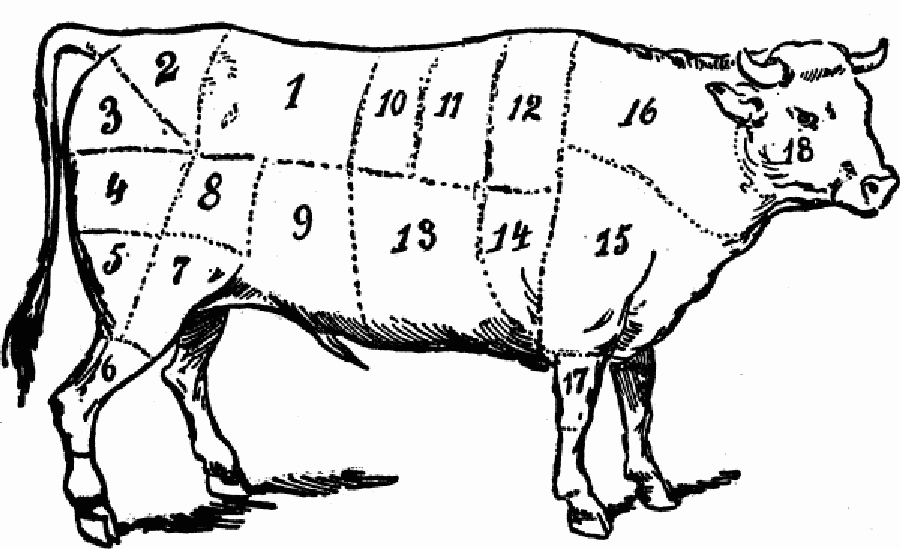
Click on the picture to enlarge it; then download it and print it.
Color Key:
1. Brown
2. Brown
3. Brown
4. Brown
5. Brown
6. Brown
7. Brown
8. Brown
9. Brown
10. Brown
11. Brown
12. Brown
13. Brown
14. Brown
15. Brown
16. Brown
17. Brown
18. Brown
Kids! Send your completed painting to this address for a special prize:
The Hon. Arlen Specter
United States Capitol
Next to Heck’s All-Nite Service Station
Washington, D.C.
Make sure you mention that Dr. Boli sent you.
FORTHCOMING WORKS BY DR. BOLI.
A Child’s Guide to Proper Self-Esteem. Educational and behavioral experts agree that proper self-esteem is essential to the correct development of young persons. Without a correct understanding of the self, the development of the personality is grotesquely stunted. Beginning with Chapter 1, “Proper Self-Esteem Means Knowing You’re a Twit,” Dr. Boli leads today’s spoiled and coddled young people on a journey of true self-discovery. Through entertaining chapters like “Understanding Your Fallen Nature” and “Where Your Parents Went Wrong,” young readers learn the value of proper self-esteem in the well-ordered life. By the time they reach the end of the book, Dr. Boli guarantees that the little creeps will have no more problems with self-esteem. 12mo, 832 pp.
THE LITTLE DUTCH BOY WHO SAVED HOLLAND.
From Dr. Boli’s Fables for Children Who Are Too Old to Believe in Fables.
–
ONCE THERE WAS a little Dutch boy who discovered a leak in the dike.
What should he do? From a single leak, a terrible breach might grow. The whole country could be flooded, and everyone he knew would drown.
So he did the only thing he could think of. He stuck his finger in the dike, and the leak stopped.
Of course, now he was stuck. He couldn’t move, because as soon as he did, the leak would start again.
So he stood there for quite some time. He was rather tired, and his finger felt a bit numb from the effort of holding back the North Sea, but he knew he was doing his duty.
At last the Burgomaster happened to pass by.
“Young man,” he said with a certain amount of sternness, “why are you poking your finger in the dike?”
“I am stopping a leak,” the boy explained. “I saw the dike leaking, so I stuck my finger in the hole.”
“Heroic boy!” the Burgomaster exclaimed. “You shall be rewarded! Meanwhile, keep your finger there while I call the Burghers together.”
So the Burgomaster called a meeting of the Burghers, and they agreed that the boy had heroically saved Holland.
“And now,” the Burgomaster asked, “what shall we do about the leak?”
“It seems to me,” one of the Burghers replied, “that private enterprise has already found an admirable solution to the problem. The boy has stuck his finger in the dike, and the leak has stopped. You might describe it as voluntary self-regulation. There is no need for expensive government action.”
So the Burghers voted to award the boy a Certificate of Good Citizenship, which the Burgomaster was delighted to be able to present to him the next day.
“Thank you,” the boy said politely, “but I still have my finger in this dike.”
“And we appreciate that,” the Burgomaster replied. “I may confidently speak for the whole Council of Burghers in saying that your heroic action is universally admired.”
So the boy stood there with his finger in the dike for a few more days.
It was not long, however, before another leak sprang in the dike, a little bit farther down the way.
“What shall we do?” the Burgomaster asked the Burghers. “There is another leak.”
“As private enterprise has so admirably solved the previous problem,” one of the Burghers responded, “the solution to this new leak is obvious. We need only persuade another heroic boy to stick his finger in it.”
So they went into the local school and found another boy who, after much persuasion, was willing to stick his finger in the dike.
It was, however, only a few days later that two more leaks appeared. This time it was much harder to persuade boys to stick their fingers in the holes; and when, a week later, half a dozen more leaks appeared, no volunteers were to be found.
“What shall we do?” the Burgomaster asked the Council. “Private enterprise seems no longer to be adequate. We may have to repair the dike itself this time.”
“Nonsense,” said one of the Burghers. “The solution that worked before will work again. We must simply force private enterprise into action.”
So the Council visited the school and dragged a number of young boys by the ears to the dike, where they were forced to plug the leaks with their fingers.
But the dike, which was old and poorly maintained, continued to spring new leaks here and there, so that it was all the Burghers could do to find more boys to plug up the leaks with their fingers. At last the Burghers compelled every little boy in the Low Countries to stick his finger in a hole. All economic activity came to a halt, as it is well known that young boys are the leading consumers of skates and cheese, on which the economy of Holland depended at that time.
“What shall we do?” the Burgomaster asked the Council. “We have run out of heroic little boys. At this rate, we may have to plug the leaks with our own fingers.”
“That would be moderately inconvenient,” one of the Burghers remarked.
So the Council voted to remove the North Sea by digging a new seabed somewhere in Germany; and they voted themselves a number of solid gold spades, befitting their dignity, for the purpose. And if you go to suburban Wilhelmshaven right now, and look into the field to your right as you drive westward on the Friedenstrasse, you will see a number of Dutch burghers very busy with their spades, trying to dig a new bed for the North Sea. It is lucky for them that the people of Wilhelmshaven have mistaken the burghers for a party of archaeologists looking for ancient Saxon remains, which has allowed them to continue the work uninterrupted.
—
Are you well-informed on every subject? Not to worry! You can overcome that embarrassing deficiency with Dr. Boli’s Encyclopedia of Misinformation.
FUNNY PAGES.

CERTAIN LESS FAMILIAR RHYMES OF MOTHER GOOSE.
The Flying Pig.
Hickory dickory dare,
The pig flew into O’Hare.
The man in brown got off, but oh!
His luggage went to Mexico.
–
A Song of Aspiration.
I won’t be my father’s Jack;
I won’t be my father’s Jill.
I will be an oilman’s wife
And have a full tank when I will.
Oh! One more mile,
One more mile,
See if you can push it
One more mile.
–
A Most Philosophical Ditty.
I do not like thee, Thomas Hobbes.
When I read thee, my head just throbs.
And so I say, between my sobs,
I do not like thee, Thomas Hobbes.
–
The Remarkably Theatrical Fowl.
Higgledy piggledy, my red hen,
She laid an egg in New Haven again.
Tsk tsk tsk and tut tut tut,
They hated her show in Connecticut.
–
An Agribusiness Lullaby.
Hush-a-bye baby, on the tree top,
When did a tree ever grow such a crop?
Try rooting a cutting of it, by all means,
And send your attorney to patent the genes.
–
A Woeful Riddle.
As I was going to Sewickley,
I met a man who sure looked sickly.
He had six wives around the state,
Six mortgage payments that were late;
And with each wife he had six kids.
No wonder he was on the skids!
His children threw unseemly fits;
His Frigidaire was on the fritz;
One wife ran off with a rodeo clown;
His BMW broke down.
Wives, cars, payments, kids, and fridge,
How long till he jumps off a bridge?
–
Cat, Queen, and Tabloid.
“Pussy-cat, pussy-cat,
Where have you been?”
“I’ve been up to London
To look at the Queen.”
“Pussy-cat, pussy-cat,
What have you done?”
“I just took some pictures
To sell to the Sun.”
CAPTAIN PLEONASM FACES THE FUTURE.
Although no recordings of the old Captain Pleonasm radio serial have survived, a number of the original scripts were recently unearthed in the archives of the Northern Broadcasting Company.
ANNOUNCER. Malt-O-Cod, the delicious and nutritious malt food drink flavored with real cod-liver oil, presents…
(Music: Theme, up and under for…)
ANNOUNCER. The Thrilling and Exciting Adventures of Captain Pleonasm and His Faithful and Trustworthy Sidekick and Assistant, Interjection Boy! Now featuring the Malt-O-Cod Orchestra and Chorus, directed by Paul Hindemith.
(Music: In full.)
CHORUS. Don’t throw a fit or have a spasm:
It’s time for Captain Pleonasm!
He battles evil, and, forsooth,
He fights for justice and for truth!
He hates the bad and loves the good,
As self-respecting heroes should.
He conquers villains strange and odd,
And saves the world for Malt-O-Cod!
(Music: Fade.)
ANNOUNCER. As you recall, in last week’s episode, Captain Pleonasm and Interjection Boy found themselves facing a strange new villain.
INTERJECTON BOY. Oscillatin’ ocelots, Captain Pleonasm! It’s just a crumbly old man in a funny costume!
(Music: stinger.)
LIEUT. COL. PLEONASM (aged voice). Is that so, Interjection Boy? Is that what you think of me now? Well, Captain Pleonasm, perhaps you will disregard and ignore Interjection Boy’s intemperate and ill-considered remarks. Perhaps you will pay no attention to him at all when you discover the truth of who I am. Perhaps you will set aside the boy’s incontinent logorrhea and—
INTERJECTION BOY. Marry come up, Captain Pleonasm! He talks just like you!
CAPT. PLEONASM. Indeed he does, Interjection Boy! He speaks with the same carefully constructed and balanced rhetorical exactitude which I have always cultivated. His periods move with the same impeccable rhythm that it has always been my studious endeavor to maintain. Could it be, sir—could it be that you are my long-lost father?
LIEUT. COL. PLEONASM. No, you idiot! Mercy, I forgot how dim I used to be. Can it be that I was ever such a moron? You know perfectly well your father is alive and well in Tarpon Springs. The only reason you’ve “lost” him is because Interjection Boy set fire to your address book when he was playing with your Inferno Ray.
INTERJECTION BOY. Red-hot yams, Captain Pleonasm! How does he know about that? You promised not to tell anybody!
CAPT. PLEONASM. Then who, sir, are you? What is your name, and whence do you come?
LIEUT. COL. PLEONASM. I’m you, you lackwit fool!
(Music: stinger.)
LIEUT. COL. PLEONASM. My name is Lieutenant Colonel Pleonasm, and I am you from the future. I have come back here thanks to the recent commercial availability of inexpensive and reliable time machines.
INTERJECTION BOY. Holy persimmons!
CAPT. PLEONASM. Then you are I, and I am yourself! We are identical, though different in age. Separated in time, we are yet united in identity.
LIEUT. COL. PLEONASM. I knew you were going to say that.
CAPT. PLEONASM. Then can it be that you have come back to aid me in my darkest hour? Is there some diabolical plot afoot, so fearful in its complexity, so awesome in its power, that only the two of us working together, with your superior future technology, can defeat it? Have you come to offer me the benefit of my own future cooperation?
LIEUT. COL. PLEONASM. No, you ignorant booby! I’ve come back to destroy you. I’ve returned to wipe you clean from the pages of history.
INTERJECTION BOY. But, jodhpurs, Lieutenant Colonel Pleonasm! Why?
LIEUT. COL. PLEONASM. Because I’ve turned evil in my old age! Forsaking the good, I have found far more profit and satisfaction in villainy! Yet the world would be a much more secure place for villainy had my former self not dedicated his life to making the world safe for good.
INTERJECTION BOY. But, gallopin’ gnus, Lieutenant Colonel Pleonasm! Does this mean I turned evil in the future, too?
LIEUT. COL. PLEONASM. No, you opened a Peugeot dealership on Baum Boulevard. I have no quarrel with you. My quarrel is only with myself. If I destroy my former good self now, all his works for good will never have happened!
(Music: Stinger.)
ANNOUNCER. Is this the end for Captain Pleonasm? Will his future destroy his present? Will his present destroy his future? Will his future, by destroying his present, destroy his future as well? Will Interjection Boy be able to make a living selling unreliable French cars to American drivers? Don’t miss next week’s enthralling and riveting episode of the Thrilling and Exciting Adventures of Captain Pleonasm and His Faithful and Trustworthy Sidekick and Assistant, Interjection Boy!
(Music: Theme, in full and under for…)
ANNOUNCER. When Captain Pleonasm wakes up in the morning, what’s the first thing he asks for? It’s Malt-O-Cod, the only malt beverage flavored with 100% real cod-liver oil. Kids, ask your moms for Malt-O-Cod, now with an official Captain Pleonasm demitasse spoon in every package. It’s the malt food drink that’s brain food—Malt-O-Cod.
(Music: In full, then out.)
THE BOY’S BOOK OF CRAFTS AND HANDY-WORKS.
No. 732.—A Modest Nation-State.
LIKE MOST BOYS our age, my friend Ned and I were captivated by Plato’s Republic, which we considered a cracking good book, certainly our third-favorite after Treasure Island and Robert’s Rules of Order. Nor was it only the twists and turns of the plot and the sparkling wit of the dialogue that kept us turning pages. Mixed in with those delights, as fans of Plato may have noticed, is a fair amount of wisdom on the subject of political philosophy. Long after we were supposed to be in bed, Ned and I kept up our debates on the questions brought up by the book, communicating between our houses by means of a telegraphic system we had devised involving night lights and Venetian blinds in our respective bedrooms.
Although we had been absolute dictators of Canada for a summer, my friend Ned and I longed for the satisfaction of founding a nation on our own principles. As we finished the book and continued our nightly discussions, this pleasant notion of ours grew almost into a kind of obsession. We desired nothing more than to rule jointly over our own small dominion, making it a model to the world of wise government and a well-ordered polity.
As we commonly did with all our projects, we began our endeavors with research. Having looked in more than three encyclopedias and a free world map from Medecins Sans Frontieres, I discovered that the requirements for founding a nation-state in the modern world are really quite simple. One needs only a plot of land, a certain number of willing inhabitants, and the approval of the United Nations.
The first requirement was not hard to meet. Ned’s house was next door to mine, and his family’s property was contiguous to ours. The two lots together would make an admirable territory for our new nation, at least until our military was strong enough to conquer more.
As for the willing inhabitants, that presented more of a problem. Ned’s father often expressed dissatisfaction with the current government, and when he had been drinking was likely to approve of any scheme for its overthrow. I cannot recall Ned’s ever having had a mother, so we could consider Ned’s half of the nation to be solidly behind the idea. My own parents, however, were unimaginative and complacent; indeed, I had once heard my mother say in so many words that she thought the government was doing a pretty good job considering what it had to work with. As for my father, I knew he would fall in line with whatever my mother decided; so it was my mother’s lack of ambition I would have to address.
Although I had little confidence in the result, I decided that my first attempt would be merely to put the case to my mother straightforwardly, and make a strong appeal to her reason.
“Mother,” I said to her as she chopped beets in the kitchen, “may Ned and I found a small independent nation on Platonic principles?”
“As long as you’re home before supper,” my mother answered.
That had been easier than I expected.
We were still left with the third requirement. Here, however, I had some confidence of success. I had often heard Ned’s father, in his more inebriated moments, explain that the United Nations was secretly controlled by a cabal of bankers and oil executives, who manipulated world events to their own advantage. Since there was a branch of the Merchants & Usurers State Bank not more than five blocks away from our houses, Ned and I determined on a course of action. We should ingratiate ourselves with one of the vice-presidents at that august institution, and he in turn would manipulate the United Nations into approving membership for our new ideal kingdom.
The next afternoon, therefore, Mr. Anderson Van Killdeer III was quite surprised (I imagine) to find, when he emerged from the bank office at 4:30, a pair of boys vigorously scrubbing his De Soto. After a moment’s consideration, he asked us how much we wanted for the car wash; but we told him that we had merely done it out of regard for him, and could not possibly be induced to accept payment for what had given us so much pleasure. That evening we mowed his lawn; the next morning, while he was still dressing, we washed his windows; at noon we delivered homemade sandwiches to his office, and, while his attention was momentarily diverted, took his jacket to the dry cleaner’s for a one-hour cleaning and pressing. At 4:30 in the afternoon, he emerged again to find us just finishing changing the oil in the De Soto.
“What is it you boys want from me?” Mr. Van Killdeer asked; in fact, he demanded it in a loud voice, showing how immensely grateful he was for the many small services we had rendered him.
Now we knew we had properly ingratiated ourselves. We explained our desires straightforwardly, and he smiled knowingly.
“Is that all? Well, of course, being a member of the cabal in good standing, I can put in a good word for you at the Security Council. Two ambitious young boys such as yourselves ought to be quite good at running a nation. But are you sure you’re being ambitious enough?”
We asked him what he meant by that, and he explained in some detail.
“A small nation provides but limited scope for your ambitions. Would you not prefer to join the cabal and control, not a tiny principality, but all the nations of the globe?”
This, we confessed, was an option we had not considered. We consulted between ourselves for a moment; then Ned and I answered a hearty affirmative.
Since that time we have frequently attended meetings of the cabal, which are usually held in either Brussels or Zurich; and every August, when the other members take their vacation, Ned and I are permitted to run the world ourselves, carefully pulling strings to make our master plan appear to be a series of random events. We have learned a great deal from the unusual degree of responsibility that has been granted us; and I say to parents of boys everywhere, There is no better education for a boy, or more fruitful source of experience, than absolute power.
DR. BOLI’S ELEMENTARY READER.
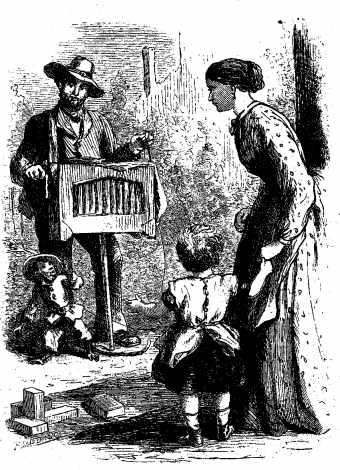
No. 1.—The Organ-Grinder.
“Mother,” said the clever little girl, “look at that funny man over there with the funny machine! Who is he?”
“That man is an organ-grinder, dear child, and if you knew how useful he was you would not think him funny at all.”
“Indeed? Oh, do tell me what he does, mother, for I love to hear you explain things. What is that machine that makes such funny noises, and why is he cranking it like that?”
“He is grinding organs, my dear. When old churches have no more need of their pipe organs, whether because they have replaced them with electrical imitations or because they prefer to sing anaemic folk songs backed by three chords on a guitar, they sell their old organs to this man, and he grinds them into compost.”
“But what are those loud tooting noises I hear from his machine?”
“Those, clever child, are the last agonies of a dying pipe organ. It is a cruel but necessary business, just as I told you when we went to see your uncle’s abattoir.”
“But, mother, what does he do with the compost when he has ground the organs?”
“He sells it to garden centers and farms, where it may even be used to grow new organs of the electrical sort.”
“How useful he is, then! I do not think him funny at all anymore. But one thing I have forgot to ask, dear mother, because I love hearing you talk so much. Why does he keep that funny little monkey with him? What does the monkey do?”
“That little monkey is the man’s administrative assistant, my dear. He sends the monkey around to pay people for bringing in organs to be ground. In a little while, you will see the monkey come around with a hat full of money. Then you should take a few coins from the hat, and the next time we find an organ for which no one has a use anymore, we shall bring it to the organ-grinder, and he will be very pleased to grind it.”
DR. BOLI’S FABLES FOR CHILDREN WHO ARE TOO OLD TO BELIEVE IN FABLES.

The Boy Who Played with Matches.
ONCE THERE WAS a little Burmese boy who went into his bedroom, locked his door, and played with matches.
It didn’t take long before he set the curtains on fire.
When his parents smelled the smoke, they knocked on his door.
“Don’t come in,” said the little boy. “I’m not doing anything, and I’ll clean it up myself.”
“But we smell smoke,” his father said.
“Not a whole lot,” the little boy replied.
“So you mean there is smoke in there?” his mother demanded.
“Only a little bit. I can take care of it.”
This admission worried his parents.
“Let us in,” the boy’s mother demanded.
“I’d rather not,” the boy replied, because he didn’t want his parents to know he’d been playing with matches.
“Is something on fire?” the boy’s father asked.
“I wouldn’t say ‘fire.’ It’s a little smoky, that’s all.”
“But where there’s smoke, there’s fire,” his mother objected.
“It may technically be a ‘fire,’ but it’s nothing I can’t take care of.” He still didn’t want anyone to know what he’d been doing in his room.
“I’m getting the fire extinguisher,” his father said, and he dashed off to find the fire extinguisher in the kitchen.
“There’s no need for that,” the boy called out. “It’s spreading a little, but I can take care of it.”
“Open the door this instant,” his mother said in her sternest voice.
“I don’t need to,” the boy answered. “It’s hardly out of control at all.”
“Your bedroom is on fire,” his mother nearly screeched. “I want that door open right now!”
“I’d rather not open the door, although I do appreciate your concern.”
At this moment, the father came back with the fire extinguisher. “Open the door,” he demanded. “I have the fire extinguisher.”
“I don’t think I need the fire extinguisher,” the boy replied, still dreading the consequences of letting his parents know what he’d been doing. “As far as I can see, I have everything I need in this room.”
“Let me in now!” his father shouted. “You need a fire extinguisher!”
“I’ll tell you what,” the boy said. “I’ll open the door a little bit, and you can slip the fire extinguisher through to me.”
“Let me in now!” his father repeated.
“I know how to use a fire extinguisher. You can just hand it to me, and I’ll do the rest. Thanks very much for bringing it, by the way.”
“Dear, your father needs to get in now,” his mother said as gently as she could, hoping that would help.
“I don’t think so,” the boy replied, thinking of the lecture he’d got a few days before when he kicked the dog. “I’m not going to open this door until Dad promises that he won’t come in.”
“That’s ridiculous,” his father replied.
“That’s my deal,” the boy said firmly. “Take it or leave it.”
“But your room is on fire!” his mother pointed out one more time.
“I wouldn’t say the whole room was on fire,” the boy said. “There are definitely a few spots that still aren’t on fire yet.” And he refused to open the door.
So the little boy burned up in his bedroom, and his parents told each other that it served him right, and they hoped it taught him a good lesson.
THE CRANE WHO WAS BETTER THAN EVERYBODY ELSE.
From Dr. Boli’s Fables for Children Who Are Too Old to Believe in Fables.

ONCE THERE WAS a crane who thought he was better than everybody else.
He thought he was better than all the other birds, because he was a crane, and cranes are tall and majestic. He thought he was better than all the other cranes, too, because he was smarter and more handsome, and because he had a better name: he was called Franklin Pierce Jones, whereas all the other cranes had very ordinary names like Harriet or Ichabod.
And because Franklin Pierce Jones insisted that he was better than everybody else, the other cranes began to believe that he really was better. If you repeat something often enough and with enough conviction, you can usually make it true.
There was, however, one skeptical crane, by the name of Alexandra, who refused to admit that Franklin Pierce Jones was better than absolutely everybody. “You may be better than the other birds,” she said, “and you may even be better than I am. But you’re not as good as people, because they wear clothes and use pocket calculators.”
At this challenge the color rose in Franklin Pierce Jones’ cheeks, although no one but him knew it because his face was covered with feathers. “I most certainly am in every way equal to people, and I’ll prove it to you,” he declared in a voice so loud that all the other cranes stopped what they were doing and listened. “I’ll wear clothes like a person, walk into the town, and do all the things people do. They won’t even be able to tell the difference.”
So that was exactly what Franklin Pierce Jones did. From a clothesline nearby he procured a pair of shorts, a white shirt, a very smart necktie, and a dark blue jacket that fitted him admirably. For a hat he wore a tasteful baby’s bonnet. Then he walked into town.
When he passed near a school, he fell among a group of children who had just finished their classes for the day.
“Look at that pointy nose!” one impolite little boy shouted, and a small group of children soon gathered around the crane as he attempted to make his way through the town.
“And he’s got skinny legs like a bird!” a little girl added, much to the delight of the other children.
“Bird-legs! Bird-legs!” the children began to chant, and soon they were all doing it. “Bird-legs! Bird-legs!”
“Did your mommy make you wear that tie?” one little boy demanded, yanking the end of Franklin Pierce Jones’ tie so it untied and fell on the ground.
“And did she put this cute little bonnet on your head?” another asked, snapping the elastic that held the bonnet in place.
“Is that a nose or a hose?” a little girl asked, and all the children laughed in a mean and very impolite way.
By this time Franklin Pierce Jones had definitely had enough, so he slipped off his jacket with one shrug, spread his wings, and took off, leaving all the children on the ground astonished.
His friend Alexandra was waiting for him when he got back, and all the other cranes were not far away.
“So did you prove that you’re equal to people?” Alexandra asked with a triumphant smirk, seeing that Franklin Pierce Jones’ clothes were mostly missing.
“No, I did not,” said Franklin Pierce Jones, and Alexandra could not keep herself from smirking even more triumphantly.
“I proved that I’m far better than people,” Franklin Pierce Jones continued. “The miserable ill-mannered creatures may be bipeds like us, but they are utterly lacking in the finer sensibilities. My experiences during my expedition prove, if any proof were needed, that I am indeed a superior being.”
All the other cranes nodded sagely, and even Alexandra had to admit the justice of his claim. Franklin Pierce Jones’ reputation was now secure.
MORAL: Travel is broadening, but that doesn’t necessarily mean it’s pleasant.