WHAT THE WORD “POEM” MEANS.

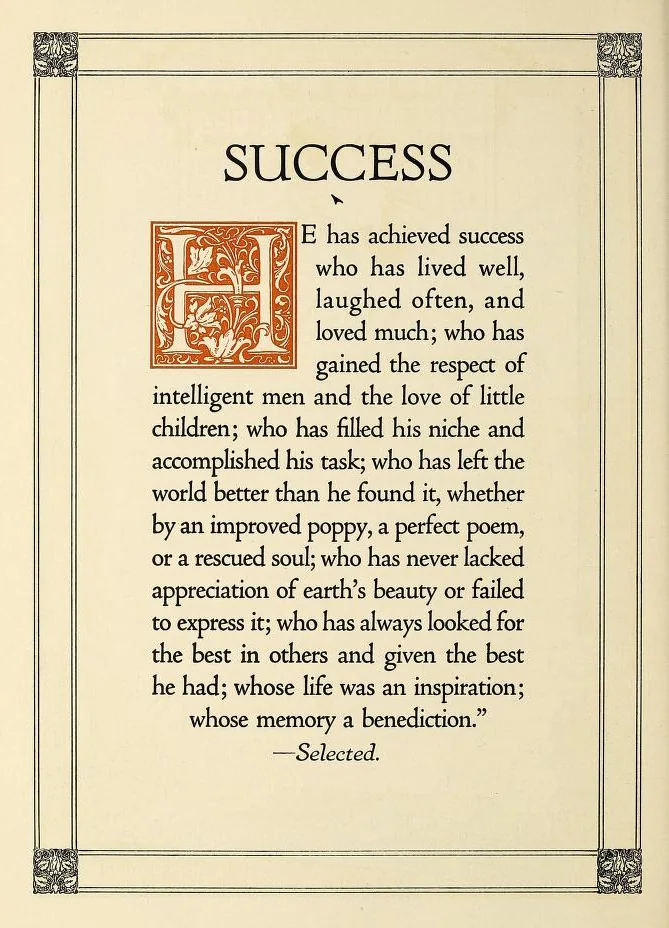
“Success” done up in style in The Inland Printer.

Where did the popular poster phrase “Live, Laugh, Love” come from? You can look it up on the all-knowing Internet and instantly find the answer: it came from a poem called “Success” written in 1904 by Bessie Anderson Stanley. Wikipedia:

The phrase is an abridged form of the 1904 poem “Success” by Bessie Anderson Stanley…

An essay by Jake Rossen in Mental Floss:

There’s the phrase itself, which appears to have grown popular thanks to a poem by Bessie Anderson Stanley.

An article by Brie Dyas in House Beautiful:

The real source of “Live, Laugh, Love” is Bessie Anderson Stanley’s 1904 poem, “Success.”

A “deep dive” by Jessica Barrett in Refinery29:

While it has often been misattributed to Ralph Waldo Emerson, the words were first linked together in a poem called “Success” by Iowan writer Bessie Anderson Stanley in 1904.

And so on. Some of the writers quote the poem:

He [has] achieved success who has lived well, laughed often, and loved much; who has enjoyed the trust of pure women, the respect of intelligent men and the love of little children; who has filled his niche and accomplished his task; who has never lacked appreciation of Earth’s beauty or failed to express it; who has left the world better than he found it, whether [by] an improved poppy, a perfect poem, or a rescued soul; who has always looked for the best in others and given them the best he had; whose life was an inspiration; whose memory a benediction.

Now, if you, like Dr. Boli, were born in the eighteenth century and came of age in the nineteenth, you might be thinking, “Where’s the poem? This is an essay.” But it seems that, if you were born in the twentieth century and came of age in the twenty-first, this is what “poem” means. It is a prose composition, generally meant to be inspirational or sincere in some obvious way. In other words, what we used to call an essay; perhaps more specifically what we used to call a personal essay. For these writers, a “poem” is any manufactured expression of sincerity, and it is the manufactured sincerity, not the form, that makes a “poem.”

There was a time—way back in April—when Dr. Boli would have been arrogant enough to say that all these writers do not know what the word “poem” means. But he is past that age. There is not a single writer who talks about this essay who does not call it a poem. “Poem,” therefore, means “prose essay,” whether divided into short lines or not, and the old Johnsonian definition “a metrical composition” must be relegated to the scrap heap of archaisms, where it will join several dozen outdated meanings of “nice.”

This does leave us with no word to describe a metrical composition, which might seem unfortunate. But a moment’s thought reconciles us to the loss. No one in the twenty-first century has any need for a word to describe a metrical composition. Like the forgotten technical terms of alchemy, the archaic meaning of “poem” may be allowed to pass from general use and linger only in a long paragraph of etymological explanation in the Oxford English Dictionary.

If you wish to see Mrs. Stanley’s poem in something like its original form, you can look in publications from 1905 in Google Books or the Internet Archive or Hathi Trust. Dr. Boli will leave you the fun of searching for it yourself, but the poem will not be hard to find, although in those unenlightened days it was never described as a “poem.” It was picked up, often but not always attributed to Mrs. Stanley, by just about every magazine and a number of other publications: The Northwest Journal of Education; The Leather Worker’s Journal; The Ladies’ Home Journal; Breeder and Sportsman; The McMaster University Monthly; Hardwood Record; a Biennial Report of the Bureau of Agriculture of Tennessee; an Annual Report of the Pennsylvania Department of Agriculture; Transactions of the Medical Society of the State of North Carolina; Motorman, Conductor, and Motor Coach Operator; The Christian Student; The San Francisco and Pacific Druggist; The Free Will Baptist; Pennsylvania Grange News; and yes, though you probably had no need to ask, it was inserted in the Congressional Record. We were not able to find the original publication in the Brown Book, but we did not devote more than three minutes to the search.
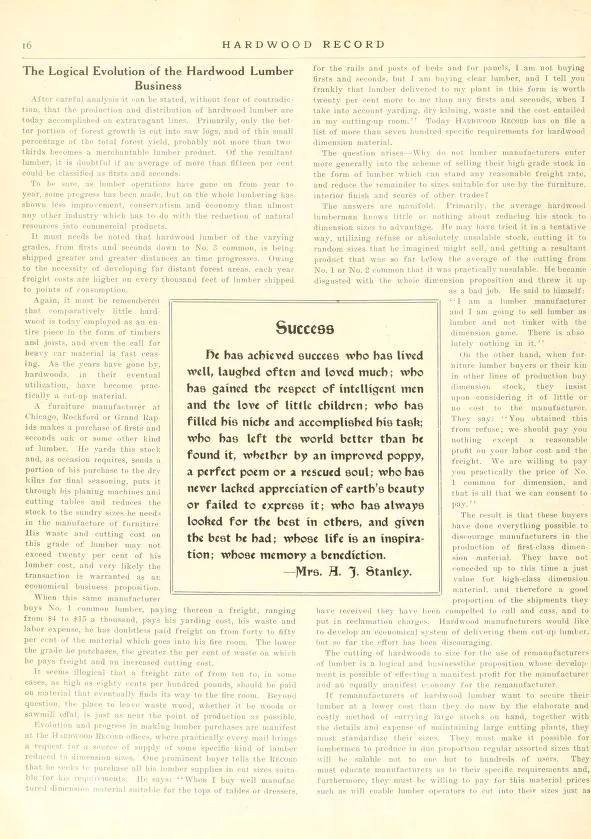
“Success” in The Hardwood Record, sharing a page with “The Logical Evolution of the Hardwood Lumber Business.”

CALL FOR COMMENTS.

The American National Standards Institute Subcommittee on Brainy Things has extended its deadline for comments on the proposed ANSI standard for stupid. The subcommittee hopes to end the decades of pointless argument over what is stupid and what is not. The deadline has been extended because, while a number of comments have already been submitted, most of them were obviously from complete morons.

Advertisement.

Best-adjective contest. We are tired of “fruity,” “robust,” &c., and so are our customers. $2,000.00 in Plaid Stamps for the best adjective describing Domaine des Piles Rechargeables Cotes du Youghiogheny Red Wine. Can you beat “obsidian” (current People’s Choice adjective)? Domaine des Piles Rechargeables, Boston, Penna.

ASK DR. BOLI.

Church of the Atonement, Carnegie, Pennsylvania

Dear Dr. Boli: There’s an Episcopal church and an Anglican church in my neighborhood. What’s the difference? —Sincerely, A Curious Presbyterian.

Dear Sir or Madam: The difference is easy to explain. The Episcopal church is a member of the Anglican Communion, whereas the Anglican church is not. To be more precise, then, as long as you go no further than your specific question, the difference is easy to explain.

SELECTED THIRD PARTIES.

Everyone is familiar with the cookie-consent notice mandated by European Union law, but the wording in different instances of the notice varies. Often, for example, a site will tell you that its cookies share data with “selected third parties.” What does “selected” mean? The English-language version of an Italian site gives us a window into the selection process by counting the third parties.

Selected 765 third parties and us use cookies or similar technologies for functional reasons and, with your consent, for other purposes as specified in the cookie policy.

With regard to advertising, selected third parties and us may use precise geolocation data and actively scan device characteristics for identification purposes in order to store and/or access information on a device and process personal data such as your usage data, for the following purposes: personalized ads and content, ads and content evaluation, audience observations, and product development.

So the next time you visit one of these sites and see the cookie notice, spare a thought and say a prayer for the poor underpaid marketers who are tasked with selecting the third parties with whom your data will be shared. We can assume that 765 is a typical number, so those marketers have a lot of selecting to do.

The cookie-consent box came up, by the way, when we were looking at the terms of service, where we are required to affirm that we have “carefully and fully read the information regarding the processing of personal data and consented to the processing of personal data,” &c. Including the linked documents that we are also required to have read and agreed to, we had more than 20,620 words to read carefully and fully. We say “more than” because one of the linked documents was a long “Code of Ethics” presented in a PDF that fell into the hands of an overzealous graphic designer, and it would have been a slog to copy and count the disconnected segments of text. We would be willing to say, daring anyone to contradict us, that every single person who uses that site is a perjurer.

ON THIS DAY IN HISTORY.

Mimeograph advertisement

On this day in 1876, a patent was issued to Thomas Edison for the Mimeograph, a device that made publishing democratic and probably enabled the distribution of more bad writing than any other invention before the blog. The patent was later licensed to the A. B. Dick Company, and we celebrate this anniversary mostly as an excuse for another look at the magnificent advertisement above.

THINGS WE LEARN FROM A DOG.

Count Howard, an English setter

Language is overrated as a means of communication.

Most problems can be solved by food.

If food cannot solve a problem, it is probably not a problem to begin with.

“Food” is a broader category than commonly supposed.

Portable objects that do not fall into the category of “food” may at least be regarded as food substitutes.

Eat it first, and then figure out what it was.

Most people accept me for who I am, because I am not going to be anybody other than a dog.

Anyone who dislikes me can be brought around to my side by a program of intensive licking.

I can be patient indefinitely as long as I get what I want right now.