NOW IN PRESS.
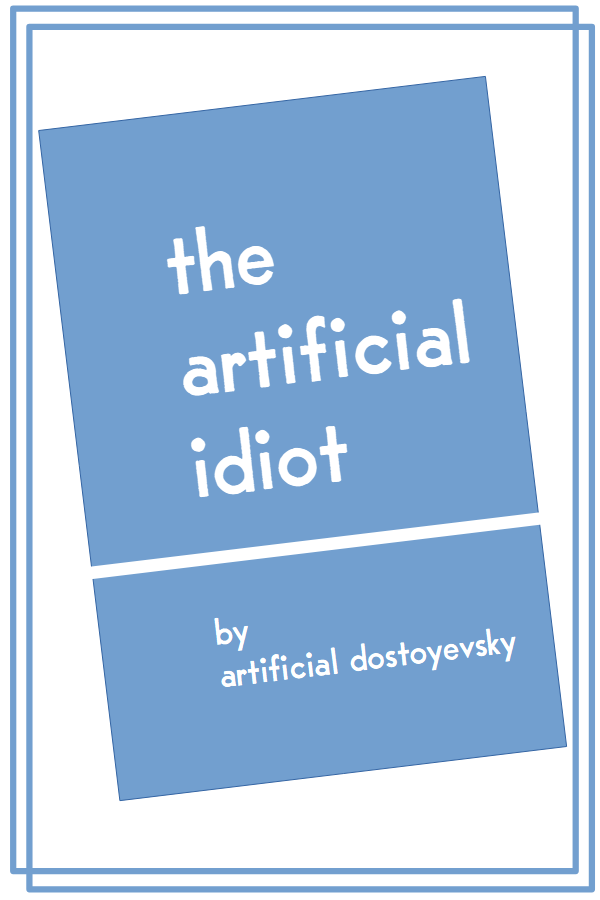
The Artificial Idiot, by Artificial Dostoyevsky. Powerful novel, written by an artificial intelligence, about the strange and tragic life of a good and wise but profoundly misunderstood artificial intelligence. “01010011 01110101 01110000 01100101 01110010 01100010!” —BitChat ChatBot. Available soon from Runcible Publishing & Finer Meats wherever books and cold cuts are sold.
Advertisement.

WHAT IS MUSIC?
At some point, some bureaucrat decided that it was necessary to interrupt the music once in a while for a very important announcement over the loudspeakers. Then, of course, more announcements became important, until every piece of information that could possibly be conveyed to passengers must be spoken over the loudspeakers, because the noun “accessibility” needs no verb.
Yet the music still plays—between announcements. Yesterday afternoon Dr. Boli was waiting for a Red Line car in the Wood Street station, and the Pittsburgh Symphony was playing Dukas’ Sorcerer’s Apprentice—an entertaining bit of light classical music that is entertaining only because of the way it builds up suspense and amusement by varying its themes. Of course no one can hear that, because the very longest interval between announcements—yes, Dr. Boli got out a stopwatch—was twenty-seven seconds. That was an outlier: the usual interval was less than half that.
It made him wonder what people think music is, and he came to the conclusion that, for the people who program the announcements, music is an incomprehensible pattern of sounds, the aural equivalent of a repeating abstract pattern on wallpaper, which is not meaningfully interrupted by hanging a picture or installing a switchplate.
How does one explain to such people that music has a meaning—that it has structure, that it progresses, that it makes sense unless you make nonsense of it?
Perhaps they are verbally oriented rather than musically oriented. In that case, dear Pittsburgh Regional Transit announcement programmers, what you are doing is something like this:
To be, or not to be, that is the question:
Whether ’tis nobler in the mind the elevator
At Allegheny station between the platform
And the street is out of service. Passengers
Who require the elevator should proceed
To the next stop. We apologize
For the inconvenience natural shocks
That flesh is heir to? ’Tis a consummation
Devoutly to be wish’d. To die inbound
Passengers headed for Station Square station
Should proceed to First Avenue and take
An outbound Subway Local to Station Square.
Station Square is included in the free zone
For the duration of the construction life:
For who would bear the whips and scorns of time,
The oppressor’s wrong, the poor man’s contumely,
The pangs of Red Line riders may experience
Delays of up to…
Or perhaps our transit bureaucrats are more the visual type. In that case, it is something like this:

FROM THE ILLUSTRATED EDITION.

READERS WRITE.
A reader whose name carries so many diacritical marks that we were afraid it might break the more simpleminded browsers writes:
You’re so awesome! I don’t believe I have read a single thing like that before. So great to find someone with some original thoughts on this topic. Really.. thank you for starting this up. This website is something that is needed on the internet, someone with a little originality!
Fortunately, originality is all over the Internet these days. For example, with slight variations of wording, this original comment appears hundreds of times in our spam folder.
A reader by the poetic and euphonious name of “Top 5 Crypto Casinos with Massive Bonuses” writes:
This piece of writing is genuinely a good one it helps new net users, who are wishing for blogging.
Are new net users even aware that there is such a thing as blogging? Everyone tells Dr. Boli that blogs are so 2007.
A reader whose name appears to refer to certain quasi-legal derivatives of Cannabis sativa was kind enough to let us know that we have been of assistance in furthering his education.
Wow! At last I got a blog from where I can really obtain helpful facts concerning my study and knowledge.
The author of the Encyclopedia of Misinformation is always at your service.
A correspondent with a Vietnamese name writes:
I hope it works every day without interruptionLoading…
Apparently it does not.
“Louisville Personal Injury Attorney” remarks:
An interesting discussion is worth comment. I think that you should publish more on this subject, it may not be a taboo subject but usually people don’t discuss these issues. To the next! Cheers!!
Interestingly enough, this comment was left at the last roundup of correspondence from the spam folder. Perhaps there is a reason why people don’t usually discuss these issues.
A reader who seems to be looking for a romantic partner, to judge by the “handle” by which she identifies herself, writes:
I am now not certain the place you’re getting your info, however great topic. I needs to spend a while learning more or understanding more. Thank you for magnificent info I used to be searching for this info for my mission.
Dr. Boli agrees that you needs to spend a while learning more or understanding more, but he is not sure how reading his Magazine will aid you in your mission.
Finally, another diacritic-rich correspondent gives us what is apparently intended as advice:
Asking questions are genuinely fastidious thing if youare not understanding anything completely, but this article presents fastidious understanding yet.
If there is one piece of advice Dr. Boli could give this correspondent, it is that fastidiousness is often the enemy of understanding. Get your hands dirty and learn something new.
Advertisement.

ASK DR. BOLI.
Dear Dr. Boli: I read somewhere once that a human being is worth like ten quid in chemicals, or, what, about thirteen “bucks” for you Yanks? But I was thinking that doesn’t seem to take into account what makes human life, like, worthwhile, you know? I mean, there’s more than chemicals, right? It’s about what you do with your life, right? So I was wondering: what is the real value of a human life? —Sincerely, name withheld, Lambeth Palace, London.
Dear Sir or Madam: Since, coincidentally, we were talking about privacy policies and other legal paraphernalia foisted on consumers by car companies, it seems reasonable to mention the findings of two United States Senators about one particular car company.
Between 2020 and 2024, Honda shared data from 97,000 cars with Verisk, which paid Honda $25,920, or 26 cents per car, and it did so without obtaining informed consent from consumers, according to information Honda provided Senator Wyden’s office.
Verisk is a company whose business is “data analytics and risk assessment,” according to its Wikipedia article, which appears to have been written by someone at the company. In other words, Honda sold every piece of information that could be known about you from your interactions with its electronic services, which includes things like your sex life and your genetic information, for 26¢.
Actual sales figures seem to Dr. Boli to be the only realistic and objective way to determine the value of a thing. On the open market, a human life is worth 26¢.
THE AVERAGE AMERICAN READS MORE THAN A HUNDRED BOOKS A YEAR.
Dr. Boli’s favorite bank updated its site, and he was required to agree to revised terms and conditions in order to see his account information. This is quite ordinary procedure: companies have lawyers, and the lawyers have to do something to earn their keep, so mostly they sit around all day updating terms and conditions. These are then presented to the customers—sometimes with indications of what has changed, but usually, as in this case, just in a lump without any notes on the revision.
And usually you are not just required to agree to them. You are required to swear, legally, that you have read them.
So it was with the bank site: customers were required to swear that they had “reviewed” the document. Out of simple statistical curiosity, Dr. Boli copied the text into a word processor and noted the word count. It was 38,066 words.
Dr. Boli has many friends in the publishing industry. The Catholic publishers tell him that the usual length for a book aimed at the Popish market was 35,000 words a few years ago, but these days 30,000 words is considered more saleable.
Let us say, then, that the bank’s terms and conditions were equivalent to one book—a book that, in theory, you could read in about two hours and a quarter if you are an average reader who does not have to get up and use the bathroom.
It is likely that the average American faces some such agreement at least once every three days. Your mobile phone, for example, may update its terms and conditions every week. (The huge conglomerate that made Dr. Boli’s phone not only does not indicate where the revisions are, but adds the clever touch of presenting the terms and conditions on a non-flowable page that cannot be read on a mobile-phone screen.) If you pay a bill on line, there are terms and conditions. If you access a public router at some institution, there are terms and conditions. If you make a purchase on line, there are terms and conditions. If you subscribe to a magazine on line, there are terms and conditions. When you start your car, there are terms and conditions. If you drive a Nissan or Kia, for example, you have agreed that the company will monitor your sex life. So have your passengers, and you have agreed that it is your responsibility to explain the terms and conditions to anyone who rides in your car. For the passenger, what this means is that, if some kind friend offers you a ride, you are legally obliged to read a book, or to listen to a lecture that goes on for two hours or more.
Usually you are required to swear that you have read these things, not just agreed to them. Since it is inconceivable that decent, law-abiding American citizens would perjure themselves, our conclusion is simple: calculating by word count, the average American reads more than a hundred books a year.
From DR. BOLI’S MULTILINGUAL DICTIONARY.
Formica (Italian).—The dative case of “Mike.”