WHAT IS SLOP?

What is “slop” in modern American slang? AI can tell you.

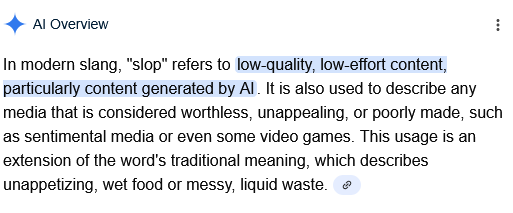
In modern slang, "slop" refers to low-quality, low-effort content, particularly content generated by AI. It is also used to describe any media that is considered worthless, unappealing, or poorly made, such as sentimental media or even some video games. This usage is an extension of the word's traditional meaning, which describes unappetizing, wet food or messy, liquid waste.

Γνῶθι σεαυτόν, as the graffiti said on the Temple of Apollo at Delphi. This is, as the young people say, very meta.


The screenshot extract from Google results is quoted for the purpose of mockery, which is one of the purposes that qualify as “fair use” in American legal theory.

IS ARTIFICIAL INTELLIGENCE STEALING YOUR STUFF?

Debate is good, especially when defish take it—

Pardon us, please. We have been reading too much James Joyce.

Let us begin again (Finnegan!).

Our article about whether there can be AI art provoked an interesting debate. Fred wrote:

The way it’s set up AI generates “art” without the permission of about eight billion involuntary contributors which I would think would be a violation of copyright. The copyright office might not think so but I suspect it will take approximately 150 years before the question is really settled.

In response, Belfry Bat wrote that

up until some remarkably recent point, ’most every artist anywhere spent most of his apprenticeship (oh, how I date my assumptions!) consuming, analyzing, synthesizing the art of Tradition; and “breaking” his hands, as it were—to make them do what he rather than they themselves wanted—by “copying” or “studying” these historical ARTifacts.

He goes on to doubt the possibility of complete originality in art, describing it as “a very young myth.”

In the case of human artists, it seems true beyond argument that every artist has learned from previous artists and is influenced by artists of the current generation, willingly or unwillingly. Even the self-trained outsider artists who are occasionally discovered by the art world, like John Kane, can usually be dated just by their style, showing that they were part of a larger environment of artists who, consciously or unconsciously, learned from each other’s art. There is nothing wrong with that, and in fact it is the very definition of culture. Dr. Boli was about to say that a society without those influences would be a society without culture; but then he realized at once that it would also not be a society.

Then when does influence become plagiarism or copyright violation?

We have spent many years working out the answer to that question for human artists (or writers, or musicians, or other workers in the fields our twenty-first century calls “creative”). The answer is that influence becomes theft when the artist adopts all or part of another’s work without credit or permission. It is not plagiarism if the original is credited, but it may be copyright violation if a large part of the work is adopted without license. For example, you might print a new edition of The Satanic Verses and credit Salman Rushdie as the author; that would not be plagiarism, but it would be copyright violation if you did not have the permission of the copyright holder. On the other hand, you might publish a novel that is word-for-word identical to Can You Forgive Her? by Anthony Trollope and claim it as your own; that would not be copyright violation, but it would be plagiarism, even if the only penalties would be social and not legal.

There is a certain latitude for “fair use” in quoting from or alluding to another’s work, and since it is impossible to draw a sharp line around the area of fair use, intellectual-property attorneys will never starve. In many jurisdictions (not including the United States), the question of “moral rights” makes the attorneys even fatter.

Now, how do the answers we have worked out for human “creatives” apply to the creations of artificial intelligence?

It seems to Dr. Boli that we can think of the bots in two different ways. Either they are minds in their own right, producing their own art the way an artist working for hire would do; or they are mindless tools in the hands of their users, like a more sophisticated (though not more artistic) version of a camera or a paintbrush.

Which of those two ways we choose is probably irrelevant, since in either case Dr. Boli’s conclusion would be the same. We can judge whether theft has occurred only by looking at the “art” the bots produce. If, after studying the works of all the artists in the world, they produce works in which substantial parts of the art they have studied are reproduced without permission, then those parts are stolen; and if they are under copyright, there are legal penalties to be paid. But if the bots’ productions are merely in the style of the artists they have studied, then they are no more plagiarizing than a human artist who paints Indianapolis street scenes in an Impressionist style is plagiarizing Monet or Pissarro.

This seems to be the case with visual art by artificial intelligence: it does seem to take what it learned and transform it (a term that is very important in American copyright law) into something original. It may not be good, but it is original, which is the moral or legal question to be answered.

It would be lovely to think that the corporate keepers of the bots trained them carefully to stay on the right side of that legal line. But if they are on the right side, it is almost certainly pure accident. As a counterexample, many open-source programmers complain that the AI bots that spew out code often take whole long sections from published open-source programs without crediting the original authors or abiding by the other terms of the open-source licenses. That is plainly illegal, but Microsoft, for example, publishes “agreements” in which you agree, merely by existing, not to prosecute the company for those violations, so we suppose it is quite all right and everyone ought to be happy.

In the case of art and literature, though, American courts seem to have settled on what Dr. Boli thinks is the most reasonable interpretation of the law. In the class-action suit against Anthropic, the court decided that it is fair use to train the bot on electronic copies of books, just as it would be fair for you to read those books and learn from them—if you have the right to use those books. But it is not legal to download a bunch of pirated copies and keep them for training purposes, any more than it would be legal for you to do the same thing.

In other words, if the bot is a tool, then the humans who use it are allowed to use it as a tool for learning skills and styles in order to make original works—but not for reproducing the copyrighted works of others. If the bot is an intelligence in its own right, then it is a sort of pet or minor person, and its keepers or guardians are responsible for making sure that it stays within the rules of fair use.

To Dr. Boli this seems like the only possible answer to the question of the legality of AI art. It does not begin to answer the question of the desirability of AI art. For that, Dr. Boli sticks to the answer he gave before: he thinks that, eventually, there will be art, and possibly even good art, that has used AI as part of the process. But most AI art—like most art in general—will be slop.

HOW PESSIMISM TAKES ROOT.

A friend gave us a complete set of a 1960s edition of Lagarde & Michard, the textbooks of French literature that have been standard in French secondary schools for more than half a century. Almost every French teenager is brought up on these books, which expose the students to the best of French literature through copious extracts and just enough introductory material to make the literary works not just understandable but also delightful. There are six volumes, one each for the Middle Ages and the fifteenth through twentieth centuries. They are gorgeous books, illustrated with art of the appropriate period, but mostly devoted to text, with the avowed object of making the students fall in love with everything glorious about French letters.

Just glancing through the introduction to the first volume, and then leafing through the pages, left Dr. Boli with the impression that these are incomparably better than any school literature textbook he has seen in America since the days of McGuffey’s Readers. The selections are both excellent and representative; the introductions are intelligent and show a positive genius for reducing complex ideas to a form that even a bored secondary-school student can absorb; the illustrations are beautiful and illustrative of currents of thought in each era, rather than pictures just thrown in with the hope that students will not be frightened by the sight of all those words.

If these books make up the standard literary education of French teenagers, then we can only conclude that the French as a whole are far better educated in literature than Americans ever have been or have any hope of being in the future.

And are the French better people than the Americans? No; they are no worse and no better; they are just about the same. They betray their most cherished principles at every opportunity. They constantly teeter on the brink of extremism in one direction or another, and are pulled back from the edge by lucky coincidences that we may choose to call Providence until Providence gets sick of them and decides to let them plummet. They pick incomprehensible quarrels. They close their minds to obvious truths. In short, they are just like us in every important way, and just like every other branch of the human race.

It is difficult to avoid the conclusion that no improvement in education, no exposure of young minds to the noblest thoughts of our species, no reform of our schools at all can ever make better people and better citizens; that mediocrity can produce only mediocrity, but that excellence produces mediocrity just as reliably.

This is how pessimism takes root in the mind of a literary man.

CAN THERE BE A. I. ART?

“Sunlight and Shadow,” by Constant Puyo. Or is it by a machine?

The world seems to be settling on a technical term for the writing, images, and videos produced by artificial intelligence, and it is a good one: “slop.” The word feels good in the mouth when one is trying to convey the empty slickness of this effortless filler. But we will see more and more of it, because it is effortless, and because, as H. L. Mencken either said or ought to have said, no one ever went broke by underestimating the taste of the American people.

The sudden rise of content by artificial intelligence has given us a chance to pour more kerosene on the ever-smoldering debate over the nature of art. What is this thing called “art,” anyway, and can a machine ever produce it? The general acceptance of the term “slop” gives us a broad hint at one popular answer to the second question. But the first question remains unanswered, probably because it is unanswerable. Dr. Boli has always been inclined to define “art” in a purely mechanical way, thus leaving room for the possibility of bad art as well as good art. But the strictly mechanical definition does not seem to satisfy most people: when they ask “Is it art?” they clearly assume that a work has to prove itself worthy of the name “art.” Thus the debate over whether art produced with artificial intelligence can ever be called “art” is really a debate over whether AI art will ever be good enough to be called art.

Now, artificial intelligence is young—amazingly young. It was born yesterday; can we even predict what it will be like tomorrow? And if not, how can we predict its mature state?

It is not just artificial intelligence that changes quickly. The humans who use it are learning and adapting, too. We have only begun to figure out what we can do with AI—or what it can do with us.

Having spun around in a circle, we are back at the question we started with. Can a machine ever produce art?

Here Dr. Boli’s long memory gives him a different point of view from that of the average Internet blitherer. Dr. Boli’s own blithering is informed by a better acquaintance with the past two centuries or so, and in this case he remembers that we have faced exactly this question before. It took us more than a century to answer it, and it was never answered definitively. But the consensus of opinion has been that, yes, a machine can produce art, when that machine is a camera.

To anyone who has lived through both revolutions, the resemblance is hard to miss.

Previously, making a picture had been a skill learned with long and laborious practice. Then along came the machine, and the skill was irrelevant. Why learn to draw when the machine can make perfect images for you? There was much grumbling about whether such laziness ought even to be allowed, and much hand-wringing about the future of Art.

With no alteration at all, the paragraph above can be made to apply to the coming of photography in the early nineteenth century or the coming of artificial intelligence two centuries later.

But life and art continued after the camera came to be, and they will continue after the rise of the bots. Furthermore, a place was found in Art for photography, and—much as we might prefer to hope otherwise—a place will probably be found in Art for artificial intelligence.

It is far too early to say what that place will be. But we can at least reason by analogy.

The first artistic photographers—the first ones, that is, who demanded a place among the fine arts for photography—tried to make their pictures look as much like paintings as camera and chemistry would allow. They had no other standard by which to judge a good picture. But after a while—a long while—photographers began to appreciate what made their art different from painting. The very things that had seemed defects to overcome in the eyes of the early generations became effects to be controlled and put to artistic use.

Depth of field, for example, is a property of lenses. A lens sees things in sharp focus only at a certain range of distances. The same is true of the human eye, which is a lens, but it is not really true of human perception, because our eyes are always changing focus to take in whatever our brains tell them to focus on. It takes deliberate and unnatural effort to focus on one thing while being conscious of another. Therefore it never occurred to painters before photography to emphasize the subject by blurring the background; and therefore the early photographers mostly considered depth of field an unfortunate limitation of their equipment. But later photographers came to rely on that limitation for some of their best effects; and today, if you decide to step up from random snapper to photographic artist, the first thing you will learn is how to control depth of field and make blur work for you. (The second thing you will learn is to say “bokeh” instead of “blur.”)

Here is just one example of how the things that made photography different from painting or drawing became tools in the hands of competent artists. Photography even developed its own artistic clichés—ask our friend Father Pitt sometime what he thinks about moving water and slow shutter speeds.

Thus we see that, although the machine produces the image, we have come to accept the person in control of the machine as an artist.

It seems likely that the same will be true of creations made with the help of artificial intelligence. We probably will not call it art if it is produced by simple prompting. We do not call a snapshot of someone’s birthday cake “art” unless a good photographer has put thought into the lighting, the composition, the colors, and (of course) the depth of field. But it is easy to imagine an artist with a vision arranging images generated by AI to form a scene matching the vision in the artist’s imagination.

In fact, the bureaucrats in charge of copyright registration have already made exactly this distinction. A report of the Copyright Office (PDF) concludes that AI productions can meet the requirements for copyright “where AI is used as a tool, and where a human has been able to determine the expressive elements they contain. Prompts alone, however, at this stage are unlikely to satisfy those requirements.” So an image generated by an AI prompt cannot be copyrighted, because even complex prompts do not generate the same image twice in a row; but an arrangement of AI-generated images can be copyrighted, because the arrangement is the original work of a human artist. “Whether human contributions to AI-generated outputs are sufficient to constitute authorship must be analyzed on a case-by-case basis,” so if you are a young person looking for a career, now is a swell time to go into copyright law.

For the moment, then, Dr. Boli is inclined to say that the question of whether there can be AI art is an updated version of the question of whether there can be photographic art. And he will give the same answer. Most images produced by the machine will not be artistic, just as most pictures snapped with a phone camera are not artistic, or—for that matter—most scribbles with a pencil are not artistic. But it will be possible for an artist to use the machine as a tool for making art.

Of course, none of this answers the question of whether an artificial intelligence is by itself intelligent enough to produce art, leaving the human manipulator out of the question. But when the bots have taken over and relegated us to menial maintenance tasks, they will have to answer that question themselves, and Dr. Boli sees no reason to give them a head start by answering it for them now.
COOKING FOR ONE.

Hey, everyone, we’re back with Herb’s Cooking for One, the show where we cook things guys like to eat, and this is going to be a short one, cause all I have today is an apology for yesterday’s special Thanksgiving episode. This is Al, by the way, in case you don’t remember. Herb hasn’t been seen in a while, but last week he sent a postcard with a picture of a cartoon turkey surrounded by girls in bikinis and palm trees in the background, but the postmark was all smudged and he didn’t write any messages.

Anyway, first of all, I don’t want to make it sound like I don’t take any of the blame for yesterday’s events. I’m a mature adult, and I can admit that I should have been more careful. I thought I was buying a turkey baster, but it is completely true that the box said “Turkey Blaster,” and I should have been more careful when I read the packaging. I also ought to have paid attention to the directions when they said “stand at least 20 feet from turkey,” but I honestly thought “feet” was a mistake for “inches” there.

But I really have to ask whether people should even be selling things like that. I mean, you guys saw what came out of that thing. It was like flames from here to the county line.

In fact, I consulted with an expert, namely my neighbor Skip, who served in the Gulf War in some capacity, I think maybe catering, and Skip is prepared to swear on a stack of Uniform Commercial Codes that this item was actually a military-surplus flamethrower inexpertly relabeled for consumer use. So, yeah, you gotta be careful what you order on Amazon these days, but, criminy, guys, who expects a turkey baster to go all apocalyptic on you?

Anyway, that’s life, and what’s done is done, and all that, and I guess I’m sleeping on the couch till Georgina gets over this in February or March.

So once again, I’d like to apologize to all my friends and neighbors, and especially to the Grant Borough Fire Department. Obviously I didn’t mean to burn down the firehall, but we live and learn, and the best we can do is try to figure out what we did wrong and, you know, not do it quite so hard the next time.

So, once again, this is Al, saying what Herb always says, which is, Remember, cooking is for guys, too. And if you see a fireman standing at the intersection of Main and Everett, maybe put something in the boot.

IN THE NEWS.

Just before Thanksgiving, the entire October and November runs of Organic Hills brand Free-Range Tofurkey Dinners were voluntarily recalled by Organic Hills, LLC. A spokeswoman for the company told reporters that the “difficult decision” had been made after the company had discovered that the tofu from its suppliers did not meet the strict standards for “free-range” that Organic Hills products promise. Shockingly, the soybean plants from which the tofu was made were kept under conditions that the spokeswoman described as “amounting to nothing less than being rooted to the soil.” Customers who bought Organic Hills brand Free-Range Tofurkey may return the unused portion for a refund, or may exchange it for an equal amount of Organic Hills Broccolurkey, which the spokeswoman explained is just as good but carries no “free-range” claims.