Posts by Dr. Boli
ON THIS DAY IN HISTORY.

YOU ARE A BIBLIOGRAPHICAL DETECTIVE.
In gathering books for a page of Ovid, or Publius O’Vidius Naso, the well-known Irish poet, Dr. Boli came across the 1626 edition of the translation of the Metamorphoses by George Sandys (pronounced “Sands,” because the Y is only in there to trip you up). He also came across a 1628 edition, and something about that latter book alerted his keen bibliographical senses. It seemed to him that it was probably a pirated edition.
Having done some research, Dr. Boli is pleased to report that his bibliographical instincts had not failed him. He found an article in the Papers of the Bibliographical Society of America, Vol. 35, No. 4 (Fourth Quarter, 1941), entitled “Early Editions of George Sandys’s ‘Ovid’: The Circumstances of Production,” by Richard Beale Davis. (You can find it in JSTOR if you have the requisite access.) It turns out that there are complaints recorded in the Stationers’ Court records brought by George Sandys against the printer of the 1628 edition, who was ordered to cease printing and selling the book, and three years later was ordered to desist again because he had ignored the first order.
But what was it that triggered Dr. Boli’s bibliographical alarms?
Both editions carry an elaborate allegorical frontispiece. Here is the one from the 1626 edition:

Enlarge it and examine the details carefully. Now here is the frontispiece from the 1628 edition. Enlarge it, examine the details, compare it to the 1626 edition, and see if you can spot the subtle differences that made Dr. Boli suspect piracy.

You see? You are a bibliographical detective.
ZOSIMUS.
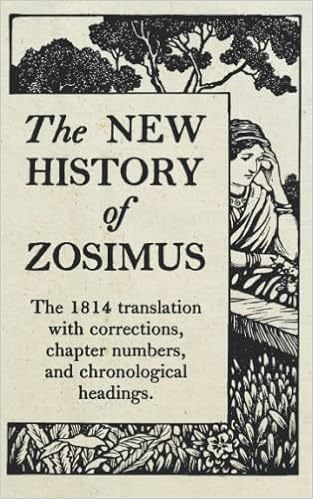
With the kind permission and consent of the publisher, Dr. Boli reprints his introduction here.
What was it like to be a pagan after the final Christianization of the Empire? There seems to be an assumption prevalent in some circles today that the triumph of Christianity in the Roman Empire was a triumph of superstition over rationalism. Zosimus should be enough to persuade us that the opposite was the case. The Christian historians can be credulous, but Zosimus handily beats them in credulity. He never misses a chance to tell a miracle story, and his objection to Christians is not that they are irrationally superstitious, but that they ignore the supernatural altogether. They refuse to accept what “thinking persons” like Zosimus know: that “the administration of human affairs” is “in the hands of a divine Providence.” It was a common pagan accusation against Christians that they were “atheists,” and this is the attitude of Zosimus. Christians are the ones who ignore the oracles, the rituals, the sacred things and places, the obvious signs of the gods’ displeasure. The gods have therefore abandoned the Roman Empire, and what else did we expect?
There seems also to be an assumption that Christians imposed a puritanical morality on the do-your-own-thing world of the Roman Empire, and again Zosimus will puncture that balloon. He has his favorite villain Constantine converting to Christianity because he had committed sins no pagan could forgive. Zosimus’ moral objection to Christianity is not that it demands excessive moral purity, but that it justifies any sin.
Not surprisingly, Zosimus’ hero in this history is Julian, known to Christian history as Julian the Apostate because he turned back to the old pagan religion, or at least to his fantasy of what the old pagan religion must have been like in better times. Zosimus is never more delighted than when he is narrating Julian’s rampage through Persia, gleefully watching him massacre women and children in the name of restored Roman glory. Those were the good old days!
Zosimus himself was not a witness to any of the events he chronicles. The best guess of modern historians is that he wrote his New History not earlier than 498 and not later than 518. His history breaks off abruptly about a century before that, in 410; either he did not finish it, or the rest is lost. Zosimus depends, however, on now-lost historians who were closer to the events: in particular Eunapius and to a lesser extent Olympiodorus. Photius, writing in the 800s, had read all three: “It may be said,” he writes, “that Zosimus did not himself write the history, but that he copied that of Eunapius, from which it only differs in brevity and in being less abusive of Stilicho. In other respects his account is much the same, especially in the attacks upon the Christian emperors.” In this edition we include Photius’ accounts of both Eunapius and Olympiodorus. His summary of Olympiodorus is quite substantial, and gives us a good idea of where Zosimus’ own history might have gone if it had been finished.
Eunapius broke off about the year 405, and the abuse of Stilicho does indeed seem to be moderated after that, leading up to a summary of his life that praises him as “the most moderate and just of all the men who possessed great authority in his time”—not very high praise, given the standard of the time as Zosimus has described it for us, but still more praise than we might have expected. But every historian would agree that Stilicho is a complex character, and Zosimus is willing to let complex characters be complex. He hates Theodosius the Great for his hostility to the traditional pagan cults, and the Christian historians would certainly back him up on some of his other criticisms of that emperor; but he candidly admits that Theodosius was also capable of great things. “These opposite features of his character have incited in me a degree of wonder,” he tells us (book IV, chapter 50), and every historian who has tackled Theodosius has felt that same kind of helpless wonder.
His dependence on earlier sources means that Zosimus had access to useful facts. But we should hold Zosimus alone responsible for the point of view. Though he may have assembled his history from spare parts pulled out of other historians’ works, he speaks in a consistent voice and makes a consistent argument throughout. It is true that his narration of events before Constantine’s conversion does not really support his contention that the Roman Empire was in fine shape till the Christians got hold of it, but that is a compliment to his honesty, or at least a mark of the limits of his dishonesty. He was willing to fudge a bit here and there, especially in the life of his arch-villain Constantine (as the notes in this edition will point out), but he did not divide his world into flat heroes and villains.
What should we think of Zosimus as a historian, then? He has inspired the most fanatically opposite reactions in later writers. Many Christian historians have dismissed him as a sour crank. On the other hand, he has his devoted fans who think him a paragon of historical integrity. The truth, of course, is somewhere in the middle. Zosimus is no more and no less trustworthy than the Christian historians of his era. He (or his sources) will occasionally distort facts, and he is sometimes simply mistaken. On the other hand, he is worth hearing even when we know he is not being quite honest with us. As a writer he knows how to keep our attention, and as a rhetorician he builds what may be the best possible case for a hypothesis that is difficult to support.
About This Translation.
Our intent has been to give the English-speaking world a good, economical general reader’s Zosimus. To that end we have adopted a flawed but generally good translation of the work, and then tried to correct the worst of the flaws.
This translation is even more of a mystery than Zosimus himself is. It was published in 1814 in an edition riddled with printer’s errors, and no translator is credited. The title page tells us only that it was “Translated from the original Greek, with the notes of the Oxford edition.”
As far as we know, there have been four translations of Zosimus into English. The most recent, by Ronald T. Ridley in 1982, is well regarded, but also rare and expensive. A translation by J. Buchanan and H. Davis, published in 1967, is not popular among Zosimus’ fans.
This 1814 translation is based on the 1679 edition of the Greek printed at Oxford with a dedication signed by “T. S.” (identified by scholars as Thomas Spark). That edition was printed with a running Latin translation in parallel columns, and it would not be surprising to discover that our 1814 translator made liberal use of the Latin in cases where the Greek puzzled him.
The Oxford edition was translated into English once before, in 1684, also anonymously (no one seems to have wanted to be publicly associated with poor old Zosimus). That translation is in the commendably brisk English of the era, but it might strike a current reader as a little dated. There is some evidence that our 1814 translator had the 1684 translation by him, and may have cribbed from it when he was in a hurry; but there is also clear evidence that he did not rely on it, since there is at least one place (in book III, chapter 35) where our 1814 translator botched the translation and the 1684 translator did not. In this edition we have unbotched the text by substituting the 1684 translation of that passage.
According to Zosimus scholars, all copies of Zosimus derive from one defective manuscript in the Vatican library, which was locked up among the very dangerous books until the middle 1800s. The 1679 Oxford edition, therefore, had only secondary manuscripts to go by, as did every edition up to the 1887 edition by Ludwig Mendelssohn. There are few important differences, however, and certainly Zosimus’ argument comes through here.
In fact, once the errors of the printer and the relatively few blunders of the translator have been corrected, this translation has considerable virtues. It presents Zosimus in clear and vigorous English that is a delight to read.
In this edition, we have corrected the printing errors of the 1814 edition, usually silently, but sometimes adding a note where the correction substantially affects the meaning. In a few places we have changed the translation where the translator clearly blundered, probably through haste; those changes have been noted. We have also in a few places noted the emendations of Ludwig Mendelssohn in his standard edition of the Greek text, and we have compared doubtful places in the translation with the Mendelssohn edition of the original text.
We include all the notes from the 1814 edition, which are translated directly from the Latin of the 1679 Oxford edition. In a few places, we have added notes from the 1684 translation of that edition, where the 1814 translation omits them. These notes are mostly argumentative: they point out where the Christian historians differ from Zosimus (which is very useful), and they generally take the side of the Christians. Neither English translation includes all the Latin notes of the 1679 edition, but the ones included here are entertaining in their own way.
In addition, the present editor has added a few notes pointing out where Zosimus’ account differs substantially from the generally received version of events. It should be remembered, though, that we do not read Zosimus for his historical reliability—even in those places where his account is the only source available. We read him for his polemical point of view, and we take that into account throughout.
We have also added the chapter numbers that have become a standard reference system for Zosimus, which should make it easy to find any given passage in the translation and compare it with the original.
Finally, we have added subheads with dates throughout, so that the modern reader will find it easy to follow the story and check Zosimus’ assertions against those of other historians. This makes the table of contents a useful chronology as well.
The 1684 translation also included a translation of the “Apology” by Johannes Leunclavius, the German historian of the 1500s whose Latin translation of Zosimus was the first printed edition (1576) of the work. It is a fine example of Renaissance scholarship at its best, as opinionated as Zosimus himself. We have added it to this edition and make no apology for the apology.
The result of all this cobbling together, we hope, will be an English Zosimus that is entertaining to read, and also represents the original with tolerable accuracy. The general reader will find our friend Zosimus an entertainingly opinionated companion. Serious scholars will not take this as a scholarly edition; but it is freely quotable at length, and the chapter numbers will make it easy to find any passage in the original Greek.
MAGRITTE THE REALIST.

It is also true that, in Belgium, people of more traditional tastes do regularly walk around with apples hovering in front of their faces, and some older houses still have troubles with steam locomotives occasionally bursting out of the fireplace.
HOMER AND VIRGIL AND HOBBES AND MORRIS.
The two greatest epic poets of antiquity, Homer and Virgil, have always attracted crowds of translators, and many unexpected famous names pop up among them.
Of course there’s George Chapman. His translation of Homer provoked Keats to write one of the most famous English sonnets, a poem that every schoolchild was forced to read at some point, and one that deserves to be read by more than yawning schoolchildren. Yet, famous as Keats’ poem is, not one reader of it in a hundred has even glanced at Chapman’s Homer. The world seems to have forgotten Chapman’s Homer exactly in proportion as it remembers Keats’ poem about Chapman’s Homer. It is as if the world had decided to give up summer days, because we have read Shakespeare’s sonnet about them, and what do we need now with the filthy experience? Sometimes, after all, too hot the eye of heaven shines, and really it’s just better to stay inside.
Chapman and Hobbes are far from the only famous translators of Homer. You know that Alexander Pope translated him, of course: Pope is ubiquitous and inevitable. But did you know that William Cowper made a blank-verse translation of both the Iliad and the Odyssey? America’s own William Cullen Bryant also tried his hand at a blank-verse translation late in his life, with some success.
Perhaps the most unexpected name on the list is William Morris, who is probably known to most of the Americans who know him at all as the wallpaper guy. He translated the Odyssey in rhymed and heavily alliterative hexameter.
Virgil also has his share of celebrity translators. In fact the history of printing in English could be traced in the history of printing Virgil in English. One of the first books ever printed in English was Caxton’s Eneydos, which he translated from the French; and although he describes it as “made in latyn by that noble poet & great clerke vyrgyle,” it is a very free adaptation. It is the sort of thing a Hollywood producer might do to the Aeneid if he got his hands on the film rights. The first real translation of Virgil in an Anglic language was by Bishop Douglas into Scots, and he is not sparing in his opinion of the book from Caxton, who
In pross hes prent ane buik of Inglis gros,
Clepand it Virgill in Eneados,
Quhilk that he sais of Frensch he did translait,
It hes na thing ado therwith, God wait,
Nor na mair like than the devill and Sanct Austyne;
Haue he na thank therfor, bot lost his pyne,
So schamfully that storye did pervert;
I red his werk with harmes at my hert,
That sic ane buik, but sentence or engyne,
Suld be intitillit efter the poet divyne;
His ornait goldin versis mair than gilt,
I spittit for despyt to see sua spilt
With sic a wycht, quhilk treulie be myne entent,
Knew neuer thre wowrdis of all that Virgill ment.
John Dryden is to Virgil what Alexander Pope is to Homer. But the list of Virgil’s translators is long and varied. William Morris shows up here, too; he translated the Aeneid into fourteeners like Chapman’s Iliads, but with much more alliteration.
Comparing these translations is revealing. All the Homers are certainly Homer, and all the Virgils (with the arguable exception of Caxton’s) are Virgil. But both ancient poets are magic mirrors in which the translators see everything they think is good in poetry. For William Morris, Virgil and Homer are perfect medieval bards, and he translates them in alliterative verse that would have appealed to William Langland. Alexander Pope’s Homer is a refined gentleman, for all his ancient ways. Chapman’s Homer is an expert at playing to the pit and delivering the applause-inspiring line that makes the patrons think they are getting their halfpenny’s worth. Bryant’s Homer is the kind of deeply thoughtful soul who might write a poem called “Thanatopsis.”
Experienced readers have already guessed that a long literary article like this means that there is a new page in the Eclectic Library. On this occasion there are two new pages: one for Homer and one for Virgil.
FROM THE ILLUSTRATED EDITION.

From DR. BOLI’S ENCYCLOPEDIA OF MISINFORMATION.

Fashion, Greek. From ancient Greek statuary we learn that it was considered correct for women to appear headless at formal occasions.
IF I HAD A TIME MACHINE,
If I could visit ancient Hellas,
I’d have to look up all the fellas.
To learn what oratory means,
I’d make my way to Demosthenes.
For history, I’d take long rides
To hear the tales from Thucydides.
I’d walk through Athens’ seedy lanes
And trade jokes with Aristophanes.
And, since I’m calling on the greats,
For physick, I’d see Hippocrates.
The priests in their white clericals
Would lead us all to Pericles,
And I’d say, “If you plan to write us,
Address us care of Democritus.”
And, best of all, I’d learn to speak
Quite fluently in ancient Greek.
RESULTS ONLY.
This sounds obviously correct. It is, in fact, what you do when you want anything that is really important to you. Suppose you decide to order a meal from the Nepalese place down the street. Do you go into the kitchen and tell the cooks what to do with their knives, how hot the burners should be, how much of each ingredient should go into each dish? No; you simply demand this kind of momo, and expect that you will get the result you desire from people who know how to make momo without your instructions.
Then why are all work environments not Results-Only Work Environments? There are doubtless many reasons, but the foremost is that the Results-Only Work Environment works only when there are results to be expected. At any given moment during the work week, six out of ten office teams are performing a buzzword. If you asked any of them to define what the result of the performance would be, they could only give you another buzzword. What are you doing? “Leveraging our core agilities!” What will you achieve? “Synergy!” Fine. I expect sixteen pounds of synergy on this table by Friday afternoon, but I don’t care how you get it there.
There is, however, a secondary reason, and for this reason Dr. Boli expects that the reign of ROWE as a management buzzword will be short. It is perfectly obvious that, if employees are capable of making results happen without the constant supervision of managers, then there are far too many managers in the world. It does not matter, therefore, if the company prospers under the ROWE regime. It does not matter if the stacks and stacks of glossy blue synergy pile up faster than ever before. Sooner or later the shareholders are going to start to ask why there are so many managers standing around doing nothing and getting paid for it.
Then the managers will have to justify their existence, and they can do that only by proving that they have to manage. And then the results will cease to matter, because they will have run up against a force far more powerful in business than mere prosperity. They will have run up against religion. It is desirable, all other things being equal, that the company should make a profit; but it is religious dogma that business-school graduates must prosper and be respected and beget more business-school graduates. You cannot ask why it is so, any more than you can ask why Huitzilopochtli demands human sacrifices. It is the order of the cosmos.
So enjoy the Results Only Work Environment while it is still a brief fad. If you work in such an office, make the most of your worker autonomy in these last few sunny days of ROWE. Pile up heaps of results to draw on during the long, cold winter when the business-school graduates are having their revenge.