Posts by Dr. Boli
From DR. BOLI’S UNABRIDGED DICTIONARY.

Divan (noun).—Having to do with a diva (q. v.).
THE LAW OF SUPPLY AND DEMAND EXPLODED.
We have always been taught that the foundation of economic science is the law of supply and demand. If supply outstrips demand, the price goes down. If there is more demand than supply, then the price goes up. It is consolingly simple, and apparently it is rubbish.
Transferring his own domain name, and managing Father Pitt’s purchase of fatherpitt.com, Dr. Boli had the opportunity to see what domain names are going for these days. The price depends on the suffix. For example, the registrar was selling .com domains for $7.99. (This is the price of initial registration, and it was marked as “on sale”; renewal costs $15.99.) On the other hand, .net costs $10.99.
A very large number of these suffixes are now available, and here are the registration prices quoted for just a few of them:
.com, $7.99
.net, 10.99
.org, 11.99
.club, 1.99
.guru, 39.95
.xyz, 89¢
.audio, 129.95
.auto, 2500.00
.bar, 84.99
.blackfriday, 129.95
.blog, 4.99
.car, 2500.00
.design, 5.99
.diet, 129.95
.farm, 31.99
.game, 349.95
.healthcare, 59.99
.hiphop, 129.95
.inc, 2099.99
.menu, 199.95
.money, 24.99
.movie, 299.95
.red, 18.99
.rodeo, 34.99
.shop, 2.99
.video, 19.95
.work, 9.99
The price depends on…something. It is a little hard to determine what. But Dr. Boli can state with absolute assurance that it does not depend on supply and demand, because—and this has probably already occurred to the alert reader—the supply is infinite. We do not dig domain names out of rare domain-ore beds found only in war zones. For practical purposes, there is no limit to the number of domains that can be registered with a suffix of .auto, for example—and yet that suffix will cost you $2500.00. If there is any restriction of the supply at all, it would be for .com suffixes, since that suffix has been around since the beginning of the public Internet and has been by far the most popular for a quarter century, so that the very most desirable domain names are already taken. Yet .com is one of the cheap suffixes.
As for demand, it is still true today that the great majority of people looking for a domain name will be looking for a .com domain. Most car dealers, for example, would prefer to have .com even if .auto were the same price. Demand is higher for the cheap suffixes.
Why, then, is there any price difference at all, when the process for registering these domain names must be exactly the same, must take the same amount of electrical power, must cost the same effort (viz. none at all) from the registrar’s staff, must be completely automated in fact? You can ask the Internet this question. And what will the Internet tell you? “The law of supply and demand.”
After explaining that the old-line domain suffixes like .com are regulated, for example, one registrar goes on to explain that the newer suffixes are not. “The wholesalers for these domain names can charge whatever they want for these new web addresses, making them subject to the open market rules of supply-and-demand and resulting in wide price ranges.”
Meaning no disrespect, Dr. Boli believes that this writer is talking through his hat. When the supply is infinite, the law of supply and demand does not apply. Clearly, when our possessions are virtual, supply is taken out of the equation. We are left with only demand—but a demand of a peculiar sort. The only explanation Dr. Boli can come up with is that more expensive domains are more desirable because they are more expensive. To spend money wastefully sends a particular message: “I have money to waste.” If that is the message you wish to send, your competitors will receive it very clearly if you pick one of the absurdly expensive domain suffixes.
If, therefore, you are an ordinary consumer, you may find it useful to examine a list of domain prices. Then if you see a car dealer whose Web address ends in .car, for example, you can be confident that this is a dealer who will overcharge you. You can march right past and stop at the first dealer who keeps her Web presence at a sensible and economical .com address.
FROM THE ILLUSTRATED EDITION.

FATHER PITT BUYS IN.

After many years in free space, our friend Father Pitt has decided to spend real money and buy himself a domain name and paid hosting without advertising. This seems to be what the Internet wants from him. You can find him at fatherpitt.com.
From DR. BOLI’S UNABRIDGED DICTIONARY.
Activist (noun).—One who, faced with a pressing problem, insists that someone else must be active in solving it. The one who actively solves the problem is generally called a plumber or some such thing.
OPTIMUM READABILITY.
It seems to Dr. Boli that most Web designers think of words as bricks, objects used to build up a visual pattern on the screen. It does not enter into their calculations that words might be meant to convey meaning. To the Web designer, every page might say “Lorem ipsum dolor sit amet,” and it would be just as good; in fact it would be better, because the text would be predictable, and the visual blocks would never change. WordPress, the software that runs half the Internet and dictates what the other half is trying to be, has decided to enforce this way of looking at text by making every paragraph a separate and distinct “block,” so that an article is now an assortment of textual bricks rather than a connected argument. (Dr. Boli cannot, however, let this glancing reference to the “block editor” pass without expressing his gratitude for the Verse block, which makes it possible to write properly formatted poetry without a knowledge of HTML code.)
Do you think that Dr. Boli is exaggerating when he says that a great number of Web designers do not consider the meaning in the text their designs display? Consider this screenshot from an article at fonts.com about designing for readability (which we confidently publish under the “fair use” doctrine for the purpose of comment and criticism):
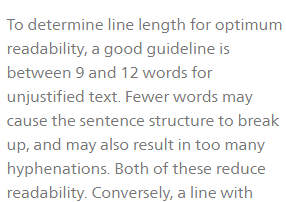
Dr. Boli is not exaggerating.
THE DAY I LAST SAW ELEANOR.
Rumored to be a deliberately lost work of Edgar Allan Poe.
The day I last saw Eleanor,
     It was the day she died;
Though some say still she walks the moor
Between the hours of three and four
(I don’t know what she does it for)
     Along the banks of Clyde.

The day I last saw Eleanor,
     She sniffed with wounded pride,
And handed me an apple core,
And told me, “Thus far, and no more,”
Concluding, “Now you know the score:
     You will not be my bride.”

The day I last saw Eleanor,
     She strode with purposed stride
Toward the billows’ haughty roar
And strode right past the pimpled shore
Till she was out a mile or more
     And swallowed by the tide.

Long since I left that cursed shore;
     Long since my clothes have dried.
And since my story makes you snore,
I tell you this, and tell no more:
The day I last saw Eleanor,
     It was the day she died.
OLYMPICS REPORT.
The United States Web surfing team brought home the gold with a record-breaking exhibition of tag-team surfing. The three-member team successfully hit every site in the Internet Archive collection of extinct Geocities personal homepages over the course of one 48-hour session. Silver went to the South African team for glancing at the online menu of every restaurant in Johannesburg, and bronze to the Japanese team for hitting every English Wikipedia article about rodents.
WITHOUT IRONY.
An advertisement from a major credit-card company carries this heading, which as far as we can see is offered unironically:
Imagine your debt-free future with a personal loan up to $35K…
Advertisement.
