Posts by Dr. Boli
TEST YOUR KNOWLEDGE.

Answer (click or tap to reveal):
The colossal head of George Washington is on Mount Rushmore, not on the desert sands of Ceylon.
INDEX VERBORUM PROHIBITORUM.
Dr. Boli is well aware that taking this principle too seriously would extinguish his celebrated Magazine, but he has never been one to let a foolish consistency stand in the way of telling other people what to do.
As regular readers are aware, Dr. Boli has been building an index verborum prohibitorum: a list of words we are not allowed to use anymore in serious discourse. The penalty for violations—that is, for using these words in serious discourse—is that Dr. Boli will not take you seriously.
Today we find it necessary to prohibit the word content, as it is applied to publications on the Internet.
Immediately Dr. Boli hears the protests from Web designers: We can’t get along without that word. How do you expect us to describe that stuff we pour into our design?
When you cannot imagine doing without a word in your profession, that might be a sign that you ought to get rid of it. It often means that the word has become a substitute for thought rather than an expression of thought.
Our usual reason for placing a word on the Index is that it has lost all meaning. In the case of “content,” however, we have a word that is actively pernicious, not just void of meaning. The word “content” both describes and—more importantly—creates a certain assumption about the things we publish on line.
Our longtime correspondent Charles Louis de Secondcat, Baron de la Breed et de Montemeow, gave us a good example the other day when he went looking for information about dryer sheets. A Maytag site told his Lordship that “Dryer sheets balance the positive and negative electrons in your fabrics that cause them to stick together.” You may look up “Electron” in Wikipedia if that does not strike you as a little bit off.
We went looking for information, but what we found was content. That is, we found a page where some meaningless blather superficially related to the subject was poured into a container to fill a certain amount of screen space. And the meaningless blather was there because the word “content” dictated what was to be on the page. If we are thinking rationally, we ask ourselves, “What information do we have that people need, and how can we give it to them in the best and most useful form?” But if we have the word “content” stuck in our heads, then we ask, “How can we fill up this empty space with words?”
In the current state of our technology, the easiest way to fill a page with words is by telling an AI bot to do it. The AI bot will then scour the Internet for the information it needs, and it will find mostly articles written by other AI bots. This is arguably an improvement over the state of the art five years ago, when the easiest way to fill a page with words was to steal an article from somewhere else and use article-spinning software to change all the words into synonyms. At least now our slop is grammatically defensible. But it is still slop.
This idea of “content” is what drives much of the rapid adoption of AI. If you think in terms of “stories” or “history” or “cooking” or “advice,” or whatever it is you like to write about, then the reason you are writing is because you have something to say. But if you think in terms of “content,” then writing is happening because there is a vessel that looks empty until it is filled with words. If you had something to say, it would not be empty. But you have nothing to say, so you instruct a bot to fill the vessel. It could also be filled with a repeating pattern from a William Morris wallpaper design, but then it would not attract suckers who are looking for information and find our “content” instead.
We live in a strange world where there is money to be made by the appearance of information. People are looking for information all the time. If they think we have it, they will visit our page, and then we can sell advertising space. That gives us a strong motivation to create pages that will lure the information-hunters, even if we have no information to give them. We create a page to trap those people who are desperately longing to know what dryer sheets really do, and then, having created the page, we need words to make it look like information. What the words say is almost immaterial.
If you are stuck in that business model, then of course you will need content. But Dr. Boli will not take you or your content seriously.
For the rest of us, though, the word content is now prohibited. Instead, we must say what we mean by picking another word that describes what kind of information it is we have to offer. Do we have a story to tell? Do we have a picture to show? Even the nearly meaningless word “article” is preferable, because it does not create the subconscious assumption that the vessel is the important thing, and the writing or picture or video is just what fills the beautiful vessel.
Therefore, by the mighty power of not caring what people think of him, Dr. Boli declares that, henceforth, the use of the word content to describe written matter, videos, audio files, pictures, and other such publications is prohibited.
FROM THE ILLUSTRATED EDITION.

Advertisement.

ASK DR. BOLI.
I am curious however about your opinion of Jefferson Davis’ fate. As I understand it, American officials were reluctant to put the man on trial for treason for two reasons:
1. The trial might require a Virginian jury, and we all know how THAT would go.
2. Treason requires a US citizen to give aid to an enemy nation; it was the policy of the Lincoln Administration that the Confederacy never actually existed as its own country. So therefore, putting the boring old history teacher on trial would reward him and his whole mad project with the thing all neo-Confederates crave: legitimacy.
So, my good doctor, what is your opinion more than a hundred fifty years later? Was Davis a traitor, and if so, what might realistically be done about it now? My understanding is that his grave is still accessible after midnight, and corpses retain their inflammability for a surprising number of years.
Jefferson Davis was certainly a traitor, and it was not expedient to prosecute him; that has been Dr. Boli’s opinion since the Civil War was brought to a successful conclusion.
When a few traitors commit crimes against the people, it is necessary to prosecute them in order that government of the people, by the people, for the people, shall not perish from the earth. But when treason has been taken up by a large part of the population and flared up into open rebellion, and then the rebellion is defeated, it is necessary for the winning side to ask, “What now?”
There are several possible answers to that question. First, we can prosecute and possibly execute all the traitors. That raises logistical difficulties when there are millions of traitors. Second, we can prosecute the leaders of the rebellion; but we do have to remember that the leaders were leaders only because they had millions of followers, and anything that makes those followers desperate enough to take up arms again is undesirable. Third, we can make the leader of the traitors our own leader, but that would be too absurd even to consider.
The wisest policy would seem to be magnanimity. We remember that we are all brothers and sisters; and though we have had a family quarrel, we can forgive each other and be family again. We should not ignore the problems that magnanimity creates for us: if the losing side still believes it was in the right, then as soon as it has recovered it will do its best to make the world it dreamed of when it rebelled. That is what happened in the South, where almost all the progress of the years after the war was undone in the era of “Redemption.” But the alternative is to keep killing each other forever, until we are all dead. In the abstract, that is probably the best possible outcome, but from a sentimental point of view we wouldn’t like it.
Now, what should we do about Jefferson Davis today? Burning him at the stake as a heretic has its attractions, but as a matter of policy postmortem incineration is never effective. It only draws attention to the dead heretic long after he himself has ceased to preach. Furthermore, it makes the orthodox look foolish and desperate. And from the point of view of justice (which Dr. Boli thinks is a sadistic concept anyway), it cannot be effective. If Mr. Davis went where he deserved to go, then our puny flames would add nothing to the experience. If, on the other hand, the Lord is as merciful as we all in our secret hearts pray that he is, then the pyre would only provide a moment’s amusement for Mr. Davis as he rests in his semi-detached mansion in the lowest circle of heaven. The most effective and the most charitable thing to do is to show the world what Jefferson Davis really was, and let the world make its own decision. Exposing the dry pedantry and twisted logic of the man ought to be enough to exorcise him from our political discourse. On the other hand, the world may decide it quite likes the fellow, in which case we in the minority can only rejoice that we are citizens of heaven, and remind ourselves that this world has never been extraordinarily wise in its choice of princes (John 12:31, 14:30, 16:11).
Addendum: A comment from our frequent correspondent Occasional Correspondent, left at the previous article on Jefferson Davis and his Rise and Fall of the Confederate Government, got caught in the gears of our all-mechanical spam-suppression device and was only rescued this morning. Because it is relevant here, and to atone for the delay, we bring it to the front page:
I say, let Jefferson Davis rest in peace, not in pyrotechnics, and good riddance.
As U. S. Grant wrote:
[…]Mr. Davis had an exalted opinion of his own military genius […] On several occasions during the war he came to the relief of the Union army by means of his
superior military genius .Personal Memoirs of U. S. Grant, vol. 2, ch. 44 (seen online at Project Gutenberg)
Was Davis a Union mole? If so, he sure maintained his cover to the end.
FROM THE ILLUSTRATED EDITION.
THE FIVE UGLY RACES OF MAN.
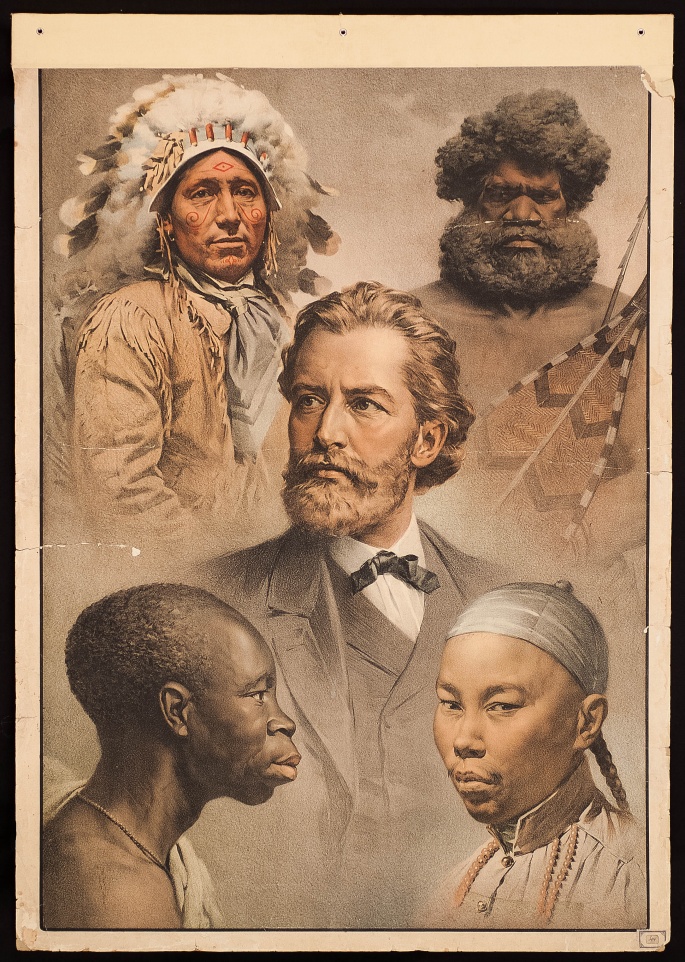
Racism and racial identity seem to be today’s most fruitful source of anxiety among people who wish to be known as enlightened. The subject is a minefield of contradictions: scientists will tell you that race is impossible to defend as a scientific concept, and so the enlightened writer or speaker must endorse and amplify that conclusion; yet the enlightenment also requires us to affirm that racial distinctions are vitally important to our identity, which is a term so indefinable in modern discourse that Dr. Boli has taken the trouble to prohibit it.
Dr. Boli does not find it necessary to repeat the shibboleths, because he has discovered, over the course of a long life and much experience, that there are no Gileadites waiting to kill him if he says the wrong thing.
All of which brings us to the picture at the head of the article. It is an illustration of Die fünf Menschenrassen (The Five Races of Man) by G. Ellka from a book of the early twentieth century. Dr. Boli has no idea what the book says; he assumes it is full of the sort of nonsense that inevitably came out when people of the era discussed race, which was different from the sort of nonsense that inevitably comes out when people of our era discuss race. The idea that there were five races—Caucasoid, American Indian, Negroid, Mongoloid, and Australoid—was one of the standard scientific dogmas of the time. It is nonsense in our age of gene sequencing, but at least it was an attempt at science, and the idea itself—as opposed to much of the rubbish built around the idea—was not inherently cruel or destructive.
Nevertheless, the mere existence of evidence of an outdated race theory triggers the shibboleth instinct in some people, and on the discussion page for this picture at Wikimedia Commons, someone felt compelled to speak out. Under the heading “This picture is very racist,” the commenter wrote,

This picture is White Supremacy at its best. Every race has good-looking people, but in this picture, the Asian guy, the African guy, and the Aboriginal Australian guy all look very ugly, the American Indian guy looks ordinary, not handsome but not too ugly, only the European guy in the centre looks handsome, gental, and very elegant.
And now Dr. Boli will apply some critical race theory to that comment, because the comment represents White Supremacy at its best. The commenter’s identity is only a number, but nevertheless Dr. Boli is confident that the person is of White European ancestry.
Of course the European illustrator’s unconscious assumptions must have been embodied in the illustration. But it seems clear that an honest attempt was made, not to draw caricatures of imaginary stereotypes, but to depict real models, probably from photographs. Yet the 21st-century commenter finds that “only the European guy in the centre looks handsome, gental, and very elegant.”
Does anyone besides Dr. Boli think the comment tells us far more about the commenter than about the artist who drew the illustration?
To Dr. Boli’s eyes, these are all fine faces. If he had to pick one as the most elegant, handsome, and gentle, it would be the American Indian. But the Australian looks deeply thoughtful; the African looks like someone we would instantly trust; the Chinese man has a faraway pensive look that suggests an active imagination. Only the European, to Dr. Boli’s eye, is dull; one suspects that his was the only portrait drawn from the imagination rather than a photograph.
Yet the stereotypical European ideals of good looks are so deeply embedded in the commenter’s mind that he takes them for universal aesthetic principles. It does not even occur to him that the Australian might be looking at the European in the center of the picture and thinking, “What a pasty-faced rube.”
We do not mean to shame a commenter whose heart is undoubtedly in the right place. Stupid race theories have done more damage to humanity than any other mistake of science. But we would encourage the commenter to think deeply about what racism is. The real damage is seldom done by overt racists these days. It is done by our hidden prejudices and assumptions, so deeply hidden that we mistake them for virtues. The commenter would doubtless have been pleased if the illustration had shown all the different races of man as more or less Northern European, but with different skin colors. But God’s taste is superior to his, and so humankind has been created in such a range of different forms and colors that we can never tire of the variety.
Now, you may be wondering what caused Dr. Boli to be thinking about the “five races of man” in the first place. The answer is in a school built in the 1930s, still standing and in use on Lemington Avenue in Pittsburgh, where a colorful terra-cotta frieze of the “five races of man” decorates the cornice—a daring assertion, considering the era, that this school was for everybody. Our friend Father Pitt pointed it out and provided these pictures. You will note that all but one of the five races is shown as dignified and respectable. The African:

The American Indian:

The Asian:

The Australian:

These four all keep their innate dignity, in an illustrated-Sunday-supplement sort of way. But when we come to Caucasoid Man…

…he looks as though someone just stuck a pin in him.
JEFFERSON DAVIS: NOT EXACTLY IVANHOE.

Book reviewers, unlike other mortals, are usually obliged to read the garbage; it is their profession to read garbage. But it does seem to Dr. Boli that there is room for a kind of review that will explain why he abandoned a book: what was so annoying, or incompetent, or merely dull about the book that he could not get past the first chapter or so.
And so we come to Jefferson Davis and his Rise and Fall of the Confederate Government. It is a book that richly deserves to be abandoned, and here are two thousand words to tell you why.
Jefferson Davis is your least-favorite high-school teacher, the one who always took the extra time to misunderstand your question and make you feel stupid for asking it, who made absurd and arbitrary rules and insisted that they were universal natural laws, and who never once in his life admitted that he was wrong about anything. You thought you had escaped him forever by graduating, but now here he is claiming your attention as if he were some important historical figure. He starts to lecture you about the late rebellion in the same tone of voice he used to tell you that your homework could not possibly be worth more than a C minus.
But now you have one weapon against him that you never had in high school. You can slam his book shut after the first chapter and refuse to listen to him anymore. This time he can’t give you detention after school.
Was Jefferson Davis ever wrong about anything in his life? He doesn’t seem to believe he was.
Here we have a man who clearly foresaw the dangers to the Union that came from the various conflicts and compromises that came up through the years before the war. He always, always made the honorable decision, the only decision that could possibly have been right, and he was infallible in these decisions even when the wisest and most experienced statesmen of the age could hardly see past their own noses. He never once regretted anything he had ever done. If he had been tried in an international court for crimes against humanity, he would have been one of those defiant prisoners who get extra time for showing no remorse.
We hear so much of the romance of the Lost Cause, about how Southerners saw themselves as characters in a novel by Walter Scott (as Mark Twain suggested), that this book is bound to be a disappointment. Jefferson Davis has a mind full of petty legalisms; there is no room in it for any romance.
It seems greatly to the honor of our country that, after an extraordinarily bloody civil war, the winning side allowed the rebel leader not only to live out most of the rest of his life in peace, but even to publish memoirs in which he proclaimed the justice of his cause. It is perhaps less to the credit of our literature that this book was published, but to our country as a whole it is a credit.
The most annoying thing about the petty legalisms that fill the mind of Jefferson Davis is the way he keeps implying, not at all subtly, that anyone who disagrees with his conclusions is a moron. “He must be a careless reader of our political history who has not observed that…” “Will any candid, well-informed man assert that…” “Can any historical fact be more demonstrable than…” These are all from just the introduction.
The cumulative effect of so many instances of this same rhetorical trick is to make the reader feel either stupid or hostile, or both. You may feel, in fact, as though you are stuck in one of those back-in-high-school nightmares, suffering through Mr. Davis’ sophomore American History class, where the teacher is eternally berating you for not having done your homework.
The first chapter begins by announcing that it will deal with, not the questions of slavery, but the nature of those questions.
Inasmuch as questions growing out of the institution of negro servitude, or connected with it, will occupy a conspicuous place in what is to follow, it is important that the reader should have, in the very outset, a right understanding of the true nature and character of those questions.
Most people misunderstand, as it turns out, not slavery itself, and not the questions about it per se, but the nature and character of those questions. Gosh, this is exciting! Why, it’s better than Ivanhoe!
So we get a capsule history of “African servitude” in the United States. We learn that, while it existed in some form in all the colonies, it was prevalent only in the South; that the Southern states themselves prohibited the importation of African slaves, but that “a few zealots in the North” began to demand that the Federal government interfere with the institutions of the states and abolish slavery. These zealots proceeded to pervert all discourse on the question of slavery.
For example, take the question of the “extension of slavery” into the territories. Here we come to an argument made by almost every Southern apologist—an argument both so legalistic and so absurd that it is hard to believe Jefferson Davis took it seriously. Yet he undoubtedly did. It is worth reading just as an example of how the kind of legalistic reasoning that apparently consumed his thoughts could completely blind someone to the most obvious facts. Speaking of the phrase “extension of slavery” as applied to the territories, he says,
To the reader unfamiliar with the subject, or viewing it only on the surface, it would perhaps never occur that, as used in the great controversies respecting the Territories of the United States, it does not, never did, and never could, imply the addition of a single slave to the number already existing. The question was merely whether the slaveholder should be permitted to go, with his slaves, into territory (the common property of all) into which the non-slaveholder could go with his property of any sort. There was no proposal nor desire on the part of the Southern States to reopen the slave-trade, which they had been foremost in suppressing, or to add to the number of slaves. It was a question of the distribution, or dispersion, of the slaves, rather than of the ”extension of slavery.” Removal is not extension.
Now, the number of implausible assumptions on which this argument rests is frightful. But we shall mention only four of the most obvious.
1. It assumes that, if slavery were made legal in a territory, no one but a transplanted Southerner could ever possibly desire to own a slave.
2. It assumes that Southerners who would migrate would never prosper—that, in spite of uprooting themselves from their old homes precisely for the purpose of making something of themselves, they would never succeed in owning anything greater than the farm they left behind, so that they would never desire more laborers for a larger farm, in spite of the obvious psychological truth that almost no one would leave his home for an unsettled territory unless there was a good chance of doing a lot better in the unsettled territory. For those who did not live through the era, it may be necessary to point out that, although the African trade had been suppressed (in the same way that the cocaine trade is suppressed today), breeding slaves domestically for sale was a profitable endeavor.
3. It assumes that the transplanted Southerners would never—in spite of the obvious inducements of material prosperity—reproduce at a faster rate than they did in the South, creating a larger class of slaveholders who would need a larger number of slaves.
4. It assumes that the Southern immigrants would never intermarry with the Northern immigrants, thus extending their “property” in slaves into the previously slaveless Northern families and the descendants of those unions.
Our author sees immigrants into the territories as if they were chess pieces. A Southern family arrives with a certain number of pawns, and that obviously removes those same pawns from the South. If you think of human beings as little wooden abstractions, this argument seems to make sense. But if you have an ounce of romance in your soul, you remember that human beings are sloppily real. Because human beings have aspirations—because they reproduce—because they imitate their neighbors, the extension of slavery into the territories would have meant more slaves, just as the introduction of free settlers into the territories meant more free settlers overall. It takes a sterile pedant to make the argument Davis makes—we had almost said a dimwitted pedant, and now that we think of it we shall just go ahead and say it. Yet, one after another, Southern writers made this argument. Is this the vaunted romance of the South?
The Missouri Compromise does not meet with Davis’ approval, because only the territory itself, not Congress, should have the right to decide whether to permit slavery. On the other hand, the admission of California as a free state, at the insistence of the territory itself, was a bad thing because it violated the Missouri Compromise. The legalistic arguments that support these assertions are too dull even to summarize.
At any rate, all this history of the slavery question leads to what may be the only really breathtaking moment in the whole chapter: the moment when Davis declares, after all these hair-splitting pedantries about the nature of the questions regarding slavery, that he has proved that the question of the morality of slavery had nothing to do with the controversies.
This brief retrospect may have sufficed to show that the question of the right or wrong of the institution of slavery was in no wise involved in the earlier sectional controversies. Nor was it otherwise in those of a later period, in which it was the lot of the author of these memoirs to bear a part. They were essentially struggles for sectional equality or ascendancy—for the maintenance or the destruction of that balance of power or equipoise between North and South, which was early recognized as a cardinal principle in our Federal system.
We went back and read that again to make sure it said what we thought it said. What can we say in response? Why did the North insist so vehemently that there must be no extension of slavery, unless it was because “the question of the right or wrong of slavery” meant everything to those Northerners? We can only assume that Mr. Davis believes the Northerners simply wanted to annoy Southerners, and they chose to needle them about slavery because thumping car stereos had not been invented yet.
But we hear this argument even today, especially from Southern apologists: the Civil War was never about slavery. It was about States’ Rights. It was a sectional rivalry. It was about grits vs. oatmeal. Anything but slavery. But Jefferson Davis has killed that argument dead. With pedantic thoroughness, he has shown us that the sectional controversies were never about anything other than slavery. It is a strange psychological mystery that he thinks he has proved the opposite, but that is between him and his therapist.
Here Dr. Boli will make an unfashionable admission. In his youth (he was only in his late 70s when the Civil War broke out), Dr. Boli was one of those moderate types who were opposed to slavery on moral grounds, but thought some sort of gradual emancipation would take care of the slavery problem without any unpleasantness. But when he began to read Southern tracts defending slavery, all of them making the same arguments Jefferson Davis makes here, he saw that, in the minds of these makers of Southern opinion, the idea of the African as a person, created with unalienable rights, equal in God’s sight to any other human being, simply could not grow; that they could never see a slave as anything but property. At that moment, when that realization dawned upon him, Dr. Boli became a raging abolitionist, thundering hellfire and damnation against the apologists for slavery, and vigorously collaborating with every effort to send fugitive slaves on their way to freedom and safety. He is a reasonable and moderate man, but Dr. Boli has his limits.
So let us hear no more about the romance of the old South. The Confederacy was founded by little men with little minds. The Underground Railroad—now, there is a big, bold, romantic idea, worthy of anything in Scott. We know where to look for the real romance of the antebellum era, and we are not responsible for the Confederate apologists who get it backwards.
Meanwhile, if you have some unaccountable desire to read the dry witterings of Jefferson Davis in his own words, the book is easy to find in the Internet Archive. There are two volumes of fairly small type, totaling 1700 pages; so if you find Jefferson Davis entertaining, you will not run out of entertainment for quite a while.
The Rise and Fall of the Confederate Government. By Jefferson Davis. New York: D. Appleton and Company, 1881.
Advertisement.

SIGNS FOR STREET BEGGARS.


