Posts by Dr. Boli
THE CODE OF THE GENTLEMAN.
It is no secret that it is easier in our North American society to be male than to be female, to be heterosexual rather than anything else, and to be white rather than any of the other decorative colors in which the human species is available. There is much hand-wringing by self-identified liberal white males about how unfair it is that they have this advantage, and much grumbling among self-identified conservative white males about how everybody seems to be trying to make them feel guilty for the way they were born.
Dr. Boli would suggest that the liberals and the conservatives, though they may never agree in politics, may come to an accommodation in everyday social intercourse. He proposes that men who wish to get along in modern society should adopt the old-fashioned code of the gentleman.
A gentleman always treats others with respect, even if he privately thinks their heads are full of excelsior. He may have the most bizarre opinions of his own superiority, but a gentleman is as courteous to people he considers his inferiors as he is to the ones he considers his peers.
If males of privileged classes, whatever classes those might be, could bring themselves to behave as gentlemen, at once all the inequalities of their position would begin to fade away. The questions that most provoke us simply would not come up.
Racism? A gentleman knows certain forms of courtesy that are universally applicable; he has them ready to hand, and even if he privately holds the most disgusting ideas on the subject of race, they will not affect his actions in society in the least.
Sexism? A gentleman simply would not interrupt a woman, or denigrate her opinions, or attempt to stand in the way of her ambitions—because he would not do that to anyone. It simply isn’t done.
Gay marriage? It is not a question for a gentleman. A gentleman may have his private opinions on the subject, and his private opinions may be measured or lunatic, according to the particular gentleman’s mind; but a gentleman cannot conceive of how the details of a particular couple’s intimate life would be of any concern to him. A marriage to him is a public declaration that a couple intend to share dishwashing duties according to an agreed-upon schedule.
Transgendered persons? If a gentleman meets someone who identifies herself as a woman, it simply does not occur to him to say, “I doubt that.” That would not be a gentlemanly thing to do.
Sexual harassment in the workplace? It is impossible, because it brings down on his head, quite automatically, the most horrific penalty a gentleman can imagine—the penalty of hearing others say, That man is not a gentleman.
In fact, there is no reason such a code cannot be adopted by all classes and however many sexes you like to count. One does not have to call oneself a gentleman, of course. One can be anything one likes and still follow the code.
Dr. Boli does not mean to suggest that all the problems of the world would be solved if we all adopted the code of the gentleman. He merely suggests that it would bring the solution a little closer.
SMYRNA.
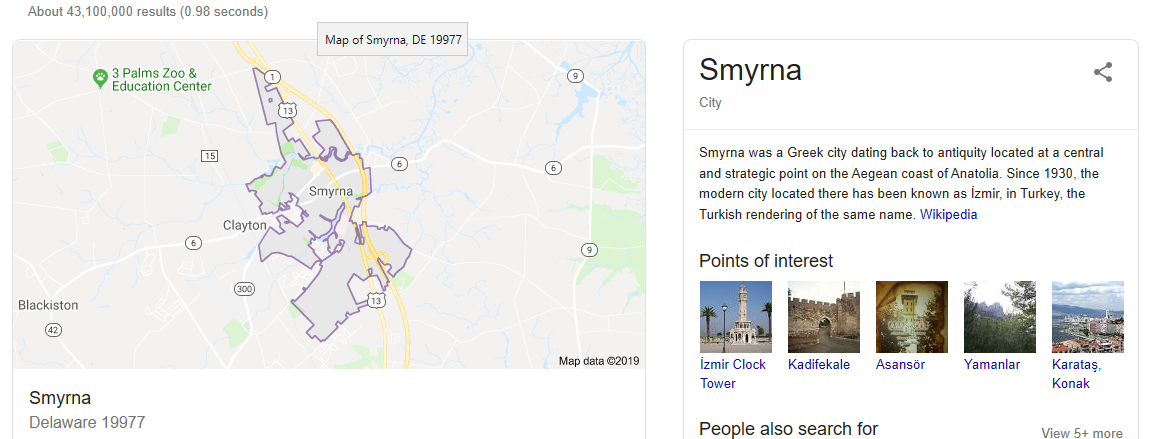
IF YOU LOOK up “Smyrna” in Google, you get a little box with the beginning of the Wikipedia article: “Smyrna (Ancient Greek: Σμύρνη, Smýrnē or Σμύρνα, Smýrna) was a Greek city dating back to antiquity located at a central and strategic point on the Aegean coast of Anatolia.” And you get a map of Smyrna and its suburb Clayton and the 3 Palms Zoo & Education Center.
Advertisement.

MONUMENTS OF THE ANCIENT WORLD.

THE UNIQUE NEMESIAN SPHINX has the body of a lion with the head of a different lion.
NOW IN PRESS.
My Life, by Irving Vanderblock-Wheedle. In a daring literary experiment, the distinguished poet and novelist brings us the first non-searing autobiography of modern times.
“A meticulous portrait from which the reader emerges, remarkably, not seared at all.”
—Booklust.
“‘Searing’ is certainly not the word for Mr. Vanderblock-Wheedle’s production. The word that most often came to mind was ‘mediocre.'”
—New York Book of Reviews.
“Of the 385 biographies and autobiographies we have reviewed in the past five years, this is the only one we have not described as ‘searing.’ That, if nothing else, renders My Life a literary landmark.”
—Publishers Treadmill.
SIGN AT AN ATTORNEY’S OFFICE.
FALL-DOWN INJURIES A SPECIALTY
Walk-Ins Welcome
SCRAMBLED-WORD PUZZLE.
UNSCRAMBLE THE LETTERS to find the secret word, and of course if you want to cheat you may use the clues provided.
1. Health resorts for the well-to-do.
SSAP = _ _ _ _
2. Hapless fools; usually preceded by “poor.”
SSAP = _ _ _ _
3. A gap between peaks, affording travelers a route through the mountains.
SSAP = _ _ _ _
4. Venomous snakes, of which Cleopatra was rather too fond.
SSAP = _ _ _ _
IN THE NEWS.
IN SPORTS NEWS, the Oakland Athletics lost to the Fort Wayne Pale Flabby Couch Potatoes, 7-2.
FREE POSTER.

THE CASE OF THE MISSING CASE.
NINTH ANNIVERSARY.
As he has done every year, Dr. Boli celebrates the anniversary of his migration to the World-Wide Web by reprinting the first story he ever published in electrical form.
—
A MAN WALKED into Abelard’s office the other day and announced that he had a singular case. Our morning had begun with tea, as usual, but I had hardly poured the first cup when the office door opened and the man with the singular case walked in.
It is well known by now that Magnus Abelard deals only with singular cases, so everyone who walks through the door announces that he has a singular case. Nevertheless, the door is, by Abelard’s explicit command, never locked; and this case really did turn out to be singular. I have taken the trouble, therefore, to record it among Abelard’s most remarkable achievements, in the hope that the record will serve as an imperishable monument to Abelard’s genius.
We began with the usual formalities. I informed our visitor that he would have ten minutes to convince Abelard of the singularity of his case. I also explained the payment schedule in the unlikely event that Abelard did pronounce his case singular. Abelard did not speak during the proceedings; he never does speak until some singular aspect of the case has caught his attention.
“Mine is a singular case,” the visitor began as I took notes. “Indeed, it is so singular that I have not spoken with anyone about it until now. I have lived for ten years in fear for my life—a fear all the worse for being secret. I have not dared reveal it to anyone, and yet it eats at me, day after day, hour after hour, like a kind of parasitic creature that gnaws but cannot consume.”
“You have nine and a half minutes,” I reminded him.
“Ten years ago, my wife, to whom I had been married only a month, announced that she had a few purchases to make, and declared her intention to walk to the drug store on Murray Avenue. She would be gone for about an hour, she said. I bid her farewell; she walked out the door; and that, Mr. Abelard, was the last time I ever saw her.
“I shall not weary you with the details of my inquiries. Over the years, I have found opportunities to interrogate our neighbors and the clerks at the drug store. From their statements, I have discovered that my wife did indeed reach the drug store; that she left and turned right on Murray Avenue; that she was last seen walking on Phillips, the very street on which we lived, in the direction of our house. But she never arrived.”
Here the visitor stopped; and, as Abelard was still silent, I knew the narration had not interested him enough for him to take the case. It was therefore incumbent upon me to disappoint our visitor.
“Disappearances such as the one you describe,” I told him, “while exceedingly regrettable, are not extraordinarily uncommon. Perhaps the city police, or a less specialized private agency, might be able to render you some assistance.”
Our visitor sat back in his chair and sighed. “I have not yet revealed to you,” he said slowly and quietly, “the singular aspect of the case.”
Abelard leaned forward. This statement had at least caught his attention.
The visitor took a deep breath, appeared to think for a moment, and then continued, picking his words with care and deliberation.
“About an hour after my wife left, a woman entered my house by the front door. She entered boldly—as if she owned the place, you might say. Now here is the singular and remarkable thing: in every particular, this woman was the exact image of my missing wife. Even her clothes were the same as the ones my wife had been wearing when she left. She proceeded to make herself quite at home; she treated me as though she were actually my wife.”
Here the visitor leaned forward and lowered his voice about a fifth. “For ten years, Mr. Abelard, that woman has inhabited my house, living in every respect as though she were my wife. For ten long years, I have lived in fear, utterly convinced that this woman in my house is somehow deeply involved in the mystery, and afraid even to sleep at night—afraid I might fall prey to the same sinister forces that took my beloved wife from me. The fear is tearing at my soul, sir, and I have at last resolved that, whatever the cost to myself, I must unravel this mystery.”
A moment of silence followed; then Abelard spoke for the first time.
“And how exactly was it that you knew this woman was not really your wife, returned from her shopping trip?”
The visitor started forward; then he sank slowly back in his chair, staring straight ahead.
“Good lord,” he whispered hoarsely.
Abelard observed him closely.
“Good lord,” the visitor said again, somewhat louder this time. “I never thought of that.”
He sat upright in his chair with a new air of confidence. “Well, sir, you certainly have earned your reputation. I never would have imagined that a mystery of such devilish complexity could be unraveled in such a short time. I shall certainly be recommending your agency. You may expect a check from me in the morning, although you must be aware that no remuneration could ever express my profound gratitude. I bid you good day, and once again I thank you from the bottom of my heart.”
Abelard watched him walk out of the office with a jaunty confidence that had been completely foreign to him only minutes before.
For some time after, Abelard was silent, as though lost in thought. At last he turned to address me.
“Perhaps,” he said, “we ought to reconsider the idea of locking the door.”