Posts by Dr. Boli
Advertisement.

FROM THE ILLUSTRATED EDITION.

PERCENTAGE WORD PROBLEMS FOR YOUNG STUDENTS.
Why must the “word problems” we give our children to solve be boring? Let the problems capture the imagination, and then math homework will be a joy. Here are a few problems, all of which Dr. Boli cheerfully donates to the public, with explicit permission to copy and use them in any form for any purpose.
1. Aralia Sneep planted 84 kangaroo seeds, but 13 of them grew into wallabies instead. What percentage of the seeds were actually wallaby seeds?
2. Because the waiter served your pie in your face, you have decided that he deserves only a 13% tip. The bill was $18.75. How much do you give the waiter?
3. In the town of Mysterious Glowing Rock, Wyoming, 27% of the people have three feet instead of two. If the population is 134, how many feet are there in town? (Round to the nearest foot.)
4. It is a known fact that 8% of male Plaid-Headed Warblers have wing markings in the shape of Carmen Miranda. Some guy at the Uni-Mart says that there are 27 male Plaid-Headed Warblers with wing markings in the shape of Carmen Miranda in Ohiopyle State Park. If that is true, how many male Plaid-Headed Warblers are there in the park? (Round to the nearest bird.)
5. This week only, the Pennsylvania General Assembly is offering a 30% discount on legislators from smaller urban areas. If it usually costs $79.95 to buy a state representative from Altoona, how much will it cost this week?
6. Brenneman’s Frosted Honey Crunch cereal is made of 92% sugar and 8% crunch by weight. If the manufacturer has 631 pounds of crunch on hand, how much sugar will be needed to make all the crunch into a batch of Frosted Honey Crunch cereal?
7. It is well known that 12 members of the royal house of Cowvetch-Hastings-Mulligan-Gasket von Toaster are mad, but no one knows which members. If there are 54 members of the family altogether, what is the percentage chance that Rupert Adolphus Griswold Cowvetch-Hastings-Mulligan-Gasket von Toaster is mad?
8. On average, 39% of everything the novelist Osmorhiza Yi writes is absolute rubbish. Assuming that this rate is consistent in all of her novels, how many pages of rubbish will you have to wade through in her 1,523-page opus Damp Petals of a Wild Geranium?
9. Mr. Zim’s Instant Gourmet shop was hit by a flood, in which 73% of his stock of freeze-dried eels were accidentally rehydrated and swam away. If Mr. Zim has 87 packages of freeze-dried eels now, how many packages did he have before the flood? (Round to the nearest package.)
10. A sloth spends 80% of its time asleep. There are 60 seconds in a minute. How many seconds in the next minute will Calvin Coolidge, the sloth at the Wilmerding Zoo, spend asleep?
(N.B.—Any answer to question 10 should be accepted if it is supported by a coherent argument.)
MORE ON GEOGRAPHICAL NAMES.
Martin the Mess writes, on the subject of French-derived place names, “Here in Illinois, we infamously mispronounce most of our French-derived placenames, such as Versailles (Ver-SAYLES), Des Plaines (DESS-Playnes), and Cairo (KAY-Row). I know the last one there is technically not French, but we manage to blame them for our mangling of it nonetheless.”
There is a borough of Ver-SAYLES on the Youghiogheny just outside McKeesport, and it is likely that there are many others in the United States. But Dr. Boli does not regard “Ver-SAYLES” as a mispronunciation. Famous foreign places have English names—Rome (not Roma), Moscow (not Москва), Munich (not München), Athens (not Αθήνα or Ἀθῆναι), and so on. As we become more ignorant of foreign places, we lose those native English names for them one by one, and have to go back to the foreign names when we do want to talk about them.
One of the more recent losses is Marseilles, so spelled (and pronounced “Mar-SAYLES”) until well past the middle of the twentieth century. A Merriam-Webster Geographical Dictionary from 1966 gives “Marseilles” as the only recognized spelling in English, and “Mar-SAYLES” as the only recognized pronunciation. Now, of course, you will be either politely corrected or snobbishly derided if you use the English spelling and pronunciation.
The same thing happens with foreign personal names. Who recognizes the name “Tully” today? We must say “Marcus Tullius Cicero” if we are to be understood. Yet the use of the correct Latin form is not a sign of better education, but of darker ignorance. Tully had an English name because he was a subject of everyday conversation in English.
Thus we may take the persistence of an English name for a foreign place as an indication that English speakers can still imagine that place as actually existing and potentially worth talking about, whereas foreign places that have lost their English names are at best unsubstantiated geographical rumors.
Local traditions, however, are more stubborn, and the English pronunciations of many foreign names are preserved in places like Ver-SAYLES and CAY-ro. You will not be able to extinguish the persistent belief that those names are “pronounced wrong,” but fortunately you will not be able to extinguish the pronunciation, either.
There is still no excuse for DESS-Playnes.
ASK DR. BOLI.

Dear Doctor Boli: I have a question for a language expert like yourself who is also an expert on all things Commonwealth of Pennsylvania. I was at my local grocery store the other day and happened to pick up a bottle of bottled water. I was intrigued by its claim to be “Naturally Alkaline” water from protected underground springs, as alkaline springs such as those found in the Southwestern USA are generally considered undrinkable bordering on poisonous. And a “protected underground spring” is probably marketing-speak for “an artesian well”.
But stupid bottled-water marketing hogwash aside, what really intrigued and annoyed me was the fact that they claimed their source to be in the “Allegany Mountains” of the NY/PA border region. I’d always seen that particular bunch of hills as the “Allegheny Mountains”, to match the Allegheny River and Allegheny County, so I wanted to check with you.
Looking at the bottled water company’s website I linked above, I am amused and horrified to see them spell that mountain range no fewer than three different ways in the space of a single paragraph: Allegany Mountains, Alleghany Mountains, and The Alleghenies. Which if any of these is most correct or the preferred spelling for people actually from that region, and not from a marketing company based in L.A. or some other area that lumps everything between the Sierra Nevadas and the Catskills as merely “Flyover Country”? —Martin the Mess.
Dear Sir: Pittsburgh is the seat of Allegheny County, and the river is generally spelled Allegheny as well.
Cumberland, the Queen City of the Potomac and the metropolis of western Maryland, is the seat of Allegany County. Belmont (New York) is also the seat of an Allegany County, although the river is still usually—but not always—spelled “Allegheny” in the Southern Tier of New York State.
Covington in Virginia is the seat of Alleghany County, and Sparta in North Carolina is also the seat of an Alleghany County.
The pronunciation of all three spellings is the same, and all three spellings are derived from the same Indian name. One could construct a neat narrative to account for the different spellings thus: Pittsburgh began as a French outpost, and the spelling “Allegheny” is the best approximation of the name to French phonetic laws; the English simply took it from the French along with the smoldering ruins of Fort Duquesne. “Allegany” is the obvious English spelling of the same name, used in areas that were first settled by the English. “Alleghany” is a sort of compromise, in which the increasing dominance of Pittsburgh as the gateway to the West encouraged natural pedantry to insert an H in the local spelling.
All this may be true, but we should be less than honest if we did not note that the French are at least not responsible for the name of the Allegheny River. The maps they made of Fort Duquesne show that they considered the Allegheny and Ohio to be the same river, called “Ohio” or “La Belle Rivière” for its entire length, with the Monongahela flowing into it at Fort Duquesne.
We may therefore fall back on a simpler explanation: the correct spelling is “Allegheny,” but people in Appalachia are very poor spellers.
The label of your bottled water is perhaps some marketer’s attempt to please everybody at once. If one must choose a spelling, however, one might point out that the population of Allegheny County in Pennsylvania is about a million and a quarter, whereas the best any of the Alleganies and Alleghanies can muster is about 75,000.
COMMUNITY BULLETIN BOARD.
Congratulations to Hailey Kalinowski, who sold the television rights to her tenth-grade social-studies research paper for $2.8 million, even though her teacher had given her a C minus on the paper. The Dumont Network has ordered twenty-six episodes of “Storm Runoff Problems and Aging Sewer Infrastructure in Allegheny County,” which is expected to make its debut in September as part of Dumont’s new Wednesday comedy lineup. Hailey says she plans to use some of the money to buy the house next to her teacher’s and rent it to a motorcycle gang.
From DR. BOLI’S UNABRIDGED DICTIONARY.

Tantric (adjective). Having to do with a tantrum (q. v.).
UNDERSTANDING MONEY IN EARLY AMERICAN LITERATURE.
If you read the literature of the young United States, you have doubtless been puzzled when the subject of money comes up. Shillings, eagles, dollars, half-johanneses, dimes, pistareens—they all seem to mingle indiscriminately in everyone’s purse. Money seems to be a very complicated subject.
In fact it was more complicated than you probably imagined. The federal government had its currency in dollars (ten dollars made an eagle), but the states had their own coinage in pounds, shillings, and pence, and the values were different from state to state. There were four different systems of values among the original thirteen states two hundred years ago. (State coins in pounds, shillings, and pence were no longer issued after 1793, but they remained in circulation for decades after that.) Furthermore, much of the money in circulation at the time was foreign: the Spanish milled dollar was the basis of the American dollar, and British, French, Spanish, and Portuguese coins all jingled in an American purse.
Fortunately we have this chart, published in Pittsburgh exactly two hundred years ago, that compares the values of the various coins an American might use.
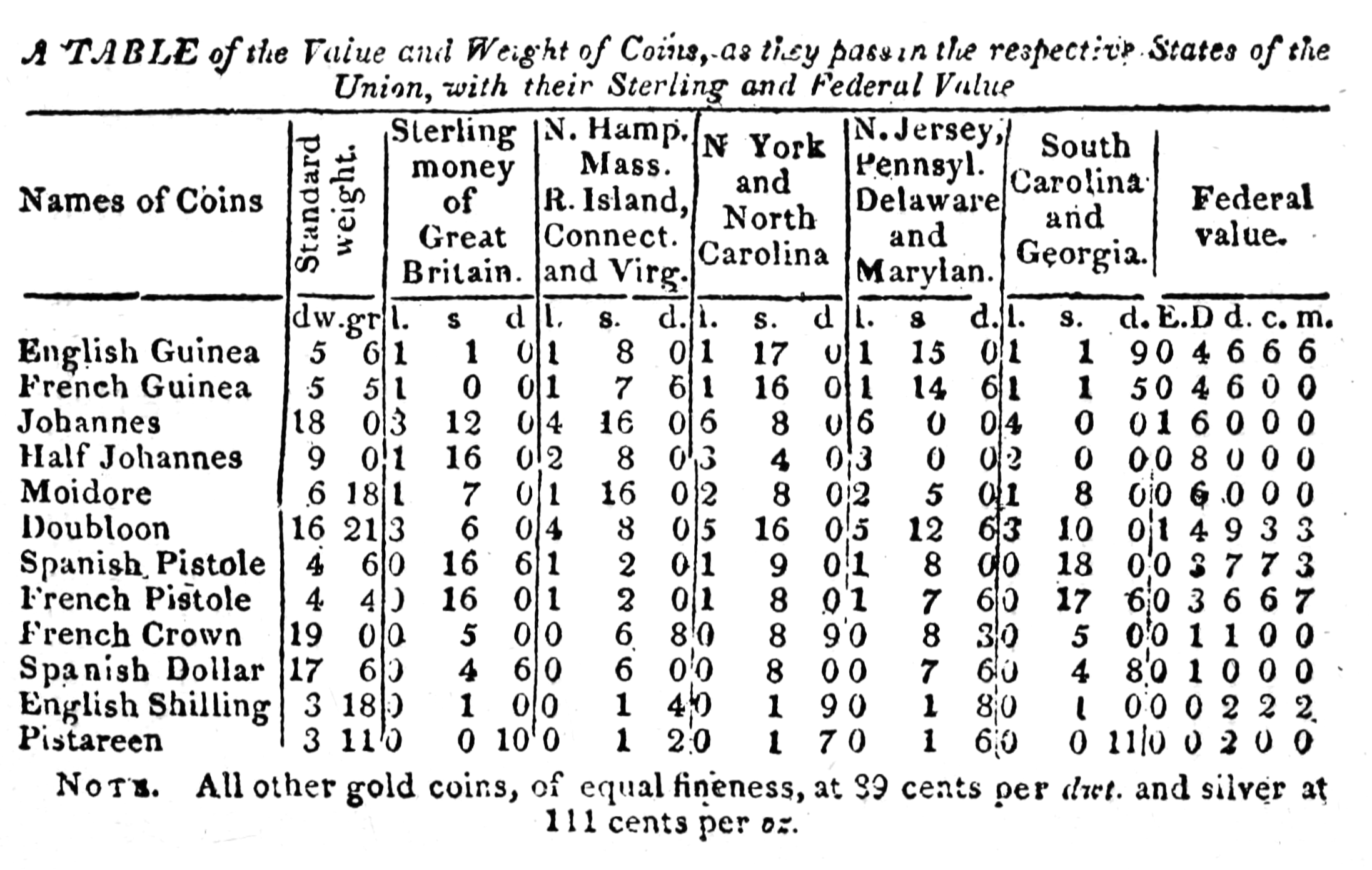
The values for state coinage are given in pounds, shillings, and pence; the values for federal coinage are given in eagles, dollars, dimes, cents, and tenths of cents.
The same book explains at length how to convert the coinage of one state to another’s—an explanation that takes up two pages: “To reduce Pennsylvania, New Jersey, Delaware and Maryland, into New Hampshire, Massachusetts, Rhode Island, Connecticut and Virginia, from the sum given deduct 1/5 thereof. Into New York and North Carolina, to the sum given add 1/15 thereof. Into South Carolina and Georgia, multiply by 3 and 1/9, and divide the product by 5, or multiply by 28, and divide by 45.” And so on.
On the whole, it is probably a good thing that the states no longer claim the power to coin their own money.
THE TOP TEN NUMBERED LISTS YOU WON’T FIND ON FACEBOOK.

Cecilia Esther Morris Clancy, Robert Morris’ second cousin twice removed (once from Philadelphia to York, and once from York to Scranton), photographed at the age of 137.
—
The list is numbered backwards, of course, thus building excruciating anticipation.
10. Twelve famous celebrities who eat their bagels with a knife and fork.
9. Thirty-six forgotten cousins of the Founding Fathers.
8. Thirteen everyday things that cannot be quantified.
7. Eight surprising things Beyoncé doesn’t know about the autonomous community of Extremadura in Spain.
6. The five most artistic left turns in the history of Breezewood.
5. Twenty-four really foul-tasting foods that can’t be improved at all by dipping in any kind of fondue.
4. Seventeen surprising books you didn’t think were thick enough to press flowers in.
3. The sixty-two dullest political memoirs of the Eisenhower era.
2. The ninety-five theses of Martin Luther.
1. The top ten numbered lists you won’t find on Facebook.
FROM THE ILLUSTRATED EDITION.
