Posts by Dr. Boli
ANOTHER HANDFUL OF RARE FIRST EDITIONS.
Dr. Boli promised more rare first editions as part of his plot to disseminate virtual communism through the Internet. Here is another handful, again made up of American authors. The capitalist running-dog lackeys of imperialism cannot long stand against the relentless assault of virtual collectivism. We begin with Edgar Allan Poe, who wrote exactly one novel, which has always been one of the least read of his works.
The Narrative of Arthur Gordon Pym of Nantucket. Comprising the details of a mutiny and atrocious butchery on board the American brig Grampus, on her way to the South Seas, in the month of June, 1827. With an account of the recapture of the vessel by the survivers; their shipwreck and subsequent horrible suffering from famine; their deliverance by means of the British schooner Jane Guy; the brief cruise of the latter vessel in the Antarctic Ocean; her capture, and the massacre of her crew among a group of islands in the eighty-fourth parallel of southern latitude; together with the incredible adventures and discoveries still farther south to which that distressing calamity gave rise. New-York: Harper & Brothers, 1838. —America’s most notoriously difficult critic called this “a very silly book.” That critic, of course, was Edgar Allan Poe, who began this story in the Southern Literary Messenger (where, you might say, he was very intimate with the editor), abandoned it, and picked it up later, all apparently with no notion of how the story was going to turn out in the end. In fact, it would not be too much to say that it never does turn out in the end. It is worth noting that this story is not the first depiction in fiction of a warm climate at the South Pole, The Monikins by Fenimore Cooper having preceded it by three years. This is the first American edition, in a very good scan at archive.org.

Now we turn to a forgotten sensation novel by an author who was quite popular in his time: J. W. De Forest, who is remembered today only as the author of Miss Ravenel’s Conversion from Secession to Loyalty, a Civil War novel remarkable for giving away its entire plot in its title. De Forest does not make the same mistake in this novel, a story of the Wilkie Collins school involving a murder, the victim’s will, and every clue pointing toward the hero.
The Wetherel Affair. J. W. De Forest. New York: Sheldon and Company, 1873. —Google Books misreads the date as 1878, owing to a poor scan of the title page. Dr. Boli is quite certain about the date 1873 because he has a copy of this edition (which is the first) in his own enormous library, bound in a volume with two American editions of novels by Dumas, making a very thick book marked “Miscellaneous Novels” on the spine.
Returning to a writer who has certainly not been forgotten, Dr. Boli presents not one but two copies of the first edition of The House of the Seven Gables by Nathaniel Hawthorne. It is sometimes worth while to have a second copy of a scanned book, since the overworked librarians who do the work of scanning sometimes slip.
The House of the Seven Gables. A romance. By Nathaniel Hawthorne. Boston: Ticknor, Reed, and Fields, 1851.
Another copy.
Henry Wadsworth Longfellow is far more famous as a poet than as a novelist, and his most famous stories—Evangeline and Hiawatha—were written in verse. His prose romances have been largely forgotten, though the poet’s reputation kept them running through edition after edition through most of the latter nineteenth century.
Hyperion, a romance. By the author of “Outre-Mer.” New York: Published by Samuel Colman, 1839. —This first edition is exceedingly rare, since the publisher failed, and half the edition was seized by creditors and probably never heard from again. Longfellow revised the text somewhat in later editions. The romance, as was usual for the time, was published in two volumes; Dr. Boli has cobbled together a complete set for you from a copy of the first volume (in a very good scan) at archive.org and a copy of the second at Google Books.
Volume I (at archive.org).
Volume II (at Google Books).

Finally, Herman Melville again. Moby-Dick was a failure; but Melville might have recovered from it if he had returned to writing more simpleminded sea tales, full of fetching Polynesian lasses garbed only by Nature. Instead, he gave the world Pierre; or, the Ambiguities, and drove a stake through the heart of his reputation as a commercial author. Nowadays, of course, far more more people read Pierre than read the disposable novels that succeeded where Pierre failed.
Pierre; or, the Ambiguities. By Herman Melville. New York: Harper & Brothers, Publishers, 1852.
—
YOUR CHANCE TO OWN A RARE FIRST EDITION
OF A FUTURE AMERICAN CLASSIC
The Crimes of Galahad, now available in paperback, for Kindle, or for Nook.
FROM THE ILLUSTRATED EDITION.

ASK DR. BOLI.
Dear Dr. Boli: What is the proper etiquette for televisions in public places? I was in a waiting room this morning with at least thirty people. Twenty-eight of those people were trying to read, or attempting conversations, or staring out the window. Two of them were watching the enormous television, which was blaring some obnoxious program about the pressing problem of teenage girls who run drugs for their abusive first cousins or some such nonsense. Now, it was clear that twenty-eight out of thirty people would rather have had the television off. But no one dared to touch it. What is the etiquette in that situation? —Sincerely, A Teenage Girl Running Drugs for Her Abusive First Cousin (no relation).
Dear Miss: Etiquette is the body of unwritten opinion embodying the common sense of a given culture as to what is proper and what is not. By that standard, the answer to your question is this: current etiquette holds that, in such a situation as you describe, the two who wish to watch the television take priority over the twenty-eight who do not. You may easily prove Dr. Boli’s statement by standing up and turning the television off: a receptionist or other very minor authority figure will instantaneously appear and take you to task after the manner of a Marine drill sergeant. And no one will stand in the way, because everyone knows that televisions in public places must be left to babble to themselves, even when no one wants to watch them.
This is the answer to the question you asked; but it is not a very satisfactory one, is it? That is because etiquette, while usually a very good guide, occasionally slips a cog. There was a time in Roman history when it was proper etiquette—which is to say, the thing any good member of proper society would do—to turn Christians over to the authorities to be thrown to the beasts. There was a time in American history when it was proper etiquette in certain states to lynch citizens of African descent who tried to vote. There was a time in German history when it was proper etiquette to throw bricks through the windows of Jewish shops. These things were wicked, but proper. And, while Dr. Boli does not wish to compare the prevalence of televisions in public places to lynch law or the Holocaust, he does believe that we have here another case where the machinery of etiquette has ground its gears and is no longer functioning reliably.
What can be done? The noble thing, doubtless, would be to take a public stand, even at the cost of martyrdom. But perhaps it is not necessary to go to such extremes. Most of these televisions are controlled remotely by infrared signals, and surely you must have noticed that “universal” remote controls have filtered down even into the dollar stores. It would cost very little money to slip a small remote control into one’s pocket, and it would not take very long to learn to adjust the thing for the most common brands of televisions. The rest Dr. Boli, who does not wish to be perceived as inciting disorderly conduct, leaves up to your imagination.
—
LEARN WICKEDNESS THE PAINLESS WAY—BY EXAMPLE.
The Crimes of Galahad, now available in paperback, for Kindle, or for Nook.
THE CRIMES OF GALAHAD—NOW FOR NOOK.
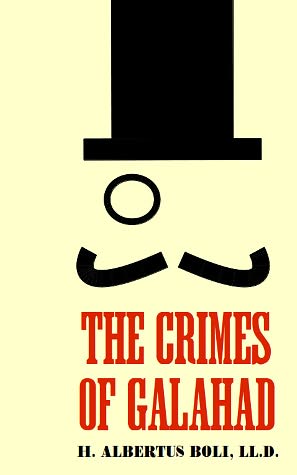
The acclaimed novel by H. Albertus Boli, The Crimes of Galahad, is now available from Barnes & Noble for your Nook reader, or for any device with access to Barnes & Noble ebooks.
The Nook version joins the Kindle version already available, as well as (of course) the print version, which is really quite a beautiful book, printed to the best 1880 standards, but on much better paper than a book from 1880 would have used.
Note that the digital versions are produced without annoying “digital rights management” technology. Dr. Boli believes that purchasers of digital copies should be free to do what they like with them, just as purchasers of print copies are.
Advertisement.

ONE-UPMANSHIP IN THE COURT OF LOUIS XIV.
Having come across this little amusement in a French book, Dr. Boli thought he might translate it for the benefit of readers to whom French is a difficult subject.
During the time when, after the revocation of the Edict of Nantes, the Protestants in France who would not abjure their faith were under persecution, an English ambassador asked Louis XIV for the liberty of those who were detained because of their religion.
The monarch responded, “What would the King of England say if I asked him for the prisoners held at Newgate?” (Newgate is a prison in London where common criminals are incarcerated.)
“Sire,” replied the ambassador, “the king my master would hand them over to Your Majesty, if you claimed them as your brothers.”
——Eugène Muller, Curiosités Historiques et Littéraires. This new translation is explicitly released into the public domain.
FROM THE ILLUSTRATED EDITION.

ASK DR. BOLI.
Dear Dr. Boli: At a snobbish coffeehouse in my neighborhood, I heard someone talking about “orthodox tea.” What did she mean? I was not aware that tea had religious principles. —Sincerely, A Coffee Drinker.
Dear Sir or Madam: Tea culture is an ancient art with many traditions, but broadly speaking the methods of preparing the tea leaves may be divided into two classes.
Orthodox tea is picked as whole leaves, traditionally by hand, the harvesters taking only the top two leaves and the bud from each twig. The leaves are then rolled by hand, or (in the cheaper grades) by a machine that simulates the action of the hand. This orthodox tea is usually sold loose by the pound.
Heretical tea, also known as CTC (for “crush-tear-curl,” the mass-production of tea being a brutal business), is harvested by a machine, something like an elevated lawn-mower, that removes the upper leaves, twigs, caterpillars, spiders, and blowing trash from the tea bushes. What is collected by the harvesting machine is passed through a machine that folds, spindles, and mutilates it all until it becomes a batch of tiny pellets or fine shavings. This is the tea that is put in sad little bags and sold in American supermarkets.
Ours is a land of religious freedom, and the right of American citizens to follow any dubious heretical sect of their choosing is guaranteed by our Constitution. Dr. Boli is a very tolerant man, and understands that the only way to secure religious freedom for himself is to grant it to everyone else. But there is a wide difference between tolerance and encouragement, and Dr. Boli would not have his tolerance of rank tea heresy misinterpreted as approval.
A SMALL COLLECTION OF RARE FIRST EDITIONS.

Communism was a delightful idea, was it not? The humblest worker should be elevated to the level of the richest aristocrat, and all the advantages of education and material prosperity that once belonged only to the wealthiest should now be showered upon the whole population indiscriminately. And if the promise was not fulfilled as well as the projectors of communism had hoped, we may charitably lay the blame at the feet of a recalcitrant reality, rather than supposing any want of effort on the part of the communists. The real world refuses to produce luxuries in quantities sufficient to make every resident of it a decadent aristocrat, and until some strong measures are taken to bring reality in line with our expectations of it, truly successful communism may be out of human reach.
On the Internet, however, we are freed from the galling constraints of reality. When possessions are virtual, they can be multiplied without limit, and everyone with an Internet connection may possess what in the real world would be beyond the reach of all but the wealthiest.
How much would an autographed first edition of Moby-Dick be worth? There cannot be many such things in existence. The book was a failure on its first publication; no more than a few thousand of the first edition were printed, and many unsold copies were doubtless destroyed. But Dr. Boli, whose generosity with things that do not belong to him knows no bounds, stands ready to give each of you, his loyal readers, an autographed first edition of Melville’s masterpiece. This is the first American edition, from which every accurate edition is derived,—not the botched English edition that slightly preceded it.
Moby-Dick; or, the Whale. By Herman Melville. New York: Harper & Brothers, Publishers. London: Richard Bentley. 1851. (Look in the end-papers, before the title page, for Melville’s autograph.)

Moby-Dick is certainly one of the most famous American novels of all time. Mr. Melville dedicated it to his good friend Nathaniel Hawthorne, who, just one year before, had published The Scarlet Letter. Hawthorne’s book was a decided success, and it would not be too much to say that American fiction falls easily into two eras: before and after The Scarlet Letter. In this color scan of the first edition, we discover that the title itself was printed in scarlet letters:
The Scarlet Letter, A Romance. By Nathaniel Hawthorne. Boston: Ticknor, Reed, and Fields, 1850.

J. Fenimore Cooper was the writer who gave the United States a place among the literary nations, rivaling Sir Walter Scott as a purveyor of adventure tales, and almost universally acknowledged in his time as the greatest master of the sea story. He wrote prolifically and in all genres, and made one fascinating attempt at a Swiftian satire:
The Monikins; Edited by the Author of “The Spy.” In two volumes [both included in this scan]. Philadelphia: Carey, Lea, & Blanchard, 1835. —The first American edition, at archive.org.

The Monikins, incidentally, though it was an embarrassing failure in 1835, has gained a surprising second life among fans of science-fiction. It tells the story of an English aristocrat and a Stonington sea-captain who meet a race of intelligent monkeys living around the South Pole.
We also have a later tale by Cooper:
The Wing-and-Wing, or Le Feu-Follet; A tale, by the author of “The Pilot,” &c., &c. In two volumes. Philadelphia: Lea and Blanchard, 1842. —Both volumes are included in this scan. Cooper’s tales were often published under different names in America and Europe, and often the name changed in later editions. This tale is the same one published in other editions as The Jack-o-Lantern or The Privateer.
There are many more interesting first editions out there, and Dr. Boli is very generous, if not downright extravagant, with other people’s virtual possessions. Look for more such valuable free gifts in the near future.
DR. BOLI’S CALENDAR FOR 2012.

We set aside one day for being grateful,
Which leaves 364 or 5
For being spiteful, selfish, mean, and hateful,
And letting all our baser instincts thrive.
So, if you hate Thanksgiving, have no fear:
Be thankful that it’s only once a year.