Posts by Dr. Boli
ADMIRAL HORNSWOGGLE’S NAUTICAL ADVENTURES.
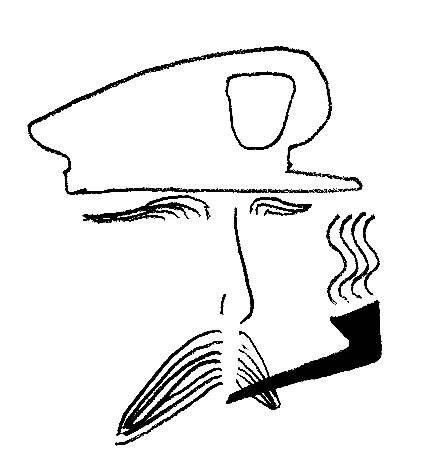
No. 20.—Mystery on Board
H.M.S. Drawing-Room, Part 3.
EXTRAORDINARY INVESTIGATOR PLENIPOTENTIARY Thicke pricked up his ears at the Marchioness’ remark. “Is that so? You the wife?” he demanded.
“The widow, apparently,” she corrected him.
“What did you mean when you said, ‘It’s happened again’?”
“I meant exactly what I said,” the Marchioness answered. “My first husband died in precisely the same way. Poor Sir Gundobald! I still miss him sometimes.”
“Is that so?” Thicke remarked with an unbecoming touch of sarcasm in his voice. “And where have you been all this time since your husband came into this room?”
“Powdering my nose.”
“Is that so?” Evidently Thicke had had little experience with the ways of women, as he seemed to have difficulty believing that the Marchioness could have been powdering her nose for two hours and a half. I did not like the man’s tone at all. To an officer in Her Majesty’s navy, gallantry is an ineradicable instinct, and I could not stand idly by and hear a lady treated with contempt. The Marchioness was still a dashed fine woman for her age, which as I recall was twenty-two, and the man who should not be moved to pity by her noble stoicism in the face of grief was certainly no gentleman. There was only one thing for me to do. If Extraordinary Investigator Plenipotentiary Thicke was set on accusing the obviously innocent grieving widow, I must solve the mystery myself. Fortunately that would not be difficult, since I had already arrived at the obvious conclusion before the men from the Royal Commission had arrived.
“If you’ll excuse my saying so,” I said, “it seems to me that the solution to this mystery is quite obvious.”
“Is that so?” Thicke asked with undisguised sarcasm.
“I believe it is. In fact, I might say that it is no mystery at all. The poor gentleman simply tripped.”
“Tripped?” Thicke repeated with an incredulous laugh.
“The solution is obvious. You will observe the positions of the various objects strewn about the room. Observe also the position of the electrical outlet. This small table was standing here, with that electric table-lamp upon it. The electrical cord passed here, in front of the chair. The marquess would have come through here, tripping over the wire, and bringing down the table with the lamp and water-pitcher on it. The pitcher fell this way, but the lamp that way, stretching the cord over the fallen table. The Marquess would have pitched forward, thus, probably making every attempt not to spill the precious cognac, whereupon his neck would have become entangled in the display of seamen’s macrame that had been hanging from the chandelier, effectively hanging the poor man. In his violent struggles to free himself, the chandelier came down, striking him on the head with one of its arms, and sending him staggering against the shelves, which collapsed, precipitating, among other objects, the small painting of Sunlight on the Sea Near the Coast of Orkney and that case of pistols, one of which discharged. When the bullet struck him, he would have dropped the cognac, spilling it all over the picture, where as you can see it dissolved much of the paint (which you will observe is predominantly Paris green), creating a poisonous solution that dribbled into the puddle of spilled water on the floor, much of which was absorbed by the rug. The poor Marquess fell forward, his neck catching on the lamp cord, which strangled him briefly until the cord pulled out of the lamp itself, leaving him to drop face first into the sodden rug on the floor, pierced as he landed by a shard of glass from the broken pitcher, and in his struggles inhaling a great deal of the liquid; so that, with the wet rug blocking his respiration, he was effectively drowned, poisoned, and suffocated at the same time. The cord, meanwhile, still connected with the electrical outlet, made a short circuit with the puddle on the floor, and electrocuted the poor man as he lay dying from his other injuries.”
Extraordinary Investigator Plenipotentiary Thicke thought for a moment. “Yes,” he agreed, “I suppose that clears everything up. Well, we’ll be on our way then. Sorry to have inconvenienced you, Marchioness, and my condolences on your loss. And thank you, admiral, for all your help. If you get tired of life in the Admiralty, our Commission is always hiring.”
I thanked him for the compliment, but assured him that the sea was in my blood. Thus the gentlemen from the Royal Commission removed the body of the unfortunate Marquess, gathered their oil paintings, and departed, leaving me to address my crew.
“Now we can all return to our duties and prepare this fine ship for her maiden voyage,” I told the men cheerfully. “But before we all go back to our stations, I should very much like to know why you all confessed to a murder you did not commit.”
The men looked down at the deck for a little and shuffled their feet, but at last Higgs spoke up.
“Well, you see, Admiral, we all thunk you done it,” Higgs explained.
“Why would you think such a thing?”
Dim-Eye Jim answered for the rest. “We all knows how you stands up for the men, Admiral. A man like that insultin’ us, why, it must have wounded you to the quick. So we all stood up for you, like as you stands up for us.”
“Do you mean you were willing to be hanged out of loyalty to me?”
“Hanged?” they all shouted at once.
“Well, yes. Murder is a hanging offense, you know.”
The men all exchanged shocked glances.
“We’d no idea, Admiral,” Jim said, apparently still speaking for the lot of them. “We thunk there’d be a fine or something.”
So the men all agreed that they would think twice before confessing to murder the next time, and I sent them back to their posts.
As for the widowed Marchioness, she inherited an enormous fortune, and a few weeks later married the Earl of Cummerbund, a man whose canny investments in the glass-paperweight industry had made him even richer than the Marquess of Rottenapple. I understand the poor Earl came to a bad end, having been stabbed, strangled, drowned, shot at close range, poisoned, hanged, bludgeoned with a pipe, suffocated, and electrocuted in his own drawing-room. The coroner’s jury in that case also returned a verdict of death by misadventure.
Advertisement.

ADMIRAL HORNSWOGGLE’S NAUTICAL ADVENTURES.
No. 19.—Mystery on Board
H.M.S. Drawing-Room, Part 2.
AS THE UNFORTUNATE incident had happened aboard one of the ships of Her Majesty’s navy, it fell under the jurisdiction of the Royal Commission for Naval Investigations, and a team of investigators was accordingly dispatched at once. When they arrived, they busied themselves making exact renditions of the crime scene in oil on canvas (for later display in the Royal Museum of Naval Criminal Art). Meanwhile, their supervisor, Extraordinary Investigator Plenipotentiary Erasmus Thicke, introduced himself to me.
“Very pleased to meet you,” I responded politely, “though I wish we might have met under more fortunate circumstances. I am Admiral Hornswoggle.”
“Is that so?” Thicke inquired with a decidedly skeptical tone. “Well, I’ll believe that when I have hard evidence. Where’s the wife?”
“If you mean the Marchioness, no one has seen her since the Marquess entered the drawing-room.”
“Is that so? Now, listen, so-called Admiral Hornswoggle, I want everyone who was on the ship assembled in this room. We’re going to catch a murderer today.”
“I’m not quite sure it will be that simple,” I told him.
“Is that so? Well, I say I’ll get a confession out of someone in ten minutes,” Thicke answered with a bit of swagger. “No one stands up to my grilling.”
I had private reasons to doubt his assertion, but nevertheless I followed his instructions, assembling all my men around the edge of the drawing-room. In the center of the room, everything had been left as it was when we found the body, except that the body itself had been decently covered with a few sheets of the Nautical Times. The men were prompt and all accounted for; the Marchioness, however, was still nowhere to be found.
“Now,” Extraordinary Investigator Plenipotentiary Thicke announced when we were all gathered together, “the first thing I want to know is this: Who found the body?”
“I did,” I answered readily.
“Is that so?” Thicke asked, turning to face me. “You know, I’m always suspicious of people who find bodies. Nine times out of ten——”
“Nay, ’twere me,” Dim-Eye Jim suddenly interjected. “I done it. I confess. But the tub o’ lard had it comin’.”
“Jim,” I said gently (for I never knew his surname), “I do not mean to impugn your veracity, but do you not recall that you were out here in the hall with us?”
Old Jim considered this difficulty for a moment, and then explained, “I slipped in while you blinked.”
“While I blinked?”
“You takes powerful long blinks, Admiral,” he said, but it was apparent that he was not convincing even himself.
“Jim’s lyin’ to you, Admiral,” Higgs interrupted. “I murdered the old pig, an’ I’m glad I done it.”
“But, Mr. Higgs,” I objected, “you were here with Dim-Eye Jim and me when the Marquess was killed.”
Higgs appeared to be nonplussed for a short time; then his face brightened. “Course I was,” he said. “I done that to put you off the scent.”
“I did it,” came a voice from behind me. It was our chief engineer. “I couldn’t forget what he said about the toy tugboat.”
“And how did you get through the locked door?” I asked.
He thought about that for a moment. “You can do most anything with steam power these days,” he replied.
“I did it,” the cook interrupted, “I was the one who murdered the beast.”
And so it went: each member of my crew put in his own claim to have been the murderer; and, when that claim evaporated in rank implausibility, another crewman stepped up to take the blame.
“What kind of nonsense is this?” Thicke demanded at last.
“Well, you did say you would have a confession in ten minutes,” I reminded him. “I see you are a man of your word.”
At this moment the Marchioness appeared in the doorway, and, taking one look at the scene of horror in the middle of the room, let out a disappointed sigh.
“Oh, dear,” she said. “It’s happened again.”
—
To be continued.
ON THIS DAY IN HISTORY.

ON THIS DAY in 1814, famous St. John’s College alumnus Francis Scott Key attempted to sing the popular drinking song “To Anacreon in Heav’n” to an audience of British admirals who had plied him with dinner and wine; but he was so far gone already that the words came out all wrong.
ADMIRAL HORNSWOGGLE’S NAUTICAL ADVENTURES.
No. 18.—Mystery on Board
H.M.S. Drawing-Room, Part 1.
ONE OF THE less onerous duties of an admiral in her Majesty’s navy is to accompany the leading figures of our time on their occasional tours of the new ships. It seems that great men and women have an insatiable appetite for such tours, as long as the ship remains firmly docked.
So it was that I found myself conducting the Marquess of Rottenapple and his wife on a tour of H.M.S. Drawing-Room, which was the first of an entirely new class of naval vessel in which the interior appointments would be indistinguishable from those of a comfortable gentleman’s country house. It was intended to serve as the flagship of our entire fleet, and I myself was given the command of her on her first voyage, which was to commence as soon as the Marquess and Marchioness had completed their tour.
I will not say that I had been looking forward to serving as tour guide for the Marquess, who had a reputation for being somewhat difficult to get along with—a reputation that was quickly confirmed when, on our first introduction, he demanded to know whether I had applied my eyebrows with a spatula.
So it went throughout the tour. In the galley, he told my honest cook (one of the company of caterers who had accompanied me on every voyage since I visited the North Pole) that men had been shot for making a stench like that. When Higgs, my boatswain, attempted a mild defense of our cook by saying that the men seemed to like their fare, the Marquess remarked that he was not surprised to find them accustomed to eating pig-slops, if they were all such men as their boatswain. He told my chief engineer that he had seen a better-regulated engine in a wind-up toy tugboat, and asked my youngest ensign whether his mama knew that he had sneaked out to play battleships. Each time he spoke up, the Marchioness attempted to mollify him; and each time, he responded to her with language I shall not repeat, and wish I did not even remember.
At length the Marquess retired to the main drawing-room with a bottle of cognac and locked the door behind him, so that (as he explained it) he would not have to be sickened by the hideous faces of the most ill-favored lot of sailors it had ever been his misfortune to glance upon.
In his absence, I attempted to explain to the men that the deficiency in good manners often observable among the nobility was attributable to their being deprived of affection at home, and that they were therefore more to be pitied than censured. My men, however, were not convinced by my arguments.
“Beggin’ your pardon for my language, Admiral,” said Higgs, the boatswain, “but it’s a darn shame that a man can talk like that to honest sailors in Her Majesty’s navy. He’s lucky no one stabs him in the back, that he is.”
“I’d wring his neck if I thought I could get away with it,” said the cook.
“He ought to be drowned like the rat he is,” one ensign suggested.
“I’d just shoot him and be done with it,” another offered.
“I’d poison that filthy cognac of his,” someone else piped up.
Here old Dim-Eye Jim, who had been with me since my earliest command, spoke up in a loud voice. “Nay, nay, ye should be ashamed o’ yerselves! A man like that ain’t one to be shot, or poisoned, or stabbed. Are ye all base footpads an’ assassins?”
“Well said, Jim,” I told him.
“Aye,” Dim-Eye Jim continued, “a man like that oughta be hanged from the yardarm, right in the daylight, where he can be a warnin’ to ’is kind!”
This suggestion received much applause, as did others that the Marquess should be beaten to death, suffocated with a pillow, or electrocuted after the manner of the Americans.
Ordinarily I allow my men considerable frankness in expressing their opinions, but I believed that the time had come to restore some kind of discipline. “Gentlemen, please,” I began, “we must rise above pettiness and——”
Suddenly there was a loud crash, and then the sound of breaking glass; and a moment later a shot rang out. I turned and dashed down the corridor in the direction of the noise, and found myself in front of the drawing-room door, behind which we could hear the sounds of furniture splintering and glass breaking, and an occasional grunt or moan. I tried the door, but it was still locked. I put my shoulder to it, but the door was too well built to give; Higgs added his own shoulder, but it still would not budge. Just as the appalling din from within died down, Higgs and I finally succeeded in gaining entry by using Dim-Eye Jim as a battering-ram.
The room was in a frightful state, with evident signs of a desperate struggle: chairs and tables overturned, the chandelier pulled down, shelves collapsed, the water-pitcher spilled, and—in the center of it all—the lifeless form of the Marquess of Rottenapple. I could not see how an attacker could have entered the locked drawing-room, or how he could have escaped. But that there had been an attacker of some sort appeared certain: for it was clear at once from the most cursory examination that the Marquess had been stabbed, strangled, drowned, shot at close range, poisoned, hanged, bludgeoned with a pipe, suffocated, and electrocuted.
—
To be continued.
ASK DR. BOLI.
Dear Dr. Boli: I visited Pittsburgh recently, and I miserably failed in trying to figure out the transit system there. It was not the map, which was explicit enough; it was the question of when to pay my fare. Why is such a simple thing so convoluted? Since I know that Pittsburgh is the capital of your celebrated publishing empire, I thought you might be able to explain it to me. —Sincerely, a puzzled Chicagoan.
Dear Sir or Madam: It is not so terribly convoluted if you remember the simple rules that govern the payment of fares on all Port Authority transit. Inbound, you pay when you get on; outbound, you pay when you get off; unless the route does not go downtown or it is after 7 p.m., in which case you pay when you get on, unless it is a trolley route, in which case you still follow the daytime rules; or unless you are going from one part of downtown to another, in which case you do not pay at all, unless it is after 7 p.m., in which case you pay when you get on a bus, but the subway is still free; and the subway is also free north of the Allegheny, but the buses are not; but the subway is not free south of the Monongahela; and on the Duquesne Incline you pay at the bottom station, but on the Monongahela Incline you pay at the top. Just remember these simple rules, and you will never be confused by Pittsburgh transit again.
DR. BOLI ACQUIRES ‘FIRST THINGS.’

IT IS WITH great pleasure that Dr. Boli announces the addition of the magazine First Things to his celebrated Publishing Empire. Many regular readers of both publications will doubtless have questions about the new arrangement. Dr. Boli will attempt to answer these questions in the catechetical format that has become so popular in disseminating information on the World-Wide Web.
Q. How did I get here?
A. If you had been looking for Dr. Boli at his old address, you arrived by means of an HTML redirect. For anyone familiar with HTML, the thing holds no mystery; for other readers, the best way to explain it is that it works by means of sorcery. Nevertheless, you should update your bookmarks, since the demonic forces behind HTML redirects are notoriously unreliable.
Q. Will First Things change radically under the new regime?
A. No. The two magazines will be operated independently. Dr. Boli will continue to edit his own magazine, and the editors of First Things will continue to do whatever it is they do.
Q. Why First Things in particular?
A. Primarily because the price of Cabling Installation & Maintenance was set unrealistically high.
Q. Isn’t First Things sort of a reactionary magazine?
A. Quite so; and reactionaries are never happy unless they have something to react to. Dr. Boli takes great delight in making people happy.
Q. What are Dr. Boli’s politics exactly?
A. Dr. Boli is still registered as a Federalist, but he has never quite forgiven his own party for the Alien and Sedition Acts, though they were passed when he was still a small boy. Since he reached his majority, his primary criterion in bestowing his vote has been whimsy. This year he will probably give his vote to the Socialist Workers Party.
Q. I don’t approve of one of the advertisements in the margin.
A. Don’t you?
Q. I thought I was supposed to be asking the questions.
A. Were you? —In any case, if you disapprove of one of the advertisements, you should remember that clicking on that advertisement costs the advertiser money. Does that suggest a logical course of action?
DR. BOLI’S CALENDAR FOR 2012.

ON PATRIOT DAY we all feel patriotic,
Wrap every surface in red, white, and blue,
Wave flags with fervor bordering on psychotic,
And make inspiring speeches all day through.
We show our country how much we adore her
So we won’t have to lift a finger for her.
DR. BOLI’S PRESS-CLIPPING BUREAU.

Advertisement.
