Posts filed under “Books & Literature”
FROM THE ILLUSTRATED EDITION.

FROM THE ILLUSTRATED EDITION.

A REMARKABLE EXAMPLE OF CRANK LINGUISTICS.
Henry Matthews believed he had cracked the linguistic nut. In a little prospectus published in 1821, or possibly 1815, or perhaps some other year (but from the type clearly early nineteenth century), he proposed to create a dictionary that would make it possible for everyone to communicate with everyone else. The title of the prospectus displays his ambition and his optimism clearly enough: “A Plan for Translating Languages, Without Study, or Any Previous Acquaintance Therewith.”
We must give Mr. Matthews credit for articulating the difficulty that keeps an artificial “universal” language from ever succeeding.
An opinion has been entertained by some learned men, in different ages, that the knowledge of overcoming the difficulties of languages would be one day accomplished; and others have thought it possible to contrive, or create, a general or universal language. Several ingenious plans have been suggested for the support of foreign correspondence, by means of a general or universal character; but, in all these, there is much to be acquired and remembered, as well as a thorough acquaintance with the principles of grammar. Except a plan can be devised to be comprehensible by the person who can merely read, as well as the scholar, the sale of such a work would not be sufficiently extensive to justify the expence.
Here he seems to hit the nail on the head. The average intelligent reader will never summon sufficient motivation to learn a constructed language. A few fanatics will do it; but the most successful of all these supposed universal languages is Esperanto, and you may measure its success by going to any large city in the world and attempting, without making prior arrangements with the local Esperanto boosters, to accomplish anything at all in that language.
What, then, is to be done?
A system fully suitable has been conceived, which, by a simple arrangement, will obviate every difficulty.
The dictionary now proposed will enable persons to correspond with foreigners, of whose language they have no knowledge; and to translate freely, every species of their literature.…
By this dictionary, it will be only pastime for children to translate English works into the languages of India and China, and their works into our own. In fact, it will unlock the knowledge of the world, and communicate it to all, the most uninformed as well as the profoundly learned.
You want a copy of this dictionary already! How can you obtain it? Well, it has not been compiled quite yet. This is, after all, a prospectus, designed to raise enough interest to persuade a publisher that it will be worth paying Mr. Matthews to compile the work. But he lays out the system clearly enough. His plan is to create a dictionary of meanings rather than words (anticipating by some decades the work of Peter Mark Roget). The meanings of words must be carefully distinguished, and each listed separately if a word has more than one meaning.
For instance, in the common dictionary the words and significations would sometimes stand thus:
Tiller, s. a ploughman; handle of a rudder.
But, in this dictionary, it must be repeated thus:
- Tiller, s. a ploughman.
- Tiller, s. a handle of a rudder.
Having made that arrangement of all the meanings in English, he will assign a number to each meaning. This number is the key to everything. Now we may compile a French dictionary, or a Nahuatl dictionary, or an Igbo dictionary, with the same meanings assigned to the same numbers.
Our author recognizes one difficulty that comes up right away: since the English language is the key, only in English will the numerical order and the alphabetical order of words be anything like the same. “The English interpreting dictionary will be both alphabetical and numerical, in one and the same book. This advantage can only fall to the language that first adopts the plan.” In every other language, the dictionary (like Roget’s Thesaurus) must have two sections: one in numerical order, and one in alphabetical order.
Now see how wonderfully this eliminates the work of translation. If you are writing to someone in China who has the Chinese equivalent of this dictionary, then you have only to write your letter as usual, and then find the number for the meaning of each word and write those numbers down. Your Chinese correspondent receives your numerical letter, looks up the numbers in his own dictionary, and transcribes the matching words, and your letter sits before him in pure Chinese! If, however, you suspect that your Chinese correspondents are not supplied with dictionaries on the Matthews system, then you can obtain a Matthews-system Chinese dictionary yourself, and you can write your letters in Chinese just as if you had been born in Peiping.
At this point you may be thinking to yourself that Mr. Matthews is a little bit naive about the extent of the differences between languages. You are correct. He seems to know a little French, though perhaps not much: he gives a translation of the first Psalm from the French version as an example of how well his system works. Even here it is necessary to make some allowances for the differences in grammar between the languages, but he thinks that anyone of ordinary intelligence can make those allowances. “The very few superfluous words, such as the double negative in the French, &c. can, at first sight, be discovered by a common capacity, and struck out, or supplied, as may be required.”
It seems to us, however, that the system utterly wrecks against the rock of Latin, or German, or (heaven forfend) Russian, or any other declined language, where the form of the word itself conveys much of the meaning. Let us apply the system to Virgil, for example:
Arma virumque—
But here we have already run up against a nearly insuperable difficulty. That little parasitic particle -que, meaning “and,” attaches itself to the end of the second word of a pair, forming a single written word, but with two meanings. We do not need to be experts in Latin, but it will be necessary to have at least so much “previous acquaintance therewith” as will allow us to recognize that “virumque” resolves into the two completely unrelated meanings “man” and “and,” and that it will be necessary to place “and” before “man” to translate the word into English. We might overcome the difficulty by listing the combined form of every Latin word that can possibly take que on the end, effectively doubling the size of our Latin dictionary. But wait: we must then effectively double the size of every dictionary in every language, because each of those Latin meanings must be assigned a number.
And we have not begun to address the problem of inflection, which we can practically ignore in English and French, but which entirely determines who does what to whom in Latin. Let us suppose that we have managed to discover, somehow, that the enclitic -que has a separate meaning, and that we have managed to deduce the dictionary entries from the inflected forms of the words, and go on to translate the first few lines of the Aeneid on the Matthews system, remembering that inflection is not accounted for:
Arm man and sing Troy which first from coast
Italy fate fugitive Lavinia and come
shore much that and land thrown and high
force above fierce memory Juno because anger
many also war step while found city
carry god Latium tribe whence Latin
Alban and father and altar wall Rome.
It would take all the imagination of Barry Fell to make a “smooth translation” from this jumble, and then it would bear little resemblance to what Virgil actually meant.
Now, this is an Indo-European language. In the great scheme of world languages, Latin and English are practically dialects of the same tongue. We cannot imagine that a translation from Cherokee would go as smoothly.
So it seems that Mr. Matthews never produced even his English dictionary, let alone the matching dictionaries for other languages that would break down the walls of incomprehension and open up any language to any intelligent reader “without study, or any previous acquaintance therewith.” But for a moment let us admire the ingenuity and optimism of a man who was ready to undo the eleventh chapter of Genesis. He was wrong, but he was gloriously wrong.
THE VARIOUS HISTORY OF AELIAN.
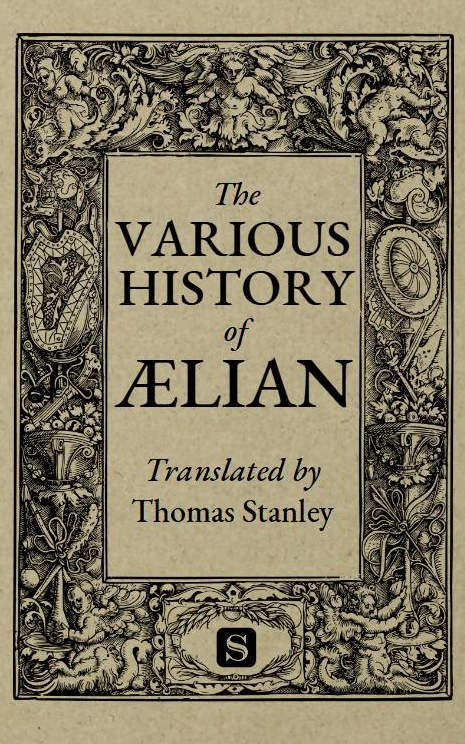
Once again Serif Press brings us a new edition of a delightful old book, and once again an introduction, which we reproduce here, is provided by H. Albertus Boli.
It seems that there were two well-known classical authors by the name of Ælian, and literary historians are generally agreed that this one was not that one but the other one. Our Ælian, Claudius Ælianus, lived about the year 200. He was a Roman, but a Hellenophile; he wrote in Greek, and was praised in his time for his pure Attic style. His love of Greek history and Greek thought comes through in every story. He was a miscellanist: his other famous work, On the Nature of Animals, is a collection of odd facts and observations (collected from books, not by observing the animals), again flung together without much system.
Modern readers find themselves more in sympathy with Ælian than with many other classical writers. He is human in a way that some of the best writers of his time are not. He has prejudices we can sympathize with. He thinks infanticide ought to be illegal, though Thebes is the only place he can think of that has such a law. He thinks forgiveness is a splendid virtue. He prefers mercy to justice, but is especially pleased when a wise ruler finds a way to have both of them at once. He thinks animals can be remarkably clever. He likes a story of remarkable wonders, but he is quick to point out that it probably isn’t true. Ælian, in short, is just the sort of guest you would like to have at a party of intellectual friends today.
As for his stories, some of them may preserve facts of history otherwise unknown to us. Many of them are probably not true, in the limited and uninteresting sense of not corresponding to the actual events that happened in the real world. They are true, however, in the much more important sense that they bring to life what the Greeks and Romans believed about themselves. They may not tell us what happened in ancient times, but they make the ancient world present to us in the same way it was present to people in the Roman Empire of the year 200 or so.
And now a word about our translator. Thomas Stanley’s translation is doubtless imperfect, as any translation must be; he leaves out some of the parts that were more embarrassing to a gentleman of 1665 (we have supplied those parts in footnotes from the earlier Fleming translation); occasionally he may misunderstand his author, though very seldom, and probably no more than most of the best translators. With its few flaws, however, this is a very good translation, and a good model of what translations of classical literature ought to be. This was in fact the last English translation of Ælian’s Various History published for more than 300 years; not until the 1990s was the book translated again.
It is worth noting, therefore, that the author of the standard English translation of the Various History was no more than fourteen years old when he wrote it. The younger Thomas Stanley was born in 1650; his Ælian was printed in 1665. According to the dedication, his father, the elder and much more famous Thomas Stanley, had set him the task. Now you see why the commendatory verses make so much of the author’s youth:
If from a Glorious Morn we justly may
Take a Prognostick of th’ ensuing Day;
What do these early glories promise, when
You shall arrive at your Meridian?
To which we may only say, Prognostick schmognostick. This translation is the only thing for which the younger Stanley is known. History is even ignorant of when he died; since we have no other works by him, he may have died young. As a memorial to him, we have reproduced two of the three commendatory verses in this edition. One of them is by Edward Sherburne, a distinguished poet of the second rank who was capable of a memorable turn of phrase:
Not to know what was done ere we were born,
Is to live Children still…
The third poem is written in Greek and printed with every arcane ligature in the compositor’s arsenal; we have omitted that one.
The Stanley translation has the virtue of making Ælian live in English, more so than the earlier Fleming translation. It keeps up a conversational style that is perfectly appropriate to the author. We have kept the original 1665 spelling and capitalization; the only thing we have changed is the use of italics, which (as was common for the time) are used in the original edition for all proper names, a convention modern readers might find distracting. Stanley adds a few judicious notes, which we reproduce here. We have added very few of our own. There may be references a modern reader will not recognize; but most of the stories stand as they are, and to weigh down the pages with footnotes would have produced an effect completely opposite to the cheerful entertainment of the original.
You probably have an Amazon gift card burning a hole in your pocket right now. Everyone has: it is nothing to be ashamed of. Whittle down that outstanding balance with Aelian’s Various History. Or consider one of the other Serif Classics, handsome editions of old books worth rediscovering. Or, if your tastes run to the modern in literature, you may wish to stock up on the works of H. Albertus Boli.
From DR. BOLI’S UNABRIDGED DICTIONARY.

Epitome (noun).—A book that grows upon another volume, using it only for support, neither causing damage nor providing benefit, and not taking nourishment from it (as a paratome does).
TELEGRAPH CODES.
Well, a species of Kalmia is the Pennsylvania state flower. That might be a clue. But it also might not be.
If, however, you were a properly trained sales representative of Steinwender, Stoffregen & Co., coffee traders in New York, then you would know that your employers had given a full answer to your inquiry about terms. “Kalmia,” to you, would mean “Cash as removed, full settlement within 30 days; basis 60 days notes, less discount at the rate of 8% per annum for the unexpired time. Bill to date when coffee is all in store. Buyers to have benefit of unexpired storage and fire insurance, and same time to weigh as wanted.”
This is a saving of at least 51 words, which is pretty near a record. But it illustrates the principle very well. Telegrams were charged by the word; multum in parvo was the obvious and sensible rule to be followed in sending them. Code books that made it possible to reduce whole sentences to a single word were almost an economic necessity.
Retailers in the new mail-order businesses were quick to seize on the idea. Would you like an Estey parlor organ, style B 70 case, four sets of reeds, manual sub-bass, octave couplers, Harp Æolienne stop? Cable “Fervid” to the Estey Organ Company, and you will get exactly the instrument you require.
In fact a whole profession sprang up to provide these codes to interested parties. You could buy a “universal” code book, but then of course anyone else with the same book could intercept and interpret your messages. For the good of the firm, would it not be better to have a specially ordered code book, kept as secret as practical?
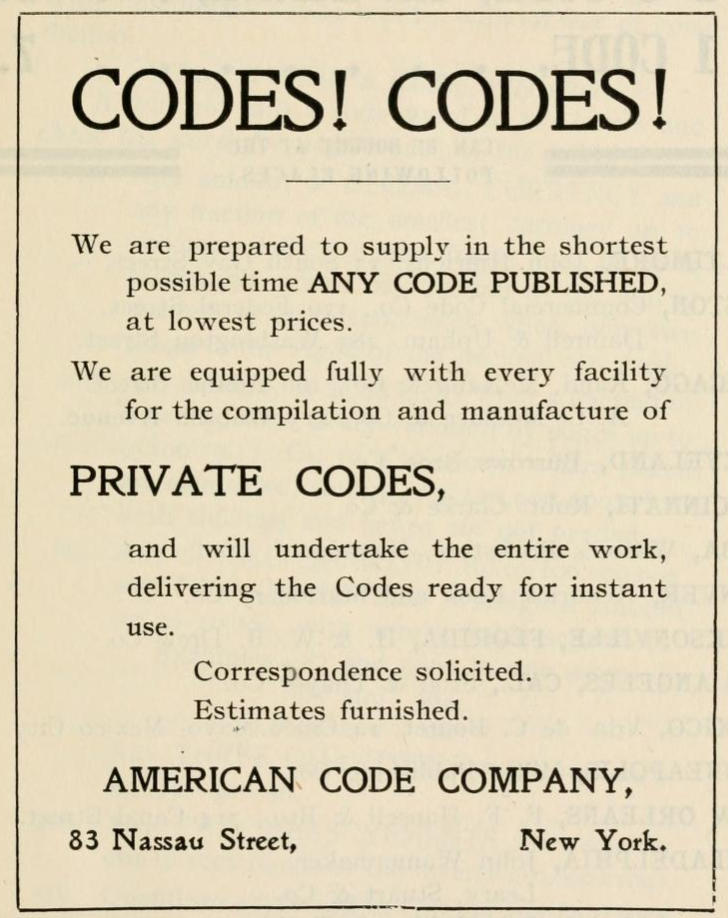
Some of these code books are remarkably comprehensive, running up to 1800 pages. Consider just a few code words taken from various telegraph code books:
Capitulate — Might save greater portion of cargo if steamers and lighters sent soon.
Conception — Send sufficient details to enable us here to form an intelligent opinion about the matter.
Distracted — We have sold 900 cases Medallion Brand hams at price named in your last quotation.
Guileless — Has (have) been declared guilty of high treason and sentenced to death.
Mudbreast — Decline to vote. Consider it a subject for discussion at meeting of the committee.
Ogress — We cannot ship barley by this steamer; can ship by next steamer; cable if we shall ship.
Outjesting — The revolution has been crushed.
Sanctitude — Telegram unintelligible; repeat same, by wire, without regard to any code.
Underway — It is evident that you do not understand.
As you might have guessed already, this whole article serves to introduce a new page in our Eclectic Library. We now have a collection of Telegraph Codes for your amusement and edification. Historical novelists will find this page an invaluable resource. Serious historians will find more information about commercial conditions than could be discovered in any number of carefully researched academic treatises. The rest of us will find a few minutes’ amusement, and that is all the profit we need to justify this little collection.
WE CAN’T KEEP OUR HANDS OFF THE VOYNICH MANUSCRIPT.

Desire [blah blah blah] pain/elimination possible the confusion of the spirit [blah] healing [blah blah].
Here is where Dr. Boli must confess that he sometimes wonders about the direction his own life has taken. To mock the sincerely deluded seems uncharitable at best. As a general rule, Dr. Boli overcomes this objection by observing that, without the sincerely deluded, there would be nothing on earth to mock at all. When, however, one of those deluded individuals has taken the trouble to leave a comment here, Dr. Boli’s doubts bubble to the surface again. Would it not be a sin against hospitality to say anything unkind about a commenter?
Yet crank linguistics has always been one of Dr. Boli’s favorite fields of study, and the commenter linked to his own article in an academic journal, where all the characteristics of crank linguistics are on display under bright spotlights. He has rolled a barrel full of fish into the room and handed Dr. Boli a pistol.
So Dr. Boli has decided not to say anything unkind. Instead, in a spirit of charity, he will address the commenter’s argument in the academic paper directly, and explain why he believes the commenter is wrong. In fact, to put it very bluntly, he believes the commenter is deluded—but sincerely deluded. He will even resort to the term “crank,” but in a technical sense: the crank in Dr. Boli’s terminology is someone who falls so deep into the well of confirmation bias that he can only dig himself deeper. Today you must look to Twitter or Facebook for your daily dose of sarcasm: we’re going to have a serious discussion here, and nothing would make Dr. Boli happier than to have the commenter in question tell him he is wrong and produce the evidence.
Here, then, is a link to the correspondent’s article in Science and Society, a pay-to-publish journal in which authors pay the magazine to publish their papers. (Dr. Boli has always preferred to see the money flow in the other direction, but he recognizes that we do not all live in an ideal world.) The journal is in PDF form:
«Science and Society» (Update years later: We are sorry to say that the journal has disappeared from the Web.)
The article by Nikolay Anichkin on the Voynich Manuscript begins on page 103.
First of all, let it be admitted at once that our correspondent really believes he has solved the mystery, and that it is very unlikely anything will convince him otherwise. This is not only simple courtesy, but it is also sound psychology. Our duty, then, is not to change his mind, but to show him what arguments would change our minds.
The paper begins with a summary of current knowledge about the manuscript. “In General, the Voynich manuscript is a collection of plant drawings, pie charts, unknown female rites, and a significant text part.” Dr. Boli would have to be convinced about the pie charts, but the rest is straightforward enough. The author describes the uncertainty about the manuscript fairly well, pointing out that some scholars believe it is “a semantic text written using an unknown language” and others believe it is a hoax.
“Chemical and radiocarbon analyses have shown that the manuscript was written no earlier than 1438.” This is very important. The author has accepted this dating as fact, which gives Dr. Boli the right to insist on it in his own arguments.
Immediately after the summary, the author drops headlong into the crank well from which there is no easy escape. “Analysis of the specialists’ approach to deciphering the Voynich manuscript showed that all of Them had one mistake.” (We preserve the eccentric capitalization of the original.) All other scientists are wrong, and I alone have discovered the secret: this is the membership card in the club of crankdom. We continue: “All of them tried to see the letters of the alphabet of any language, and the European language, in the signs that the Voynich manuscript was written with.” This is not true; it is easily refuted by a look at the Wikipedia article. Before you make an assertion about the current state of knowledge, look at the Wikipedia article: this is a good general rule that prevents much crankiness.
Since, by common admission, the one-letter-per-sign method of interpretation has failed,
Therefore, it is necessary to change the method of approach to decryption. For example, try a variant in which the basis is not to take a single sign, but the entire system of signs as a whole. Now it is necessary to find a system in the variety of characters that the Voynich Manuscript is written with. After analyzing the signs used in the Voynich Manuscript, it was possible to find such a system. Now the question arose of finding a language whose alphabet format would coincide with the format of The Voynich Manuscript’s sign system. The search yielded results. An ancient language was found, the format (or structure) of the alphabet of which coincided with the format (or structure) of signs used in the text of the Voynich Manuscript.
This is where, in an academic paper, you would expect the “ancient language” to be identified. But it is not. Is it Sanskrit? Is it Akkadian? We simply don’t know, because the author refuses to tell us. This is hardly playing fair. Dr. Boli suspects the author is afraid that, if he revealed the language, other scholars would beat him to a successful decipherment of the entire manuscript. Allow Dr. Boli to reassure you, Mr. Anichkin: that probably will not happen.
Let us, however, assume for the moment that the author is correct. An ancient language has been discovered that corresponds perfectly to the characters in the Voynich Manuscript. Why was that ancient language being written after 1438? Certainly some ancient languages, like Latin and Sanskrit, are still being written today. But we must know the language, so that we can gauge the probability that someone was still writing it in the 1400s or so.
But, again, let us assume that the ancient language is the key. Then we have succeeded, haven’t we? No.
But then everything did not go smoothly. The structure of the complex of characters and the alphabet of the proposed language are identical, but the number of letters was slightly more.
Since we have not even been told what “the structure of the complex of characters” is, we cannot evaluate this statement. But it sounds as though the author is about to widen the field of interpretation to give himself a whole lot of wiggle room.
I had to go back to the text. As a result, a numeric mark was found in the text itself. Using this mark as a hint and attaching two letters to a certain number of characters, everything fell into place. In the future, when translating some short words, this assignment of characters to letters was confirmed.
Here again, the author refuses to describe his method, so we cannot evaluate the statement. A good rule of thumb in any scientific investigation is this: unless you describe your method in such a way that we can repeat it, we don’t believe you. You are simply telling us, “Take my word for it.” But we do not take your word for it, because we have already met too many cranks.
According to our author, there are three layers of encryption in the Voynich Manuscript. If the method of decrypting each one were clear and repeatable, this would not cause us any difficulties. Since we do not know any of the methods, we are not inclined to believe that our author has a method.
We might be inclined to believe him, even if he refused to reveal his methods, if he were able to produce a coherent translation that made obvious sense. But here we fall into the kind of crank linguistics made famous in our own United States by the late Barry Fell.
Here is a marker by which you may identify crank linguistics immediately. Does the author produce a “translation” that is nearly random gibberish, and then concoct a smooth translation by freely associating those random ideas with no set method? If so, we have tumbled into the world of crank linguistics. Our own Barry Fell (America produces the best crank linguists) was a master of this sort of “translation,” which can find meaning in any arbitrary assortment of marks.
Here is an example. Above one of the bathing scenes in the manuscript is a line of eleven words (assuming, of course, that spaces indicate a separation of words). Our author claims to have translated five of them—if we number them from left to right, they are numbers 1, 5, 6, 7, and 9.
1: Desire.
5: Pain, elimination.
6: Possible.
7: The confusion of the spirit.
9: Healing.
If these translations are accurate (which we have to take on faith, and the fact that our author’s method fails in more than half the words does not give us confidence), we have a line that reads “Desire [blah blah blah] pain/elimination possible the confusion of the spirit [blah] healing [blah blah].
Now our author circles the consecutive words 5, 6, 7, leaving out the other two translated words, giving us a phrase “pain/elimination possible the confusion of the spirit.” Above it he produces his smooth translation: “It is possible to eliminate the mental disorder.”
Dr. Boli could immediately think of other interpretations of that string of words. “Pain in elimination may cause confusion,” for example. It is a known fact that urinary-tract infections can cause mental confusion, so this would fit remarkably well with the conclusions of modern medical science. But of course Dr. Boli has no reason for assuming that the words are related in that way. We need some understanding of the grammar of the underlying language, but it does not appear that our author has even considered the question of grammar. Instead, true to crank form, he makes wildly imaginative guesses about the relationships between words without even looking for a method of regularizing those relationships. This is not translation: it’s simply a free-association word game that anyone can play.
But this was the second example, in which we succeeded with almost half the words. In his first figure, our author shows us a section of the manuscript with (by Dr. Boli’s count) 83 words and a picture of a blue flower. Our author then proceeds to translate four out of 83 words: “To be saturated,” “Six,” “Hemp Clothing,” “Food.”
It is easy to see that the meaning of the translated words corresponds to the drawing [of a blue flower]. So the word, the translation of which corresponds to “hemp, hemp clothing” says that this plant was used to obtain the source material in the manufacture of threads and subsequently material and clothing. In our time, these plants are flax and hemp. The next word translates as “food”. It is known that flax and hemp produce oil that is used in cooking.
First of all, our author would make a poor botanist. If the illustration is meant to be flax, then it is true that the five-petaled blue flowers are flax-like. But the leaves are nothing like the leaves of flax. They are drawn in a very specific shape, and there is no way to interpret that shape as the shape of a flax leaf. And then the idea that flax and hemp are the only plants that produce material for clothing in our time is baffling. What about cotton? What about bamboo?
And how about that “six” in the list of translated words?
In many of the texts in this section, there is a word whose translation means the word “six”. The presence of this word can be explained as follows. At the time of writing the Voynich Manuscript, a different chronology was in effect, according to which the week consisted of nine days. Multiplying the number of days in a week by six, we get: 9 x 6 = 54. That is, six weeks corresponds to 54 days, which in modern terms corresponds to almost two months. And it is known that this is how long it takes for most plants to Mature.
First of all, where was this nine-day week in use after 1483? Possibly, says Google, in Lithuania, and less possibly in Wales. Oh, dear—we may have let the cat out of the bag: we may have figured out that ancient language. Or possibly not. What is our author’s evidence that a nine-day week was in use after 1483 when and where the Voynich Manuscript was written? We strongly suspect that his only evidence is in the equation just quoted.
And how is it “known” that 54 days is how long it takes for most plants to Mature? When spring comes around, look at the backs of the seed packets in your local hardware store. They will give you a wide variety of days to maturity, depending on the crop. For example, flax takes about 90 days to produce usable seeds. Why did we pick flax, of all crops? Oh, no reason. (And if, incidentally, it were known that most plants take 54 days to mature, why would it be necessary to repeat that information so often? We do not generally add If you drop it, it falls down to the entry for every known substance in the encyclopedia. Instead, we note the rare exceptions, like hydrogen or helium.)
Now, would you be surprised to find that the Holy Grail makes an appearance in the manuscript? At this point, probably not.
Modern humanity knows about the existence of the Grail. In the Voynich manuscript, in addition to the Grail, the Font and Cradle of Jesus are indicated. The place where they are located is indicated. Next to their image, there are 4 words that I managed to translate. The meaning of these words: “God of treasures”, “Protect”, “Destroy”, “Hack”. In this case, there can be no two opinions about the meaning of the sentence.
Our author believes that there can be only one interpretation of this string of oddly assorted words, and that it is so obvious that he has no need to tell us what it is. Therefore we do not know what it is. Dr. Boli’s first interpretation produced a prayer for Windows users: “God of treasures, protect us from the hackers who would destroy us.” But other interpretations occurred to him: “The God of treasures attempted to protect them, but their data were destroyed by hackers.” Or perhaps “The God of treasures will protect us by destroying the rented horses of our enemies.” So it is true that there can be no two opinions, because we have just come up with three. Nor would it be reasonable to say that we have exhausted the possibilities.
After all this, what would it take to convince Dr. Boli that the author really has found the key to deciphering the Voynich Manuscript?
First of all, it would take not being coy with information. You have discovered an ancient language that fits the pattern of the manuscript. Tell us what it is. Then explain why this ancient language was in use after 1483. Dr. Boli is going to keep insisting on that date as part of the argument, because you have accepted it as fact. Show us where in the world there were people writing that language on parchment in the 1400s or 1500s. If the “ancient language” is Latin, or Greek, or Church Slavonic, for example, you may have a case.
Next, there must be a method that produces coherent translations. You cannot just take a random string of ideas from your supposed interpretations of individual words and arrange them in subordinate clauses and prepositional phrases to your liking. You must show how the words are related in a consistent grammar that conveys meaning.
Then we must see repeatability. We must be able to take the method that worked on one page and apply it to the text on another to get equally coherent results. If your grammatical rules worked on page 24 but fail on page 25, that is a strong indication that you have not really found the right rules.
You must also justify every assumption that makes your method work. If you have to posit a nine-day week, for example, you must show that there was a nine-day week in use somewhere in the world after 1438, and that it was in use in the same area where your supposed ancient language was still being written. If the only evidence you have that there was a nine-day week in that area is your interpretation of the Voynich Manuscript, then which is more likely to be at fault: all of known history, or your interpretation of the Voynich manuscript? (Even as he asks that question, Dr. Boli knows what a truly dedicated crank’s answer will be.)
This has been quite a long article, and we probably have very few readers left this far down. But it will have been worth the writing if the same correspondent will answer these objections. Almost nothing would delight Dr. Boli more than a discovery of the true key to the Voynich Manuscript. He is still reeling from the decipherment of the Maya hieroglyphs, which is possibly the greatest epigraphic achievement of the twentieth century. Deciphering the Voynich manuscript would delight him almost as much. He would probably be more delighted by a decipherment of the Harappan script, if it is a script, or an unambiguous discovery that the Peruvian quipus really were a complete system of writing (as el Inca Garcilaso de la Vega tells us they were), but he has had to reach very far for something more delightful than piercing the secrets of the Voynich Manuscript.
So, Mr. Anichkin, if you really do have the key, share it with the world. Even if someone else uses your information to finish the translation, you will be remembered as the Champollion of the Voynich Manuscript, because you found the key that eluded everyone else. Prove it to us! Take your place in history! Dr. Boli is waiting to shower you with the praise you will deserve.
Finally, according to his comment, Mr. Anichkin is looking for collaborators, or even successors. Dr. Boli’s readers should take note. If we combined the imagination of Mr. Anichkin with a somewhat sturdier notion of the scientific method, much might be accomplished.
THE VOYNICH MANUSCRIPT AGAIN.

Dear Editor,
You say, “… imaginative botanical treatise whose author, not content with drawing imaginary plants, used imaginary language to describe them”.
First, the idea of the content as created by a single author is the result of Wilfrid Voynich’s imagination and the internal evidence strongly suggests that his imagination erred. Secondly, that it is a ‘treatise’ of any sort is another bit of kite-flying, and the fact that the plant-pictures aren’t amenable to presuming their origin European doesn’t prove they are products of anyone’ invention, only that the drawings are not like European ‘specimen’drawings in the Dioscoridan tradition. Nor is is true to say that the language is ‘imaginary’ although it is possible that the script – like all scripts – is the result of human ingenuity. The old ideas you repeat mostly stem from deeply conservative people maintaining guesswork presented without a shred of evidence in 1921.
Pity you cut off the previous comment, I should like to have read it, and seen the commentator’s name.
The previous comment to which our current writer refers is this one:
“completely readable. If one backs up from trying to crack its language you can see that its in three different languages.. one is picture language, 2nd is plant language and third is most important, it is star constellations language.. Its actually telling you a story you are not ready to here..its repeating the same message on every page too..”
It makes Dr. Boli happy when people take the trouble to write a substantial reply to an article they have just discovered among the back numbers of the Magazine, and he believes their effort should be rewarded with a considered reply to the reply. Here is what Dr. Boli wrote in reply to Diane, which is published here to bring her comment before the current readership, and to offer other readers the chance to join in the discussion.
Thank you for the comment, which seems to show that you have studied the manuscript in some detail. Dr. Boli hopes you will forgive him for asking you to share some of the results of your study, since this strangely beautiful work has fascinated him for many years. Note, by the way, that all the comments quoted above can be read in full at the page linked in the article, so if you want to read all of that last comment, it’s waiting for you.
Now, you seem to believe that Dr. Boli was mistaken in some assumptions about the Voynich Manuscript. Here is what would convince him that you are correct—and the same conditions apply to anyone with a theory about the wonderful manuscript:
First, you must make clear assertions of what you believe to be the truth.
a. Do you believe that the writing in the manuscript is a decipherable script? The Wikipedia article on the Voynich Manuscript mentions several good statistical reasons for believing that it is, but when it comes to what might be encoded in that script, the theories multiply; furthermore, many of the theories contradict the supposed statistical evidence. If you believe there is real information encoded here, what is your reason for believing it?
b. Do you believe that the plants represented come from other continents than Europe? You must produce at least some evidence that there is a pattern here—not just a few isolated and dubious resemblances—of recognizable plants from other continents appearing in the pages of the manuscript. Now, it happens that botany is a bit of a hobby with Dr. Boli; and many of the illustrations show plants that are botanically impossible, at least in earth botany. They could, however, have been drawn from much-diluted rumors of plants on other continents, the way European illustrators drew the cotton plant as a tree bearing lambs at the ends of its branches. In that case, of course, it is easy to see how the illustrations represent the rumors that had reached Europe, and if the same could be said for plants in the Voynich Manuscript, that would be a good explanation of the drawings.
Second, you must identify “the old ideas you repeat” specifically so that we can have a discussion about them. Merely being old does not invalidate an idea. “While the earth remaineth, seed-time and harvest, and cold, and heat, and summer, and winter, and day and night, shall not cease” is in a very old book (Genesis 8:22), but it’s still a pretty safe bet.
Third, whenever you accuse “deeply conservative people” of making statements since 1921 “without a shred of evidence,” you should (a) identify those statements (so that we can see whether you are right), (b) provide the evidence that your opponents have not provided evidence, and (c) provide your evidence for belief in contrary statements. Dr. Boli himself has made statements without a shred of evidence, but that was before anyone had bothered to argue with him; if you wish to refute him you can demand to see his evidence (he will either produce it or confess that he has none, in which case you win) and show him yours. But the argument cannot continue at all unless we know which statements you are refuting.
Fourth, when you do refute specific statements, it is not enough simply to say that they are wrong. For example, Dr. Boli said that the language was imaginary; you say that it is not. Why not? How do we know that it is not imaginary? It seems to Dr. Boli that the only decisive proof that the language was not imaginary would be a complete decipherment, one where the method was repeatable and reliable.
Finally, if you do have a theory that explains what the Voynich Manuscript really is, you will need to show with evidence why yours is more likely to be true than any of the others. Otherwise your theory becomes just another almost inaudible note in the cacophony of theories that explain it as an astrological treatise, a list of Finno-Uralic names, the first five books of the Old Testament in the King James version, a writing in obscure languages of rural Pakistan, or a description of transspecies migration.
Since Dr. Boli insisted on clarity, he will be clear about his own beliefs. To him the most plausible explanation of the manuscript is that it is a deliberately concocted mystery. At a time when noblemen were paying large sums of money for esoteric manuscripts that promised the secrets of magic and alchemy as revealed to the great occult masters of the past, it could easily occur to a clever scribe that an undecipherable manuscript might fetch a price equivalent to a lifetime of honest work if it were promoted as holding the secrets of Hermes Trismegistus or Roger Bacon in coded form. Nor was the noble dupe badly victimized here, since he received a priceless work of imaginative art—and, as a bonus, a hobby for life in attempting to decipher the script.
The only evidence for this hypothesis, which Dr. Boli will not dignify with the name of “theory,” is the known fascination with alchemy among nobles of the Renaissance, and their equally known fascination with occult books, and the fact that in materials alone this was a very expensive manuscript—it consumed quite a lot of parchment, aside from the expense of the scribe and artist.
The rest of the evidence is negative. The fact that decades of scientific and statistical study have only multiplied theories about the manuscript’s meaning rather than narrowing the possibilities suggests that there is no meaning to be extracted. The script is absolutely unique—it is not known from a single other example—which seems odd for an expensive production, but would be explained if it were part of a con job, so to speak, in which the expense of the production persuaded the mark that the information concealed in the supposed cipher was remarkably valuable.
This is all speculation, and Dr. Boli freely admits it. He is interested, therefore, in hearing contradictions and alternatives, and would be delighted to hear his readers’ own speculations.
FROM THE ILLUSTRATED EDITION.

HAPPY HOLIDAYS.

Which brings us to a handwritten letter in the Internet Archive, where you can find anything as long as you’re not looking for it, from Nathaniel Parker Willis (who died in 1867) to his publisher.
Xmas day
New YorkMy dear sir
Will you be kind enough to send me six copies of “Prose Works” & two of “poems,” by Express, as soon as possible, directed to me at
19 Ludlow Place
Corner of Houston &
McDougal St’s.I suppose you will put these to me low, will you not?
Happy holidays to you, & believe me
Yours very truly
N. P. Willis