Posts filed under “Books & Literature”
THE MICROSOFT EFFECT.
“But first we have to take care of a few things…”
“Have to” should be “must,” says Word, because “More concise language would be clearer for your reader.” “Have to” is two words; “must” is one. 1 < 2.
“In spite of his natural reluctance to…”
“In spite of” should be “despite,” because “More concise language would be clearer for your reader.” 1 < 3.
The effect of these and similar changes is to make the language sound more bureaucratic, even though the intention was certainly the reverse. The office drone who expresses himself in natural American English because he wants to get the writing out of the way as quickly as possible is pushed toward formalistic vocabulary that makes him sound less like a living human being and more like all the other Word users in the English-speaking world. Since most writing for publication (as memos, as academic articles, as textbooks, as court opinions) is still done in Microsoft Word, and since every Word user who has not specifically dismissed them will get these suggestions, they must have a significant effect on our language.
Dr. Boli’s readers, as a class, are probably little influenced by the Microsoft Effect. He has noticed that his readers have strong opinions on language (frequently they even disagree with Dr. Boli!), so they are not likely to be bullied by mere software. But the average secretary or temporary receptionist who has to write a memo (“has to” should be replaced with “must,” Microsoft suggests) is going to take these suggestions seriously. Microsoft wouldn’t say these things if they weren’t true, right?
There is good news, however. Google Docs will probably replace Microsoft Word as the dominant word processor in a few years. That means we all have to (“must”) adapt to Google’s prejudices, correcting “all right” to “alright” and so on. But they will be different prejudices.
From DR. BOLI’S UNABRIDGED DICTIONARY.
Reubenesque (adjective).—Resembling or having some of the attributes of a Reuben, but not meeting the strict definition.
FROM THE ILLUSTRATED EDITION.

OF THE CRAFT OF POINTING.
The original, which is printed without a date or printer’s mark, is written with what strikes a modern reader as eccentric spelling. Dibdin or Herbert or Ames remarks on it: “I suspect that this little volume was printed abroad; there being so foreign an air throughout the whole orthography.” Now, Dr. Boli was a callow youth of less than 30 when this volume of the Dibdin edition was printed in 1812, but even then he could have set Mr. Dibdin right on that score. The dialect is clearly Northern; the marks are obvious—“tway” for “two,” plurals made with “-is” or “-ys” rather than “-s” or “-es,” “theton” and “thetother” for “the one” and “the other.”
For your edification, and your use when interpreting older printed books, Dr. Boli has transcribed the passage in mostly modern spelling, but leaving the punctuation exactly as it was in the original. Note the most important differences from modern punctuation:
1. The virgule or slash is used for a comma.
2. The colon is called “comma” (or “come” in the original).
3. There is no semicolon.
The passage may be found in the original spelling (but with commas instead of virgules) in the second volume of Typographical Antiquities.
Of the craft of pointing.
There be five manner points/ and divisions most used with cunning men: the which/ if they be well used/ make the sentence very light/ and easy to understand both to the reader/ and the hearer/ and they be these: virgule/ comma/ parenthesis/ plain point/ and interrogative.
A virgule is a slender strike: leaning forward thiswise/ betokening a little/ short rest without any perfectness yet of sentence: as between the five points afore rehearsed.
A comma is with tway tittles thiswise: betokening a longer rest: and the sentence yet either is unperfect/ or else/ if it be perfect: there cometh more after/ longing to it: the which more commonly cannot be perfect by itself without at least somewhat of it: that goeth afore.
A parenthesis is with tway crooked virgules: as an old moon/ and a new belly to belly: the which be set the one afore the beginning/ and the other after the later end of a clause: coming within another clause: that may be perfect: though the clause/ so coming between: were away and therefore it is sounded commonly a note lower/ than the outer clause. If the sentence cannot be perfect without the inner clause/ then instead of the first crooked virgule a straight virgule will do very well: and instead of the latter must needs be a comma.
A plain point is with one tittle thiswise. And it cometh after the end of all the whole sentence betokening a long rest.
An interrogative is with tway tittles: the upper rising thiswise? And it cometh after the end of a whole reason: wherein there is some question axed/ the which end of the reason/ trying as it were for an answer: riseth upward.
We have made these rules in English: because they be as profitable/ and necessary to be kept in every mother tongue/ as in Latin. Since we (as we would to God: every preacher would do) have kept our rules both in our English/ and Latin: what need we/ since our own be sufficient enough: to put any other examples.
NOW IN PRESS.
Me, Him, and Me, by Irving Vanderblock-Wheedle. A searing tale of a tragic love triangle with only two characters, one of whom is a narcissist.
“Printed and bound to Vanderblock-Wheedle’s usual standards.” —North American Printer’s and Bookbinder’s Weekly Companion.
Advertisement.

FROM THE ILLUSTRATED EDITION.
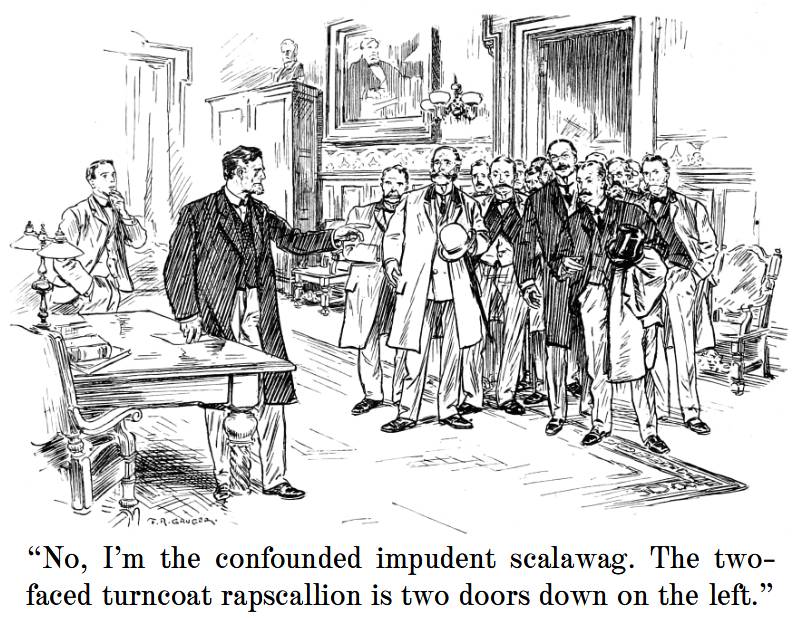
FROM THE ILLUSTRATED EDITION.

THINGS WE SIMPLY CANNOT IMPROVE.

I had visited him, in the year 1780, at his residence, in the glades of the Allegheny mountain, on my way from Philadelphia to Pittsburgh. He had then just finished a commentary on a part of the prophet Ezekiel: it was the vision of the temple; the walls, the gates, the sea of glass, &c. Logger-head divines, heretofore, had interpreted it of the New Jerusalem; but he conceived it to apply to the western country; and the walls were the mountains, the gates, the gaps in them, by which the roads came, and the sea of glass, the lake on the west of us. I had no hesitation in saying, that the commentary was analogous to the vision. He was pleased; and said, I was the only person, except his wife, that he ever got to believe it. Thought I, your church is composed, like many others, of the ignorant and the dissembling.
This comes from Brackenridge’s history of the Whiskey Rebellion, a new and accurate edition of which is now available.
FROM THE ILLUSTRATED EDITION.
