Posts filed under “Books & Literature”
THERE OUGHT TO BE A WORD FOR IT.
For some time Dr. Boli has been thinking of building a glossary of a particular kind of term in English. He has no term for this kind of term, and perhaps readers can suggest one. He calls the phenomenon “word drift,” but “drifted words” seems too awkward as a term for the terms affected by the phenomenon.
The terms Dr. Boli has in mind are terms that are misapplied through ignorance of outdated technology. As we forget how old things worked, related but distinct terms drift into the wrong categories.
For example, “SLR camera,” as we see in this demonstration page for a WordPress theme, has come to mean “35-millimeter film camera.” The stock photo shows a rangefinder camera.

From the Independent Publisher 2 demo page. Reproduced for the purpose of criticism and comment.
Originally the term “SLR” (short for single-lens reflex) was invented precisely to exclude rangefinders and every other kind of camera where the photographer did not compose the shot through the taking lens. When not used by professional photographers, the term has drifted into meaning almost the opposite of what it was meant to mean.
Similarly, the term “upright piano” usually refers to spinet or console pianos in classified advertisements. In the days when every house had a piano in the living room, the term “upright” was used to exclude those other vertical pianos: an “upright” was a piano at least 48 inches tall. Piano technicians still use the term that way, but few non-musicians under forty grew up in a house with a piano, and what Dr. Boli still thinks of as the incorrect use has become the majority usage.
The word “tape” has come to refer to any long flexible consumable thing inserted in a device. It is used for “ribbon” when eBay sellers have a typewriter to hawk. It is used for “film” when they talk about cameras.
An antique movie camera is often described as a “camcorder.” A unifocal lens on an old camera is called the “zoom.” The lens cap is called the “shutter.”
Dr. Boli is sure his readers can come up with many other examples of word drift, and he invites them to do so. But what shall we call these drifted words?
FROM THE ILLUSTRATED EDITION.

From DR. BOLI’S UNABRIDGED DICTIONARY.

Divan (noun).—Having to do with a diva (q. v.).
FROM THE ILLUSTRATED EDITION.

From DR. BOLI’S UNABRIDGED DICTIONARY.
Activist (noun).—One who, faced with a pressing problem, insists that someone else must be active in solving it. The one who actively solves the problem is generally called a plumber or some such thing.
OPTIMUM READABILITY.
It seems to Dr. Boli that most Web designers think of words as bricks, objects used to build up a visual pattern on the screen. It does not enter into their calculations that words might be meant to convey meaning. To the Web designer, every page might say “Lorem ipsum dolor sit amet,” and it would be just as good; in fact it would be better, because the text would be predictable, and the visual blocks would never change. WordPress, the software that runs half the Internet and dictates what the other half is trying to be, has decided to enforce this way of looking at text by making every paragraph a separate and distinct “block,” so that an article is now an assortment of textual bricks rather than a connected argument. (Dr. Boli cannot, however, let this glancing reference to the “block editor” pass without expressing his gratitude for the Verse block, which makes it possible to write properly formatted poetry without a knowledge of HTML code.)
Do you think that Dr. Boli is exaggerating when he says that a great number of Web designers do not consider the meaning in the text their designs display? Consider this screenshot from an article at fonts.com about designing for readability (which we confidently publish under the “fair use” doctrine for the purpose of comment and criticism):
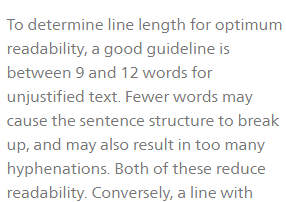
Dr. Boli is not exaggerating.
FROM THE ILLUSTRATED EDITION.

FROM THE ILLUSTRATED EDITION.

THINGS TO READ.
The Eclectic Library is constantly growing, and as it grows Dr. Boli often finds articles, poems, and whatnot in forgotten out-of-the-way places where no one would ever look for them. Since these things did not fit easily in any of the other publications in his celebrated publishing empire, he has created a home for them, which is modestly named The Argosy of Pure Delight. For example, what did Edgar Allan Poe think of Ralph Waldo Emerson?
Mr. Ralph Waldo Emerson belongs to a class of gentlemen with whom we have no patience whatever—the mystics for mysticism’s sake. Quintilian mentions a pedant who taught obscurity, and who once said to a pupil “this is excellent, for I do not understand it myself.” How the good man would have chuckled over Mr. E! His present role seems to be the out-Carlyling Carlyle. Lycophron Tenebrosus is a fool to him. The best answer to his twaddle is cui bono?—a very little Latin phrase very generally mistranslated and misunderstood—cui bono?—to whom is it a benefit? If not to Mr. Emerson individually, then surely to no man living.
Now you know. What else will you discover? Right now there are only five articles, but each one is guaranteed delightful or your money cheerfully refunded at any G. C. Murphy’s location.
FROM THE ILLUSTRATED EDITION.
