Posts filed under “Books & Literature”
OUR VALUED CORRESPONDENTS.
Our frequent correspondent “Greybeard” complains of a current science-fiction novel:
The author ruins a perfectly good story by inserting three must-haves of modern literature.
First, the characters must use crude language even if the objects involved are not anatomically capable of the actions attributed to them.
Second, the characters must take the name of a Christian deity in vain. Even though the novel is set in a distant future where all religion is viewed as a social construct and athiesim is axiomatically understood as the only true alternative, all surprises are met with the utterance of a name first introduced in the ancient Gospels. Why doesn’t anybody ever yell, “Oh Buddha!” when they hit their thumb with a hammer?
Third, characters must speak of the normality of all politically correct perversions.
Dr. Boli agrees that at least two of these three are sins against literary craft, but perhaps for different reasons from the ones his readers might expect.
1. It seems unlikely that we should even be able to recognize the crude language of the distant future. To take the mildest possible example of current vulgarity, what would a (presumably already surprised) time-traveler from 1950 make of the simple declaration “This book sucks”? Just to start with, such a traveler would be baffled by the intransitive use of a transitive verb. The best way to deal with a vulgarian as a character in a story of the future would be to have her spout random words in grammatically unlikely contexts (“Argh! Synergizing hammer! It hit my downsized thumb!”), and allow the shock and dismay of the politer characters to show us that we were hearing crude language.
2. In the case of the Christian deity, Dr. Boli can think of a historical analogue that gives the blasphemy a bit of plausibility. A pagan Roman of the sixth century, having seen his ancient religion thoroughly beaten down by Christianity, and knowing that paganism was destined for the dustbin of history, would be quite incredulous if he were told that, thirteen or fourteen centuries later, aristocrats in the far-off island of Britain would swear “By Jove!” at the drop of a hat. Yet it was true.
3. This one, however, is certainly an egregious sin against plausibility. If a thing is actually considered normal, we do not mention its normality. No one says, “Gee, walking down to the IGA to buy a quart of milk and some corn flakes sure is normal, isn’t it?” If we do speak of the normality of something, we speak defiantly, because we know that there is a considerable part of the population that still considers it abnormal. In 1855, one might have said (and in fact one did say), “It’s perfectly normal for free colored citizens to go to church with free white citizens,” but in saying it one knew that one was causing several million egregious bigots to succumb to apoplectic fits, thus reducing the manpower of the other side in the inevitable civil war to come. So if a writer of speculative fiction imagines a future in which interspecific marriage is really considered normal, the one thing none of his characters can say is, “Irv’s wife is a Bougainvillea in a hanging basket, which of course is perfectly normal.”
A PERFECTLY GOOD PREDICTION.

Dr. Boli has famously made predictions about the future that have since come to pass exactly as he predicted. He is, however, candid enough to admit that not everything he predicts comes to pass. Sometimes, through no fault of his own, the world simply fails to see the inevitability of the course he has planned for it, and runs merrily off on a different track.
It seems a shame to waste a good prediction just because events have run their own course without it. One of Dr. Boli’s most reasonable and most certain predictions had to do with electronic books. More than a decade ago, he predicted that ebooks would become an important part of the publishing market only when the reading hardware had become so cheap that it was disposable. He envisioned a marketplace in which electronic versions of books were sold as dedicated units, book and reader, at roughly the same price as printed books.
Now, this was a very reasonable prediction. Today, one can walk into any store that carries electronics and walk out with an Android tablet for less than $50—about the cost of two hardcover books. A $50 tablet is anemic for browsing the Web and impossible for processor-hungry games, but as an ebook reader it works just fine. (Dr. Boli has read many books on just such a beast.) And some of the $50 cost comes from components that could be cut out in a dedicated reader—sound, capacitive touch screen, color display, card reader, and most of the internal flash memory, just to name a few. So the idea of technology improving to the point where an electronic reader cost no more to manufacture than a printed book was not at all outlandish; indeed, it seems to be vindicated by the event.
And what could be more plausible than to suppose that readers, accustomed to thinking of a book as a physical object that one owned, would continue to think that way? Ebooks would become popular when they no longer required a profound change in readers’ habits—when, in other words, it was not necessary to make buyers swallow an entirely new concept of “book.”
No matter how Dr. Boli looks at the question, he still comes to the same conclusion. Ebooks would not be popular until they could be bought in the same way books have always been bought since ancient times—as physical objects, in stores that specialize in books. If, therefore, history has taken a different course, it is history, not Dr. Boli’s prediction, that must be blamed for the discrepancy.
WILL DR. BOLI READ YOUR NOVEL?
The number of novels published every year is so great that Dr. Boli cannot read most of them. Indeed, he often excuses himself from reading twenty-first-century fiction by saying that he has not caught up with the nineteenth century yet, which is strictly true.
Nevertheless, he will occasionally read a current novel. How, you may ask, does he decide whether a current novel is worth his time?
It may surprise you to hear that Dr. Boli can tell by the first three words of the book whether he will enjoy the rest of the novel. It is a very simple test: Are the first three words a character’s first and last name followed by a verb? If so, Dr. Boli will set the book aside unread.
Doubtless you will leap up to tell him how many great and inspiring works of fiction he has missed by applying this completely arbitrary standard. Probably you, the reader from whose ears cartoon jets of steam are erupting right now, have written a novel, perfect in every detail, whose first three words are “Zachary Mulligan turned,” and they are the only three words with which the story could possibly begin.
Dr. Boli will not contradict anyone who tells him that he has missed a number of very good books by applying his first-three-words test. He will only say that he has been spared an enormous number of very, very bad ones. When time for reading is limited, one must find a way of apportioning it, and Dr. Boli has found one that works well for him.
ASK DR. BOLI.
Dear Dr. Boli: We’ve just adopted a newborn baby from Ethiopia, and we need to learn Amharic within a year so we can understand her when she begins to talk. Can you recommend a good book? ——Sincerely, A Lovely Yuppie Couple in Point Breeze.
Dear Proud Parents: Dr. Boli has always thought that The Crimes of Galahad was a very good book indeed. He is not sure what your question has to do with your problem, however.
Dear Dr. Boli: The dog dropped my slippers in the fireplace, and now I’m leaving carbon footprints everywhere. How can I reduce them? ——Sincerely, A Man with Black Slippers That Used to Be Teal.
Dear Sir: You may wish to look into carbon trading. Dr. Boli has never thoroughly investigated the whole business, but it seems to be something like the old S&H Green Stamps program, in which you would trade your excess carbon for articles of value, such as toasters, which in turn might produce more carbon. Theoretically there is no reason why you should not get rich in this business.
“I COULD CARE LESS”
The expression “I could care less” is a bit of Yiddish sarcasm that causes frothing fury among the pedants. Dr. Boli has always wondered why, and he has decided at last to ask his readers.
Whether the expression is originally Yiddish or not, “I could care less” fits right into the stream of Jewish irony that doubtless began long before the Old Testament books were written and continues uninterrupted to the present day. Jesus of Nazareth was a prominent exponent of that sort of irony.
And the Pharisees said unto him, “Behold, these men with whom thou eatest and drinkest are publicans and sinners.” And Jesus said, “I could care less.” (Mark 53:48.)
“But that’s not what you mean,” say the pedants. “You mean that you could not care less. You are saying the opposite of what you mean!”
Yes, that is the point of sarcasm. Sarcasm, in the current use of the term, is irony with a steel-toed boot. One says the opposite of what one means for the purpose of kicking the subject in a sneering manner. It is a technique familiar to children of elementary-school age, so there is no reason why it should baffle college graduates.
One wonders how these pedants react to other well-known sarcastic expressions. How do they believe one should respond to them? “No, Ollie, it is not a nice mess I have gotten you into. It is a very distressing mess, and I am truly sorry.”
Or is “I could care less” uniquely offensive? Dr. Boli is asking all of you for your opinions.
FROM THE ILLUSTRATED EDITION.

From THE TRIBUNE PRIMER.
By Guest Contributor Eugene Field.
—
The Bad Man.
Here is a Man who has just Stopped his Paper. What a Miserable looking Creature he is. He looks as if he had been stealing Sheep. How will he Know what is going on, now that he has Stopped his Paper? He will Borrow his Neighbor’s Paper. One of these Days he will Break his leg, or be a Candidate for Office, and then the Paper will Say Nothing about it. That will be treating him just Right, will it not, little Children?
The Editor’s Knife.
Here we have a Knife. It looks like a Saw, but it is a knife. It belongs to an Editor, and is used for Sharpening Pencils, killing Roaches, opening Champagne Bottles, and Cutting the Hearts out of Bad men who Come into the office to Whale the Reporters. There is Blood on the Blade of the Knife, but the Editor will Calmly Lick it off, and then the Blade will be as clean and Bright as ever. The Knife cost seventy Cents, and was Imported from London, Connecticut. If you are Good, perhaps the Editor will Give it to you to Cut off the Cat’s Tail.
The Nasty Oil.
Do not take the Castor Oil. It is very Nasty and will Make you sick. Mamma wants you to Take it so you Will be Sick and can’t go Out and Play with the other Boys and Girls. If Mamma will give you a Velocipede and a Goat and a Top and a Doll, then you may Take the Castor Oil and it will not Hurt you.
Generous Richard.
This is good Little Richard. His Mamma has Taught him to be Generous. See, he has the Measles, and he is going over to Give them to his Neighbors. Is he not a Nice Boy? When you get the Measles, you must give them to all the little Boys and Girls you can. If you Do, maybe your Mamma will Give you Something. I guess she will Give you a Licking.
The Bad Mamma.
Why is this little Girl crying? Because her Mamma will not let her put Molasses and Feathers on the Baby’s face. What a bad Mamma! The little Girl who never had any Mamma must enjoy herself. Papas are Nicer than Mammas. No little girl ever Marries a Mamma, and perhaps that is Why Mammas are so Bad to little Girls. Never mind; when Mamma goes out of the Room, Slap the horrid Baby, and if it Cries, you can tell your Mamma it Has the Colic.
The Contribution Plate.
This is a Contribution Plate. It has just been Handed around. What is there upon it? Now Count very Slow or you will Make a Mistake. Four Buttons, one Nickel, a Blue Chip, and one Spectacle glass. Yes, that is Right. What will be Done with all these Nice things? They will be sent to foreign Countries for the good of the Poor Heathens. How the Poor Heathens will Rejoice.
The Proof-Reader.
See the Proof-Reader. He has been reading the Proof of a Medical Convention. He is not Swearing. He is reading the Bible. You cannot See the Bible. It is Locked up in an Iron Box in the Editor’s Room. The Proof-Reader is Saying something about Damming Something. Perhaps it is the Creek.
The Mud.
The Mud is in the Street. The Lady has on a pair of Red Stockings. She is Trying to Cross the Street. Let us all give Three cheers for the Mud.
Mamma’s Scissors.
These are Mamma’s Scissors. They do not Seem to be in good Health. Well, they are a little Aged. They have considerable Work to Do. Mamma uses them to Chop Kindling, cut Stove Pipe, pull Tacks, drive Nails, cut the children’s Hair, punch new Holes in the Calendar, slice Bar soap, pound beef Steak, open tomato Cans, Shear the New Foundland dog, and cut out her New silk Dress. Why doesn’t Papa get Mamma a new Pair of Scissors? You should not Ask such a Naughty question. Papa cannot Afford to Play Billiards and Indulge his Extravagant Family in the Luxuries of Life.
The Poet
Who is this Creature with Long Hair and a Wild Eye? He is a poet. He writes Poems on Spring and Women’s Eyes and Strange, unreal Things of that Kind. He is always Wishing he was Dead, but he wouldn’t Let anybody Kill him if he could Get away. A mighty good Sausage Stuffer was Spoiled when the Man became a Poet. He would Look well Standing under a Descending Pile Driver.
The Business Manager.
Here we Have a Business Manager. He is Blowing about the Circulation of the Paper. He is Saying the Paper has Entered upon an Era of Unprecedented Prosperity. In a Minute he will Go up Stairs and Chide the Editor for leaving his Gas Burning while he Went out for a Drink of Water, and he will dock a Reporter Four Dollars because a Subscriber has Licked him and he cannot Work. Little Children, if we Believed Business Managers went to Heaven, we would Give up our Pew in Church.
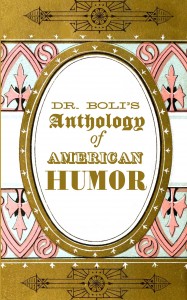 This essay and hundreds of pages of other amusements may be found in Dr. Boli’s Anthology of American Humor, now available in splendid paperback or as a free PDF download. Look at the PDF, and if you think this book is exactly what you need to hand out to your entire Sunday-school class, buy the paperback book.
FROM THE ILLUSTRATED EDITION.

A BID FOR AN EDITORSHIP.
By Guest Contributor Fanny Fern.
—
I think I should like to be an editor, if somebody would do all the disagreeable, hard work for me, and leave me only the fancy touches. I don’t know how profound my political articles would be, but they would be mine. I think my book reviews would be pleasant reading, at least to everybody but some of the authors. I should have a high railing round my editorial desk, and “through the lattice” microscopically and leisurely regard the row of expectant men waiting outside for a hearing. I should not need a spittoon in my office. Nobody should contribute to my paper who smoked, or chewed, or snuffed tobacco; that would diminish my contributors’ list about right. I should discard Webster and Walker, and inaugurate a dictionary of my own. I should allow anybody who felt inclined to send me samples of big strawberries and peaches, and bunches of flowers; and I should get a fine library, free gratis, out of the books sent me to review. As to grinding the axes of the givers in return, why that, of course, should always be left to the option of the editor. Before I commenced an editor’s life, I should secure money enough in some way to be able to snap my fingers in the face of that grim ogre, “Stop my Paper!” I tell you I wouldn’t stop it. It is a free country. I’d keep on sending it to him. I’d always have something in every number about him, so that he couldn’t do without having it, how much soever he might want to.
Then you should see my desk. It should be dusted once a year, to show editors what a desk might be. My editorial chair shouldn’t pivot; there should be no shadow of turning about that. Gibraltar should be a circumstance to it. The windows of my editorial den should be scraped with a sharp knife occasionally, to take off sufficient dirt to enable me to write legibly. I should keep my best bonnet in a bandbox under my desk, for any sudden dress emergency, as do editors their go-to-meetin’ hat. Like them, too, I should have a small looking-glass for—visitors! also a bottle of—“medicine” for—visitors! I don’t think I should need a safe, as the principles upon which my paper would be conducted would render it unnecessary. My object would be to amuse myself, and say just what came uppermost, not by any means to please or edify my species. Now, I have examined all the papers that cross my threshold, and I am very sure that I have hit on quite an original idea.
If it stormed badly on publication day, I wouldn’t send the poor devils in my employ out with my paper, just because my subscribers fancied they wanted it. Let ’em wait. The first fair day they’d have it, of course. In the meantime, the printer’s devil, and the compositors, and the rest of ’em, could play chequers till the sky cleared up.
If anybody sued me for libel, I’d—I’d whine out, “Aint you ashamed to annoy a female? Why don’t you strike one of your own size?” I should insist on being treated with the deference due to a woman, though in all respects I should demand the untrammeled-seven-leagued-boots-freedom of a man. My object would be to hit everybody smack between the eyes, when I felt like it; and when I saw brutal retribution coming, to throw my silk apron over my head and whimper.
I have not yet decided upon the title of my paper. Children are not generally baptized until after they are born. Nor do I know who will stand sponsor. All that is in the misty future. As to the price, I should nail up a cash-box at the foot of the stairs, and people could drop in whatever they liked. I should, by that means, not only show my unshaken confidence in human nature, but also learn in what estimation the general public held my services. There’s nothing so dear to my heart as spontaneity.
This essay and hundreds of pages of other amusements may be found in Dr. Boli’s Anthology of American Humor, now available in splendid paperback or as a free PDF download. Look at the PDF, and if you think this book is exactly what your Uncle Vratislaus needs for Christmas, buy the paperback book.
THE EDITOR OF THE PATRIOT.
By Guest Contributor Max Adeler.
—
Major Slott, like most other editors, is continually persecuted by bores, but recently he was the victim of a peculiarly dastardly attack from a person of this class. While he was sitting in the office of the Patriot, writing an editorial about “Our Grinding Monopolies,” he suddenly became conscious of the presence of a fearful smell. He stopped, snuffed the air two or three times, and at last lighted a cigar to fumigate the room. Then he heard footsteps upon the stairs, and as they drew nearer the smell grew stronger. When it had reached a degree of intensity that caused the major to fear that it might break some of the furniture, there was a knock at the door. Then a man entered with a bundle under his arm, and as he did so the major thought that he had never smelt such a fiendish smell in the whole course of his life. He held his nose; and when the man saw the gesture, he said, “I thought so; the usual effect. You hold it tight while I explain.”
“What hab you god id that buddle?” asked the major.
“That, sir,” said the man, “is Barker’s Carbolic Disinfecting Door-mat. I am Barker, and this is the mat. I invented it, and it’s a big thing.”
“Is id thad thad smells so thudderig bad?” asked the major, with his nostrils tightly shut.
“Yes, sir; smells very strong, but it’s a healthy smell. It’s invigorating. It braces the system. I’ll tell you—”
“Gid oud with the blabed thig!” exclaimed the major.
“I must tell you all about it first. I called to explain it to you. You see I’ve been investigating the causes of epidemic diseases. Some scientists think they are spread by molecules in the air; others attribute them to gases generated in the sewers; others hold that they are conveyed by contagion; but I—”
“Aid you goig to tague thad idferdal thig away frob here?” asked the major.
“But I have discovered that these diseases are spread by the agency of door-mats. Do you understand? Door-mats! And I’ll explain to you how it’s done. Here’s a man who’s been in a house where there’s disease. He gets it on his boots. The leather is porous, and it becomes saturated. He goes to another house and wipes his boots on the mat. Now, every man who uses that mat must get some of the stuff on his boots, and he spreads it over every other door-mat that he wipes them on. Now, don’t he?”
“Why dode you tague thad sbell frob udder by dose?”
“Well, then, my idea is to construct a door-mat that will disinfect those boots. I do it by saturating the mat with carbolic acid and drying it gradually. I have one here prepared by my process. Shall I unroll it?”
“If you do, I’ll blow your braids out!” shouted the major.
“Oh, very well, then. Now, the objection to this beautiful invention is that it possesses a very strong and positive odor.”
“I’ll bed it does,” said the major.
“And as this is offensive to many persons, I give to each purchaser a ‘nose-guard,’ which is to be worn upon the nose while in a house where the carbolic mat is placed. This nose-guard is filled with a substance which completely neutralizes the smell, and it has only one disadvantage. Now, what is that?”
“Are you goig to quid and led me breathe, or are you goig to stay here all day log?”
“Have patience, now; I’m coming to the point. I say, what is that? It is that the neutralizing substance in the nose-guard evaporates too quickly. And how do I remedy that? I give to every man who buys a mat and a nose-guard two bottles of ‘neutralizer.’ What it is composed of is a secret. But the bottles are to be carried in the pocket, so as to be ready for every emergency. The disadvantage of this plan consists of the fact that the neutralizer is highly explosive, and if a man should happen to sit down on a bottle of it in his coat-tail pocket suddenly it might hist him through the roof. But see how beautiful my scheme is.”
“Oh, thudder add lightnig! aid you ever goig to quid?”
“See how complete it is! By paying twenty dollars additional, every man who takes a mat has his life protected in the Hopelessly Mutual Accident Insurance Company, so that it really makes no great difference whether he is busted through the shingles or not. Now, does it?”
“Oh, dode ask me. I dode care a ced about id, adyway.”
“Well, then, what I want you to do is to give me a first-rate notice in your paper, describing the invention, giving the public some general notion of its merits and recommending its adoption into general use. You give me a half-column puff, and I’ll make the thing square by leaving you one of the mats, with a couple of bottles of the neutralizer and a nose-guard. I’ll leave them now.”
“Whad d’you say?”
“I say I’ll just leave you a mat and the other fixings for you to look over at your leisure.”
“You biserable scoundrel, if you lay wod ob those blasted thigs dowd here, I’ll burder you od the spod! I wod stad such foolishness.”
“Won’t you notice it, either?”
“Certaidly nod. I woulded do id for ten thousad dollars a lide.”
“Well, then, let it alone; and I hope one of those epidemic diseases will get you and lay you up for life.”
As Mr. Barker withdrew, Major Slott threw up the windows, and after catching his breath, he called down stairs to a reporter, “Perkins, follow that man and hear what he’s got to say, and then blast him in a column of the awfulest vituperation you know how to write.”
Perkins obeyed orders, and now Barker has a libel suit pending against The Patriot, while the carbolic mat has not yet been introduced to this market.
This story and hundreds of pages of other amusements may be found in Dr. Boli’s Anthology of American Humor, now available in splendid paperback or as a free PDF download. Look at the PDF, and if you think this book is exactly what your Aunt Winifred needs for Christmas, buy the paperback book.