
Advertisement.
Edited by H. Albertus Boli, LL.D.
By an Associate.
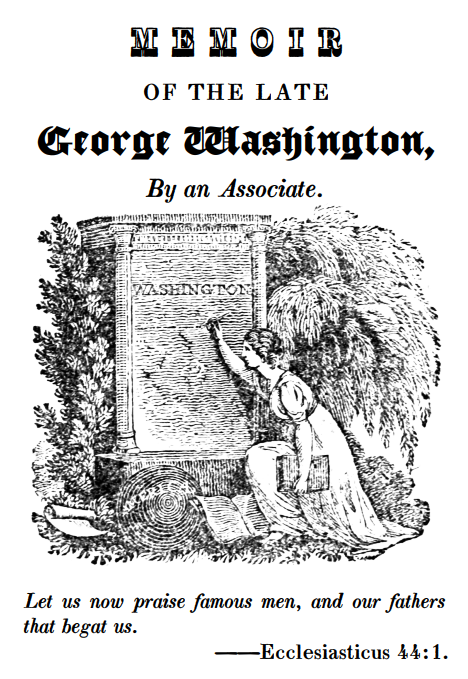
When the knock came at my door, I was, I admit, rather surprised, and not a little apprehensive. Visitors came seldom to my cabin on the Potomac, far upstream as it was and at the very edge of English settlement; and it was not out of the question that I might find some lawless savage waiting for me outside the door, ready to take my scalp to add to his personal museum. With that possibility in mind, I seized my staff, which I have always found more useful at close quarters than a musket or a rifle, and opened the door with a quick jerk.
I saw no one before me until I heard a voice saying, “Pardon the intrusion”; then I looked down and beheld a small man, about four feet nine inches tall, looking up at me. He was dressed in military fashion in buff and blue, and he was holding an empty burlap sack. He seemed barely more than a boy, but there was something commanding in his bearing, and a sort of inherent dignity in his address, that compelled my immediate respect.
“Pardon the intrusion,” said he, “but I have urgent need of a boat, and I was hoping I might perhaps make use of yours.”
“You need to cross the river?” I asked.
“Yes, to retrieve the money that was in this bag.” He held up the empty sack. “There were fifty-six Spanish milled dollars in here.”
“But how did they get across the river?”
“Well, I—” He looked down at the ground. “I’m afraid I threw them.”
I fear I may have responded with undignified incredulity. “You threw them?”
“In a moment of absence of mind,” he replied, looking up at me again. “You see, as a boy I whiled away so many hours throwing dollars across the Rappahannock that the thing became an ingrained habit, as it were. When there is a river, and there are dollars, they always seem to end up on the other side.”
“That does seem inconvenient,” I said.
“But there is, I believe, a wise saying that applies very well to such inconveniences.” From his breast pocket he produced a small, well-thumbed copybook, and he leafed through it until he found the page he desired. “‘When in good company at dinner, do not pick your teeth until after the ladies have withdrawn.’” He closed the book and returned it to his pocket.
“Well,” I said, “I am at your service, Mr…”
“Oh! Washington, sir. George Washington, adjutant to Governor Dunwoodie, sir.”
“Dinwiddie?”
“Yes, sir. Forgive me—I ought to have introduced myself at once. I’m on an important mission from the governor, sir, and the cares of my commission must have been weighing heavily on my mind.”
I extended my hand, and the little man gripped it with surprising firmness. “Christopher Gist, sir,” I said, “and my boat is at your service. I shall be happy to take you across.”
“There are several of us in the party,” Washington said. “Allow me to introduce you.” He turned aside to let me through the door, and I stepped out into the cold November air. Four other men were waiting out there, and Washington introduced them one by one.
“This is Mr. Gadelle, an Indian trader recommended to me as familiar with the ways of the savages.”
“Yup,” said Mr. Gadelle.
“And this is Mr. Beadle, another Indian trader, whom I have persuaded to accompany me to consult on the commercial possibilities of certain lands I possess near the Forks of the Ohio.”
“Yup,” said Mr. Beadle.
“Mr. Beadle and Mr. Gadelle are from Connecticut,” Washington explained. “And this is Mr. Von Schloss.”
“Guten Tag, mein Herr,” said Mr. Von Schloss.
“As my mission is to confront the French and warn them to depart the Ohio country, I have engaged Mr. Von Schloss as an interpreter,” Washington explained. “And this is Parson Weems.”
“How do you do, sir?” said the ecclesiastical gentleman.
“Parson Weems will use his most persuasive rhetoric to redeem the French officers from the wickedness of popery,” said Washington. “When that is accomplished, they will doubtless become much more friendly toward us, their fellow Christians.”
“It is an honor to make your acquaintance, gentlemen,” said I. “I fear it may take more than one crossing to transport all of you and your baggage across the river, but I can—”
“Oh, that will not be necessary,” said Washington. “It will suffice to transport me so that I may retrieve the dollars, and then you can bring me back, and we shall be on our way.”
“But aren’t you headed for the Ohio country?”
“Yes, that is our destination.”
“Then you’ll have to cross the river. North is that way.”
“Is it?” He looked puzzled for a moment, and then seemed to reach a sudden decision. “Mr. Gist, you seem to be extraordinarily well informed in matters of geography. Would you consider serving the great country of Virginia in the capacity of a scout or guide? I have sore need of a man with your obvious gifts.”
I did not accept his invitation at first. But when he pressed it on me a second and third time, I reconsidered. I had no wife or children, nor even so much as a hunting dog, to tie me to my simple cabin. If I could be of service to Virginia, ought I not to place my meager abilities at her command? After some hesitation, I accepted the proposal.
“Governor Denwaddie and I will be most grateful,” said Washington. “And now, if you will conduct us to the other side, we can be on our way.”
“It might be best to set off tomorrow,” I suggested. “The day is already far advanced, and I have some small preparations to make before I leave. You gentlemen are welcome to my cabin tonight, where, poor though it may be, you will at least be warm and comfortable. Tomorrow we may start at dawn, and we should be able to make good progress on the Indian trail.”
“A fine suggestion,” Washington agreed. “Only—”
He hesitated, looked to the left and the right, and lowered his voice.
“You haven’t heard a sound around here that might be described as ‘braying,’ have you?”
I listened. Except for the usual sounds—the river, the wind in the trees, and a crow in the cherry tree near the riverbank—I heard nothing, and certainly nothing that could have been called braying.
“I don’t think so,” I answered.
“One can never be too careful,” said Washington. “Now, if you would be so kind as to take me across to pick up my dollars, I shall be most grateful to you.”
“By all means. Please follow me.”
“Just a moment.” He turned to Mr. Von Schloss and pointed to another burlap sack, this one sitting on the ground and obviously full. “I rely on you, Mr. Von Schloss, to guard that bag. It is of the highest importance.”
“Guten Tag, mein Herr,” said Mr. Von Schloss.
“Well done. And now, Mr. Gist, to the boat.”
We walked down to the riverbank, and had almost reached my little rowboat, when suddenly Washington came to an abrupt halt.
“Is that a cherry tree?” he asked so quietly that at first I could not hear him distinctly.
“I beg your pardon?”
“It is a cherry tree, isn’t it?”
I looked down at the man, and in just a few seconds, there in the November chill, large beads of perspiration had formed on his forehead.
“Yes,” I answered cautiously. “A wild black cherry. Very productive of fruit in its season.”
Washington was trembling all over. “Hatchet,” he whispered through gritted teeth. And then he shook his head vigorously. “Please forgive me, Mr. Gist. I am in perfect control of my actions.” His manner, however, suggested the opposite, and I wondered whether he was speaking more to convince himself than to inform me.
We made the crossing with no difficulty, as the river was calm at the time, and on the opposite shore we easily found the dollars we were seeking. They were distributed over a remarkably small area. “You must have very good aim with a dollar,” I remarked.
“It is not boasting to say that I can throw a dollar farther than anyone else in the colonies, and with greater accuracy.” He picked up one of the dollars, and, turning to face the river, suddenly launched it with almost incredible force. It sailed through the air until I lost sight of it; and then, a few moments later, we heard a sharp yelp from the opposite shore.
“Oh, dear,” said Washington, gazing in that direction. Then he turned away. “Well, it can’t be helped now. As they say…” He pulled the copybook out of his pocket and thumbed through it rapidly until he found his page. “A pair of clean stockings every day will do much to improve one’s standing among men of discernment.” Then he replaced the book in his pocket and resumed filling his sack with dollars.
When we returned with the sack of fifty-five dollars, we found Mr. Gadelle prone on the ground. Washington passed the cherry tree as quickly as he could and then addressed Mr. Beadle apologetically. “I appear to have struck Mr. Gadelle with a Spanish milled dollar.”
“Yup,” replied Mr. Beadle.
“He’ll come around soon enough,” Parson Weems remarked. “They generally do.”
“Under the circumstances,” said Washington, “I think I ought to let him keep the dollar as usual.”
“Yup,” replied Mr. Beadle.
And indeed Mr. Gadelle recovered soon afterward and took possession of the dollar without further remark.
I managed to feed the five guests and myself fairly well, and when we retired, though the cabin was small, we slept soundly, except for a brief moment when Washington shouted the name “Irving” in his sleep, waking the rest of us but not himself.
The next morning I woke just before dawn to the sound of some sort of pounding on the outside of the cabin. My alarm turned to curiosity when I noticed that Washington was missing, and that none of the other guests seemed to be alarmed by the sound. Tossing on my coat, I stepped around and over the sleeping guests, or rather the grudgingly waking guests, and walked out into the grey chill of pre-dawn November.
Washington was pounding a nail into the wall beside the door with a stone for a hammer. When he moved his hand, I saw that the nail went through a hole in a brass panel or plaque. Another nail was already driven through a hole in the other end of it, and as I approached closer, and Washington stepped back to admire his work, I was able to read these words on the plaque, in finely engraved letters:
“I have always thought,” said Washington, “that gratitude ought to be promptly expressed, or it is as good as not expressed at all. In fact, there is a wise saying on that subject.” The copybook came out of its pocket again, and Washington flipped through its pages. “I remember that it was… Oh, yes—here it is. ‘Gratitude ought to be promptly expressed, or it is as good as a cucumber.’ I may have miscopied that.” He closed the book and slipped it back in the pocket.
By this time the rest of the party had risen, so after a breakfast of johnny cakes and salt beef, we set out on our way. I had brought the lightest possible pack, but it took four trips across the river to carry all the men and the baggage over. I admit that we were perhaps overly cautious, and the bag of dollars made every trip, owing to Parson Weems’ reasonable insistence that it was unwise to leave Washington and the coins alone together on the riverbank, and Washington’s flattering (if inexplicable) unwillingness to trust anyone but me with it. Once we had crossed the river, and the men had all assumed their burdens (Washington seemed to be carrying nearly his own weight in equipment), we set off along the Indian trail that crosses the Alleghenies.
“And what gives me the most satisfaction,” Washington said as we walked, “is that I am almost certain that Irving has not followed us across the river.”
“Who is this Irving?” I asked. “Forgive me for asking, but we heard you shouting his name in your sleep last night.”
“Irving,” he said gravely, “is my mortal enemy. For most of my life he has pursued me relentlessly, and I have no doubt but that he will continue to pursue me to the end of my life. He lives to deepen my sorrows, to blast my victories, and to hound me into an early grave. I am morally certain that Irving will be the death of me sooner or later.”
“But how can one man be so thoroughly wicked?”
“Oh, Irving is not a man. Irving is a mule.”
“A mule?” I asked incredulously.
“The most fiendishly devious and diabolically wicked mule ever bred.”
“But—but what does he look like, this Irving?”
“Irving,” Washington said, “is not visible in the strict sense.”
To this I could think of no reply, so we walked on in silence for a while.
The weather was turning colder as we crossed the mountains. We camped under a rocky overhang the first night; in the morning, Washington produced another brass plaque from his big clanking sack, but had the devil of a time trying to get his nails pounded into the rock, until I suggested that he apply the plaque to a nearby tree instead. This solution satisfied him, and we continued on our way.
So we went, crossing the Alleghenies in nine days and leaving a trail of brass plaques behind us. At the Allegheny River we made the trifling mistake of leaving Washington alone on the shore with the bag of dollars; but since we were obliged to make the crossing anyway, we suffered no serious inconvenience.
Eventually we reached the French post at Fort Le Boeuf, where we were received courteously by a lieutenant in a rather tattered uniform. Washington immediately brought forward his interpreter, Mr. Von Schloss.
“Guten Tag, mein Herr,” said Mr. Von Schloss.
“I’m terribly sorry,” the lieutenant replied, “but I don’t speak a word of High Dutch. However, I have some rudimentary knowledge of the English tongue, if that will suffice.”
“That will be suitable,” Washington agreed. “I have a message from Governor Dimwittle that must be delivered personally to your commanding officer.”
“If you will follow me,” said the lieutenant, “I will conduct you to him forthwith.”
We all followed Washington as he followed the lieutenant. The fort was a hastily constructed stockade, but one small building in the center showed considerably more effort than the rest. To this building we were conducted, and we waited outside while the lieutenant went in to inform his superior of our presence.
He emerged a few minutes later and told us, “Captain Hautain will see you now.”
Washington entered, and we filed in after him, one after another.
The interior was sumptuously appointed, with carved chairs upholstered in fleur-de-lis patterns, fine tapestries on the walls, and a magnificent table whose marquetry top was covered with an array of pastries the likes of which I had never seen before in my life. Captain Hautain was standing before it in all his military splendor, his mustache perfectly waxed to a pair of dangerous points.
“Bonjour, mes amis!” the captain said cheerfully. “Vous avez quelque chose à dire? Bien! Mais maintenant, des napoléons!”
“Captain Hautain says that before you speak, you might like some of these pastries, which for some reason are called ‘napoleons,’” the lieutenant said.
“Lieutenant!” the captain said sharply. “Vous êtes de trop! I will be the handling of these matter. —Gentlemen! Comme vous voyez, I speak English assez good.”
“I’m grateful to you for your hospitality,” Washington responded. “I shall come straight to the point. My name is George Washington, adjutant to Governor Dunwattle of Virginia, and I have come to warn you that you are trespassing on Virginian soil. It is imperative that you leave as soon as practicable.”
“Ho! Virginian soil? It is a plaisanterie, oui? This is the soil of the Nouvelle France. Dites-moi, little adjutant fellow, if I should refuse the moving of my fort, yes?—then what would your Governor Denwallow do, hein? Comment?”
Washington appeared to be taken aback. He was silent for a few moments, and then he replied, “Well, I don’t know. I had relied upon your honor as a gentleman to persuade you to do what was obviously the right thing. But perhaps you would like to hear Parson Weems preach first on the reasonableness of the Protestant religion.”
“My text,” Parson Weems began without further preamble, “is taken from the Letter of St. Paul to the Galatians, the second chapter, beginning with the—”
“Sacred blue!” the captain interrupted. “Away with your preachers of the preaching! I have the réponse for your governor, yes? You may tell your Governor Dingbattle that it is my irrevocable intention to keep toute la Nouvelle France, yes? Et par Dieu, if he comes here, je vais twiquer his nose! That is what il faut dire to your governor!”
An interval of silence followed this outburst; then Parson Weems suggested, “Perhaps you would like to read a small tract which I have composed, entitled ‘Fifty Popish Falsehoods and the Answers Thereto,’ which gives—”
“Hors d’ici!” the captain shouted. “And take with you your miserable heretical tracts! No napoléons! Allez-vous-en!”
The lieutenant was very apologetic as he escorted us to the gate of the fort. “Captain Hautain is of a warm disposition,” he explained.
“I have done my duty, Lieutenant de Trop,” Washington replied. “You have been most courteous, and I shall not forget your gentlemanly conduct. I have a reply to bring to my governor, and I shall bring it. For myself, I am certain now that Irving has preceded me here and has poisoned the mind of your captain.”
“Irving, Mr. Washington?” the lieutenant asked.
“My mortal enemy. But I need not burden you with my personal affairs. Irving is no concern of yours. Farewell, Lieutenant de Trop, and may we meet again under more favorable circumstances.”
So saying, Washington picked up his heavy sack of brass plaques, and the rest of us resumed our burdens for the long march southward.
The weather was now sharply colder, and flakes of snow were dancing among the brown leaves. Streams we passed were freezing along the edges, and at night the cold seemed to penetrate me with unusual power. Washington, however, made light of the difficulties of the journey, reminding me that, as it was written in his copybook, “When ladies are present, one can wait to use the chamber-pot.” Our misery was compounded by a steady cold rain the third day, which soaked our clothes; and I think we might have frozen to death had we not found another natural rock shelter in which to build a fire.
We met a small party of Indians on the fourth day, and here our Indian traders proved invaluable to us. I directed them to ask the shortest route to the Allegheny River, which I intended to follow for some distance. Mr. Beadle addressed the Indian who appeared to be the leader of the group.
“Mr. Washington, him big chief in Williamsburg. Him heap socially connected. Him going places. Him needum find heap quick trail to river of many waters.”
“I’m sorry,” the Indian replied, “but I don’t quite catch your drift.”
“He says,” Mr. Gadelle explained, “that the little fellow over there is a very important man, and he needs to know the shortest route to the Allegheny River.”
“Ah, yes, of course,” the Indian replied. “Tell him to head straight for that gap in the hills down there to the southeast, and then the trail will wind down to the river. You can’t miss it.”
Mr. Gadelle turned to Mr. Beadle. “Him say, takum trail to hole in hill, walkum down to many waters.”
“Heap much thanks,” said Mr. Beadle.
Mr. Gadelle turned to the Indian. “He says he’s very grateful to you.”
Washington gave the four Indians a dollar each for their trouble, which seemed to please them; and indeed we found the trail exactly as they had told us. When we came to the Allegheny, which was much more boisterous this time, owing to the recent heavy rains, we continued downstream for a day and a half, until Washington came to a sudden halt in a grove by the riverbank.
I looked down at him to ask the cause of our abrupt stop, and saw the beads of sweat rapidly growing on his forehead.
“Hatchet,” he whispered. “Hatchet… Hatchet… Hatchet…”
I looked around us. From the bark, I could recognize that the grove in which we stood was made up entirely of wild black cherry trees.
Suddenly Washington erupted. “Hatchet!” he shouted, dropping all his possessions with a loud clatter of brass plaques and drawing a hatchet out of his pack. “Hatchet! Hatchet!” With a mad gleam in his eye, he attacked the nearest tree like a man possessed. “Hatchet!” he bellowed as the splinters flew. “Hatchet! Hatchet! Hatchet! Hatchet!” So vigorous was his assault that the tree was felled in less than a minute. The rest of us scrambled to get out of the way as it fell, but Washington was still attacking it as it collapsed, and did not rest until the tree was reduced to a pile of logs of varying sizes. Then it was as if the devil had left him, and he sank down exhausted beside the logpile.
“Forgive me, gentlemen,” he said after a few minutes’ rest. “The…indisposition is usually under my control. But—so many cherry trees!” He took a few more heavy breaths, and then added, “I place the blame on Irving, of course.”
“Well,” said I, “since my plan was to build a raft at some convenient spot, and since we now have a ready supply of logs, I propose that we stop here and make our camp for the night, and then tomorrow we may assemble our raft at our leisure.”
This proposal met with ready agreement; so we all set to work establishing our camp, and then retired early.
Washington woke us as usual with the sound of a brass plaque being nailed to a tree. Once we had fortified ourselves with some of our provisions, we set to work on the raft, using some stout frost-grape vines to bind the logs together. It took us most of the day, except for a few intervals of rest, during which Washington managed to empty his bag of dollars before anyone noticed what he was doing; but since we had to cross the river anyway, we thought the incident would be attended with little inconvenience.
With the raft finished, I proposed to camp there another night, making the crossing in the morning, when I hoped the river might be somewhat lower; but Washington insisted that time could not be lost, saying that it was of vital importance to inform the governor of the French response quickly. Thus, though it was already late in the day, Washington insisted on crossing the river immediately. We therefore piled our baggage on the raft and carefully launched it, using a long branch as a pole until the river became too deep, and then resorting to some improvised paddles.
The river was turbulent, and it took all our effort to stay on the raft and propel it in the direction of the southern shore. Nevertheless, we continued without serious incident until about two-thirds of the way across, when our raft was struck by a drifting branch, which knocked Washington’s sack of brass plaques into the river.
Instantly and without a word, Washington leapt into the icy water. I shouted after him, but he sank like a brick. For some time—it must have been brief, and yet it seemed infinite—there was no sign of him. Our consternation may be imagined. Parson Weems began whistling “Lillibullero,” as I would discover was his habit whenever danger threatened. But then, when we had already given him up for drowned, Washington appeared above the water and grasped the raft with one hand.
“Give me your other hand!” I called out to him. “I’ll pull you up!”
“Impossible,” he replied, in between loud gasps. “The other… the other hand…has…the sack.”
“Let it go!” I begged him. “The plaques can be replaced!”
“A gentleman does not part with his honor!”
Casting about for some way to end this impasse, I leaned out with the branch I was using for a pole. “Get the sack on the pole!” I directed him, bringing it as near as I could to where I supposed his other hand must be. With much effort, he managed to snag it with the branch, so that Parson Weems and I could haul it aboard. Meanwhile, Washington’s other hand was free, and Mr. Von Schloss and the two Indian traders were able to pull him up on the raft.
“Guten Tag, mein Herr,” said Mr. Von Schloss, and we all concurred in the sentiment.
We landed a good mile downstream; but Washington, wet, frozen, and exhausted as he was, still insisted on walking that mile to retrieve his dollars before he would rest. Only when he had them safely back in his sack did he consent to make camp for the evening. Then we built a fire, and Washington carefully laid his copybook on a rock near the fire to dry. I think the poor man nearly froze to death in his wet clothes that night, but we never heard a word of complaint from him, save that, several times in the quiet of the night, he groaned out the name “Irving” in his sleep.
From there the next morning we followed the Allegheny down to the Forks of the Ohio, since the forbidding bluffs that lowered over the narrow strip of land on the south shore suggested to me that our most efficient route to the south would be by way of the Monongahela. At the point where the two rivers met, we stopped for a quick meal of the abundant game in those parts; and while we admired the magnificent view down the mighty Ohio, Washington was much taken with the strategic potential of the place.
“A fort here,” said he, “at the confluence of these two mighty rivers, would command the only water route into the west, and thus keep the French from penetrating any further into my land.”
“Your land, sir?” I asked.
“Indeed. My late brother founded the Ohio Company for the purpose of developing the western lands. As I inherited the estate, the land now belongs to me, from the Allegheny Mountains westward to the Russian Empire, assuming, as seems to be the case, that there is a connection between the western extremity of America and the eastern part of Asia.”
“But how did your brother acquire it in the first place?”
“By forming the Ohio Company to develop it. You see, at present the only occupants of the land are Indians, who are savages, and the French, who are papists. The land thus belongs to the first civilized Christian gentlemen who are prepared to plant the seeds of true Christian civilization in it. A fort here will be but the beginning. At this commanding location I foresee a mighty city rising—a city whose position at the head of navigation into the west will give rise to undreamt-of prosperity—a city of titanic industries and globe-circling commerce—a city of gleaming towers and verdant parks—a center of learning and the arts—a city called Washington.”
The remainder of our journey passed without any remarkable incident, and we reached my cabin early in December. Once again I offered the company my hospitality, which once again was accepted with thanks; but Washington and his party left so early the next morning that I was not able to bid them farewell. When I did come out of my cabin, I found the cherry tree by the river felled and a note stuck on the stump:
Mr. Gist—
My apologies for the state of your cherry tree, but the fit came upon me suddenly this morning. In compensation, I have left you ten Spanish milled dollars, if you will make the trifling effort to retrieve them from the opposite shore. I owe you a debt of gratitude that can never be properly repaid, but I shall see to it that the governor sends a handsome reward.”
Yours, &c.,
George Washington.
Not too long afterward I received the handsome reward of which he spoke, in the form of a framed certificate headed “Valued Team Member” in elaborate blackletter, and signed by Governor Dinwiddie himself.
As for Washington, I had rather pitied the young man, imagining that the governor would be less than pleased with the outcome of the expedition, which had utterly failed in its object of displacing the French. I had not reckoned, however, with Washington’s mastery of the art of the dispatch. As soon as he reached Williamsburg, he wrote an account of his expedition that placed his own conduct—and, I understand, mine as well—in a very favorable light. Governor Dinwiddie was immensely pleased and had Washington’s dispatch printed as a small duodecimo, which proved to be the most popular work ever issued by the press in Williamsburg, having sold upwards of eighteen copies.
So ended my first adventure with young George Washington, and I fully expected not to see the man again, at least for a great while. Momentous events were afoot, however, which would soon bring us together again.
To be continued in Chapter 2. Or you can order the whole book now and spare yourself the wait.
Yes, I know most of you aren’t old enough to be getting married yet, unless you’re in West Virginia, and oh dear I can smell another kerfuffle on the way already. But many of you will have big brothers or sisters getting married, or cousins, or maybe your dad is finally going to marry your mom and make an honest woman of her. About time, isn’t it? So you’re probably going to be invited to a wedding sometime, and you’ll want to know what to do.
The first thing you want to do is get a wedding gift. These days there are things called registries, where the bride and groom can make up a list of the things they could really use to start their new life. So what you should do is look up and down the list very carefully and see what gifts are still not taken, and then you should get a blender. It’s not really a proper wedding unless there are piles and piles of blenders all prettily wrapped on the back table at the reception. And by the way, if you’re a bride, check out Auntie Social’s Swag Shop, where you can get whole boxes of thank-you cards pre-printed with “Thank you for the blender” in nice copperplate cursive. They have pictures of historic blenders on the fronts of the cards, too. Even the original 1937 Waring Blendor, which I got from some Russian photo site.
So once you’ve picked out a blender and paid for it with your mom’s credit card, you’ll need to think about what you’re going to wear. A lot of you are going to have parents who want to dress you up like a paper doll for the wedding, so you’re just going to have to sit still for that, because there’s nothing that can stop parents once they get it into their heads that their children will look cute dressed up like miniature Mafiosi. The best thing you can do is find a mud puddle just before the wedding, and then your parents will have to let you wear what you want. So if it’s up to you, here’s the golden rule for wedding clothes: jeans without holes and a T-shirt without a slogan.
Okay, so now you’re at the wedding, and you probably think it’s just going to be I do, I do, done. But no, there’s always an officiant, which is somebody who thinks he’s important because he’s licensed to do weddings by Underwriters Laboratories or whoever certifies these people. And this is like his one time to talk in front of an audience, and he thinks he’s got something so special to say, so he’s just going to keep rattling on for three hours. So this is why you should always remember to bring one of those little portable game consoles to a wedding.
Now, when the bride and groom are finally married and they’re leaving the church, it’s traditional to throw rice at them. It’s a tradition passed down from generation to generation. I don’t know why. I think it’s because older generations were stupid. But these days there are people who say you shouldn’t throw rice, because it gives our little birdie friends indigestion, although after what they did to my windshield this afternoon I say our little birdie friends can have all the indigestion they want. But rice is boring anyway, so I say find something more fun to throw at the bride and groom. I’m thinking firecrackers.
Then comes the reception, and this is where you have to be at your most polite, because most brides these days hire a disk jockey, and most disk jockeys make you want to punch them. But your old Auntie Social can tell you from personal experience that punching them doesn’t do any good. So I just say—
Oh, dear, there goes that phone. And I see by the caller ID that it’s a network vice president, so it looks like kerfuffle time again. And I’m out of time anyway, so we’ll wrap this up right now, and your old Auntie Social will be back with more etiquette advice next time. We’re going to talk about gender-reveal parties. Won’t that be a lark?

Drawing by Calvi, CC BY-SA 4.0, via Wikimedia Commons.
Dear Dr. Boli: The other day I heard one of our borough councilpeople interviewed on the radio about something—I kind of missed the subject, but I think he was talking about either a cellular mast or a petting zoo—and he was saying that whatever it was was an “existential threat” to our borough. I was trying to figure out what he meant, but I couldn’t work out the meaning of the words. What does “existential threat” mean? —Sincerely, A Resident of Grant Borough, Third Ward, but the Good Part of the Third Ward.
Dear Sir or Madam: “Existential threat” means that Jean-Paul Sartre left a note in your mailbox saying he would put a brick through your window. This is how philosophical debates usually progress among the Existentialists. Ignore him and he’ll go away.
Anisotropic (adjective, from the Greek).—Turning toward anise.
…you just had to hope that your advertisement didn’t appear too near the ones for other quacks for whom the engraver had used the same model.

From the Pittsburg Press, May 17, 1890, p. 2. Are we being unfair in calling these gentlemen quacks? Probably not. Notice that the first one is relying on the old bromide that back pain always indicates kidney disease—an assertion that, even in 1890, the American Medical Association was pointing out as the infallible mark of a quack. The second is selling a patent medicine, so we need say no more about him.
Gorgonzola (noun).—A mythical French novelist with snakes for hair.
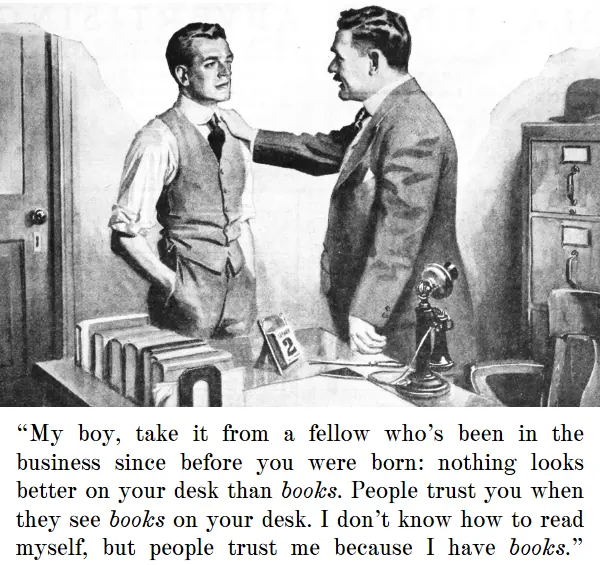

Every year on this date we celebrate the anniversary of Dr. Boli’s move to the World-Wide Web by reprinting the first story this Magazine ever published in digital form. If we take 1993 as the foundation date of the public Web, then for 19/33 of the history of the Web, Dr. Boli’s Celebrated Magazine has been one of its prominent features. Furthermore, the site has always run on WordPress, which was first released in 2003; so that this Magazine has been one of the highlights of WordPress for 19/23 of its existence. A whole generation has reached adulthood whose members have no experience of a world without the Web, and have no experience of the Web without Dr. Boli. This is an awful responsibility, and every time we think of it we need to lie down for a while, which is why we print a 19-year-old feature today.
It is well known by now that Magnus Abelard deals only with singular cases, so everyone who walks through the door announces that he has a singular case. Nevertheless, the door is, by Abelard’s explicit command, never locked; and this case really did turn out to be singular. I have taken the trouble, therefore, to record it among Abelard’s most remarkable achievements, in the hope that the record will serve as an imperishable monument to Abelard’s genius.
We began with the usual formalities. I informed our visitor that he would have ten minutes to convince Abelard of the singularity of his case. I also explained the payment schedule in the unlikely event that Abelard did pronounce his case singular. Abelard did not speak during the proceedings; he never does speak until some singular aspect of the case has caught his attention.
“Mine is a singular case,” the visitor began as I took notes. “Indeed, it is so singular that I have not spoken with anyone about it until now. I have lived for ten years in fear for my life—a fear all the worse for being secret. I have not dared reveal it to anyone, and yet it eats at me, day after day, hour after hour, like a kind of parasitic creature that gnaws but cannot consume.”
“You have nine and a half minutes,” I reminded him.
“Ten years ago, my wife, to whom I had been married only a month, announced that she had a few purchases to make, and declared her intention to walk to the drug store on Murray Avenue. She would be gone for about an hour, she said. I bid her farewell; she walked out the door; and that, Mr. Abelard, was the last time I ever saw her.
“I shall not weary you with the details of my inquiries. Over the years, I have found opportunities to interrogate our neighbors and the clerks at the drug store. From their statements, I have discovered that my wife did indeed reach the drug store; that she left and turned right on Murray Avenue; that she was last seen walking on Phillips, the very street on which we lived, in the direction of our house. But she never arrived.”
Here the visitor stopped; and, as Abelard was still silent, I knew the narration had not interested him enough for him to take the case. It was therefore incumbent upon me to disappoint our visitor.
“Disappearances such as the one you describe,” I told him, “while exceedingly regrettable, are not extraordinarily uncommon. Perhaps the city police, or a less specialized private agency, might be able to render you some assistance.”
Our visitor sat back in his chair and sighed. “I have not yet revealed to you,” he said slowly and quietly, “the singular aspect of the case.”
Abelard leaned forward. This statement had at least caught his attention.
The visitor took a deep breath, appeared to think for a moment, and then continued, picking his words with care and deliberation.
“About an hour after my wife left, a woman entered my house by the front door. She entered boldly—as if she owned the place, you might say. Now here is the singular and remarkable thing: in every particular, this woman was the exact image of my missing wife. Even her clothes were the same as the ones my wife had been wearing when she left. She proceeded to make herself quite at home; she treated me as though she were actually my wife.”
Here the visitor leaned forward and lowered his voice about a fifth. “For ten years, Mr. Abelard, that woman has inhabited my house, living in every respect as though she were my wife. For ten long years, I have lived in fear, utterly convinced that this woman in my house is somehow deeply involved in the mystery, and afraid even to sleep at night—afraid I might fall prey to the same sinister forces that took my beloved wife from me. The fear is tearing at my soul, sir, and I have at last resolved that, whatever the cost to myself, I must unravel this mystery.”
A moment of silence followed; then Abelard spoke for the first time.
“And how exactly was it that you knew this woman was not really your wife, returned from her shopping trip?”
The visitor started forward; then he sank slowly back in his chair, staring straight ahead.
“Good lord,” he whispered hoarsely.
Abelard observed him closely.
“Good lord,” the visitor said again, somewhat louder this time. “I never thought of that.”
He sat upright in his chair with a new air of confidence. “Well, sir, you certainly have earned your reputation. I never would have imagined that a mystery of such devilish complexity could be unraveled in such a short time. I shall certainly be recommending your agency. You may expect a check from me in the morning, although you must be aware that no remuneration could ever express my profound gratitude. I bid you good day, and once again I thank you from the bottom of my heart.”
Abelard watched him walk out of the office with a jaunty confidence that had been completely foreign to him only minutes before.
For some time after, Abelard was silent, as though lost in thought. At last he turned to address me.
“Perhaps,” he said, “we ought to reconsider the idea of locking the door.”
Of course, if you are impatient and want to read all about George Washington now, the whole book is available in print or electronic form.