Posts by Dr. Boli
Advertisement.

IN THE NEWS.
HEY, CODERS! WHO WILL CREATE THIS BROWSER EXTENSION?
Dr. Boli does not like information presented in video form. What he especially dislikes is running across a Web page that is so certain he wants his information in video form that it immediately starts playing a video at him without his permission. And the very worst offenders are the pages that do have information that is meant to be read, but overwhelm it with dancing animations and videos that make it impossible to keep our eyes on the text. For example, the current front page of the Carnegie Library of Pittsburgh site, which fills the screen with a confused cacophony of moving images to inform us that we can get a printed program guide if we like. Can anyone think of a better way to inform readers of the availability of printed schedules of library programs than with a video showing library patrons dancing around with the printed guide and not reading it?
That was the site that finally sent Dr. Boli off on a quest for some way to kill the moving images. If you use Firefox, there is a simple setting to disable autoplay. If you use Chrome or Edge, there is no such setting. There used to be years ago, but it was taken away, on the grounds (we suppose) that users were abusing it by disabling autoplay, which is a rotten thing to do. Advertisers pay good money to Google to place animated ads all over the Web, and Google does not fund the Chromium project just to flush that money down the sewer. What was that famously aspirational Google slogan again? “Let’s be evil”? Something like that.
Fortunately, there are browser extensions that will accomplish the same thing. But there is not yet a browser extension that does exactly what Dr. Boli would like. The one he uses right now stops videos from automatically playing without his permission, which is good as far as it goes. What Dr. Boli would really like, however, is an extension that would allow him to click on any video or animation that started by itself, and with that click simultaneously kill the movement on the page and deliver a harmless but painful electric shock to the Web designer who thought the autoplaying video was a good idea. Dr. Boli is prepared to reward a programmer who can create such an extension with his patronage. Note that, if the “harmless” part of the specifications proves impossible to implement, Dr. Boli is still likely to be generous.
HOW BUSINESSES THINK.
Each year, together we set goals to appreciably advance the company in its 8 key business areas: Firm Structure, Finance, Operations, People, Culture, Marketing, Production, and Design.
Q. What comes dead last on the list of key business areas for this firm?
A. Design.
Q. What is this firm trying to sell?
A. Architecture.
THE BASILISK.
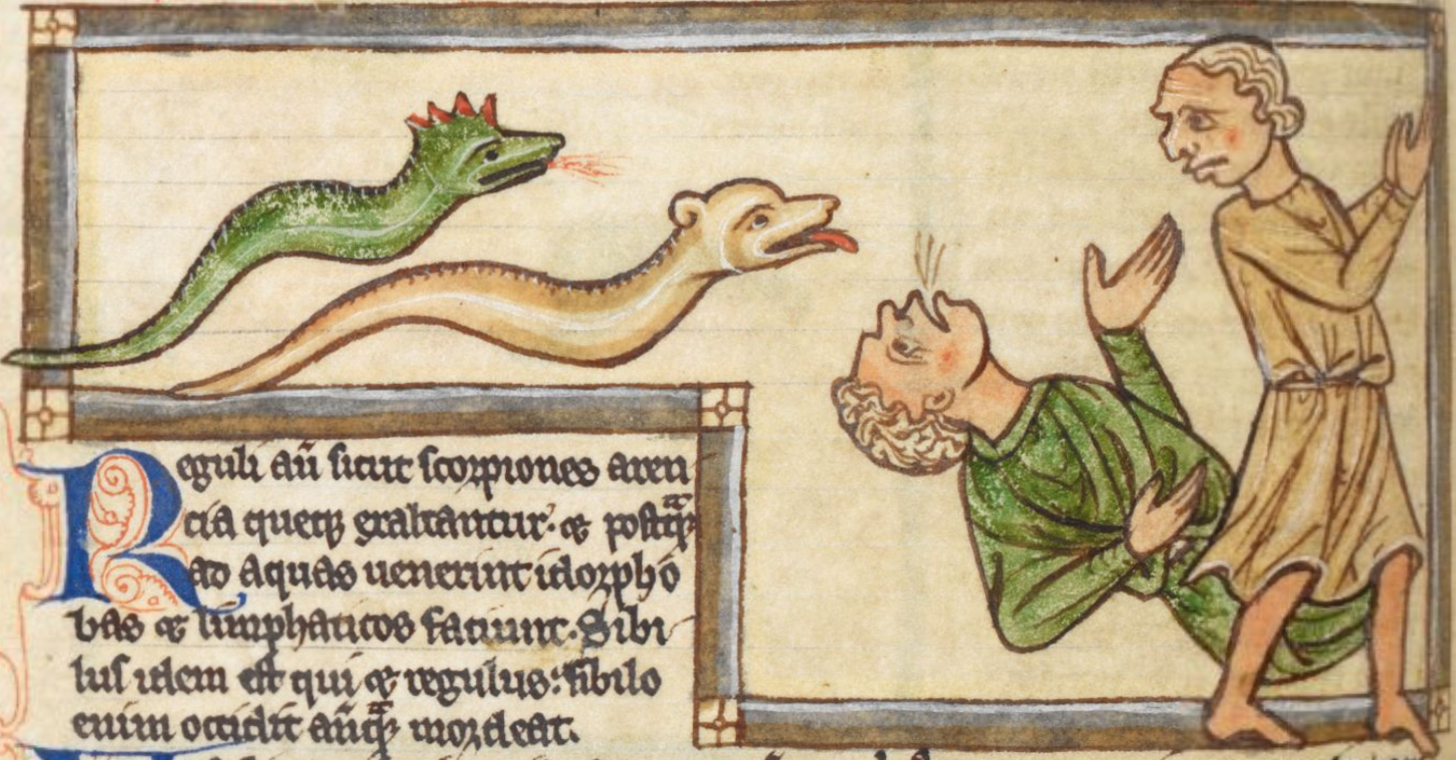
Then a key turns in the lock. Slowly the massive door creaks open, and in the blinding light is the silhouette of the consul of the city.
“All right, men,” he says. “There’s a basilisk in an old cellar, and it needs to come out. In exchange for a full pardon, who wants to put on the mirror suit and go down after it?”
One of the men volunteers.
The basilisk or cockatrice (the two terms had become synonymous by the 1600s) was a known fact of natural history, and now you can be well informed on all matters to do with basilisks, because Dr. Boli has taken the trouble to transcribe a learned treatise on the subject by George Caspard Kirchmayer, one of those wonderful old naturalists who studied all of nature without setting foot in the grubby outdoors. “To deny the existence of the basilisk is to carp at the evidence of men’s eyes and their experiences in many different places,” says Kirchmayer. However, he is not such a fool as to believe in those old wives’ tales about its killing men with a glance. No silly mirror suits for him. They wouldn’t do him a bit of good: the basilisk could kill him with its breath.
This translation of Kirchmeyer’s learned treatise is by Edmund Goldsmid, a Scottish bibliophile who published a number of translations of old Latin treatises in very limited editions. Unfortunately he died young; otherwise he might have left us English versions of much more of that “lost continent of literature,” as James Hankins called the neo-Latin world. Mr. Goldsmid’s notes are worth reading in themselves: they introduce us to many of the other characters in the scholarship of the 1500s and 1600s. It is remarkable how many of them died of stubbornness. “Having convinced himself that one could not catch the plague at 60 years of age, he took no precautions, and died of that disease in 1596.” “Cardanus…starved himself to death in 1576, to accomplish his own prophecy that he would not live beyond the age of seventy-five.”
You can read Kirchmayer on Basilisks at the Argosy of Pure Delight, where we present it in mobile-friendly and Web-friendly form. You can also see the original page images of Edmund Gosmid’s translation in the Internet Archive; you may notice that, in his transcription, Dr. Boli has silently corrected a number of printing errors in Goldsmid’s edition—and doubtless introduced some new ones, because that always happens.
LETTER TO THE EDITOR.
Sir: I asked for a cup of tea at the coffeehouse around the corner, not the one where they have the mimes, but the other one, and they handed me a foam cup with a teabag in it, and the teabag had a tag dangling from it. And this was the message on the tag: “Trust your identity; be in touch with your reality.” Well, my reality never calls. It never even sends a postcard. My reality and I haven’t spoken since 2014, when I told my reality to take a hike. And my identity was stolen by Slovenian hackers last October, so I certainly don’t trust that. So I think we should tell these big tea companies, first of all, you can just keep out of my personal life, thank you very much, and in return we won’t ask you about your relatives. And second, it’s not “tea” unless it’s made from Camellia sinensis, okay? So don’t go telling me peppermint and licorice root and dogbane and lawn clippings all stuffed into a little bag make “tea,” because you’re not fooling anybody but yourselves. —Sincerely, Name Withheld Against My Will.
From DR. BOLI’S UNABRIDGED DICTIONARY.
Lackawanna (noun).—Deficiency of earnest desire: “If I don’t make it to Scranton, it won’t be for Lackawanna.”
AN OBSERVATION ON INTELLECTUAL PROPERTY.
This seems like a very good idea. Few if any sales will be discouraged: the people who want to remember the exhibition with an expensive coffee-table book will probably still want the book, and the Google Books scan probably generates sales to people who see the book on line and think it would be lovely to have it on paper. But the main thing is that the Met understands its mission as disseminating information to the public, not making money for the stockholders.
We can contrast this with the attitude of Princeton University Press. Princeton University Press wants $81.60 for the ebook version of F. E. Peters’ Jerusalem, a book published in 1985. We repeat that this is the ebook, so no material costs whatsoever are involved. You might think that, say, $19.95 would seem a bit much for a 38-year-old backlisted ebook, but at least it would not trigger the automatic “outrageous” flag in every sane brain. You laugh at $81.60. You will not pay it. And your reaction is probably typical. Does Princeton University Press really make more money by pricing this ebook at $81.60 than it would make by pricing it at $9.99?
Now, if you want the book on paper, well, that runs into money. For Jerusalem, the price is $260—for a paperback copy.
What accounts for that price? How does the publisher justify it?
“The Princeton Legacy Library uses the latest print-on-demand technology to again make available previously out-of-print books from the distinguished backlist of Princeton University Press. These editions preserve the original texts of these important books while presenting them in durable paperback and hardcover editions.”
Gosh! Dr. Boli—and he is revealing a trade secret here—uses the latest print-on-demand technology in his celebrated Publishing Empire, too! But he sure feels like a sucker now for pricing The Emperor at $11.88 when he could be charging twenty times that. To reveal another trade secret, he actually makes a small profit at that price. It is just enough so that the book sales pay for the Web hosting and domain names in the on-line division of the Publishing Empire, which is thus self-supporting and therefore self-justifying. Furthermore, Dr. Boli will point out that he wrote the book, which cost him some amount of effort, whereas Princeton University Press is merely scrounging in the big old barrel of long-out-of-print books to which they still have the rights. For that they get $260. Or at least they ask $260. We must suppose that they do sometimes get it, doubtless from people who are spending other people’s money, because the “Legacy Library” scam has been going on for several years.
But now you can amuse yourself for a moment by speculating: How much of the $260 price for Jerusalem do you suppose goes to F. E. Peters, the author thereof, thus promoting the Progress of Science and useful Arts by encouraging him to write more books?
The answer: None of it, because F. E. Peters died three years ago.
ERRATA.
p. vii for Preface read Foreword
p. xviii for Foreword read Preface
p. xxxvii for has earned my profoundest gratitude read can go suck eggs for all I care
p. 23 for sculpture read rupture
p. 64 for Athanasius read Anastasia
p. 89 for accustomed vigor read a custard figure
p. 146 for pthhhhhht read pthhhhhhht
p. 204 for It was the best of times, it was the worst of times read Call me Ishmael
p. 278 for To Be Continued read The End
Advertisement.
